Cover image

Heart of Scale: Why Bigger ECG Models Don’t Always Beat Better Biases

Heart of Scale: Why Bigger ECG Models Don’t Always Beat Better Biases A hospital does not buy an ECG model because it enjoys leaderboard furniture. It buys one because somebody wants a cheap, reliable signal from a noisy waveform: rhythm abnormality, structural heart disease, ICU risk, mortality risk, maybe a demographic or physiological clue that was not explicitly labeled during pre-training. ...

June 1, 2026 · 19 min · Zelina
Cover image

The Heart of the Model: ECG Foundation Models Need the Right Backbone Before More Data

Cost is not always about size. That is an inconvenient sentence for anyone trying to sell a larger medical foundation model by waving parameter counts like a hospital procurement trophy. In ECG modeling, the expensive question is not simply whether one can pretrain on more recordings. The harder question is whether the model architecture and pretraining task actually match the structure of the signal. ...

May 24, 2026 · 14 min · Zelina
Cover image

The Mask Matters: Teaching AI What Not to See

Water is an unforgiving application domain. It does not care whether a model is fashionable, transformer-shaped, or blessed by a large parameter count. If a public agency needs warning of cyanotoxin risk, a model that is statistically elegant but physically confused is not “emergent intelligence.” It is a very expensive shrug. That is the useful provocation in SpecTM: Spectral Targeted Masking for Trustworthy Foundation Models.1 The paper does not argue that Earth-observation AI needs yet another larger model. Its sharper claim is that the training signal itself may be wrong. In masked image modeling, the model is usually trained by hiding random parts of the input and asking it to reconstruct them. This works impressively well in natural images, where missing pixels can often be inferred from texture, shape, and local continuity. Hyperspectral remote sensing is different. Some wavelengths are not just “pixels.” They are physical clues. ...

March 24, 2026 · 14 min · Zelina
Cover image

When EEG Stops Thinking in Squares: Why Linear-Time Models Are Quietly Winning

The hospital problem is not that EEG is too small. It is that EEG refuses to stay the same shape. A hospital does not run machine learning inside a clean benchmark. It runs it across devices, departments, vendors, technicians, recording protocols, and patients who rarely behave like textbook signals. Electroencephalography, or EEG, makes this especially inconvenient. The signal is long, noisy, clinically useful, and structurally inconsistent. Different datasets may use different electrode counts. Different institutions may follow different montage conventions. A model that looks competent on one electrode layout can become less confident when the scalp is wired slightly differently. Apparently, brains did not agree to standardize themselves for our convenience. ...

March 20, 2026 · 16 min · Zelina
Cover image

Glyphs That Remember the Past: Teaching AI to Read History Without Being Told It

Symbols are easy to digitize and surprisingly hard to respect. A business team sees two product names, two supplier records, two compliance clauses, or two scanned forms that look related. The lazy engineering answer is: “label the matches, label the non-matches, train a contrastive model.” That answer often works. It is also how many embedding systems quietly turn uncertainty into false certainty, then call the result “semantic similarity.” Very tidy. Very confident. Occasionally very wrong. ...

March 10, 2026 · 15 min · Zelina
Cover image

Heartbeat in Stereo: Why ECG AI Needs Both Contrast and Context

ECG models have a deceptively simple job: read a heartbeat and infer what might be wrong. The real problem is that a heartbeat is not a single line of data. A standard 12-lead ECG is a coordinated view of cardiac electrical activity from multiple spatial angles. Meanwhile, the associated clinical report is not a clean label. It is a human-written summary: useful, compressed, inconsistent, and occasionally full of stylistic residue. Medicine, regrettably, still contains humans. ...

February 25, 2026 · 14 min · Zelina
Cover image

Don’t Just Fuse It — Align It: When Multimodal Recommendation Grows a Spine

A product page has a photo. A description. A category. A few user clicks. Maybe a rating, if the platform is lucky. The ordinary recommender-system reflex is to pour all of that into the model and call it “multimodal.” Image embedding here, text embedding there, concatenate, pool, sum, ship. Then, when performance disappoints, add another feature extractor, another graph layer, another auxiliary objective, and hope the leaderboard blushes. ...

January 20, 2026 · 19 min · Zelina
Cover image

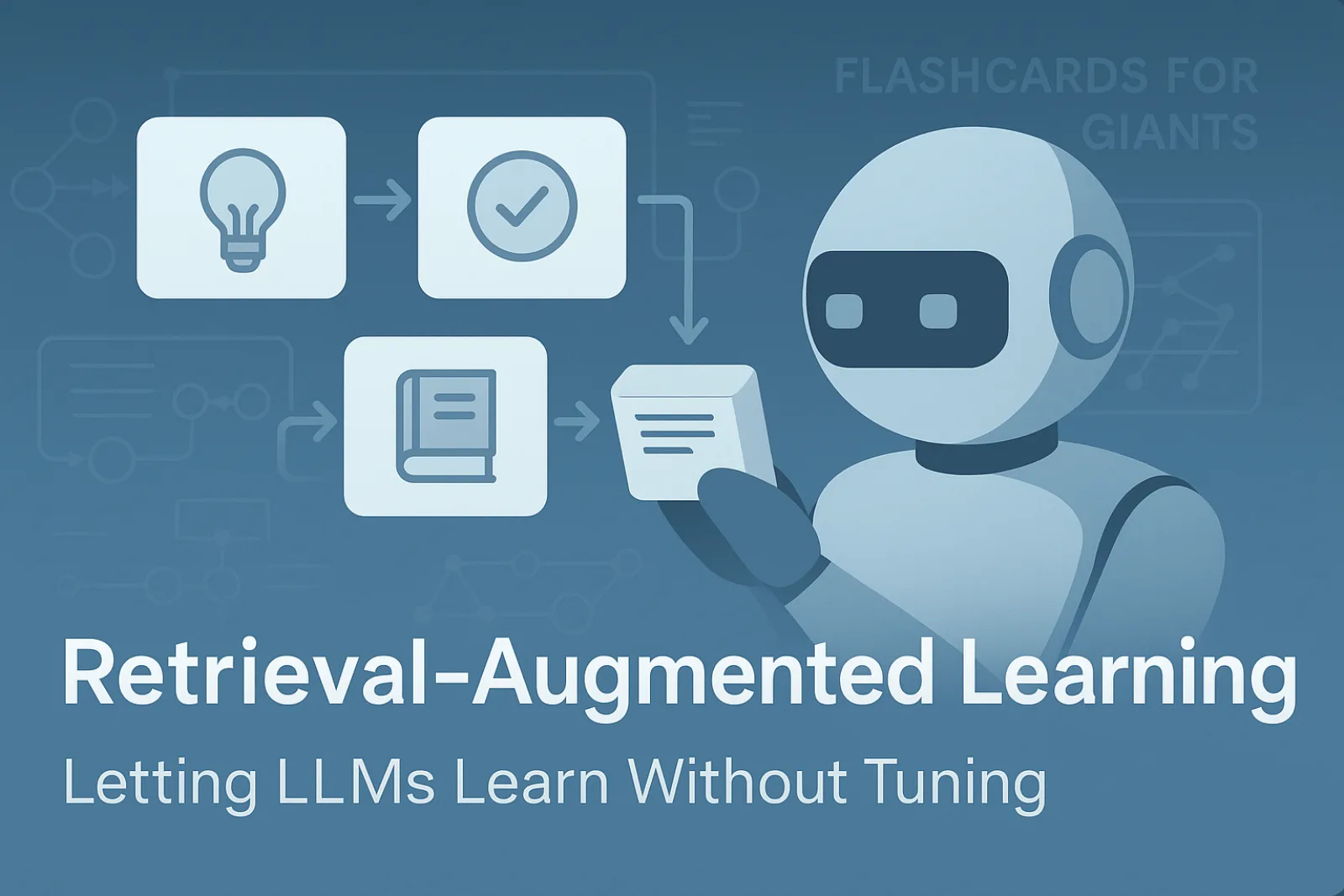
Flashcards for Giants: How RAL Lets Large Models Learn Without Fine-Tuning

TL;DR for operators Training a model is not the only way to make it behave less cluelessly in a specialised environment. The paper behind Retrieval Augmented Learning, or RAL, proposes a cheaper route: let the agent try strategies, validate what happened, and store the resulting lessons as retrievable experience rather than changing the model’s weights.1 ...

May 6, 2025 · 16 min · Zelina