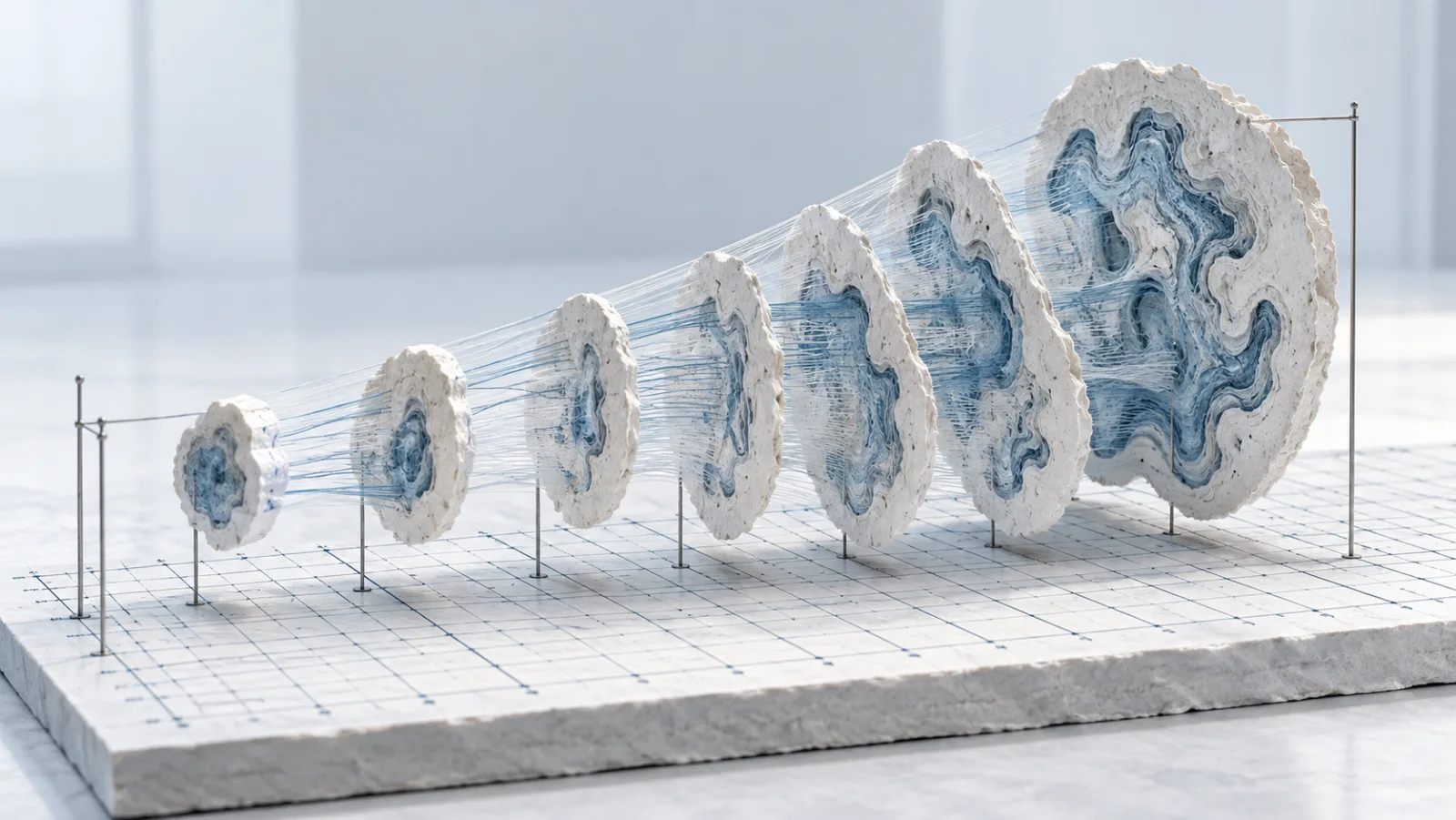
TL;DR for operators
If a reconstruction system has observations at two time points or tissue depths, improving the match between those endpoints is only part of the problem. TP-DATE shows that the trajectory used to connect them can independently affect reconstruction quality.
The authors hold the static quadratic-form optimal transport coupling fixed and change only the conditional path. Replacing TP-DATE’s interaction-aware trajectory with straight interpolation worsens every reported mean metric on both Mouse brain and ARTISTA. That isolates a practical point: the path carries modeling information that is not already contained in the endpoint assignment.
TP-DATE formalizes this with dynamic quadratic-form optimal transport, where particles move in interacting pairs rather than independently. It then marginalizes those pair interactions into a single-particle velocity field that can be learned with simulation-free flow matching.
For spatial-omics and serial-section reconstruction, the relevant design decision is therefore not simply which endpoint transport objective to optimize. It is also whether intermediate states should preserve evolving relational structure. The paper provides evidence that they should in the tested settings, but it does not establish downstream biological validity, cost savings, or performance outside these domains.
A good endpoint match can still produce the wrong middle
Suppose a spatial-omics team measures tissue at an earlier and later developmental stage but does not observe every state between them. A reconstruction pipeline can first determine which cells or regions in one snapshot correspond to those in another. It must then decide how the distribution evolves between those observations.
It is tempting to treat the second step as largely mechanical. Once the endpoint assignment is good, straight interpolation appears to provide a reasonable path.
The experiments in Dynamic Generalized Gromov-Wasserstein Optimal Transport1 challenge that assumption. In a controlled ablation, the authors use the same endpoint coupling and matched training settings, but replace their interaction-induced conditional paths with straight displacement paths.
On Mouse brain, balanced fused $W_2$ rises from 9.593 to 10.053, spatial $W_2$ from 0.08678 to 0.09615, expression $W_2$ from 6.40989 to 6.45808, and SC-eMSE from 1.47693 to 1.52589. Lower is better for all four metrics.
The ARTISTA result is similar in direction. Balanced fused $W_2$ rises from 8.012 to 8.429, expression $W_2$ from 5.393 to 5.946, and SC-eMSE from 0.878 to 1.025. Spatial $W_2$ changes only slightly, from 0.09196 to 0.09210.
This is an ablation, not a second benchmark thesis. Its value is diagnostic: because the coupling stays fixed, the deterioration cannot be attributed simply to choosing worse endpoint correspondences. The construction of the intermediate trajectory contributes separately.
Dynamic QOT makes relational structure part of the trajectory
Ordinary optimal transport assigns mass from one distribution to another according to pointwise transport cost. That becomes restrictive when relative geometry matters—for example, when a tissue reconstruction should preserve relationships among nearby cells rather than merely place individual cells near plausible destinations.
Quadratic-form optimal transport, or QOT, expands the objective so that relationships between pairs can influence the coupling. Gromov-Wasserstein optimal transport is one important structure-aware case.
TP-DATE extends that idea from endpoints into continuous time. Instead of describing one particle’s path independently, it defines a travelling pair: two particle trajectories whose motion can interact. A Lagrangian assigns cost to their joint path, combining kinetic terms with penalties governing changes in relational structure.
Under convexity in the two velocities, the paper proves an equivalence between its path-action static and dynamic QOT formulations:
The distinction in the inequality matters. The theorem establishes equality between the paper’s static and dynamic path-action forms. It does not establish equality with the Benamou-Brenier-style fluid objective; the two path-action forms generally upper-bound it.
For the distance-change interaction used in one construction, the framework also connects familiar transport regimes. With zero interaction weight, it reduces to standard OT. As interaction strength grows, the induced static objective approaches scaled GW-OT. This is not simply static fused GW with another parameterization: the weighting enters through the dynamic Lagrangian and induces a different objective.
Pair interactions are compressed into a learnable particle flow
Interaction-aware trajectories raise an immediate computational problem. A deployment system ultimately needs to move individual samples, not explicitly simulate every possible interacting pair through training.
TP-DATE resolves this through marginalization.
For a particle at state $\mathbf{x}$, the single-particle velocity is defined as the expected pair velocity over possible partner states:
The resulting field still contains interaction information because the averaging is conditional on the pair distribution. The authors then derive a tractable conditional flow-matching loss and show that its parameter gradient matches that of the inaccessible marginal regression objective.
The practical consequence is specific: training can use interaction-aware conditional paths without repeatedly simulating the full interacting dynamics. A standard single-particle velocity network can represent the marginal probability flow.
There is also an information boundary. The single-particle marginal transports the required source distribution to the target, but it does not generally retain enough information to reconstruct the complete two-particle dynamics. Marginalization makes the model usable; it does not make pair-level interaction structure fully identifiable afterward.
The benchmarks test reconstruction, not biological causality
The empirical evaluation uses hold-one-out reconstruction. Models see endpoint snapshots and are evaluated against an unseen intermediate snapshot.
On synthetic rigid rotations, where the underlying dynamics are known, TP-DATE reports spatial MSE of $0.02565\pm0.00480$ versus 0.09268 for the next-lowest reported baseline mean, CytoBridge. With an expression distractor added, TP-DATE reports $0.02269\pm0.00176$.
On developing Mouse brain data, TP-DATE has the lowest reported mean across all four reconstruction metrics. On ARTISTA axolotl brain regeneration, it has the lowest reported expression $W_2$, SC-eMSE, and balanced fused $W_2$, although stVCR has lower spatial $W_2$.
For serial tumor sections used for continuous 3D reconstruction, TP-DATE again records the lowest reported expression $W_2$, SC-eMSE, and balanced fused $W_2$. ContextFlow has the lower spatial $W_2$: 0.06768 versus TP-DATE’s 0.06959.
These comparisons support reconstruction accuracy under the paper’s evaluation protocol. They do not establish that reconstructed intermediate states reveal true biological mechanisms.
The operational decision is whether interpolation deserves its own model
For spatial-omics platforms, the paper changes where modeling effort may be allocated.
A pipeline built around sparse time points or serial sections could treat continuous reconstruction as two distinct decisions: first determine structure-aware endpoint correspondence; then determine an interaction-aware path between those endpoints. TP-DATE’s fixed-coupling ablation indicates that collapsing the second decision into straight interpolation can discard reconstruction signal even when the first decision is unchanged.
Cognaptus inference: this makes dynamic path modeling most relevant where intermediate states themselves are consumed—continuous tissue visualization, exploratory trajectory analysis, volumetric reconstruction, or planning whether additional measurements are needed. If only endpoint matching matters to a downstream task, the extra dynamic machinery may offer less operational value.
The paper also gives a path toward larger datasets. Its sparse bidirectional KNN support reduces Monte Carlo QOT gradient-estimation complexity from $O(RMN)$ to $O(RK(M+N))$, and its K-ablation reports broadly similar reconstruction quality from $K=64$ to $1024$. Those results address computational feasibility rather than proving unrestricted scalability.
The current boundary is structured reconstruction in a common space
Several limits matter before treating TP-DATE as a general recipe for dynamic structured data.
The theory assumes source and target distributions inhabit the same metric space. Extending the notion of a continuous flow to genuinely different spaces remains unresolved.
The empirical range is also concentrated: synthetic rotations, two spatiotemporal transcriptomics datasets, and tumor serial sections. The static QOT optimization itself can be non-convex, while the implementation relies on Frank-Wolfe iterations, Monte Carlo gradient estimation, and sparse support rather than a global-optimum guarantee. The ARTISTA hyperparameter sensitivity study further reports one run per setting rather than repeated seeds.
For the tested reconstruction problems, however, the central result survives a particularly informative control: hold the endpoint coupling still, change the path, and reconstruction changes with it.
That makes the intermediate trajectory a modeling object in its own right.
Cognaptus: Automate the Present, Incubate the Future.
-
Junda Ying and Zhiwei Zeng and Peijie Zhou and Lei Zhang (2026). Dynamic Generalized Gromov-Wasserstein Optimal Transport. arXiv:2609.20008. https://arxiv.org/abs/2609.20008 ↩︎