
Cover image

Fixed Priorities, Moving Rewards: What ReCAST Changes in Diffusion Training

TL;DR for operators An image-generation product may need to follow prompts, produce attractive images, and render specified text correctly. Its team can assign a fixed importance to each objective, but that does not establish when each objective’s feedback should influence training. ReCAST separates these decisions: it preserves specified reward budgets while reallocating their influence across diffusion denoising steps. In experiments on Stable Diffusion 3.5-Medium, this improves aggregate training rewards for text rendering but not for compositional generation; independent reward models nevertheless favor ReCAST on average in both settings. For training teams, the opportunity is more selective reward allocation without surrendering control of objective priorities. The tradeoff is expensive, approximate temporal profiling whose reliability beyond the tested configuration remains uncertain. ...

October 24, 2026 · 9 min · Zelina
Cover image

The Path Between Slices Is Part of the Model

TL;DR for operators If a reconstruction system has observations at two time points or tissue depths, improving the match between those endpoints is only part of the problem. TP-DATE shows that the trajectory used to connect them can independently affect reconstruction quality. The authors hold the static quadratic-form optimal transport coupling fixed and change only the conditional path. Replacing TP-DATE’s interaction-aware trajectory with straight interpolation worsens every reported mean metric on both Mouse brain and ARTISTA. That isolates a practical point: the path carries modeling information that is not already contained in the endpoint assignment. ...

October 13, 2026 · 7 min · Zelina
Cover image

Human Demonstrations Need a Relevance Filter Before VLA Post-Training

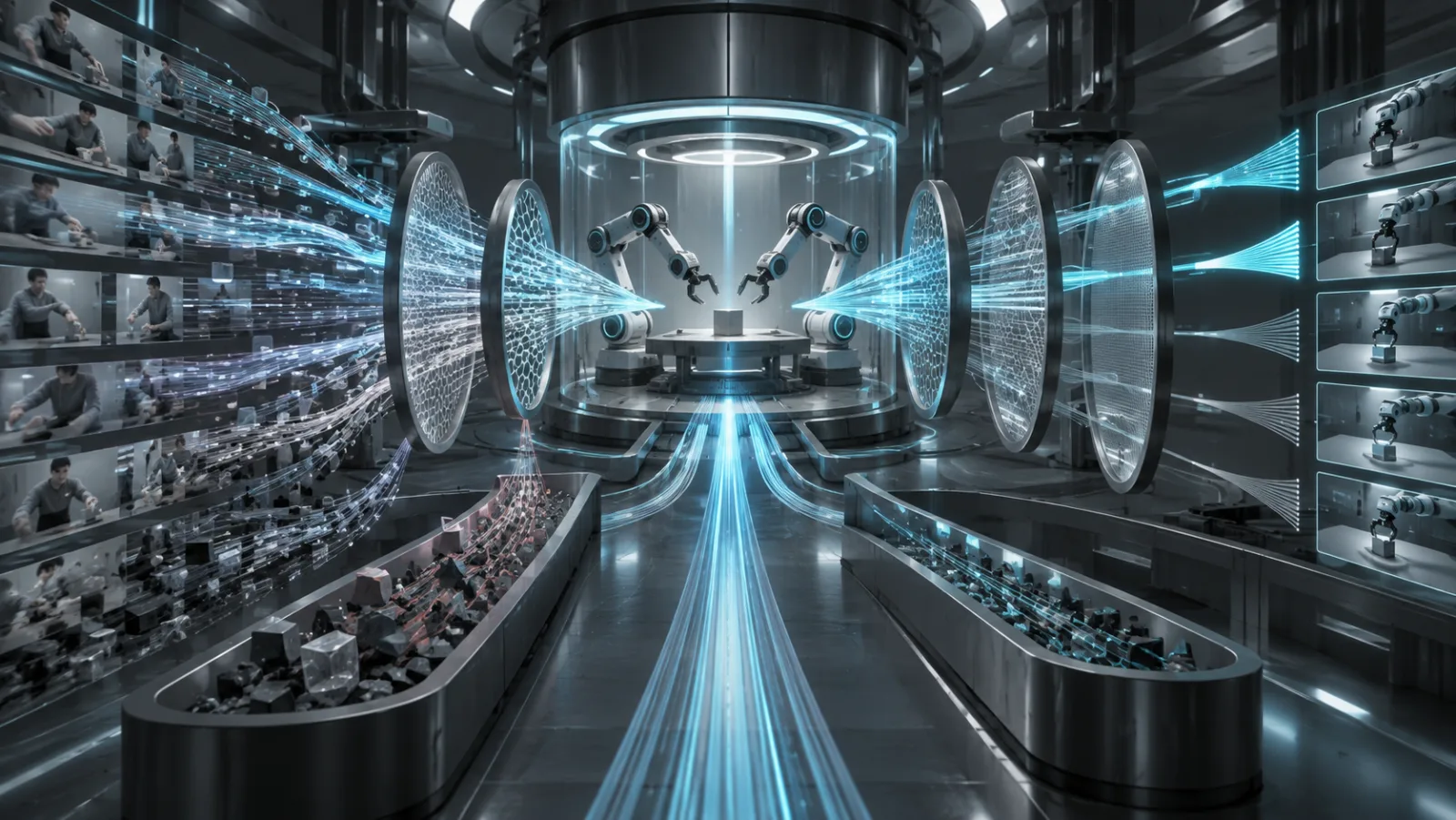
TL;DR for operators A robotics team may have a small, expensive set of demonstrations from its target robot and a much larger pool of cheaper human demonstrations of apparently similar tasks. The tempting move is to combine them. The paper’s randomized simulation results show why that decision needs more control: robot-only training averages 0.34 task success, while randomly mixed human data falls to 0.32. Selecting human demonstrations by relevance raises the average to 0.40, and adding sample-specific weighting raises it further to 0.42. ...

September 25, 2026 · 7 min · Zelina
Cover image

Compression, But Make It Pedagogical: Rate–Distortion KGs for Smarter AI Learning Assistants

Training teams know the ritual. Someone uploads lecture slides, notebooks, policy manuals, onboarding decks, or certification material into an AI tool. The system dutifully produces quiz questions. Some are useful. Some are bland. Some include giveaway answers. Some test trivia. Some hallucinate just enough to be annoying but not enough to be obviously illegal. Everyone nods, calls it “AI-assisted learning,” and then quietly sends the outputs to a human reviewer. Automation, but with adult supervision. So, normal Tuesday. ...

November 20, 2025 · 19 min · Zelina
Cover image

From Sobol to Sinkhorn: A Transport Revolution in Sensitivity Analysis

TL;DR for operators Models rarely fail because nobody ran a sensitivity analysis. They fail because the sensitivity analysis answered the convenient question instead of the relevant one. The paper behind gsaot introduces an R package for Optimal Transport-based global sensitivity analysis.1 Its practical value is not that it makes Sobol’ indices obsolete. It does not. The useful shift is narrower and more interesting: gsaot estimates how much the entire output distribution changes when an input is known, rather than asking only how much of the output variance can be attributed to that input. ...

July 27, 2025 · 17 min · Zelina