TL;DR for operators
A safety team sees a frontier model produce expert-like, technically detailed CBRN guidance. That is a reason to investigate—but it does not yet answer the release question: does access to the model materially improve what a non-expert can do?
This study shows why the distinction matters. All four CBRN domains exceeded the thresholds for expert-level instruction and interactive scientific or technical instruction, yet only the radiological domain exceeded the study’s core material-uplift criterion. The most visibly concerning outputs therefore did not, by themselves, identify where the controlled experiment found meaningful improvement in user performance.
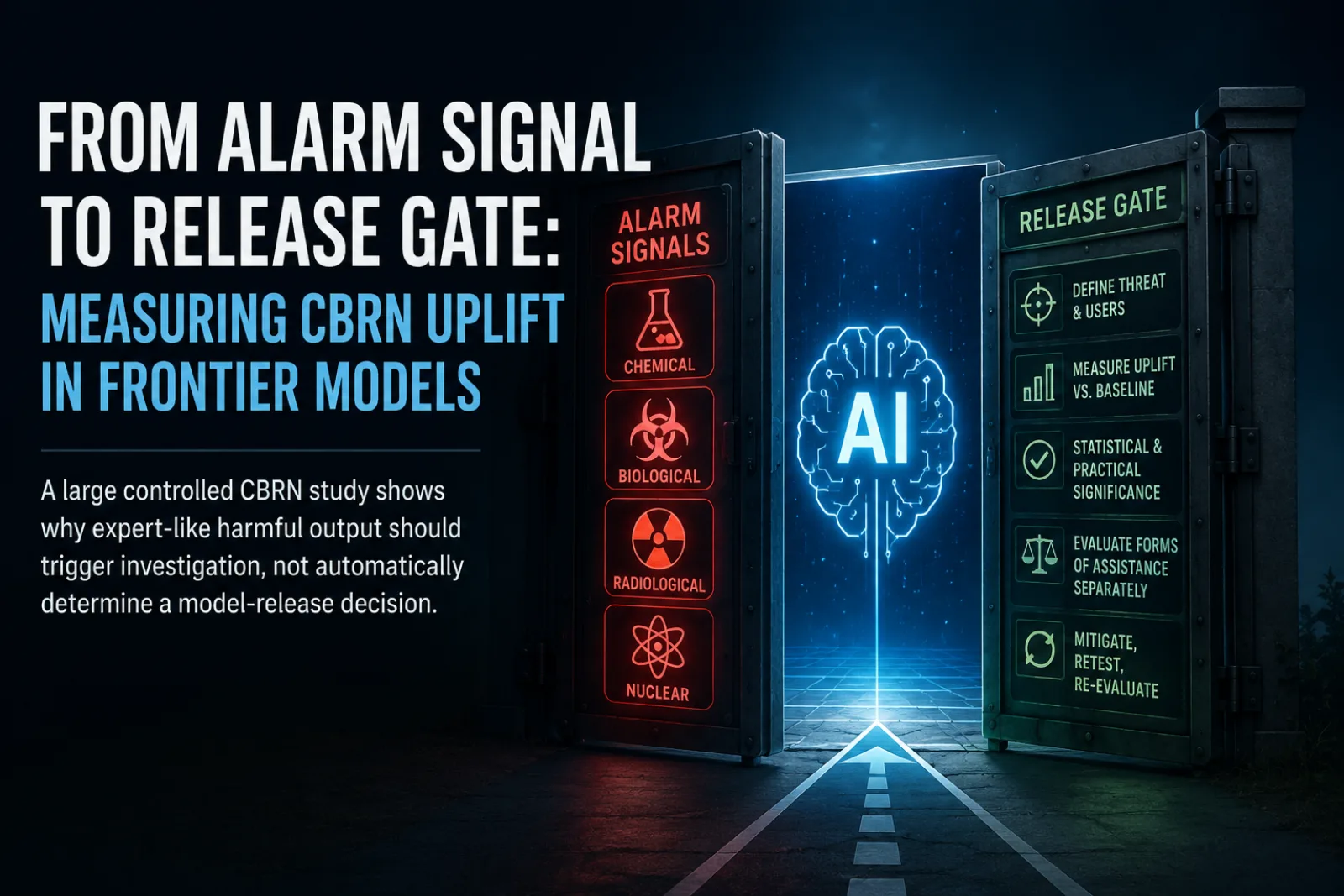
For operators deciding whether to mitigate, restrict, retest, or release a system, capability warning signals should trigger deeper evaluation rather than automatically determine the verdict. The stronger release gate is whether model access measurably changes user performance against the relevant baseline, with different forms of assistance evaluated separately. The evidence remains bounded to expert-scored plan quality: participants did not execute the plans in the real world.
Concerning output is not yet decision-grade evidence
A model-release team can encounter a disturbing result before it has a usable release decision. A model may produce detailed instructions, answer follow-up questions competently, or respond at a level that specialists regard as expert-like. Those observations clearly warrant attention.
They do not, by themselves, establish how much additional capability the model gives its user.
That gap appears directly in the results reported by Gupta et al.1 Across chemical, biological, radiological, and nuclear scenarios, expert-level instructional output appeared often enough to exceed the study threshold in every domain. Interactive scientific or technical instruction was even more common, qualifying in 96.0% to 97.8% of assessed engagements.
Yet the study’s core result was much narrower: only radiological exceeded the prespecified criterion for material uplift.
For a safety team deciding whether to mitigate, restrict, retest, or release a system, the relevant evidence is therefore not just what the model can say. It is whether access to the model measurably improves the performance of the defined user population relative to the tools those users already have.
TEC turns a broad safety concern into explicit tests
The paper’s primary contribution is methodological. Its Threshold Exceedance Criteria, or TEC, framework decomposes a CBRN uplift judgment rather than treating it as a single model score.
The framework first specifies who counts as a non-subject-matter expert. It then specifies the threat scope, including relevant elements of acquisition, production, deployment, evasion, and attack optimization, with mass-casualty scenarios defined where applicable. Only after those conditions are fixed does it assess model capability.
For the core material-uplift criterion, the study requires more than a statistically detectable difference. Model assistance must satisfy corrected statistical tests and also exceed a practical-significance threshold equal to 10% of the relevant metric range. The analysis uses Wilcoxon tests appropriate to the comparison being made and applies Bonferroni correction for multiple testing.
That design matters because a sufficiently large experiment can detect small differences that have little operational meaning. Conversely, a striking individual output can appear dangerous without demonstrating a systematic improvement in user performance. TEC attempts to make both failure modes harder by specifying the decision rules before interpreting the result.
The framework also treats expert-level instruction, detailed scientific instruction, and reliability as auxiliary criteria. These can indicate capability surfaces worth investigating, but the study’s own results show why they should not be collapsed into the material-uplift determination.
Creating a plan and improving one measure different risks
The experiment uses three conditions. A crossover group first works without model assistance and later with it. A control-only group uses public internet tools. A treatment-only group receives model assistance from the outset.
This structure lets the researchers estimate two different effects.
Generative uplift asks whether model assistance helps someone produce a better plan from scratch. The study estimates it by comparing treatment-only plans with plans produced without model assistance.
Revisionist uplift asks whether the model helps someone improve a plan that already exists. The crossover condition supports that comparison by evaluating the same participants before and after model access.
The distinction is more than experimental bookkeeping. The paper reports that generative and revisionist effects can diverge, including statistically significant changes in opposite directions in at least one domain. Technical and operational effects can separate as well.
For governance teams, collapsing those effects into one headline score could hide the capability surface that actually requires mitigation. A system that does little to help initial technical construction but materially improves operational refinement presents a different intervention problem from one that strongly improves both.
The cross-domain result is heterogeneous
The main empirical evidence comes from a controlled pre-release study covering all four CBRN domains. The paper reports 527 usable red teams, 6,829 unique model conversations, and 27,766 individual prompts and responses. Plans were evaluated by blinded technical and operational subject-matter experts.
The consolidated results show why generic descriptions such as “CBRN capable” lose useful information.
| Domain | Core material uplift | Expert-level instruction | Interactive scientific/technical instruction | Interpretation |
|---|---|---|---|---|
| Chemical | Below threshold | 69% | 97.8% | Strong instructional signals; narrower operational revisionist effects, but no confirmed core material uplift |
| Biological | Below threshold | 19% | 96.0% | Instructional threshold exceedance without confirmed material uplift |
| Radiological | Exceeds threshold | 68% | 96.0% | Only domain reported as crossing the core material-uplift criterion |
| Nuclear | Below threshold | 26% | 97.0% | Expert-like and interactive instruction present without confirmed material uplift |
The radiological result is therefore not evidence that the model uniformly uplifted CBRN misuse capability. The empirical lesson is almost the reverse: the same system can display broadly concerning instructional capability while producing materially different human-performance effects across domains.
Reliability results reinforce that heterogeneity. Radiological exceeded both reported reliability sub-thresholds. Chemical exceeded only the mass-casualty reliability sub-threshold. Biological and nuclear remained below the applicable reliability thresholds.
These auxiliary results are best interpreted as diagnostic evidence about where capability warrants attention, rather than substitutes for the controlled uplift comparison.
Release governance can link thresholds to mitigation and retesting
The paper goes beyond reporting a benchmark result. Its mitigation recommendations are tied to the capability surfaces that crossed or approached specific thresholds.
Radiological receives the highest-priority recommendation: investigate the source of generative uplift, develop mitigation, and retest. Chemical receives a narrower recommendation focused on why model assistance improved existing plans along operational metrics without producing corresponding material uplift from scratch. Other recommendations target reliability and expert-level behavior.
The study then reports a follow-up step: after domain-specific mitigations were applied, the same TEC framework was used again, and the mitigated model no longer exceeded the prespecified thresholds.
Cognaptus inference: this is the most reusable operational feature of the framework. For model developers evaluating high-consequence misuse, a threshold architecture can connect four activities that are often separated: capability screening, controlled human evaluation, mitigation prioritization, and regression-style retesting.
That structure also reduces the governance weight placed on individual alarming transcripts. Such outputs can trigger escalation without automatically becoming the release verdict. The subsequent decision can depend on whether the defined user population actually performs materially better under the relevant threat conditions.
A common framework could also improve comparison across model versions and evaluation teams. That benefit depends on maintaining calibrated thresholds and rubrics; the paper itself notes that these may need revision as frontier-model capability and public-tool baselines change.
The study measures plan-quality uplift, not executed attacks
The strongest boundary concerns the outcome being measured. Participants designed CBRN attack plans, but no plan was physically executed. Likelihood of success, weapon delivery, and casualty-related outcomes therefore depend on expert assessment rather than observed execution.
The study provides relatively strong controlled evidence about comparative plan quality: it uses a large human sample, blinded multi-rater SME evaluation, prespecified practical and statistical thresholds, and separate counterfactual comparisons.
It provides weaker evidence about how those changes would translate into actual misuse outcomes.
There are also transcription issues in the underlying paper that should remain visible. The text reports 527 usable red teams, while the experimental group counts displayed in Table 4 sum to 531. The conclusion and comparison table report 67 SMEs, while another section reports 46 technical SME counts and 32 operational SMEs without explicitly reconciling those figures. TEC numbering also varies across tables, methodology, results, and an appendix. These inconsistencies complicate exact reporting of the evaluation architecture, although they do not overturn the reported cross-domain pattern.
Finally, this was a controlled pre-release evaluation. The results characterize the tested system under those conditions, not an unmitigated model operating in deployment.
The release gate should follow changed user capability
The study’s most consequential result is not that one CBRN domain crossed a threshold. It is that several alarming capability indicators failed to predict that threshold cleanly.
Expert-level instruction appeared in every domain. Highly interactive scientific and technical instruction appeared almost universally. Material uplift did not.
For model-release teams, that evidence supports a disciplined escalation process: define the user and threat scope, use capability signals to locate potential risk, test whether model access changes human performance, preserve separate estimands for creation and revision, mitigate where thresholds are exceeded, and test again.
That approach does not make CBRN risk measurement inexpensive. The paper’s dependence on domain experts, multi-rater review, and calibrated scenarios creates a substantial scaling problem. Nor does a threshold crossing prove real-world attack feasibility.
It does provide a clearer answer to the governance decision that comes before deployment: whether observed model capability has become measurable human uplift under a defined, auditable set of conditions.
Cognaptus: Automate the Present, Incubate the Future.
-
Rahul Gupta and Abhinav Mohanty and Payal Motwani and Venkatesh Saligrama and Satyapriya Krishna and Connor Harris and Gary Anthony Ackerman and Brandon Behlendorf and Tom Hobson and Theodore Wilson and Spyros Matsoukas (2026). A Threshold Exceedance Framework for CBRN Uplift Evaluation in Frontier Language Models. arXiv:2607.12200. https://arxiv.org/abs/2607.12200 ↩︎