TL;DR for operators
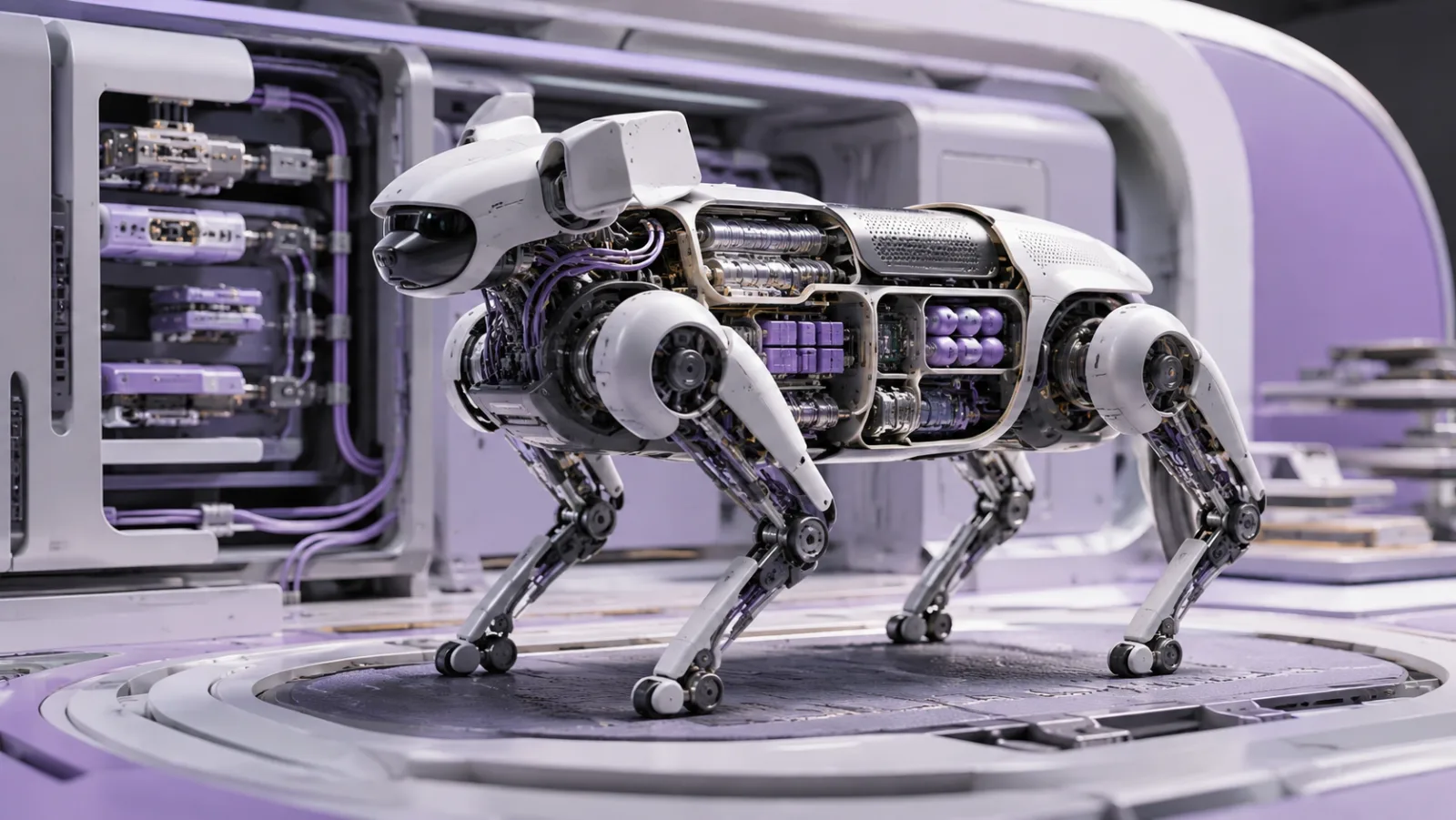
ABot-C0 is best understood as a behavior production system for quadruped robots, not as one giant model that accepts any instruction and directly controls every motor. It combines a 16,074-clip motion library, a generalist motion tracker, several specialized locomotion and interaction policies, and a deployment layer that decides which controller should be active.
The paper’s most consequential result is not that a robot dog can shake hands, climb stairs, or perform expressive movements. Robotics demonstrations have never suffered from a shortage of photogenic tricks. The meaningful result is that held-out motion tracking improves as the training motion library grows. Increasing the training set from 30 to 7,076 motions reduces unseen mean per-joint position error from 24.61 mm to 14.79 mm and raises unseen completion success from 84.30% to 88.54%.
The system also shows why raw scale is insufficient. Per-motion specialist policies are distilled into a deployable flow-matching controller; low-quality references are filtered or deprioritized; and a learned motion-manifold representation helps the controller understand the local structure of an unfamiliar movement. With manifold conditioning, unseen tracking success reaches 91.02%.
For businesses building or purchasing quadruped systems, the practical lesson is architectural. Valuable robotic behavior may come from a compounding data engine, reusable controllers, explicit safety constraints, and reliable policy switching before it comes from a single universal robot brain. The boundary is equally important: ABot-C0 is demonstrated on one hardware platform, many evaluations are simulation-heavy, contact interaction is represented mainly by a handshake case study, and the cloud-to-robot reasoning interface remains unresolved.
A demo performs a trick; a product has to survive the transition
Making a quadruped robot walk across a stage is no longer especially mysterious. Making it walk across rough ground, respond to a human, switch into an expressive motion, recover safely, and continue operating without exceeding its actuator limits is another matter.
The gap is not merely one of model accuracy. It is a systems problem involving data scarcity, incompatible control objectives, perception latency, physical constraints, policy switching, recovery behavior, and hardware-specific deployment.
ABot-C0, developed by the Amap team at Alibaba, approaches that problem by assembling what the authors call “behavior foundations” for quadruped robots.1 The phrase is carefully chosen. The system is aimed toward the role occupied by behavior foundation models in humanoid robotics, but it has not yet collapsed its capabilities into a single general-purpose controller.
Instead, ABot-C0 contains several learned policies and supporting modules:
- a motion-data engine;
- a generalist reference-motion tracker;
- a robust velocity controller;
- a biomimetic omnidirectional locomotion controller;
- a perceptive all-terrain controller;
- an interaction pipeline;
- a runtime coordination and safety layer;
- and a high-level agent that routes semantic commands to those capabilities.
That distinction matters because “foundation model” implies one kind of scalability, while ABot-C0 demonstrates another. Its current foundation is the shared data, interfaces, training procedures, and deployment architecture beneath multiple policies.
This may be less glamorous than an end-to-end robot intelligence model. It is also closer to how physical products are usually made.
The data engine turns motion scarcity into a filtering problem
Humanoid robotics benefits from a convenient historical accident: humans produce an enormous amount of human-motion data. Motion-capture studios, videos, animation systems, and body models already provide substantial raw material for training.
Quadruped robots do not inherit the same data economy. Animal motion is harder to capture systematically, and a biological dog’s trajectory cannot simply be copied onto a robot with different joints, mass distribution, torque limits, and contact dynamics.
ABot-C0 addresses the shortage by combining four motion sources:
| Data source | What it contributes | Structural weakness |
|---|---|---|
| Motion capture | Natural animal-like locomotion | Limited control over composition and collection scale |
| Teleoperation | Robot-executable demonstrations | Expensive and difficult to scale |
| Artist-designed motion | Expressive and extreme behaviors | Physical feasibility is not guaranteed |
| Video generation | Controllable, scalable behavioral variety | Generated motion must be reconstructed and aggressively filtered |
The fourth source is the most scalable and the most failure-prone. The system generates videos from text and image prompts, reconstructs a three-dimensional robot trajectory from each clip, and then subjects the result to three filters.
First, a semantic gate checks whether a re-rendering of the recovered trajectory visually resembles the source video. The paper reports a 97.0% pass rate.
Second, a geometric gate examines reprojection error. Only 70.2% of the remaining trajectories pass. This is the pipeline’s main bottleneck, by design. The authors prefer generating excess candidates and discarding suspicious reconstructions rather than feeding attractive nonsense into policy training.
Third, each surviving motion is tested for physical feasibility. The system trains a specialist tracking policy for that motion and runs a complete simulated rollout. Motions that cause falls, excessive divergence, or unstable velocity are removed. The reported pass rate at this stage is 97.6%.
The resulting library contains 16,074 physically validated clips, including 7,488 produced by the video-generation branch. Each clip is accompanied by language annotations.
This is the first important business mechanism in the paper. Generative models do not eliminate the robotics data problem. They change its shape:
Data collection becomes candidate generation followed by increasingly expensive verification.
That pattern should be familiar to anyone using synthetic data in less physical domains. Generation is cheap. Establishing that the generated example preserves the constraints that matter is where the real engineering begins.
For robotics, physical rollout becomes part of data quality assurance. A motion is not useful merely because it resembles a backflip. The robot has to remain a robot while performing it.
There is one reporting wrinkle worth noting. The paper states a total duration of 22.43 hours, while the source-level durations displayed in its dataset table do not add cleanly to that aggregate. The 16,074-clip count is therefore the safer headline figure for comparisons until the duration accounting is clarified. A technical report can contain a typo without collapsing civilization, but procurement models should not build storage or training estimates around an ambiguous total.
The generalist tracker is where the scaling claim actually lives
The motion library becomes valuable only if one controller can use it. Maintaining thousands of separate policies—one for every trick—is a fine way to build a research archive and an inconvenient way to ship a robot.
ABot-C0 begins by training one reinforcement-learning specialist for each reference motion. Each specialist has a narrow objective and avoids the gradient interference that arises when a single policy is asked to learn dynamically incompatible movements from scratch.
The specialists are then distilled into a unified flow-matching policy. During training, the student visits its own states, while the appropriate specialist supplies the desired action. A small residual reinforcement-learning policy can subsequently correct the distilled controller.
The baseline comparison establishes which stage does the real work.
| Controller | Seen MPJPE | Seen success | Unseen MPJPE | Unseen success |
|---|---|---|---|---|
| Independent specialists | 11.66 mm | 97.34% | — | — |
| Direct multi-motion RL | 22.18 mm | 87.24% | 22.20 mm | 84.86% |
| Distilled flow policy | 12.04 mm | 95.26% | 16.51 mm | 86.42% |
| Flow policy with residual RL | 11.98 mm | 95.49% | 16.50 mm | 86.43% |
This is main evidence, not an incidental ablation. Directly training one reinforcement-learning policy on the combined motion set performs poorly. Distillation recovers most of the specialists’ seen-motion accuracy while materially improving performance on held-out motions.
The residual policy, by contrast, contributes very little to unseen performance. Its role is local correction, not generalization. The fashionable temptation would be to discuss the extra reinforcement-learning stage at length because it sounds sophisticated. The numbers decline the invitation.
More motions improve unfamiliar-motion tracking
The paper’s central scaling experiment trains the same generalist pipeline with motion libraries ranging from 30 to 7,076 references.
| Training motions | Unseen MPJPE | Unseen success | Seen-unseen MPJPE gap |
|---|---|---|---|
| 30 | 24.61 mm | 84.30% | 10.17 mm |
| 100 | 20.27 mm | 85.26% | 8.58 mm |
| 300 | 18.84 mm | 85.90% | 6.70 mm |
| 1,000 | 16.51 mm | 86.42% | 4.47 mm |
| 3,000 | 15.15 mm | 88.22% | 3.37 mm |
| 7,076 | 14.79 mm | 88.54% | 2.41 mm |
The trend is unusually clean for a robotics system report. More training motions consistently reduce error on the 1,000 held-out references, improve completion success, and narrow the seen-unseen gap.
The interpretation requires some care.
The full-data model does not produce the best seen-motion score. Seen success falls from 97.20% at 100 motions to 92.74% with all 7,076 motions. The controller is absorbing a much more heterogeneous task distribution, so some specialization accuracy is traded for breadth.
That is not a defect hidden in the results. It is the result.
A foundation-style controller should be judged less by how perfectly it memorizes a small repertoire and more by whether adding diverse experience improves its response to unfamiliar movements. ABot-C0’s evidence supports that narrower and more useful claim.
The paper calls this a scaling law. Strictly speaking, it demonstrates an empirical scaling trend over the tested range rather than deriving a stable functional law that can be extrapolated across model sizes, datasets, platforms, or compute budgets. Nobody should calculate the number of clips required for canine superintelligence from six rows in a table.
Still, the operational finding is substantial: the quadruped controller benefits from behavioral diversity instead of merely becoming confused by it.
Better selection helps when the training budget is fixed
Scale is useful when more data and compute are available. Operators also need to know what happens when they are not.
The paper therefore compares random subsampling with several motion-curation strategies under a fixed budget equal to 70% of the training pool. References are scored using:
- physical feasibility;
- successful closed-loop execution;
- and confidence of the distilled flow policy.
The combined selector preserves coverage across motion-complexity groups and ranks candidates using all three signals. It improves unseen MPJPE from 16.04 mm under random selection to 15.56 mm. Unseen success changes only slightly, from 85.53% to 85.66%, while seen performance improves much more strongly.
This is a curation ablation, not a second scaling result. Its implication is correspondingly narrower. Quality-aware selection can improve a fixed training set, especially on motions the model has seen, but it does not reproduce the full generalization gain obtained from increasing the total library.
In business terms, the choice is not “data quality or data quantity.” ABot-C0 suggests a more tedious answer: quality determines the return on a fixed budget, while quantity expands the behavioral distribution the system can cover.
Robotics has once again refused to fit into a slogan.
Manifold conditioning gives the tracker useful context
A controller receiving only the current reference frame knows where the robot should be now, but not necessarily what kind of motion segment it is entering.
The same posture could appear during a jump, a recovery, a transition, or a stylized gesture. These futures may demand different actions even when the current geometry looks similar.
ABot-C0 trains a variational autoencoder on short windows of curated reference motion. The resulting latent representation describes where the upcoming segment lies on the learned motion manifold. This code is supplied to the student tracker as additional context.
Under the full-scale setting, adding the manifold code reduces unseen MPJPE from 14.79 mm to 12.53 mm and increases unseen success from 88.54% to 91.02%.
This experiment is a controlled conditioning ablation: the training set, evaluation protocol, and policy architecture remain fixed while the reference information changes. It supports a specific mechanism. The student performs better when it receives a compact description of the motion’s local future structure.
A reconstruction-error signal also helps, but less. Combining reconstruction error with the latent code does not outperform the latent alone on unseen motions. Uncertainty indicators are not automatically useful just because they look responsible in an architecture diagram.
The larger lesson extends beyond quadrupeds. Generalist action models often need representations of trajectory context, not merely the current target state. The useful unit of behavior is a segment with direction and intent, not a sequence of unrelated poses.
Locomotion is three operating regimes disguised as one capability
“Locomotion” sounds like one feature until the robot encounters a payload, a sideways command, and a staircase. ABot-C0 divides the problem into three categories with different objectives and different evidence.
Robust control estimates what the sensors do not directly reveal
A quadruped’s current joint positions do not fully reveal its physical condition. Payload mass, center-of-mass shifts, surface friction, and external pushes affect the dynamics but may not be directly measured.
The robust locomotion policy uses recent proprioceptive history in two ways. It learns an implicit temporal representation and explicitly estimates quantities such as base velocity, payload mass, and center-of-mass displacement.
In a robustness ablation across payload variations, mass shifts, velocity commands, and lateral impulses, the current-observation-only controller records a 7.5% fall rate. A conventional history encoder reduces this to 1.5%. The learned temporal representation and the full implicit-explicit model record no falls in the reported tests.
The full model also produces the lowest velocity error, 0.14 m/s, and the fastest recovery time, 0.82 seconds.
These are robustness tests under defined disturbances, not universal guarantees. “Zero observed falls” means zero within the authors’ evaluation grid. Gravity has not signed a service-level agreement.
Safety constraints outperform asking the reward function nicely
The paper separately tests whether the controller respects actuator limits during a high-speed hardware stress test.
Vanilla PPO produces frequent torque and joint-velocity violations and a 55% fall rate. A penalty-shaped PPO reduces the problem but still records violations and a 15% fall rate. The constrained NP3O controller records zero torque violations, zero velocity violations, and zero falls in the test.
This comparison supports one of the paper’s most practically important design decisions: hardware limits are treated as explicit constrained-optimization objectives rather than preferences mixed into a general reward.
Reward penalties allow the policy to trade safety against performance. A sufficiently attractive task reward can compensate for violating a soft penalty. That may be mathematically convenient and commercially awkward.
Explicit constraints are not a complete safety case. They do not cover every structural, thermal, perception, or environmental failure. They do, however, align the training formulation more closely with the reality that some actuator boundaries are not negotiable.
Biomimetic locomotion has to remain controllable
Natural-looking movement and accurate command following can conflict.
Animal-motion datasets are dominated by forward movement. An imitation model can learn convincing gaits while ignoring lateral or backward commands, because continuing forward looks more like the reference data.
ABot-C0’s biomimetic controller uses a command-conditioned diffusion prior to evaluate state transitions rather than requiring biological torque data. It also adds symmetry and yaw augmentation to counter the directional bias of the source motions.
The report compares this approach with an adversarial imitation baseline and presents ablations of its directional augmentation and safety components. The diffusion-based method substantially improves its reported motion-distribution metric relative to vanilla adversarial imitation and executes backward commands that the unaugmented baseline fails.
The particularly instructive result is that removing the symmetry augmentation produces a better motion-quality score while severely damaging directional tracking. On a forward-walking test, the unaugmented variant accumulates 25.03 metres of positional deviation, compared with 1.08 metres for the full controller.
This is a useful warning against optimizing a generative realism metric in isolation. A gait can look statistically more animal-like because the robot has learned to disregard the inconvenient commands animals rarely demonstrate.
The detailed biomimetic evaluation is summarized from a related method paper rather than developed entirely within the ABot-C0 report. It should therefore be read as evidence for an integrated subsystem, not as an independently exhaustive benchmark of quadruped gait generation.
Terrain perception matters because the ground has memory
The all-terrain controller uses a three-stage teacher-student process.
A privileged teacher first learns with clean access to terrain geometry and hidden physical variables. A student then learns to reconstruct the teacher’s control-relevant representation using an eight-frame LiDAR history. Finally, the student is fine-tuned while acting under noisy, deployable observations.
Temporal memory is necessary because a current LiDAR frame is not a stable map. As the robot moves, earlier scans must be aligned with its changing position. The controller therefore learns ego-motion compensation and receives auxiliary supervision for terrain reconstruction.
On the paper’s procedurally generated terrain curriculum, the proprioception-only baseline succeeds in 28.0% of trials and reaches an average maximum level of 2.2. The full perceptive system succeeds in 83.2% and reaches 7.8.
The ablations explain where that gain comes from:
| Variant | Success | Maximum level | Bad impulse | Unsafe footholds |
|---|---|---|---|---|
| Proprioception only | 28.0% | 2.2 | 90.0 Ns | 31% |
| Full perceptive controller | 83.2% | 7.8 | 18.5 Ns | 14% |
| Without memory | 72.4% | 6.4 | 30.0 Ns | 20% |
| Without ego-motion compensation | 65.8% | 5.6 | 43.0 Ns | 18% |
| Without terrain-reconstruction supervision | 68.6% | 5.9 | 38.0 Ns | 22% |
Removing memory hurts. Removing terrain reconstruction hurts. Removing ego-motion compensation causes the largest increase in bad contact impulse, because historical scans become spatially misaligned.
This is a component ablation with a clear purpose: it shows that the gain cannot be attributed merely to attaching LiDAR to the robot. The temporal representation and its alignment objectives are doing material work.
The perceptive system consumes more energy than the proprioception-only baseline, but the baseline often terminates early. Among the controllers that meaningfully traverse the terrain, the full system has both the highest success and the lowest reported energy.
Failure is an excellent energy-saving strategy. It is rarely the one operations teams requested.
Interaction shows reusable composition, not general manipulation
ABot-C0’s principal contact-interaction case is hand-shaking.
The robot detects a human hand, walks toward it, stops at an appropriate distance, generates a reaching trajectory through inverse kinematics, executes that reference using the motion tracker, lowers selected joint gains for compliant contact, and then returns to locomotion.
The significance lies less in the social ritual than in the composition:
Rather than training a monolithic visual policy to solve approach, balance, reaching, timing, and contact simultaneously, the system reuses existing capabilities and adds task-specific data only where necessary.
This reduces the amount of perception-conditioned interaction data required. It also preserves inspectable interfaces: the approach controller receives a target, the IK system generates a reference, and the tracker executes it.
The evaluation deliberately separates planning quality from physical execution.
The generated IK references have a mean endpoint error of 11.83 mm. That result only verifies that the planned reference is geometrically feasible. It is not the main measure of the deployed handshake.
After whole-body execution, the final front-foot-to-hand-target error averages 137.4 mm, with a median of 121.5 mm. The gap comes from dynamic tracking, movement of the robot base, compliance, and contact behavior.
This is sufficient to demonstrate a coarse social interaction. It is not precise manipulation. A 12-centimetre median endpoint error would be less charming if the task involved inserting a connector, turning a valve, or administering medication.
The case therefore supports policy composition for low-precision contact interaction. It does not establish a general quadruped manipulation capability.
The deployment layer is the most product-like contribution
Research papers naturally foreground models. Operators eventually discover that models spend much of their life waiting for software around them to behave properly.
ABot-C0 keeps its locomotion and motion-tracking policy runners resident on the robot. A coordination layer selects the active output and blends motor targets when transitioning between policies or stored postures.
The low-level motor-command loop runs at 200 Hz. Decision-making and policy inference run at 50 Hz. The latest policy outputs are consumed without blocking the higher-frequency motor loop.
This architecture addresses a mundane but consequential problem: loading a new policy or rebuilding its observation state during a task transition introduces latency exactly when the robot is changing behavior.
The runtime stack also uses the same state and command abstractions in MuJoCo and on physical hardware. This supports sim-to-sim testing before deployment and reduces differences in the control interface.
At the semantic level, ABot-C0 separates cloud reasoning from local control. Expensive multimodal interpretation and task decomposition can run in the cloud. High-frequency stabilization, policy execution, recovery, and safety remain onboard.
The division is sensible:
| Function | Best location | Reason |
|---|---|---|
| Language and scene interpretation | Cloud or high-capacity compute | High compute demand and relatively low update frequency |
| Task routing | Cloud or onboard supervisory layer | Compact decisions can be communicated as structured commands |
| Motion-policy inference | Onboard | Latency-sensitive and coupled to current physical state |
| Stabilization and motor commands | Onboard | Must continue despite network delay or loss |
| Safety gating and recovery | Onboard | Cannot depend on remote availability |
This is not the same as solving the cloud-robot interface.
A semantic command may be ambiguous. Network latency may arrive at the wrong phase of an action. A cloud model may issue a valid high-level instruction that becomes unsafe under local conditions. An interrupted behavior may require more than returning to a standard standing pose.
The paper acknowledges this “brain-body interface” as an open problem. That boundary deserves more attention than another demonstration of speech-controlled movement, because it determines how responsibility is divided when reasoning and physical execution disagree.
What the experiments establish—and what they do not
| Paper claim | Evidence and likely purpose | Business interpretation | Boundary |
|---|---|---|---|
| Motion data can be expanded through generation | Automated video reconstruction plus semantic, geometric, and simulated physical filters | Synthetic behavior data can become a scalable asset when validation is built into the pipeline | Generation quality depends on platform-specific reconstruction and feasibility testing |
| Specialist knowledge can be compressed into one tracker | Main comparison against direct multi-motion RL and specialist upper reference | A large skill library need not require one deployed model per behavior | Specialists must still be trained, creating substantial upstream compute cost |
| More motion data improves unfamiliar tracking | Main scaling experiment from 30 to 7,076 motions | Broader behavior libraries may compound in value rather than merely increase storage | Demonstrated on one embodiment, one tracker family, and one held-out distribution |
| Curation improves a fixed data budget | Controlled motion-selection ablation | Training budgets should prioritize executable, physically plausible, informative references | Gains in unseen success are modest compared with gains from full data scaling |
| Manifold context improves generalization | Observation-conditioning ablation | Trajectory-segment representations can be more useful than frame-level targets alone | The learned manifold is tied to the training motion distribution |
| Explicit constraints improve hardware safety | Real-hardware sprint stress comparison | Safety boundaries should enter optimization directly, not only as reward penalties | Zero violations in one stress test do not constitute full certification |
| Temporal LiDAR representations improve terrain traversal | Simulation curriculum and component ablations | Perceptive locomotion requires aligned history, not simply a current point cloud | Broad real-world terrain statistics are not reported |
| Existing policies can be composed for interaction | Handshake planning and execution analysis | Modular skill reuse can lower the data requirement for new interactions | Validation is narrow and endpoint accuracy is unsuitable for precise manipulation |
| Multiple policies can behave as one product surface | Resident runners, arbitration, blending, and shared I/O | Runtime orchestration may deliver practical generality before model unification | Transition reliability and long-duration field performance are not comprehensively benchmarked |
The commercial asset may be the behavior supply chain
The obvious business reading is that better robot dogs are coming. The more useful reading is that ABot-C0 outlines how their behavior could be manufactured.
A motion library can become a compounding proprietary asset
A conventional robot project often treats each new behavior as an isolated engineering effort. Collect demonstrations, tune a controller, test it, and move on.
ABot-C0 suggests a more scalable loop:
- generate or collect candidate motion;
- reconstruct it into the robot’s state space;
- filter it for semantics, geometry, and physical feasibility;
- train or query specialists;
- distil behaviors into a generalist tracker;
- deploy through a common runtime interface;
- use failures to improve curation and training.
Once this loop exists, every additional behavior can strengthen both the library and the shared controller. The economic asset is not only the final policy. It is the infrastructure that converts ideas, videos, demonstrations, and field failures into validated training trajectories.
This could reduce the marginal cost of adding expressive movements, task-specific postures, recovery sequences, and customer-specific behaviors.
The paper does not measure that cost reduction. Cognaptus is inferring the operational pathway from the architecture, not reporting an ROI figure the authors never calculated.
Modular generality may arrive before monolithic generality
ABot-C0’s interface can look general from the outside. A user issues a language command, and the robot selects a relevant behavior.
Inside, however, different controllers remain responsible for different regimes. The apparent generality comes from routing, common representations, and smooth transitions.
That is not a temporary embarrassment to hide until the universal model arrives. It may be the commercially rational architecture for some time.
Specialized controllers can be validated against narrower requirements. Safety-critical locomotion can remain insulated from changes to cloud reasoning. Interaction modules can evolve without retraining the terrain policy. Hardware-specific constraints can be enforced locally.
A unified model might eventually reduce integration complexity and support transfer across tasks. It might also couple failures that were previously contained.
Businesses should therefore evaluate “generality” at two levels:
- model generality: how many tasks one learned policy can perform;
- system generality: how many tasks the complete product can execute through coordinated components.
ABot-C0 is stronger on the second.
Safety architecture is part of model value
Robotics vendors frequently present capability metrics and treat safety as an implementation detail. Physical deployments reverse that priority rather quickly.
ABot-C0’s strongest product-design choice is to preserve explicit safety mechanisms across training and runtime:
- constrained optimization for actuator limits;
- local high-frequency control;
- interruption and recovery logic;
- smooth policy blending;
- shared simulation and hardware interfaces;
- and separation of cloud reasoning from onboard stabilization.
These mechanisms do not prove the system is safe. They make safety failures more inspectable and reduce the number of components that must behave correctly over a network before the robot can remain upright.
For industrial inspection, public-space navigation, and home interaction, that architectural containment may matter more than the number of impressive motion clips in a demonstration reel.
The evidence is strongest in tracking and weakest at the product boundary
The paper spans data generation, motion tracking, locomotion, interaction, hardware, software, and applications. Evidence quality is not uniform across those categories.
The motion-tracking section is the strongest. It includes a clear held-out set, comparisons with direct multi-motion learning, a controlled scaling experiment, fixed-budget curation tests, and conditioning ablations.
The locomotion section is mixed. The robustness and constraint comparisons are directly informative, while the biomimetic subsection summarizes results developed more fully in related work. The all-terrain ablations are detailed but rely on a procedurally generated simulation curriculum for their quantitative comparison.
The interaction section is appropriately narrow but sometimes easier to overread. It proves that a composed pipeline can execute a handshake-like behavior. It does not establish dexterous contact, broad human-robot interaction quality, or robust adaptation to arbitrary people and environments.
The application demonstrations show that the stack can support companionship-style interaction and autonomous navigation. They are demonstrations of integration, not longitudinal product evaluations. The paper does not report large-scale field hours, intervention rates, network-failure statistics, maintenance burden, user studies, or total cost of operation.
Those missing measures are not flaws in a technical report focused on behavior foundations. They are simply where the scientific result ends and the product claim would have to begin.
Boundaries to preserve before calling it a foundation model
Four limits materially shape the interpretation.
First, ABot-C0 is a coordinated multi-policy system. Its generality comes from a shared data and deployment stack, not one model jointly conditioned on language, terrain, motion references, and interaction targets.
Second, validation is concentrated on the Tutu platform. The video-reconstruction process, motion manifold, actuator constraints, reward design, and deployment interfaces all contain embodiment-specific assumptions. Cross-platform transfer is proposed, not demonstrated.
Third, many quantitative evaluations occur in simulation. Real-hardware tests and demonstrations are present, especially for locomotion safety and integrated applications, but the paper does not reproduce every large experimental comparison at physical scale.
Fourth, the cloud-to-control interface remains a reliability boundary. Keeping stabilization local is the correct architectural instinct. It does not resolve uncertainty over command timing, semantic ambiguity, interrupted tasks, changing environmental conditions, or degraded connectivity.
These limits do not erase the contribution. They locate it.
ABot-C0 is not evidence that quadruped robotics has reached a universal behavior model. It is evidence that the field is beginning to build the data and control infrastructure from which such models—or commercially useful alternatives—could emerge.
The foundation is the machinery for adding the next behavior
ABot-C0’s most important achievement is not any particular gait, gesture, or terrain demonstration.
It is the conversion of quadruped behavior from a collection of isolated controller projects into a more systematic production process.
The system generates and filters motion data, trains narrow experts where specialization is useful, compresses them into a general tracker, adds trajectory-level context, retains specialized policies for operating regimes with different constraints, and coordinates everything through a deployment layer designed for interruption and recovery.
The scaling experiment supplies the scientific center: a broader motion library improves tracking of unfamiliar behavior. The surrounding system explains what would be required to turn that effect into a robot product.
The paper’s language points toward a quadruped behavior foundation model. Its actual contribution is more grounded and, for operators, perhaps more valuable. ABot-C0 builds the machinery for acquiring, validating, learning, combining, and deploying behaviors before pretending that one model has absorbed the entire robot.
A single universal controller may arrive later. In the meantime, the stack has work to do.
Cognaptus: Automate the Present, Incubate the Future.
-
Xufeng Zhao et al., “Behavior Foundations for Quadruped Robots: ABot-C0 Technical Report,” arXiv:2607.07370, version 2, July 9, 2026. ↩︎