TL;DR for operators
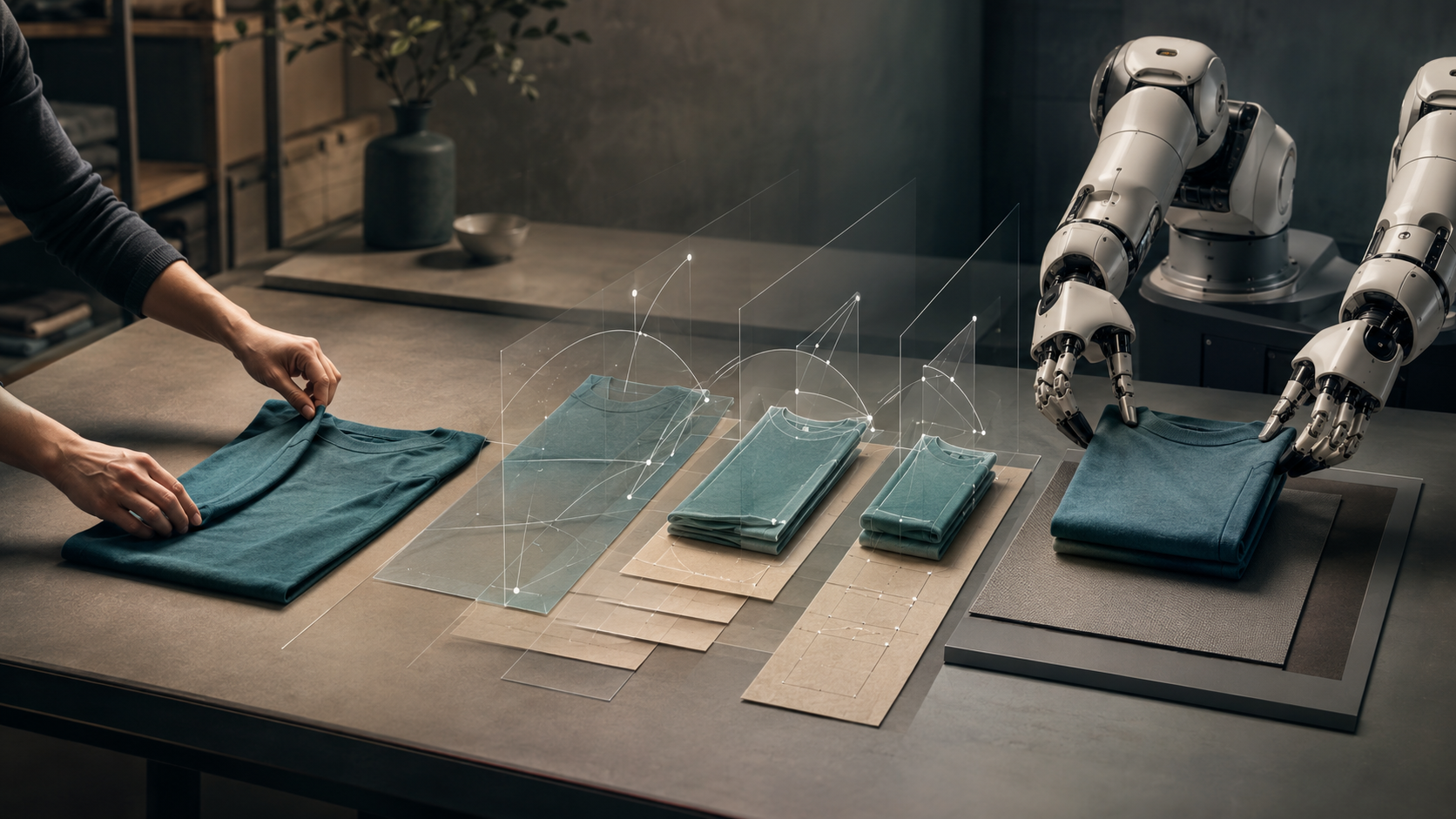
Instant-Fold is not mainly a “robot folds shirts” paper. That is the demo-friendly surface layer, and robotics papers do need a surface layer. The more useful idea is that a single demonstration can work as an operational interface for deformable tasks where language is too thin, checklists are too brittle, and final-state labels hide the important part: how the object got there.1
The paper directly shows three things. First, deformable object manipulation can be framed as in-context imitation learning: give the model one demonstration at test time, and it infers the intended folding mode without updating weights. Second, this only works because the system learns deformation-aware visual tokens before policy learning, using temporal contrastive pretraining over simulated cloth trajectories. Third, a flow-matching transformer policy can condition on those demonstration tokens and execute dual-arm folding in simulation and, with no real-world finetuning, on a real robot setup.
The most business-relevant result is the gap between “understanding the requested mode” and “executing the requested geometry.” On held-out folding contexts, a language-conditioned policy without pretraining reaches 75.0 context-following accuracy, close to the 73.5 of an unpretrained demo-conditioned policy. But conditional success is very different: 20.2 for language versus 42.3 for demonstrations. The demonstration is not just a label. It carries spatial ordering, intermediate deformation, hand timing, and manipulation style. Apparently the robot, like everyone else in operations, benefits from being shown what “do it properly” actually means.
The boundary is just as important. The system is evaluated on garment tops and nearby garments, starts from foldable states rather than arbitrary crumpled piles, assumes reliable segmentation, uses a manually designed context library, and depends on a controlled dual-arm setup with camera calibration. The real-world average success across eight unseen garments is 60.9, much better than the compared baselines, but not a production SLA unless one has a thrillingly low bar for production.
Cognaptus interpretation: this is a paper about demonstration as a high-bandwidth task specification layer. For companies trying to automate variable physical workflows, the lesson is not “buy a folding robot.” It is: where written instructions collapse under geometry, timing, and material variation, examples may become the interface.
The annoying part is not the goal. It is the procedure.
A work instruction can say “fold the sleeves first.” It can even say “fold the left sleeve, then the right sleeve, then bring the bottom upward.” That sounds precise until a garment is skewed, a sleeve is slightly curled, the cloth is stiff, one arm occludes the camera, and the “same” fold has several valid execution orders.
This is why deformable object manipulation is an unpleasant class of automation problem. The object does not simply move. It changes shape. It hides parts of itself. It creates many intermediate states that may all be valid on the way to the same final appearance. A rigid part can often be described by pose. Cloth responds with a small opera.
Instant-Fold’s central move is to treat the demonstration as the task prompt. Instead of asking a model to infer the task from language or a fixed target, the system receives a single human demonstration, extracts keyframes, encodes the demonstrated cloth geometry and hand events, and then generates actions for the current scene. No gradient update is performed at test time. The demonstration is context, not new training.
That distinction matters. In-context imitation learning is not merely “learning from one example” in the old sense. The model has already been trained across a diverse library of manipulation modes. At deployment, the example selects and specifies a mode inside that learned space. It is closer to giving a skilled worker a reference video than handing a novice one photograph and saying, “Please discover textile mechanics.”
The mechanism has three jobs, not one
The paper’s system is easiest to understand as a pipeline with three separate responsibilities:
single demonstration
        ↓
keyframes of cloth state + hand/robot events
        ↓
deformation-aware cloth tokens
        ↓
demonstration context encoder
        ↓
current scene conditioned on the demo
        ↓
flow-matching action decoder
        ↓
dual-arm trajectory
Each stage exists because a simpler version would confuse one kind of information for another.
The first stage learns a deformable representation. The system takes masked RGB-D observations, back-projects visible depth pixels into a 3D point cloud, samples garment surface points, and associates each sampled point with a visual feature. Each cloth token therefore has two parts: a 3D position and a semantic feature. This is not decorative tokenization. It gives the policy something compact enough to process and structured enough to retain geometry.
The second stage encodes the demonstration. Keyframes are extracted from gripper open-close transitions and related state events, because the meaningful temporal structure of folding is not uniformly distributed across the video. Most frames are not equally informative. A grasp, a release, a retraction, and a transition between simultaneous and sequential arm motion are far more useful than a random middle frame. The model then uses spatial and temporal attention to compress the demonstration into context tokens.
The third stage generates actions with a flow-matching transformer. The decoder conditions on both the current scene and the demonstration context, then predicts dual-arm action trajectories. It also includes auxiliary keypose prediction, which acts like short-horizon subgoal supervision. In plain operational language: the system is not only asked to move; it is also trained to know the next meaningful manipulation phase.
That is the mechanism-first point. The result is not caused by one glamorous model block. It depends on separating representation, task specification, and action generation. Boring architecture, when properly aligned with the problem, has the discourteous habit of working.
Why generic vision features are the wrong kind of smart
The representation problem is subtle. A generic visual model can recognize that an object is a shirt. That does not mean it can track “this physical point on the sleeve” as the sleeve folds, disappears under another layer, and reappears in a new configuration.
Instant-Fold addresses this through temporal contrastive pretraining. The system uses simulator particle geometry to define correspondence targets: tokens that correspond to the same physical cloth region across time should be close in feature space, even when the garment deforms. It also adds cross-cloth semantic keypoint supervision, so that corresponding garment parts across different clothes can align.
This is a representation designed for deformation, not classification. The model is not rewarded for merely recognizing category. It is rewarded for preserving identity through movement.
The appendix matters here because the pretraining experiments are not a second thesis. They are mostly ablations and robustness checks for the representation mechanism. They test whether the temporal contrastive objective, soft weighting, cross-trajectory supervision, multi-layer feature aggregation, and curriculum weighting actually contribute to correspondence quality.
The useful reading is:
| Test or result family | Likely purpose | What it supports | What it does not prove |
|---|---|---|---|
| Temporal contrastive pretraining comparisons | Main representation evidence plus ablation | Deformation-aware features outperform frozen generic DINOv3-style features on correspondence probes | That the representation alone solves manipulation |
| Intra-trajectory and cross-trajectory ablations | Ablation and sensitivity test | Dense temporal contrast, soft positives, and cross-context supervision improve feature consistency | That all future deformable tasks need exactly this loss |
| Multi-layer feature aggregation ablation | Implementation ablation | Combining intermediate and final visual features helps correspondence, especially cross-cloth | That adding architectural complexity always helps |
| Qualitative PCA visualizations on real demonstrations | Qualitative transfer check | Learned features appear more temporally consistent under real deformations | That real-world control will be reliable under all fabrics |
The paper’s full pretraining results show strong intra-trajectory and cross-cloth correspondence, while cross-trajectory matching remains harder. That is exactly the right failure to notice. The bottleneck is not “can the model see cloth?” It is whether it can maintain precise correspondences across the wide variety of deformations that different folding paths produce.
This matters for operators because many physical workflows have the same structure. Bags, cables, fabric, sheets, soft packaging, food items, and flexible components do not merely appear different across SKUs. They deform during handling. A vision system that is good at recognizing the object may still be bad at preserving the action-relevant structure through the task. Recognition is not manipulation. A shocking discovery, but apparently still necessary.
The demonstration is not a label. It is a compressed procedure.
The most tempting misconception is to treat the demonstration as a fancy way to specify the final fold. That is too weak. The demonstration specifies at least four things:
| Demonstration signal | Why language underspecifies it |
|---|---|
| Spatial convention | “Fold inward” does not fully define pick points, target points, or geometry under deformation |
| Temporal ordering | The same final fold may require sleeve-first, body-first, sequential, or simultaneous execution |
| Intermediate shape | Correct progress may pass through states that look temporarily worse before becoming better |
| Interaction style | Hand timing, retraction, release, and two-arm coordination affect whether the cloth lands correctly |
The context encoder is built around this view. It does not simply encode an image of the target. It encodes keyframe cloth tokens, robot or hand state tokens, spatial interactions, temporal structure, summary tokens, and state-event tokens. Those last details are not cosmetic. The ablations show that removing the components that preserve global mode information and sparse grasp-release timing hurts held-out performance.
This is an important business distinction. If the task can be specified by a static target, a final-state controller may be enough. If the task depends on how one gets there, the interface must carry procedure. Demonstrations carry procedure by default. Language carries it only when written by someone patient enough to produce a manual no one will read.
The main experiment separates intent from execution quality
The policy experiments compare language-conditioned and demonstration-conditioned policies under different pretraining regimes. The evaluation uses 60 held-out garments over 32 folding contexts, totaling 1,920 rollouts. The paper reports several metrics, but the most useful pair is context-following accuracy and C-SR@95.
Context-following accuracy asks whether the rollout follows the requested folding context. C-SR@95 is stricter: the rollout must follow the requested context and achieve final fold quality within an oracle-calibrated 95th-percentile success envelope. In other words, it is not enough to choose the right kind of fold. The fold must also be physically good enough relative to oracle executions.
The held-out fold results are the clearest evidence:
| Conditioning | Pretraining | Held-out context accuracy | Held-out C-SR@95 | Held-out geometry error | Distribution distance |
|---|---|---|---|---|---|
| Language | None | 75.0 | 20.2 | 3.36 | 0.280 |
| Language | Full | 92.0 | 28.7 | 2.97 | 0.200 |
| Demonstration | None | 73.5 | 42.3 | 2.24 | 0.140 |
| Demonstration | 8-mode | 91.8 | 43.5 | 2.13 | 0.137 |
| Demonstration | Full | 95.8 | 58.3 | 1.89 | 0.099 |
The first comparison is the most revealing. Without pretraining, language and demonstration are similar on held-out context accuracy: 75.0 versus 73.5. If one only measured whether the system picked the intended mode, language would look competitive. But conditional success tells a different story. The demonstration-conditioned policy reaches 42.3, more than double the language-conditioned 20.2.
That means the demonstration is not merely improving intent recognition. It improves the geometry and execution of the fold. It gives the policy information language does not compactly provide.
Full pretraining then improves both language and demonstration policies, with the strongest overall held-out result coming from the fully pretrained demonstration-conditioned policy: 95.8 context accuracy, 58.3 C-SR@95, 1.89 geometry error, and 0.099 distribution distance.
There is still a gap to the oracle, which is calibrated at 95.0 C-SR@95. The paper is not claiming solved cloth manipulation. It is showing that demonstration-conditioned adaptation substantially narrows a specific gap: how to transfer a manipulation mode to unseen garments and unseen context variants without updating the model.
The ablations say the architecture is doing actual work
Ablation tables are easy to skim. That is usually a mistake. Here they explain why the mechanism works.
The policy ablations remove major components from the full model and evaluate the effect on held-out folds. The full model reaches 58.3 C-SR@95. Removing the context encoder drops held-out C-SR@95 to 36.7. Removing the keypose auxiliary branch drops it to 35.3. Removing summary tokens drops it to 38.7. Removing state-event tokens drops it to 41.8. Removing 3D ALiBI drops it to 43.5.
Those are not tiny dents. They show that the model needs structured demonstration aggregation, short-horizon phase supervision, global summary of the procedure, sparse gripper-event preservation, and geometry-aware attention bias.
| Removed component | Held-out C-SR@95 | Likely role exposed by the ablation |
|---|---|---|
| Nothing: full model | 58.3 | Complete mechanism |
| Context encoder | 36.7 | Demonstration must be structured, not merely concatenated |
| Keypose auxiliary | 35.3 | Long-horizon folding benefits from explicit intermediate subgoals |
| Summary tokens | 38.7 | Global fold plan needs compact representation |
| State-event tokens | 41.8 | Sparse grasp-release timing must not be diluted by cloth tokens |
| 3D ALIbi | 43.5 | Geometric bias matters especially for held-out generalization |
The paper also notes a concrete failure pattern: without state-event information, the policy can collapse simultaneous folds into sequential ones. That is a useful detail because it tells us what the model is confusing. It is not failing in some vague “AI robustness” way. It loses timing and coordination structure.
For business readers, that is the diagnostic lesson. When demonstration-conditioned systems fail, the first question should not be “was the model large enough?” It should be: which part of the procedure was not represented clearly enough? Geometry? Phase? Timing? Contact state? The expensive answer is often not “buy more model.” The annoying answer is “instrument the missing variable.”
Context diversity buys transfer, not just memorization
The scaling experiment varies the number of downstream training contexts while keeping the pretrained encoder and policy recipe fixed. Its likely purpose is to test whether broader context diversity helps generalization rather than merely improving seen-context performance.
The result is asymmetric. Seen-fold C-SR@95 rises gradually from 63.6 at 4 contexts to 70.4 at 16 contexts. Held-out C-SR@95 improves more sharply: 38.7 at 4 contexts, 58.3 at 8 contexts, and 63.7 at 16 contexts.
That pattern matters. If extra contexts only helped the model memorize more training cases, the seen split would carry most of the gain. Instead, the stronger improvement appears on held-out contexts. The paper also notes that adding body-first folds improves evaluation on sleeve-first held-out folds, suggesting the model benefits from broader procedural diversity rather than only near-duplicate examples.
The business translation is straightforward, though not necessarily cheap. The value is not in collecting one perfect demonstration for every exact SKU-state combination. The value is in building a context library broad enough that the model learns how procedural variation works. The demonstration at deployment then selects within that learned procedural space.
That makes data strategy less about “more footage” and more about coverage design. Which manipulation modes are actually distinct? Which ordering variants matter? Which object states are within the operational manifold? Which failure modes require new contexts rather than retry logic? That is not glamorous. It is data engineering wearing gloves.
The prior-work comparison is strong, but it tests a narrow arena
The paper compares Instant-Fold against primitive-based clothes folding methods in simulation and real-world experiments. In FleX simulation, Instant-Fold reports 99.7 success, compared with 71.0 for ClothFunnels, 82.0 for UniFolding, and 72.7 for UniGarmentManip. In Isaac Lab sim-to-sim transfer, Instant-Fold reports 92.5, compared with 73.3, 86.7, and 83.3 for the same baselines.
The likely purpose of this comparison is not to prove a universal robotics hierarchy. It shows that, within the paper’s clothes-folding benchmark and transfer setup, the in-context demonstration-conditioned mechanism outperforms several established primitive-based approaches.
The real-world comparison is more interesting because it is messier. Across eight unseen garments, Instant-Fold averages 60.9, while ClothFunnels averages 9.4, UniFolding 29.7, and UniGarmentManip 26.6. Instant-Fold succeeds 6 out of 8 trials on several garments, but only 1 out of 8 on garment #8, which the paper identifies as stiff and difficult for simple pick-and-place behavior.
That is exactly the kind of result one should not sand down into a press-release sentence. “Best among baselines” and “not yet reliable across all garments” are both true. A serious operator needs both.
The real-world setup also includes several important engineering details. The policy uses a calibrated Intel RealSense D415 camera, SAM2 for cloth tracking, camera-frame action representation, fixed end-effector orientations, and a dual-arm Dobot platform. Demonstrations can be collected from human hands, but the paper reports manual inspection and correction of incorrect or missing interaction points in the keyframes.
So, yes, the system transfers zero-shot from simulation to real deployment in the sense that it does not use real-world training data or finetuning. No, that does not mean a plant manager can wave a phone video over a pile of laundry and receive a compliant autonomous workcell by lunch. Reality remains inconsiderate.
The failure modes are business requirements in disguise
The paper’s failure modes are unusually useful because they map directly onto deployment requirements.
The reported real-world failures include robot kinematic or Cartesian controller errors, workspace limitations, severe overhead-camera occlusions during second-stage folds, sim-to-real physics discrepancies, stiff fabrics that do not drape as expected, slippery table interactions, camera calibration drift, gripper slipperiness, and segmentation failures.
That list should be read as a bill of materials for operational robustness.
| Failure mode | Business interpretation |
|---|---|
| Kinematic and controller errors | The learned policy still depends on execution hardware staying inside reachable, stable motion regimes |
| Camera occlusion | Sensor placement and occlusion modeling are not optional peripherals |
| Sim-to-real cloth physics mismatch | Simulator coverage must include material behavior, not only shape variation |
| Calibration drift | Deployment reliability needs maintenance processes, not just model checkpoints |
| Slippery grippers or tables | Contact mechanics can dominate model quality |
| Segmentation failures | Perception assumptions become system-level failure points |
This is where many AI automation projects quietly lose money. The model is treated as the core system, while sensing, calibration, contact hardware, and process envelopes are treated as integration details. In physical automation, integration details are often the product. The model may be the clever part, but the table surface still gets a vote.
What the paper directly shows, what Cognaptus infers, and what remains uncertain
The paper directly shows that a demonstration-conditioned, flow-matching transformer policy trained in simulation can generalize across a designed library of garment-folding modes, outperform language conditioning on conditional fold success, benefit from deformation-aware temporal contrastive pretraining, improve with context diversity, and transfer to a real dual-arm robot setup without real-world finetuning.
Cognaptus infers that demonstrations can become a practical specification layer for variable physical tasks when the procedure is difficult to write down. This is relevant beyond garment folding: soft-goods handling, packaging, retail returns processing, laundry, cable or hose arrangement, flexible component kitting, and other workflows where object state and manipulation order matter. The inference is not that this architecture transfers unchanged to every domain. The inference is that the interface pattern is promising: show the system the mode, let the learned policy adapt within a trained family.
What remains uncertain is the breadth of that family. The paper’s own limitations are clear. It assumes reliable object segmentation. It starts from states within the foldable manifold rather than from arbitrary crumpled configurations. It studies a single object category, garment tops, though real-world tests include some nearby garment types. Its context library is manually designed and limited in scale. The real-world results still expose sensitivity to occlusion, stiffness, calibration, contact, and hardware constraints.
A more operational way to say this:
| Deployment question | Evidence from the paper | Boundary |
|---|---|---|
| Can one demonstration specify a manipulation mode? | Yes, within the trained garment-folding context family | Not arbitrary new task families |
| Does demonstration help more than language? | Yes, especially for conditional success and geometry on held-out folds | Language may still identify coarse intent reasonably well |
| Can simulation replace real-world training data here? | The paper shows zero-shot real deployment without real finetuning | The setup still requires domain randomization, occlusion modeling, segmentation, calibration, and manual keyframe correction |
| Does more context diversity help? | Yes, especially for held-out C-SR@95 | Context design remains manual and bounded |
| Is this production-ready garment automation? | Not shown | Real-world average success is 60.9 across eight garments, with severe failure on the stiffest garment |
This separation matters because “promising research” and “deployable automation” are separated by a region known technically as the budget.
The business value is not cheaper training. It is richer task specification.
It would be easy to frame this paper as a data-efficiency story: one demonstration, no finetuning, trained in simulation. That is true, but incomplete.
The deeper business value is interface design. Many automation workflows fail because the task interface is too weak. A text instruction cannot carry enough geometry. A final-state target cannot carry enough procedure. A hard-coded primitive cannot cover enough variation. A per-SKU program is too expensive to maintain.
A demonstration can compress the missing information. It shows what matters without requiring the operator to formalize every contact, fold order, intermediate shape, and timing decision. It becomes a high-bandwidth input channel between human operational knowledge and machine execution.
But the demonstration only works because the model has been prepared to understand it. Instant-Fold needs deformation-aware tokens, context encoding, action-phase supervision, and broad context diversity. Showing is powerful only when the system knows what to look for. Otherwise, a demonstration is just a video with misplaced confidence.
This is the sober takeaway for companies. The future of physical AI will not be built only from larger policies or better language interfaces. It will need better task interfaces: demonstrations, state events, geometric tokens, constraint libraries, recovery behaviors, and carefully chosen context coverage. Less “tell the robot what to do,” more “show the robot the procedure inside a domain it has actually learned.”
Fold once, execute many times. That is the promise.
Not fold anything, anywhere, forever. That is the brochure.
Conclusion: examples are becoming operational APIs
Instant-Fold is important because it reframes a stubborn robotics problem. Deformable manipulation is not only a perception problem, not only a control problem, and not only a data problem. It is also a specification problem. The system needs to know which valid procedure the operator wants, not merely which final state looks acceptable.
The paper’s mechanism-first contribution is therefore clean: learn cloth representations that survive deformation, encode a single demonstration as procedural context, and use a flow-matching transformer to generate actions conditioned on that context. The evidence supports the mechanism across main policy comparisons, representation ablations, policy ablations, context-diversity scaling, simulation baselines, and real-world trials.
For operators, the practical implication is narrower but more useful than the hype version. Demonstrations may become a serious interface for variable physical work, especially when written instructions are too lossy. But the deployment envelope still depends on segmentation, calibration, hardware reachability, material physics, context-library design, and recovery from messy starting states.
The robot can now be shown what to do. Splendid. Someone still has to build the world in which showing it is enough.
Cognaptus: Automate the Present, Incubate the Future.
-
Yilong Wang, Cheng Qian, and Edward Johns, “Instant-Fold: In-Context Imitation Learning for Deformable Object Manipulation,” arXiv:2606.04269v1, 2 June 2026, https://arxiv.org/abs/2606.04269. ↩︎