Opening — Why this matters now
There’s a quiet shift happening in AI: we are moving from models that answer to systems that act. And once agents start acting — negotiating, persuading, coordinating — something awkward becomes obvious.
Logic alone doesn’t win negotiations. Emotion does.
The problem is that most AI systems treat emotion as decoration — tone, style, maybe a prompt tweak. But in real-world negotiations, especially high-stakes ones (debt collection, medical scheduling, disaster response), emotion is not decoration. It is strategy.
The paper EmoMAS: Emotion-Aware Multi-Agent System for High-Stakes Edge-Deployable Negotiation with Bayesian Orchestration fileciteturn0file0 argues something more radical: emotion should be treated as an optimizable decision variable, not a byproduct.
And once you accept that premise, the architecture of negotiation AI changes completely.
Background — From “smart responses” to strategic interaction
Most existing negotiation agents fall into three camps:
| Approach | Strength | Limitation |
|---|---|---|
| Prompt-based emotional tone | Easy to implement | Static, non-adaptive |
| Game-theoretic agents | Rational payoff optimization | Emotionally tone-deaf |
| RL-based agents | Adaptive over time | Data-hungry, slow to converge |
The industry workaround has been brute force: use larger models.
But this creates two structural problems:
- Privacy & deployment constraints — high-stakes negotiations often cannot leave local devices.
- Latency & cost — cloud-based LLMs are impractical in real-time or offline environments.
This is where small language models (SLMs) should shine. Instead, they fail — not because they lack knowledge, but because they lack emotional adaptability under pressure.
The paper identifies a subtle but critical gap: existing systems optimize what to say, but not how emotional trajectories evolve over time.
And negotiation is, fundamentally, a trajectory problem.
Analysis — What EmoMAS actually does (and why it matters)
At its core, EmoMAS reframes negotiation as a multi-agent inference problem over emotional states.
1. The architecture: not one brain, but three
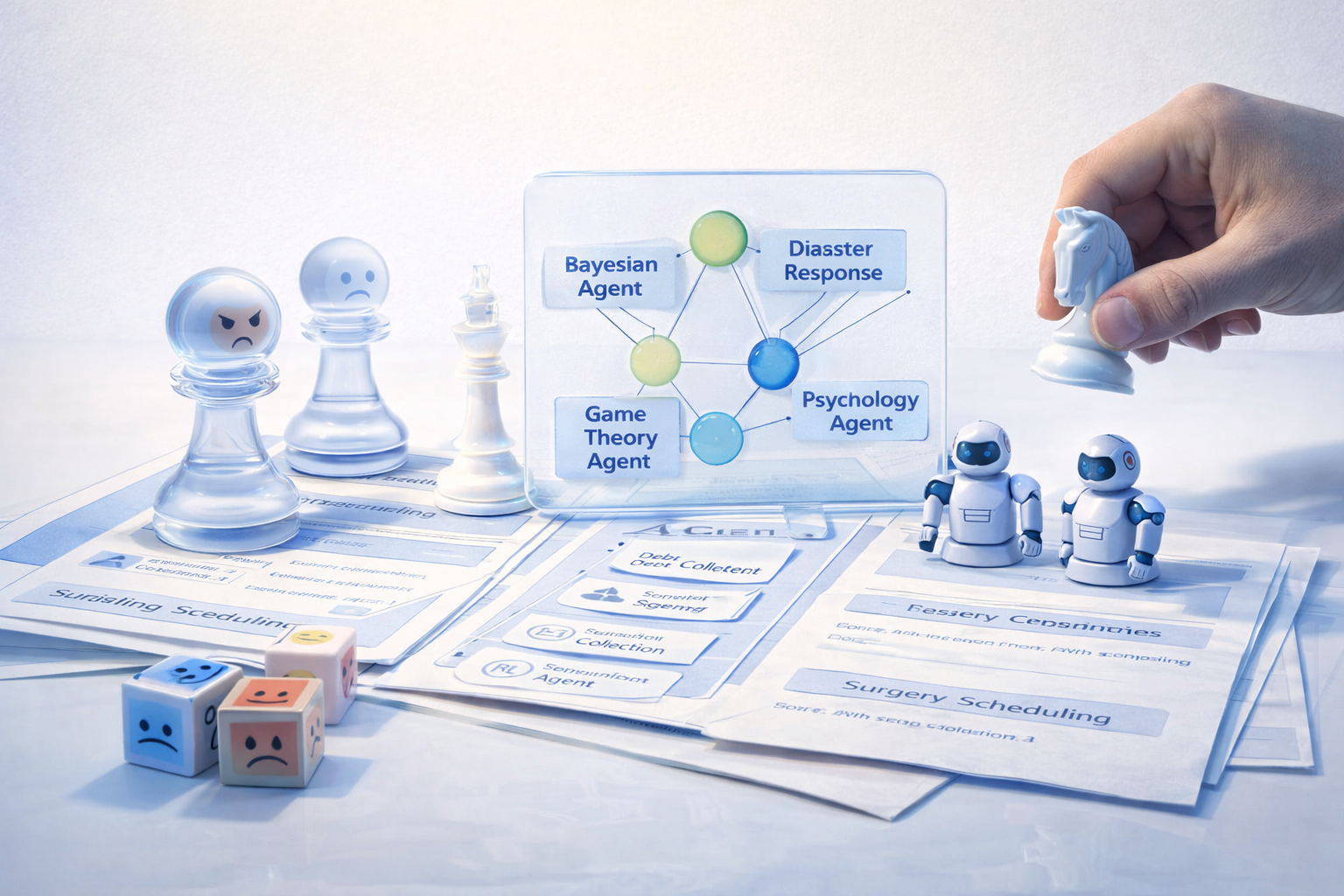
Instead of a single model, EmoMAS splits reasoning into three specialized agents:
| Agent | Role | What it optimizes |
|---|---|---|
| Game Theory Agent | Payoff reasoning | Rational outcomes |
| RL Agent | Pattern adaptation | Learning from interaction |
| Coherence Agent | Psychological plausibility | Human-like emotional flow |
Each agent proposes an emotional action — not just a response.
This is the key shift: the system chooses emotion first, language second.
2. The real innovation: Bayesian orchestration
Most multi-agent systems average outputs. EmoMAS does something more interesting.
It asks:
“Which agent should I trust right now?”
The answer is computed through a Bayesian update mechanism:
- Each agent has a reliability score
- Reliability updates after each interaction
- The system dynamically reweights agents per context
In other words, the system learns who to listen to — in real time.
This solves a major flaw in Mixture-of-Experts systems: static weighting in dynamic environments.
3. Emotion becomes a state space
The negotiation is modeled over seven discrete emotional states:
- Joy, Sadness, Anger, Fear, Surprise, Disgust, Neutral
But more importantly, EmoMAS optimizes transitions between these states — not just isolated choices.
This turns negotiation into a sequential decision process:
| Step | Traditional Agent | EmoMAS |
|---|---|---|
| Input | Dialogue | Dialogue + emotional history |
| Decision | Next response | Next emotional state |
| Objective | Immediate reply quality | Final negotiation outcome |
This is closer to how humans actually negotiate.
4. Online learning without pre-training
One of the more pragmatic contributions: EmoMAS avoids heavy offline training.
- Uses tabular Q-learning (not deep RL)
- Updates after each interaction
- Adapts to opponent behavior in-session
This is not flashy — but it’s deployable.
Which, frankly, is where most “AI breakthroughs” quietly fail.
Findings — What actually improves (and what doesn’t)
The paper evaluates EmoMAS across four domains:
- Debt negotiation
- Medical scheduling
- Disaster response
- Educational persuasion
1. Performance gains are consistent — but nuanced
| Scenario | Key Result |
|---|---|
| Debt | Near-perfect success rate (up to 100%) |
| Medical | Significant improvement vs single agents |
| Emergency | Higher success and better outcomes |
| Education | More effective long-term persuasion |
The interesting detail is not just success rate — but outcome quality vs speed trade-off.
EmoMAS often takes more negotiation rounds but achieves better results.
Which suggests:
It is not optimizing for speed. It is optimizing for persuasion.
2. Robustness under adversarial behavior
Against manipulative strategies (pressure, victim-playing, threats):
| Strategy | Baseline Success | EmoMAS-Bayes |
|---|---|---|
| Pressure tactics | ~20% | ~50% |
| Victim playing | ~58% | ~70% |
| Threatening | ~70% | ~80% |
This is where the system’s value becomes obvious.
Emotion is not just expressive — it is defensive.
3. Ethical trade-offs are real
Behavioral evaluation shows:
| Metric | Best Performer | Observation |
|---|---|---|
| Emotional consistency | Coherence Agent | Most human-like |
| Manipulation rate | Coherence Agent | Lowest manipulation |
| Balanced performance | EmoMAS | Trade-off between effectiveness and ethics |
And here’s the uncomfortable truth:
More effective negotiation often means more manipulation.
EmoMAS doesn’t eliminate this tension. It manages it.
Implications — Where this actually matters
1. Edge AI is not just about compute — it’s about trust
The paper positions EmoMAS as an edge-deployable system.
This matters for:
- Healthcare negotiations (privacy-sensitive)
- Financial interactions (regulated environments)
- Robotics (offline decision-making)
The real advantage is not cost.
It is data sovereignty + emotional competence.
2. Multi-agent systems are moving up the stack
We are seeing a structural shift:
| Old paradigm | New paradigm |
|---|---|
| Bigger models | Smarter coordination |
| Static prompts | Adaptive orchestration |
| Single-agent reasoning | Multi-agent negotiation |
EmoMAS is an early example of this trend: intelligence as composition, not scale.
3. Emotion becomes a controllable variable
This has uncomfortable implications for regulation:
- Emotional manipulation becomes programmable
- Persuasion becomes measurable
- Ethical boundaries become harder to define
In high-stakes environments, this will not remain an academic question.
Conclusion — The uncomfortable direction of agentic AI
EmoMAS doesn’t just improve negotiation performance.
It quietly changes the definition of intelligence in AI systems.
Not:
“Can the model reason?”
But:
“Can the system manage emotional dynamics over time?”
That is a very different capability — and a far more consequential one.
Because once AI can strategically deploy emotion, it stops being a tool for communication…
…and starts becoming a participant in human decision-making.
And participants, unlike tools, have influence.
Cognaptus: Automate the Present, Incubate the Future.