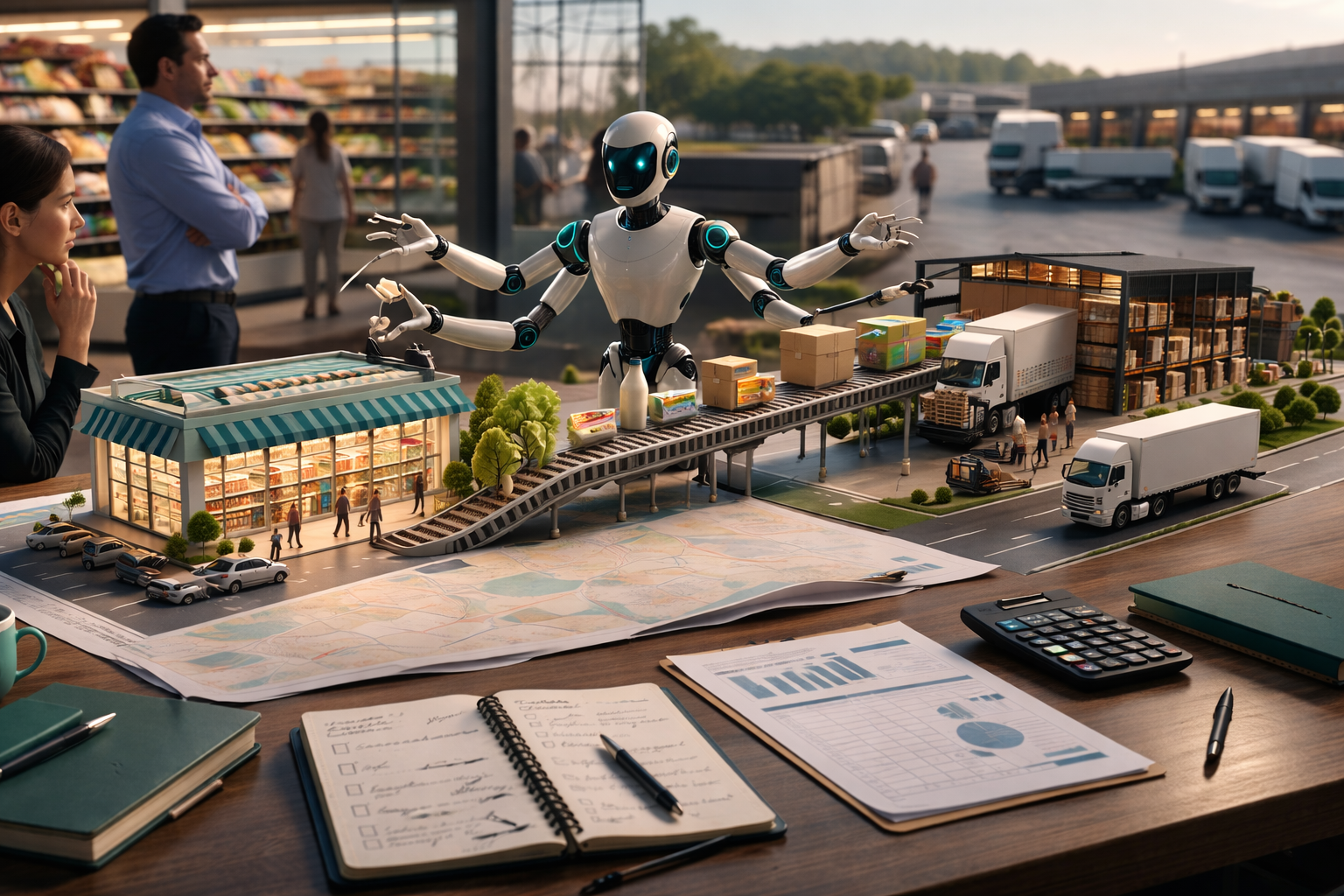
Opening — Why this matters now
Retail supply chains are not broken. They are simply overwhelmed.
For decades, supermarket operations have scaled by adding more dashboards, more analysts, and more coordination layers. The result is a system that works—until it doesn’t. Demand spikes, supplier delays, or perishable inventory mismatches expose a structural limitation: human coordination does not scale linearly with operational complexity.
The emergence of agentic AI reframes the problem. Instead of asking how AI can assist individual decisions, it asks a more uncomfortable question:
What if the entire workflow—not just the decision—should be automated?
The paper “Flowr — Scaling Up Retail Supply Chain Operations Through Agentic AI” fileciteturn0file0 offers one of the first serious answers.
And notably, it avoids the usual trap of overpromising intelligence. Instead, it focuses on something far more valuable: coordination.
Background — From Tools to Workflows
Most enterprise AI deployments today are glorified calculators.
- Forecasting models predict demand
- Optimization engines suggest prices
- Dashboards visualize inventory
Each works well in isolation. Together, they produce… friction.
The missing layer is not intelligence—it is orchestration.
Traditional systems assume:
| Layer | Responsibility | Limitation |
|---|---|---|
| Data systems | Store and retrieve information | Fragmented across silos |
| Analytics models | Generate predictions | No execution capability |
| Humans | Coordinate and decide | Bottleneck under scale |
Flowr introduces a different abstraction: agentic workflows.
Instead of humans stitching together outputs from multiple tools, AI agents own the full loop:
- interpret → decide → act → monitor → escalate
This is not “AI replacing humans.” It is AI replacing coordination overhead.
Analysis — What Flowr Actually Builds
At its core, Flowr is not a model. It is a system architecture.
It decomposes the retail supply chain into six cognitive roles:
| Agent | Function | What It Replaces |
|---|---|---|
| Demand Forecasting | Continuous SKU-level prediction | Manual spreadsheet analysis |
| Inventory Monitoring | Real-time stock reasoning | Periodic human checks |
| Procurement & Ordering | Order generation + supplier selection | Procurement teams |
| Supplier Coordination | Communication + negotiation | Emails / calls |
| DC Replenishment Planning | Routing + allocation optimization | Logistics planners |
| Exception & Alert | Cross-stage anomaly detection | Reactive escalation |
This decomposition is deceptively simple. The real innovation lies elsewhere.
1. LLM Consortium (Not a Single Brain)
Each decision is not produced by one model, but by multiple domain-specialized LLMs, whose outputs are then synthesized by a reasoning model.
This creates:
- redundancy (less hallucination risk)
- diversity (multiple reasoning paths)
- auditability (traceable justification)
In practice, this resembles a committee of specialists, chaired by a strategist.
2. Human-in-the-Loop as Governance, Not Labor
Humans do not disappear. They shift roles:
| Before | After |
|---|---|
| Execute workflows | Supervise workflows |
| Manually coordinate | Approve critical decisions |
| React to issues | Handle exceptions |
This is subtle but important. The system is not autonomous—it is supervised autonomy.
3. MCP (Model Context Protocol) as Infrastructure Glue
Flowr relies on MCP to connect agents to real systems:
- inventory databases
- supplier portals
- logistics systems
This matters because most AI projects fail not at reasoning—but at integration.
MCP effectively standardizes the interface between AI cognition and enterprise reality.
Findings — What Actually Improves
The paper evaluates two core workflows: procurement and replenishment planning.
The results are not flashy—but they are operationally meaningful.
Procurement Performance
| Metric | Result |
|---|---|
| Human evaluation score | 4.7 / 5 |
| Output completeness | High (structured POs with justification) |
| Key advantage | Supplier selection reasoning + uncertainty flags |
| Time reduction | From hours → single agent run |
The interesting detail is not accuracy—it is reasoning transparency.
Each purchase order includes:
- supplier selection logic
- delivery timing rationale
- flagged uncertainty cases
In other words, the system does not just decide—it explains.
Replenishment Planning Performance
| Metric | Result |
|---|---|
| Efficiency gain | ~16% reduction in routing distance |
| Human evaluation | 4.6 / 5 |
| Strength | Multi-constraint reasoning |
| Insight generation | Route consolidation opportunities |
This is where agentic systems outperform humans decisively.
Humans optimize sequentially. Agents optimize simultaneously across constraints.
Implications — Where the Real Value Is
Most readers will focus on automation. That would be a mistake.
The deeper implication of Flowr is this:
Enterprise value is shifting from prediction accuracy to workflow ownership.
1. The New Competitive Moat: Coordination Systems
Companies no longer compete on:
- better forecasts
- faster dashboards
They compete on:
- who owns the execution loop
Agentic workflows collapse latency between insight and action.
That gap—previously filled by humans—is now programmable.
2. AI ROI Moves Up the Stack
Traditional AI ROI:
- improve accuracy by 3–5%
Agentic AI ROI:
- eliminate entire coordination layers
The difference is not incremental. It is structural.
3. Governance Becomes the Bottleneck
Flowr’s design quietly acknowledges a reality most AI startups ignore:
The hardest part of AI is not intelligence. It is trust.
This is why it includes:
- multi-model validation
- explicit reasoning traces
- human approval gates
In high-stakes operations, explainability is not a feature—it is permission to deploy.
4. Generalization Beyond Retail
Although tested in supermarkets, the pattern generalizes cleanly:
| Industry | Equivalent Workflow |
|---|---|
| Finance | Trade execution pipelines |
| Healthcare | Patient triage + treatment planning |
| Manufacturing | Production scheduling |
| Logistics | Fleet optimization |
Anywhere coordination dominates, agentic systems have leverage.
Conclusion — The Quiet Shift
Flowr does not look revolutionary.
There is no new model architecture. No breakthrough algorithm. No claim of artificial general intelligence.
And yet, it represents something more consequential:
A shift from AI as a tool to AI as an operating layer.
The real transformation is not that machines think better.
It is that they coordinate faster, continuously, and at scale.
Which leaves humans with a new role—less operator, more governor.
A role that is harder to automate.
And much harder to get right.
Cognaptus: Automate the Present, Incubate the Future.