Opening — Why this matters now
The current generation of AI agents has an obsession: thinking deeper.
Longer chains of reasoning. More steps. More tokens. More “intelligence.”
And yet, when asked to do something annoyingly practical—like compiling a complete dataset across dozens of sources—they fail in surprisingly mundane ways: missing entries, duplicated facts, or simply running out of context.
This is not a reasoning problem. It is a structure problem.
The paper fileciteturn0file0 introduces InfoSeeker, a system that quietly challenges a dominant assumption in AI: that better performance comes from deeper reasoning. Instead, it argues that real-world AI search is not about depth—it is about width.
And width, as it turns out, breaks most existing systems.
Background — The Limits of “Thinking Harder”
Most modern agent frameworks follow a familiar loop:
- Think
- Act
- Observe
- Repeat
This works reasonably well for problems requiring sequential logic. But when tasks require aggregating large volumes of heterogeneous information, the system begins to collapse.
The paper identifies three structural bottlenecks:
| Bottleneck | What Happens | Why It Matters |
|---|---|---|
| Context Saturation | Too much information floods the model | Important signals get diluted or lost |
| Error Propagation | Early mistakes cascade downstream | Later steps become unreliable |
| Latency Explosion | Sequential steps take too long | Real-world usability collapses |
Even advanced systems—commercial “deep research” agents included—struggle with these constraints. Expanding context windows only delays the failure. It doesn’t fix it.
The authors frame this as a mismatch between how AI systems are designed and how real-world information behaves.
Reality is messy, parallel, and distributed.
Most agents are not.
Analysis — A System That Thinks in Layers, Not Chains
InfoSeeker introduces a deceptively simple idea: separate thinking from doing, and isolate both.
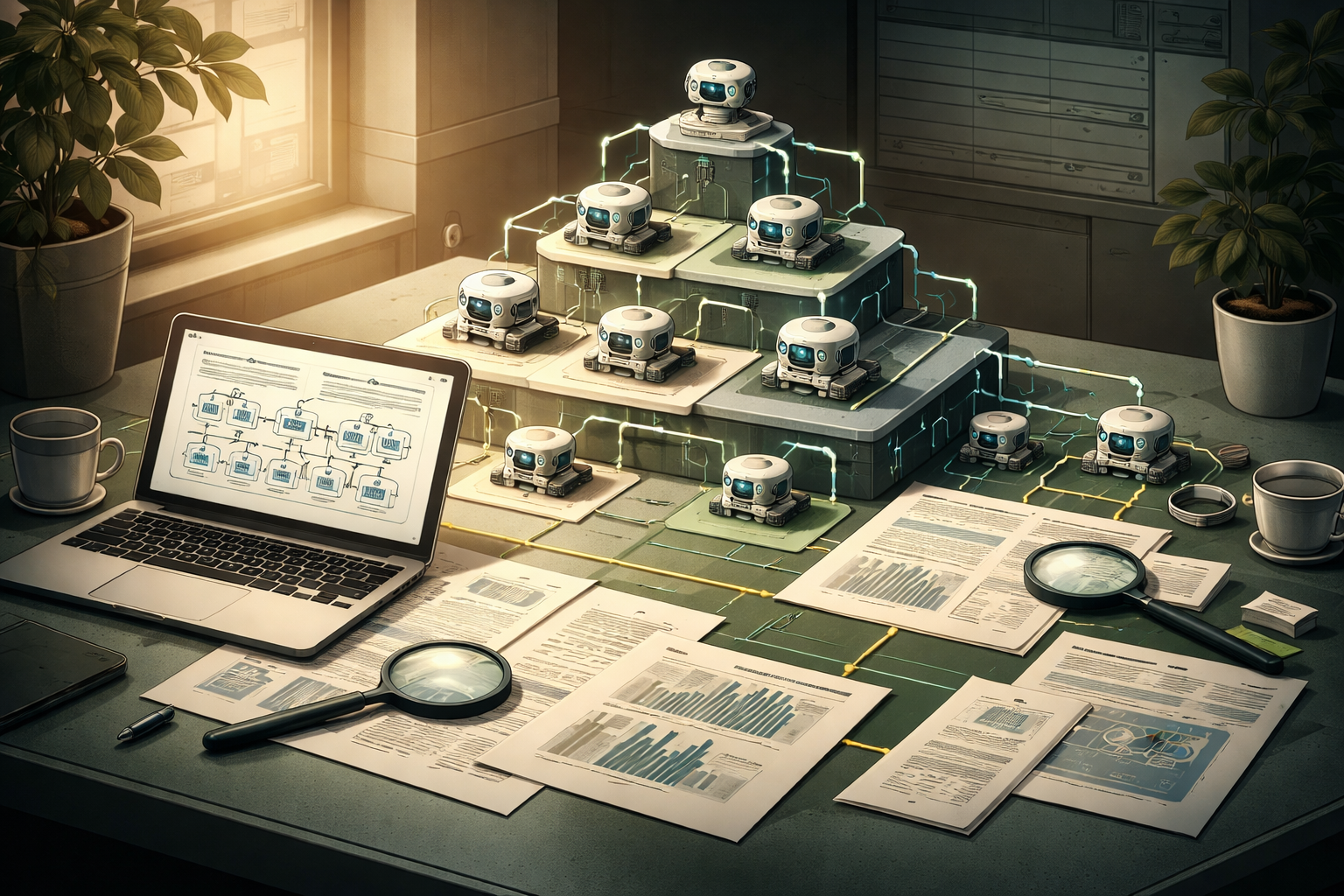
The system is built on a three-layer hierarchy:
| Layer | Role | Key Constraint |
|---|---|---|
| Host | Strategic planning | Sees only summaries |
| Managers | Task decomposition & validation | Operate within domains |
| Workers | Execute subtasks via tools | Fully parallel, isolated |
This is not just modularity. It is controlled ignorance.
The Host never sees raw data. Workers never see global context. Managers act as translators between the two.
Why? Because most failures come from too much shared context, not too little.
The Key Mechanism: Context Isolation
Instead of passing everything upward, InfoSeeker compresses results into step-level summaries before feeding them back into the system.
From the workflow diagram (page 3), we see a clear separation:
- Workers handle tool-level interactions
- Managers aggregate and verify
- Host plans based only on distilled outputs
This prevents context from exploding—a problem that single-agent systems cannot avoid.
Parallelism, But With Discipline
Parallelism is not new. What’s new is where it happens.
Most systems parallelize reasoning branches. InfoSeeker parallelizes execution.
The difference is subtle—and economically significant.
The paper formalizes this with a simple contrast:
- Sequential execution time: sum of all subtasks
- Parallel execution time: max of subtask durations
In other words:
| Mode | Time Complexity (Intuition) |
|---|---|
| Sequential | Add everything |
| Parallel | Wait for the slowest |
That shift alone produces 3–5× speed improvements.
Not by making models smarter.
By making them less entangled.
Findings — Performance That Actually Moves the Needle
The results are unusually concrete.
Benchmark Performance
| Benchmark | Metric | Baseline Best | InfoSeeker |
|---|---|---|---|
| WideSearch | Success Rate | ~5.1% | 8.38% |
| WideSearch | Item F1 | ~62% | 70.27% |
| BrowseComp-zh | Accuracy | 42.9% | 52.9% |
On WideSearch—a benchmark designed to stress information breadth—the improvement is not incremental. It is structural.
The paper explicitly notes a 66.7% improvement in task success. fileciteturn0file0
Latency Comparison
| System | Relative Time Cost |
|---|---|
| InfoSeeker | 1.0× |
| OpenAI Deep Research | 3.3× – 3.9× |
| Gemini Deep Research | 2.6× – 4.6× |
The chart on page 8 shows a consistent pattern: parallel execution collapses runtime dramatically.
Scaling Behavior (The Quiet Killer Feature)
Increasing worker count reduces latency from:
- 911 seconds → 162 seconds (≈5.7× speed-up)
This is not just optimization. It is linear scalability emerging from architecture.
Implications — The Real Shift: From Intelligence to Orchestration
The most important insight is almost uncomfortable:
The limiting factor in AI systems is no longer model intelligence. It is system design.
1. The End of Monolithic Agents
Single-agent systems—even powerful ones—are structurally disadvantaged.
The paper shows that even with identical models and tools, a hierarchical system dramatically outperforms a single-agent setup.
This suggests a future where:
- “One model does everything” becomes obsolete
- Multi-agent orchestration becomes the default
2. Context Is a Liability, Not an Asset
For years, the industry treated larger context windows as progress.
InfoSeeker treats context as something to contain, compress, and isolate.
This is a philosophical shift:
- Old paradigm: more context = more intelligence
- New paradigm: less shared context = more reliability
3. Compute Strategy Becomes Architecture Strategy
Instead of scaling model size, InfoSeeker scales:
- Number of workers
- Degree of parallelism
- Quality of aggregation
This aligns AI more closely with distributed systems like MapReduce.
Which, ironically, the paper explicitly references.
4. Cost Efficiency Becomes Predictable
The system achieves:
- ~$2 per task (WideSearch)
- ~$1 per task (BrowseComp-zh)
By pushing heavy computation into cheaper worker models.
In other words: architectural arbitrage.
Conclusion — Smarter Systems, Not Just Smarter Models
InfoSeeker doesn’t try to make AI think harder.
It makes AI think less, but organize better.
And that distinction matters.
Because as AI moves from answering questions to executing workflows, the challenge is no longer reasoning—it is coordination under constraint.
The systems that win will not be those with the biggest models.
They will be the ones that know how to distribute attention, isolate complexity, and recombine results without collapsing under their own weight.
Quietly, this paper suggests that the future of AI is not a single mind.
It is a well-managed organization.
Cognaptus: Automate the Present, Incubate the Future.