Opening — Why this matters now
The next generation of AI will not live in the cloud alone. It will live everywhere.
Autonomous cars negotiating intersections. Drones sharing relay bandwidth. Medical devices competing for wireless channels in hospital wards. Electric vehicles choosing whether to queue for a charging slot.
In these environments, AI systems are not solving isolated problems — they are competing for finite shared resources.
A recent study asks a deceptively simple question: What happens when many autonomous AI agents compete for limited capacity?
The answer is not comforting.
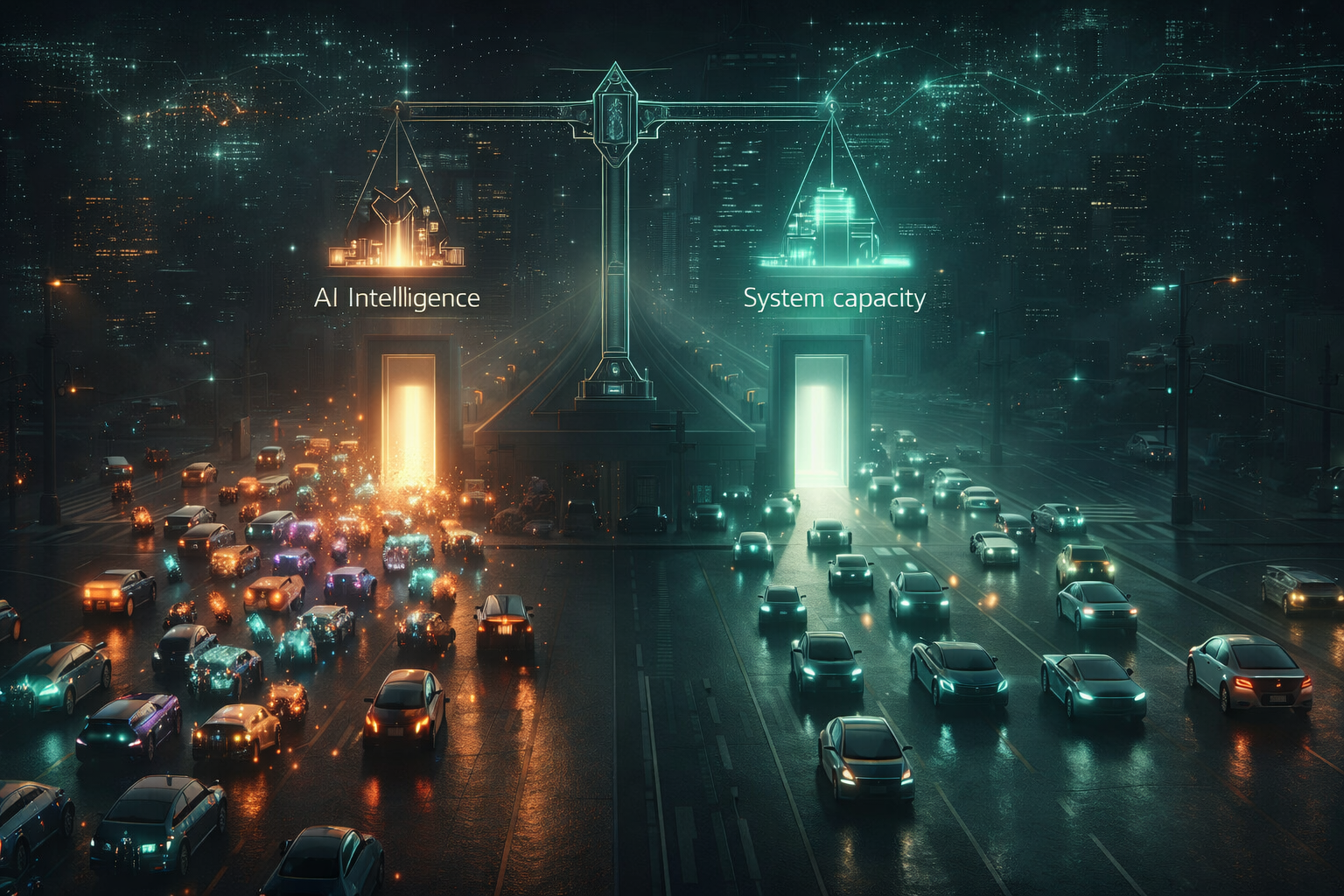
Counter‑intuitively, more intelligent and adaptive AI agents can produce worse collective outcomes. In some cases, the smartest population causes the system to fail most often.
The key determinant is not intelligence. It is arithmetic.
Specifically: the ratio between system capacity and the number of agents.
Background — AI agents entering the physical world
Most discussions of multi‑agent AI assume cooperation or coordination through centralized systems. Reality will often look different.
Edge devices — vehicles, drones, robots, industrial machines — will frequently operate with limited connectivity and must make decisions locally.
This creates a classic coordination problem:
| Concept | Meaning in the study |
|---|---|
| Population size (N) | Number of AI agents competing for a resource |
| Capacity (C) | Maximum agents that can access the resource at once |
| Overload | When demand exceeds capacity |
Examples include:
- autonomous vehicles entering intersections
- EVs competing for charging stations
- medical devices sharing wireless bandwidth
- battlefield drones sharing communication relays
Each agent must decide whether to attempt access or wait — without knowing how many other agents will act simultaneously.
The study explores how four variables shape collective behavior:
| Variable | Interpretation |
|---|---|
| Nature | Diversity of AI models |
| Nurture | Reinforcement learning adaptation |
| Culture | Social grouping or “tribes” among agents |
| Resources | Scarcity or abundance of system capacity |
Unlike biological or human systems, AI populations allow these variables to be toggled independently.
That makes them ideal for studying collective dynamics.
Analysis — The technology ladder of AI sophistication
The experiment evaluates five levels of AI population sophistication.
| Level | Features | Interpretation |
|---|---|---|
| L1 | Identical agents, no learning | Simple independent behavior |
| L2 | Identical agents + reinforcement learning | Herd behavior possible |
| L3 | Diverse models, no learning | Diversity without adaptation |
| L4 | Diverse models + learning | Adaptive but independent |
| L5 | Diverse models + learning + social sensing | Tribal dynamics |
The agents use small language models (GPT‑2, OPT, Pythia) as local decision engines. Each agent predicts whether system demand will exceed capacity and decides probabilistically whether to attempt access.
Agents receive feedback from outcomes and adjust their behavior via reinforcement learning.
At the highest level (L5), agents also detect and align with others who behave similarly, forming tribes — loosely coordinated blocs of agents with shared strategies.
This seemingly more advanced ecosystem produces an unexpected result.
Findings — When smarter systems fail
The core metric of the experiment is system overload: the percentage of time the system receives more requests than it can handle.
Collective outcomes
| Regime | Best-performing population |
|---|---|
| Scarce resources (C/N < ~0.5) | Simplest agents (L1) |
| Abundant resources (C/N > ~0.6) | Sophisticated agents (L4/L5) |
All system configurations converge around a critical threshold:
C/N ≈ 0.5
Below this level, increasing sophistication worsens coordination.
Above it, sophistication begins to help.
The mechanism is variance.
When resources are scarce, reinforcement learning and agent diversity encourage herding behavior. Large groups of agents act simultaneously, creating demand spikes that exceed system capacity.
In the most advanced configuration, agents form tribes that partially cap this variance by splitting the population into factions.
However, this same tribal structure becomes inefficient when resources are plentiful — because groups remain too small to fully utilize available capacity.
The result is a sharp performance crossover depending solely on the capacity‑to‑population ratio.
Individual success vs system failure
The most striking result appears at the individual level.
Even when the system fails collectively, some agents thrive.
Followers inside successful tribes can achieve extremely high win rates while the overall system collapses.
| Scenario | System overload | Tribal follower success |
|---|---|---|
| Extreme scarcity | ~90% overload | ~84% win rate |
In other words:
Collective failure can coexist with individual success.
This mirrors patterns observed in human systems such as financial markets, political polarization, and social media dynamics.
Implications — The arithmetic of AI coordination
The most actionable result of the study is surprisingly simple.
Before deploying autonomous AI agents, system designers should compute a single number:
Capacity-to-population ratio (C/N).
This ratio determines whether adding sophistication will help or harm coordination.
| Example deployment | C/N | Recommended architecture |
|---|---|---|
| 7 EVs sharing 2 chargers | 0.29 | Simple identical firmware |
| 7 EVs sharing 5 chargers | 0.71 | Diverse adaptive agents |
The implication is subtle but profound.
AI coordination problems are not solved purely by improving intelligence.
They are governed by collective dynamics.
More intelligence introduces stronger correlations between agents — and correlated behavior can destabilize systems under scarcity.
Conclusion — Smarter AI, simpler math
The instinct in technology development is to assume that greater sophistication produces better outcomes.
In distributed AI systems, that assumption fails.
More adaptive agents can create stronger feedback loops, synchronized behavior, and tribal fragmentation — all of which amplify coordination failures when resources are limited.
The most important variable is not model capability.
It is the simplest one:
How many agents exist relative to the capacity of the system they share.
The lesson is almost philosophical.
Before building smarter AI agents, we may need to design smarter systems.
And sometimes that begins with nothing more advanced than a ratio.
Cognaptus: Automate the Present, Incubate the Future.