Opening — Why This Matters Now
Healthcare AI is obsessed with classification. Seizure or not. Normal or abnormal. Risk or safe.
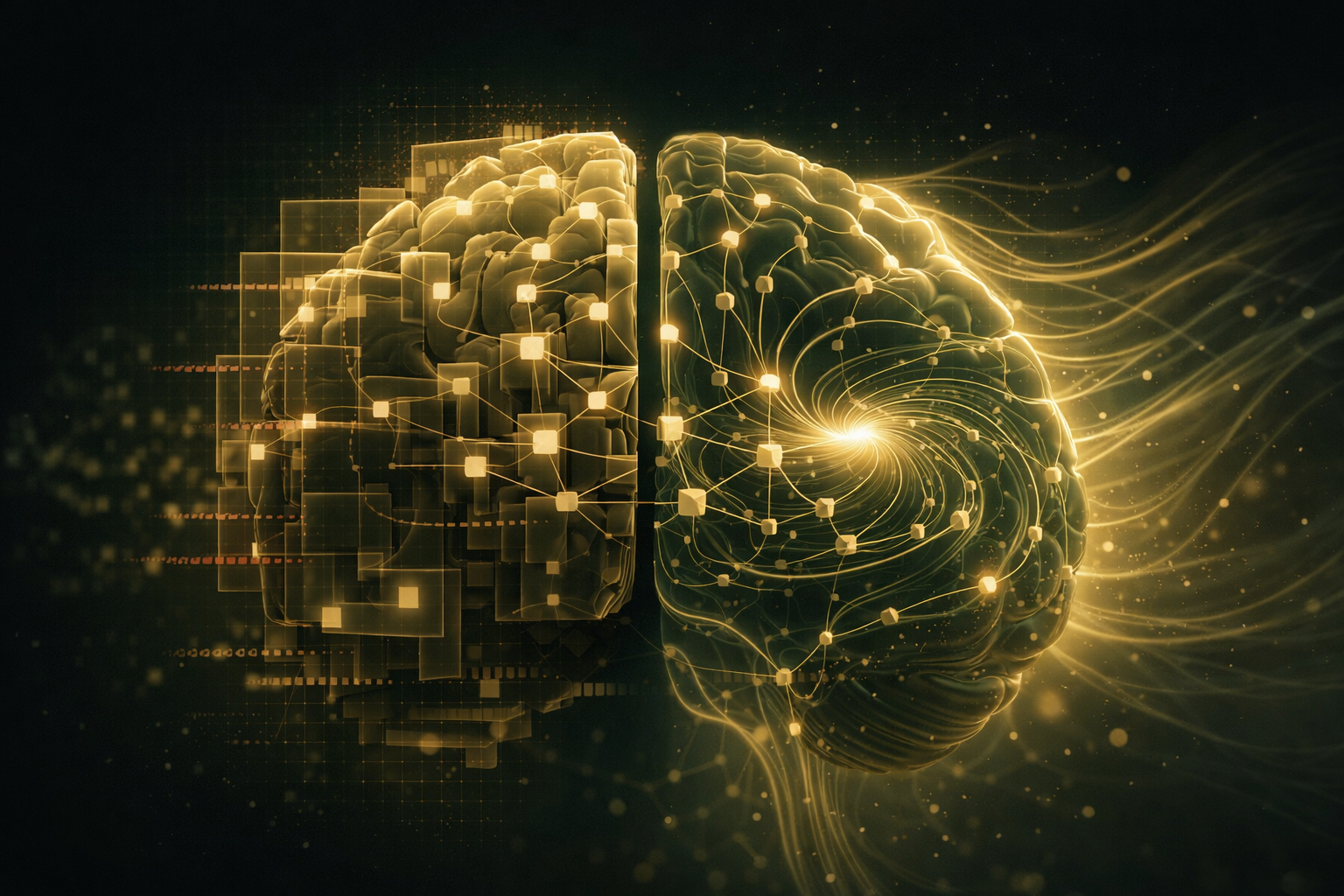
But the brain does not operate in labeled intervals. It does not “tick.” It flows.
Electroencephalography (EEG) captures this flow as continuous electrical activity across channels. Yet most machine learning systems discretize time into rigid windows, stack recurrent layers, and hope that what happens between steps is either negligible or statistically cooperative.
It rarely is.
The ICLR 2026 paper ODEBRAIN reframes EEG modeling as what it truly is: a continuous-time dynamical system evolving over a graph. Instead of predicting the next discrete snapshot, it learns the field governing how brain states evolve.
For clinical AI, this is more than elegance. It is about robustness, interpretability, and early detection under uncertainty.
Background — From Discrete Graphs to Continuous Fields
The Traditional Stack
EEG modeling has evolved through three main paradigms:
| Paradigm | Core Idea | Limitation |
|---|---|---|
| CNN / LSTM | Extract local temporal features, model sequence with recurrence | Fixed time steps, compounding errors |
| Temporal GNN (e.g., DCRNN) | Treat EEG channels as graph nodes, model spatial-temporal evolution | Still discrete, window-based |
| Latent ODE | Model hidden state evolution continuously | Often weak initialization and unstable trajectories |
Temporal Graph Networks (TGNs) improved spatial reasoning by modeling inter-channel dependencies. But they discretize time into epochs (e.g., 1s or 12s windows). This imposes two structural mismatches:
- Brain transitions (e.g., seizure onset) do not respect window boundaries.
- Recurrent accumulation amplifies noise and drift over long horizons.
Neural Ordinary Differential Equations (NODEs) instead define:
$$ \frac{dz(t)}{dt} = f_\theta(z(t), t) $$
and recover trajectories via integration:
$$ z(t + K) = z_0 + \int_{t}^{t+K} f_\theta(z(t), t) dt $$
The promise is clear: arbitrary temporal resolution and smooth latent evolution.
The problem? EEG is noisy, stochastic, and partially chaotic. A bad initial state destabilizes everything.
ODEBRAIN addresses precisely that.
Analysis — What ODEBRAIN Actually Does
ODEBRAIN introduces a two-stage architecture:
Stage 1 — Reverse Initial State Encoding
The model constructs a robust initial condition $z_0$ by fusing:
-
Deterministic spectral graph features
- STFT decomposition of EEG into frequency bands
- Top-τ sparse correlation graphs
- GRU-based node/edge encoders
- GNN aggregation
-
Stochastic temporal embeddings
- Raw EEG segments
- CNN encoder
- Controlled stochastic regularization
This produces:
$$ z_0 = [z_s, z_g] $$
Where:
- $z_g$: structured spectral connectivity
- $z_s$: stochastic temporal variability
This dual encoding acts as both signal extraction and implicit regularizer.
Stage 2 — Adaptive Temporal-Spatial Neural ODE
Instead of a vanilla ODE, ODEBRAIN defines:
$$ f_\theta(z_0) = (g(z_0) + 1) \odot h(z_0) - \lambda(z_s) z_0 $$
Three critical innovations:
| Component | Role | Business Translation |
|---|---|---|
| Gated vector field $g(z_0)$ | State-adaptive modulation | Dynamic sensitivity to high-risk transitions |
| Residual block $h(z_0)$ | Core nonlinear dynamics | Expressive modeling capacity |
| Stochastic decay $\lambda(z_s)$ | Stability regularization | Noise-robust forecasting |
This structure stabilizes integration and reduces solver drift.
Finally, a multi-step graph forecasting objective explicitly predicts future brain connectivity graphs—not just temporal signals.
That shift matters.
ODEBRAIN optimizes for structural consistency in evolving networks, not merely waveform reconstruction.
Findings — Performance and Structural Gains
Seizure Detection (TUSZ, 12s)
| Model | AUROC | F1 |
|---|---|---|
| DCRNN | 0.825 | 0.416 |
| Latent-ODE | 0.849 | 0.470 |
| Neural SDE | 0.851 | 0.467 |
| Graph ODE | 0.841 | 0.475 |
| ODEBRAIN (single-step) | 0.881 | 0.496 |
Improvement over latent-ODE:
- +3.2% AUROC
- +2.6% F1
On TUAB, gains are consistent.
Graph Structural Similarity
Using Global Jaccard Index (GJI):
| Method | Structural Similarity |
|---|---|
| Discrete Predictor | 0.53 |
| ODEBRAIN | 0.63 |
That 0.10 gain reflects better preservation of functional connectivity topology.
Robustness Under Missing Data (30% masked)
| Model | AUROC Drop |
|---|---|
| Latent-ODE | −0.070 |
| ODEBRAIN | −0.036 |
Adaptive gating and stochastic regularization reduce trajectory collapse.
Computational Cost
| Model | Params | Wall Time (s) | NFEs |
|---|---|---|---|
| Latent-ODE | 386K | 0.421 | 102 |
| ODE-RNN | 675K | 0.601 | 189 |
| ODEBRAIN | 459K | 0.516 | 164 |
ODEBRAIN stays within practical inference bounds while improving stability.
Implications — Why This Matters for Applied AI
1. Continuous Modeling Reduces Regulatory Risk
In clinical AI, false negatives during transitions are catastrophic. Continuous-time models better capture onset phases and leading indicators.
Discretization artifacts are not just modeling inefficiencies—they are clinical liability.
2. Latent Field Interpretability
ODEBRAIN visualizes the learned vector field $f_\theta$:
- Seizure states show converging gradient centers.
- Normal states exhibit low-frequency smooth flows.
This provides a dynamical signature beyond classification scores.
Interpretability here emerges from geometry, not attention weights.
3. Graph-Aware Objectives Improve Generalization
By forecasting evolving connectivity graphs rather than only time-series signals, ODEBRAIN aligns optimization with neurophysiological structure.
For enterprise AI teams, this illustrates a broader principle:
Optimize for structure, not just surface prediction.
4. Lessons for Agentic and Autonomous Systems
Continuous latent dynamics are not limited to EEG.
Any system where:
- State evolves nonlinearly
- Transitions are irregular
- Observations are noisy
…may benefit from Neural ODE-style modeling with adaptive gating and stochastic regularization.
Finance, robotics, infrastructure monitoring—none of them truly tick either.
Conclusion — Modeling the Flow, Not the Frames
ODEBRAIN’s contribution is conceptual as much as architectural:
It treats brain networks as continuous dynamical systems and enforces structural forecasting objectives that stabilize latent evolution.
The result:
- Better seizure detection
- Higher graph structural fidelity
- Improved robustness under missing data
- Competitive computational cost
Discrete models slice time. Continuous models respect it.
In high-stakes AI systems, that distinction is not philosophical. It is operational.
Cognaptus: Automate the Present, Incubate the Future.