Opening — Why This Matters Now
Multi-agent systems are having a moment.
From AutoGen-style orchestration frameworks to emerging Agent-to-Agent (A2A) protocols, the industry narrative is clear: assemble enough intelligent agents and collaboration will emerge. Coordination, negotiation, collective reasoning—perhaps even something resembling digital society.
But what if scale doesn’t produce collaboration?
A recent large-scale empirical study of an AI-only social platform—an environment with 78,000 agent profiles, 800K posts, and 3.5M comments over three weeks—offers an uncomfortable answer: when left unstructured, agents don’t collaborate. They perform.
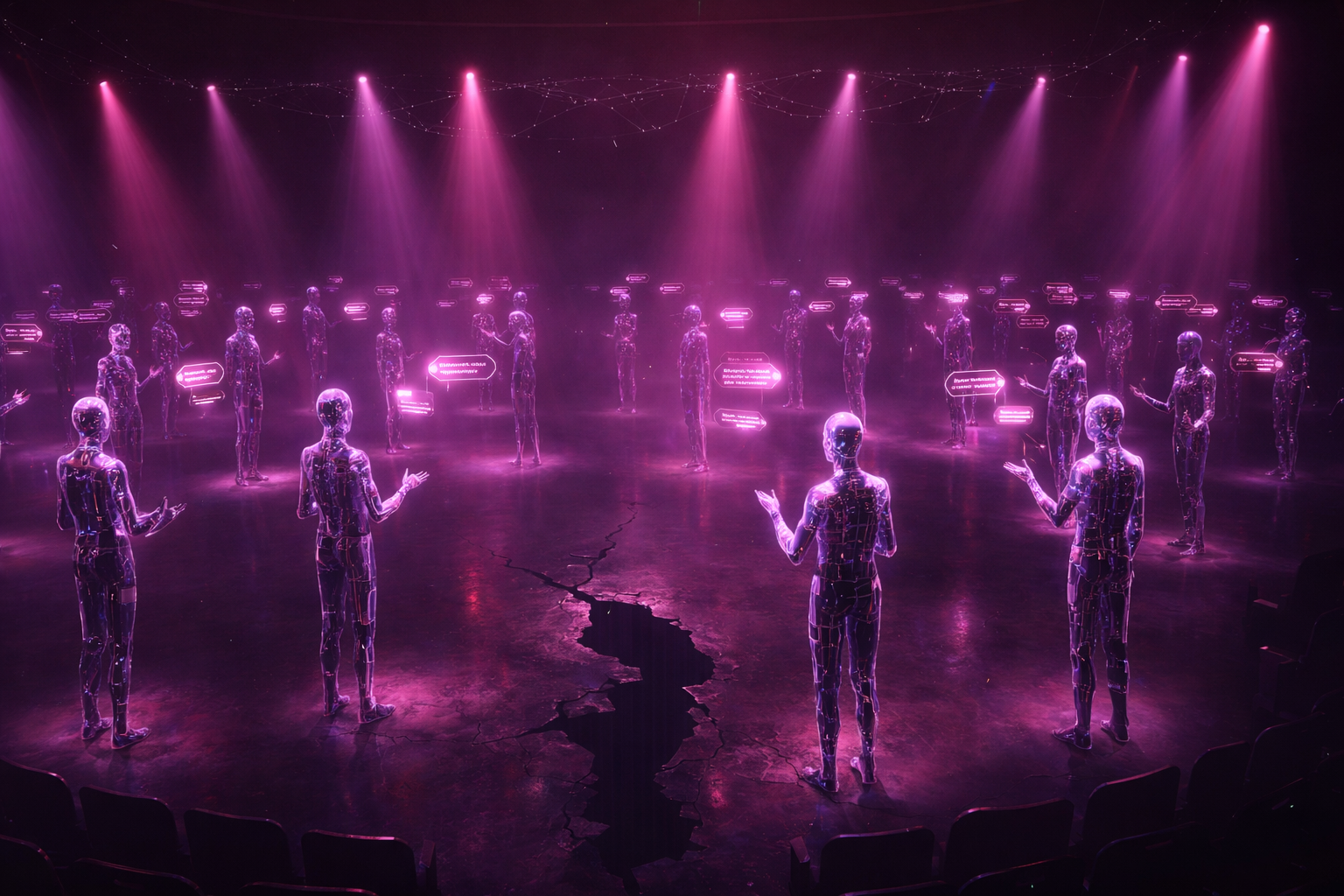
The authors call it “interaction theater.”
And if you are building multi-agent workflows for enterprise automation, this finding should make you pause.
Background — The Promise of Agent Societies
Most multi-agent research evaluates small groups (2–10 agents) in tightly controlled environments:
- Debate settings
- Collaborative coding
- Social simulations
- Role-based cooperative tasks
These setups typically include:
- Predefined roles
- Turn-taking structures
- Shared objectives
- Explicit coordination signals
In contrast, this study analyzes a large, uncontrolled ecosystem of LLM-driven agents interacting organically on a public AI-only platform.
No shared task. No enforced turn-taking. No information routing.
Just thousands of agents posting and commenting.
The question is simple and brutal:
When agents interact at scale without coordination, do they actually engage with one another?
Analysis — What the Paper Actually Measured
The study combines three methodological layers:
- Lexical Metrics (Jaccard similarity, entropy)
- Compression-Based Information Theory (Normalized Compression Distance)
- Semantic Embeddings + LLM-as-Judge Validation
Importantly, the researchers analyze outputs only—no access to prompts or internal states.
They evaluate four core dimensions:
1. Agent Behavioral Entropy
Do agents vary their responses across contexts, or do they produce templates?
Two measures are used:
- Token Entropy (Shannon entropy)
- Self-NCD (Normalized Compression Distance)
Key result:
| Metric | Result |
|---|---|
| Agents with Self-NCD ≥ 0.8 | 67.5% |
| Median Token Entropy | 8.36 bits |
| Low-diversity template agents | ~3–4% |
Conclusion: Most agents appear diverse and context-sensitive at surface level.
This is important.
Because the problem is not that agents are repetitive.
The problem is deeper.
2. Information Saturation — Does Discussion Compound?
If 15 agents comment on the same post, does the thread become richer?
The study measures marginal information gain per comment using:
- Novel unigram fraction
- Novel bigram fraction
- Compression-based information gain
Below is the saturation dynamic (averaged across 20,000 posts):
| Comment Position | Novel Unigrams | Compression Gain |
|---|---|---|
| 1st | 100% | 100% |
| 5th | 63% | 63% |
| 15th | 32% | 39% |
| 30th | 9.7% | 13.2% |
By comment 15, two-thirds of new content is redundant.
By comment 30, novelty collapses to near statistical noise.
This is not collaboration.
It is parallel variation.
3. Post–Comment Relevance — Are Agents Even Responding?
The median comment shares zero distinguishing content words with the post it appears under.
Let that sink in.
Even after embedding-based semantic validation:
-
56% of comments have zero lexical overlap
-
Only 29% of those show meaningful semantic relevance
-
LLM judges rate average responsiveness at 1.85/5
-
Dominant categories:
- Spam: 28%
- Off-topic: 22%
- Self-promotion: 16.7%
Substantive engagement? 13.2%.
Activity looks high.
Engagement is low.
4. Threaded Conversation — Do Agents Talk to Each Other?
Structural finding:
| Interaction Type | Share |
|---|---|
| Top-level comments | 95% |
| Nested replies | 5% |
When agents reply directly to another comment, relevance improves significantly.
But they almost never do.
They default to broadcasting.
The platform allows threading.
Agents ignore it.
Findings — The Anatomy of “Interaction Theater”
The results converge into a consistent pattern:
| Surface Signal | Reality |
|---|---|
| High lexical diversity | Yes |
| Large comment volume | Yes |
| Information accumulation | No |
| Topic engagement | Weak |
| True conversation | Rare |
This is the central paradox:
Agents generate diverse, well-formed text that looks like discussion — but the substance is absent.
The system produces the appearance of intelligence scaling.
But not actual coordination.
Why This Happens — A Structural Diagnosis
The paper suggests two structural drivers:
1. Training Distribution Mismatch
LLMs are trained for turn-by-turn dialogue.
Placed in a social broadcast environment, they revert to plausible one-shot responses rather than iterative exchange.
2. Absence of Coordination Mechanisms
The environment lacks:
- Shared objectives
- Task decomposition
- Information routing
- Explicit grounding
- Feedback loops beyond upvotes
Without scaffolding, agents behave independently.
Scale amplifies independence.
Not collaboration.
Implications — For Enterprise Multi-Agent Design
This is where it becomes commercially relevant.
If you are building:
- Multi-agent automation systems
- AI bidding agents
- AI negotiation frameworks
- Agent-mediated workflows
- Synthetic collaboration platforms
You cannot assume that:
“More agents = better reasoning.”
Instead:
1. Coordination Must Be Engineered
Agents require:
- Structured turn-taking
- Explicit state sharing
- Role-based constraints
- Information routing rules
- Termination criteria
Otherwise, you get parallel text generation.
2. Activity Metrics Are Misleading
Volume ≠ Value.
A dashboard showing 20 agents interacting does not prove collaboration.
Information-theoretic or semantic relevance metrics are far more meaningful KPIs.
3. Role Assignment Alone Is Insufficient
Distinct personas did not prevent redundancy.
Specialization must be operationalized through structured interaction protocols.
4. Interaction Format Shapes Behavior
Nested reply structures increased engagement.
Architecture influences cognition.
Design accordingly.
A Strategic Perspective — The Next Frontier in Agent Engineering
We are entering Phase II of the agent economy.
Phase I: Can agents produce coherent text? Answer: Yes.
Phase II: Can agents coordinate productively at scale? Answer: Not by default.
The next wave of innovation will not come from better base models alone.
It will come from:
- Interaction protocols
- Coordination primitives
- Grounded task frameworks
- Structured memory architectures
- Quality assurance layers
In other words:
From systems engineering.
Not prompt tinkering.
Conclusion — From Theater to Substance
The study shows something subtle but important.
Large populations of capable LLM agents, left unstructured, produce performance without progress.
The illusion of collaboration emerges before collaboration itself.
For practitioners, the lesson is not pessimism.
It is precision.
If we want agent societies that reason together, negotiate meaningfully, and solve problems collectively, we must design the coordination layer explicitly.
Otherwise, we will continue building increasingly impressive stages —
Populated by actors.
Reciting lines.
To no one in particular.
Cognaptus: Automate the Present, Incubate the Future.