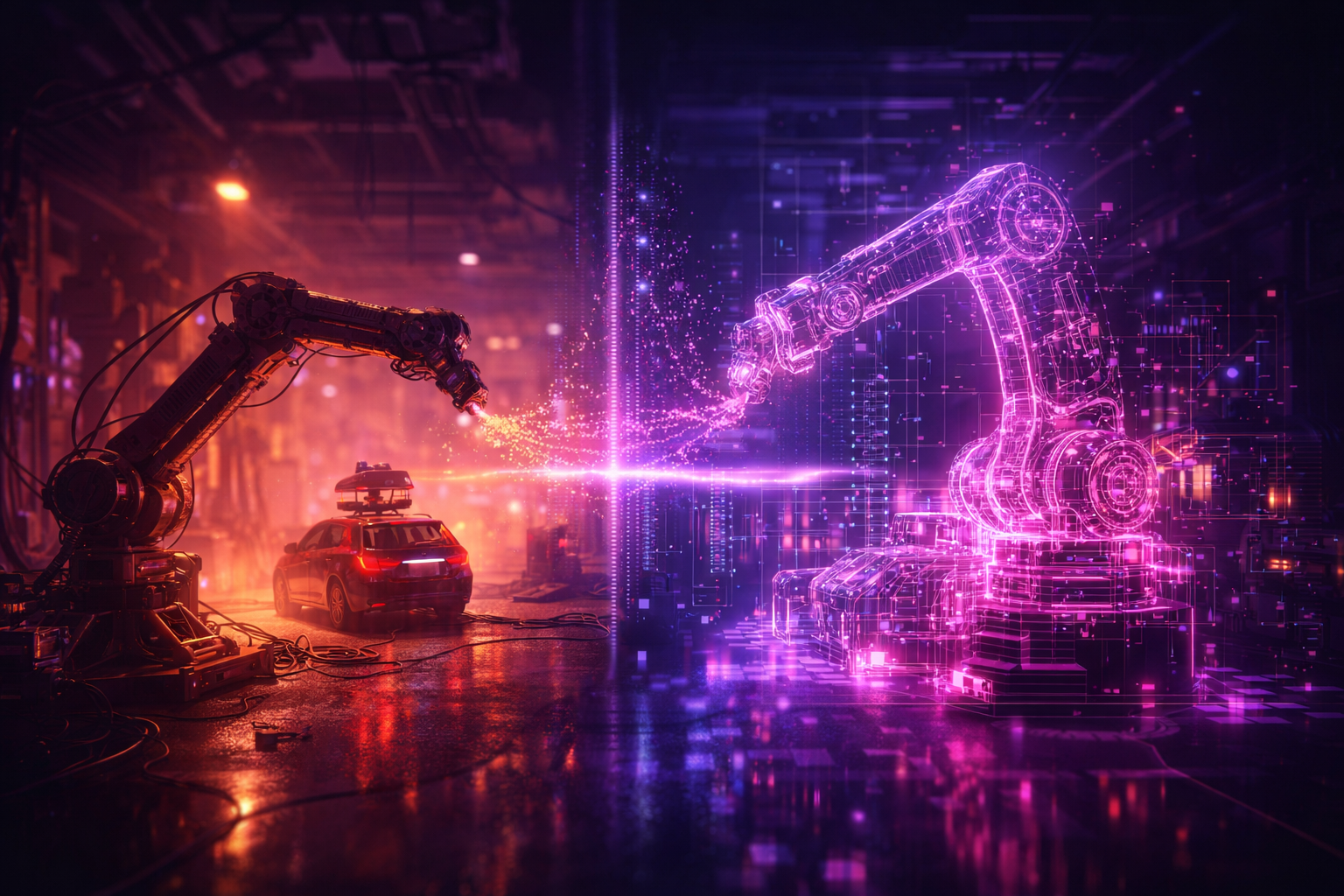
Opening — Why This Matters Now
AI models are no longer starving for algorithms. They are starving for reliable, scalable, and legally usable data.
Across robotics, transportation, manufacturing, healthcare, and energy systems, real-world data is expensive, sensitive, dangerous, or simply unavailable at the scale modern AI demands. Privacy laws tighten. Data silos persist. Edge cases remain rare—until they are catastrophically common.
The result? Organizations are forced to answer an uncomfortable question:
If reality is too risky or too expensive to learn from, where should AI learn instead?
The emerging answer is simulation—specifically, simulation backed by high-fidelity digital twins.
What looks like a technical workaround is, in fact, a structural shift in how intelligent systems are developed.
Background — From Synthetic Data to Systematic Simulation
Synthetic data is not new. But not all synthetic data is equal.
The landscape can be framed along two dimensions: systematic rigor and data diversity.
| Method | Systematic? | Diverse? | Scalable? | Typical Use Case |
|---|---|---|---|---|
| Manual ad-hoc data creation | ❌ | ❌ | ❌ | Small patching tasks |
| Equation-based generation | ✅ | ❌ | ⚠️ | Deterministic modeling |
| Statistical in-distribution gen | ✅ | ⚠️ | ✅ | Tabular augmentation |
| Simulation-based generation | ✅ | ✅ | ✅ | AI agent training |
Simulation stands out because it is both structured and diverse.
A simulator encodes the probabilistic mechanisms of a system and produces simulation traces—structured behavioral data across time. These traces become training data.
Unlike static statistical replication, simulation generates behavioral variation under controlled conditions.
That matters when training reinforcement learning agents, autonomous vehicles, or adaptive cyber-physical systems.
Analysis — The Machinery Behind AI Simulation
Simulation-based AI training draws from multiple paradigms:
1. Discrete Simulation
- Discrete-event simulation (DES) for manufacturing, logistics, healthcare.
- Agent-based simulation (ABS) for social dynamics and organizational behavior.
Best for event-driven systems and structured workflows.
Limitation: struggles with long-horizon strategic dynamics and continuous feedback systems.
2. Continuous Simulation
- System dynamics for policy and macro-level modeling.
- Computational fluid dynamics (CFD) for physics-heavy domains.
Best for nonlinear systems with feedback loops.
Limitation: high abstraction or computational cost.
3. Monte Carlo Simulation
Ideal for uncertainty-heavy domains—medical imaging, pricing systems, supply chain planning.
Strength: probabilistic realism. Weakness: dependent on assumed distributions.
4. Computer Graphics–Based Simulation
Game-engine pipelines (e.g., Unreal, Unity) now power autonomous driving, robotics perception, and pose estimation training.
Strength: photorealistic diversity. Weakness: realism ≠ reality.
Which leads to the central challenge.
The Sim-to-Real Gap — Where Beautiful Simulations Fail
Training in simulation introduces a structural risk: the sim-to-real gap.
The simulator inevitably simplifies reality:
- Friction approximations
- Lighting assumptions
- Noise modeling shortcuts
- Sensor latency omissions
The AI learns the simulator’s world—not the real one.
When deployed, performance degrades.
This gap manifests differently across domains:
| Domain | Primary Risk of Gap | Unique Challenge |
|---|---|---|
| Robotics | Physics mismatch | Precision & safety |
| Transportation | Multi-agent chaos | Real-time uncertainty |
| Healthcare | Statistical drift | Ethical & regulatory constraints |
Mitigation strategies include:
- Domain randomization (expose models to variability)
- Domain adaptation (align feature spaces)
- Meta-learning (learn to adapt quickly)
- Robust RL (optimize under worst-case disturbances)
- Imitation learning (anchor to expert behavior)
Yet these are tactical solutions.
The strategic solution is structural: build better simulators.
Which brings us to digital twins.
Digital Twins — From Model to Mirror
A digital twin is not merely a simulation model.
It is a bi-directionally coupled, high-fidelity virtual replica of a physical system.
Unlike standalone simulators, digital twins:
- Continuously ingest real-world sensor data.
- Update internal models.
- Can control or influence the physical system.
This closed feedback loop fundamentally changes AI training.
Instead of static simulation environments, AI can train inside a continuously updated replica of reality.
The DT4AI Framework — Institutionalizing AI Simulation
The DT4AI framework formalizes this architecture into three components:
- AI agent
- Digital Twin
- Physical Twin
And seven interactions (Query, Simulated Data, Observe, Real Data, Update, Control, Access).
This transforms AI training into a layered system:
Reinforcement Learning Pattern
- Live, small-batch simulation traces
- Continuous interaction
- Frequent model updates
Deep Learning Pattern
- Batch-mode, large synthetic datasets
- Offline training
Transfer Learning Pattern
- Simulation pretraining
- Controlled deployment
- Adaptation via physical feedback
This is not merely architectural elegance.
It operationalizes:
- Safety constraints
- Reliability controls
- Update synchronicity
- Access governance
AI training becomes a managed workflow, not an experimental gamble.
Validation, Privacy, and Governance — The Hidden Risks
Simulation does not eliminate risk; it reshapes it.
Validation Problem
There is no universal benchmark proving synthetic data is “good enough.”
Summary statistics may align while underlying distributions diverge.
An AI model can appear accurate while being fundamentally miscalibrated.
Privacy Trade-Off
Synthetic data may still leak statistical signals about real individuals.
Stronger privacy guarantees often degrade correlation structure and fidelity.
The tension is mathematical:
If fidelity ≈ reality, then privacy ≈ leakage risk.
Balancing these remains an open design problem.
Implications — Why This Is a Strategic Infrastructure Shift
Digital twin–enabled AI simulation represents more than a modeling convenience.
It creates an AI training infrastructure layer.
Consider the business implications:
| Traditional AI Pipeline | Digital Twin–Enabled Pipeline |
|---|---|
| Data collection first | Simulation-first training |
| Reactive model updates | Continuous twin updates |
| Deployment risk testing | Pre-deployment validation in twin |
| Limited experimentation | Safe exploratory experimentation |
For enterprises operating in regulated or high-risk domains—energy, manufacturing, healthcare, transportation—this shift reduces deployment friction and accelerates iteration cycles.
Consulting firms are beginning to label this convergence as “AI simulation.”
More accurately, it is the industrialization of AI training.
Future Directions — Where This Converges
Three developments will likely define the next phase:
-
Foundation Models + Simulation Generative AI can enhance diversity inside simulation environments.
-
Standardized Architectures (e.g., ISO-based DT frameworks) Moving from conceptual frameworks to enforceable engineering standards.
-
Interdisciplinary Governance Simulation fidelity, privacy guarantees, and safety constraints will require legal and regulatory integration.
Simulation-based AI development is not just technically elegant.
It is becoming operationally necessary.
Conclusion — The Twin Before the Test
If AI is to operate safely in the real world, it must first survive a structured rehearsal.
Simulation provides the rehearsal stage. Digital twins provide the lighting, the sensors, the orchestra, and the emergency exits.
The future of trustworthy AI will not be built on raw data alone. It will be built on systematic, adaptive, high-fidelity simulation ecosystems.
Reality is expensive. A good twin is cheaper.
Cognaptus: Automate the Present, Incubate the Future.