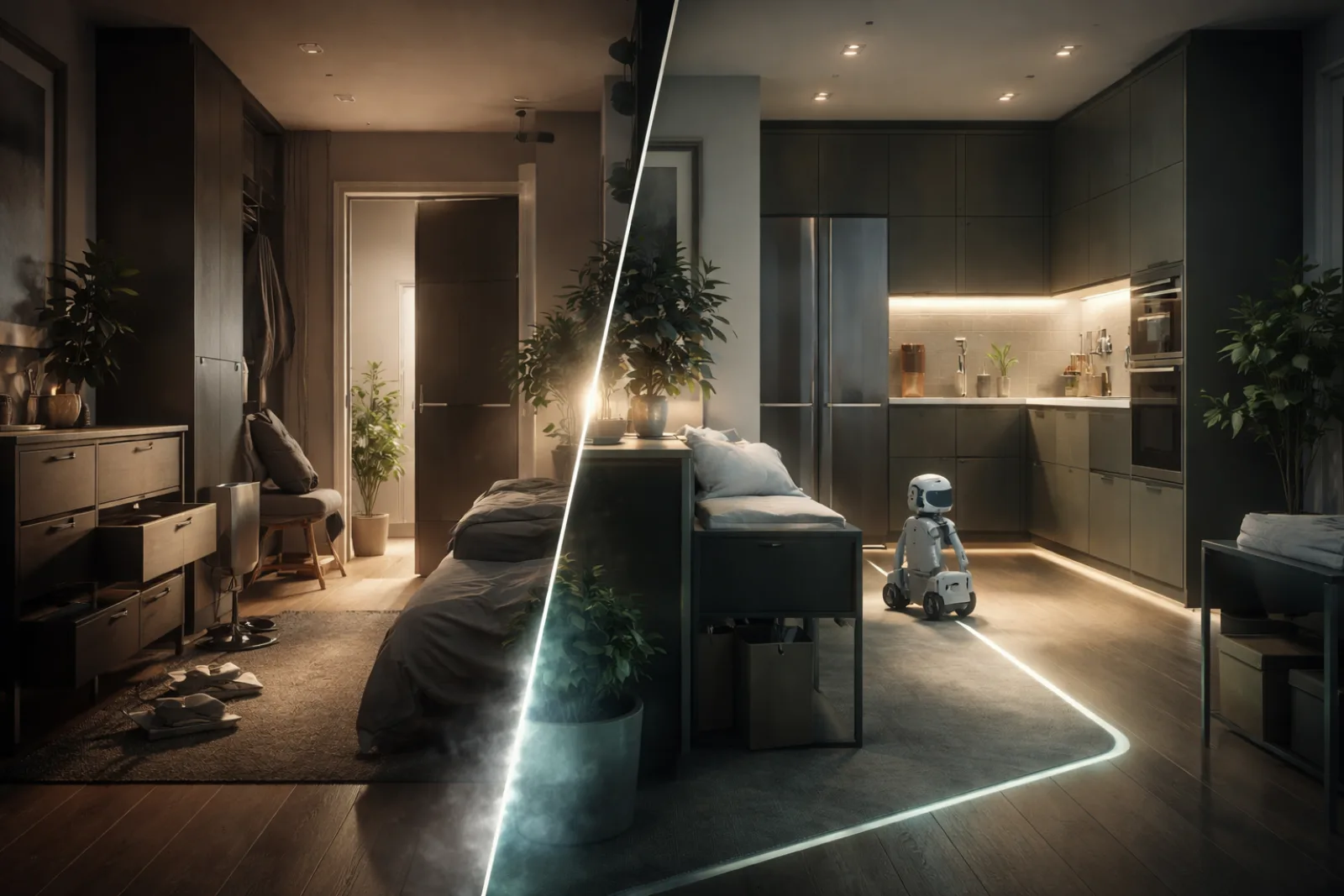
A drawer is a small test of whether a generated world is lying.
A rendered apartment can look plausible from the camera angle. The sofa is against a wall, the table is centered, the cabinet has a tasteful texture, and the lighting politely pretends that nothing is wrong. Then a robot tries to open a drawer and discovers that the drawer path intersects the bed. Or a chair is placed so close to a cabinet that neither object can actually be used. The scene was visually acceptable. It was operationally useless.
That is the gap SceneFoundry tries to close. The paper introduces a language-guided diffusion framework for generating apartment-scale 3D indoor environments with controllable layouts, articulated furniture, object-count constraints, and walkable-space control.1 The important point is not that an LLM can “generate a 3D apartment.” That would be the easy headline, and therefore the slightly misleading one. The LLM does not carry the system on its back like some overworked intern with a GPU budget. It translates user intent into parameters. The heavy work is done by floor-plan generation, diffusion posterior sampling, asset retrieval, and constraint-driven repair.
The distinction matters. For robotics, embodied AI, VR training, and digital-twin prototyping, a synthetic environment is valuable only if agents can use it. A pretty room is not enough. The door must open. The chair must move. The robot must have space to pass. SceneFoundry’s contribution is therefore less “text-to-3D” than “intent-to-usable-simulation.”
SceneFoundry is a pipeline, not a magic prompt
The first useful correction is architectural. SceneFoundry is not a single end-to-end model that reads “make me a two-bedroom apartment” and emits a finished interactive world. It is a staged system.
The paper’s pipeline has three major layers:
- LLM-guided floor-plan parameter generation: natural-language prompts are mapped into low-level parameters for a procedural floor-plan generator.
- Diffusion-based furniture population: a diffusion model places objects into the generated floor plan, using a scene representation that includes object location, size, orientation, semantics, and latent shape features.
- Functional control and repair: object quantity, articulated-object clearance, and walkable area are enforced through guidance functions or post-processing.
This is a sensible division of labor. Language models are useful for interpreting intent: “open-plan loft,” “family home,” “two bedrooms,” “work-from-home layout,” “balcony apartment.” They are less naturally suited to calculating whether an open drawer collides with the edge of a bed. Diffusion models are useful for sampling plausible object configurations. They are less naturally suited to understanding whether a user requested exactly 11 objects. Post-processing is useful when a constraint is too expensive or unstable to impose inside every denoising step.
SceneFoundry uses these components together rather than pretending one model can do everything. That restraint is the interesting part. In a field that often markets integration as intelligence, the paper is quietly arguing for decomposition.
The LLM translates intent into layout parameters
The first mechanism is the least glamorous and probably the most commercially important. SceneFoundry uses an LLM to convert high-level natural-language prompts into controllable parameters for floor-plan generation. The paper builds on Infinigen-style procedural layout generation, where floor plans are governed by reward functions and simulated annealing. That parameter space is powerful, but not friendly. A human user should not need to know which numerical penalty controls room squareness or how adjacency constraints are encoded.
So the LLM acts as a semantic interface. It maps user instructions into the lower-level knobs that control the procedural generator. The result is still stochastic. The system can generate diverse layouts, but the diversity is bounded by prompt-derived constraints.
That is a good pattern for business systems. Most users do not want “AI creativity” in the abstract. They want a system that understands a business-relevant request and converts it into operational constraints. In this paper, the request is spatial: room types, adjacencies, areas, and layout logic. In enterprise workflows, the same pattern appears as policy-to-rules, query-to-data-pipeline, and instruction-to-automation. The model is not valuable because it daydreams. It is valuable because it compiles vague intent into executable structure.
The evidence for this layer comes from the paper’s LLM controllability tests. The authors evaluate generated floor plans using graph-based metrics for room presence, adjacency, and constraints. In the main experiment, SceneFoundry reports scores of 0.989 for node similarity, 0.923 for constraint satisfaction, and 0.954 for edge similarity. In the appendix, a 20-prompt benchmark reports an average score of 96.5%, with room presence at 98.9%, adjacency at 92.3%, and constraints at 95.4%.
The numbers are strong, but the pattern is more informative than the average. Room presence is easier than adjacency. It is not hard to include a bedroom. It is harder to arrange the bedroom, bathroom, balcony, kitchen, and living area with the requested connections. The weaker cases in the appendix—such as home-office and separated-zone layouts—suggest that complex spatial intent still stresses the mapping layer. That is not a failure. It is exactly where a controllable interface should be tested.
Diffusion handles furniture, but guidance makes it useful
Once the floor plan exists, SceneFoundry uses a diffusion model to populate rooms with furniture. The scene is represented as an unordered set of objects. Each object has geometric and semantic attributes, plus a latent shape feature used to retrieve assets from 3D-FRONT, 3D-FUTURE, and GAPartNet.
This matters because indoor scenes are not sequences in any natural sense. A room is not written left to right like a sentence. Autoregressive scene generators such as ATISS place objects sequentially, which can accumulate errors and make global editing difficult. Diffusion models are a better fit for holistic placement because they can refine the whole configuration through denoising.
But diffusion alone does not know what a usable room is. It learns a distribution of plausible layouts. Plausible, unfortunately, is not the same as functional. A cabinet can be in a statistically reasonable location and still be unusable because another object blocks its moving part.
SceneFoundry therefore uses posterior guidance. During reverse diffusion, the model’s sampling trajectory is adjusted by gradients from explicit constraint functions. The paper applies this idea to object quantity and articulated-object collision. The point is not to train a separate model for every possible condition. The point is to train a general scene generator and steer it at inference time.
That is an important design choice. In business terms, it is the difference between building a new model for every client’s simulation requirement and building a controllable generator with modular constraints. The second path is more scalable, assuming the constraints are well-defined and differentiable enough to guide generation.
Exact object counts are treated as a constraint, not a suggestion
The object quantity module is easy to underestimate. A user asks for a room with a target number of objects. Many generative systems treat this kind of instruction as a polite suggestion. SceneFoundry turns it into a differentiable control problem.
The method uses potential object slots, including an “empty” class. To enforce a target count, the system applies a binary cross-entropy loss to guide which slots should be non-empty. During sampling, the gradient steers the model toward the requested number of objects.
The paper tests target object counts from 5 to 16, with 100 generated scenes per target. The success rate ranges from 0.95 to 0.97. That is not a dramatic cinematic result. It is better: it is operationally boring. If a simulation engineer asks for scenes with exactly 12 objects because a downstream benchmark requires controlled clutter levels, the system should not improvise.
For robotics training, this is more than aesthetics. Object count is a proxy for density, difficulty, and scenario distribution. A navigation policy trained only in sparse rooms may fail in cluttered apartments. A manipulation policy tested only in crowded rooms may look artificially weak. Controlling object count helps generate targeted data distributions instead of hoping random sampling eventually gives enough examples. Hope is not a data strategy. It is a spreadsheet with anxiety.
The drawer problem is the real paper
The title of this article is not accidental. The paper’s most concrete contribution is its treatment of articulated-object clearance.
Traditional collision checks often focus on static geometry. Two objects should not overlap. Fine. But a closed drawer is not the same object as an opening drawer. A cabinet door, sliding drawer, or movable chair has a functional volume: the space it needs when used. If that space is blocked, the object is visible but not interactive.
SceneFoundry introduces an articulated collision constraint. For articulated objects, the system approximates the object’s extended state by expanding its bounding box along the primary axis of articulation. It then penalizes intersections between that functional bounding box and other static objects using pairwise 3D IoU. The resulting gradient pushes diffusion sampling away from arrangements where movable parts are obstructed.
This is not a full kinematic simulation. It is a heuristic. But it targets the right failure mode. The paper compares a baseline without the articulated collision constraint against the guided version. The functional collision ratio drops from 0.191 to 0.109, while object reachability improves from 0.742 to 0.808.
The evidence here is best read as main evidence for functional improvement, not as proof of full physical realism. The system checks a simplified functional envelope. It does not model every joint trajectory, frictional contact, human ergonomic preference, or robot-specific manipulation affordance. Still, the measured drop in obstruction is meaningful. A generated scene that lets more objects be used is more valuable than one that merely renders them convincingly.
Walkable space is repaired after generation
The third functional mechanism is walkable area control. Here SceneFoundry makes a pragmatic engineering choice: it does not force walkability directly inside every diffusion step. The authors argue that doing so would require expensive spatial queries during sampling and could destabilize generation. Instead, they use post-processing.
The walkable-area module calculates the ratio of unobstructed floor area to total room area. If the generated scene fails the target threshold, the system iteratively replaces large objects with smaller nearest-neighbor alternatives from the asset database, preserving placements while improving navigability.
This is not elegant in the mathematical sense. It is elegant in the product sense. The system does not re-solve the entire room. It changes object sizes while keeping the semantic layout intact. For many applications, that is the right compromise: keep the apartment structure and furniture logic, but make sure an agent can move.
The paper tests walkable-ratio thresholds from 0.60 to 0.95 and reports that the constrained version consistently improves success rates over the baseline. The exact curve values are shown in a figure, not as a full numeric table in the text, so the safe interpretation is directional: walkable-area control materially improves navigability across tested thresholds.
The ablation study adds more detail. Without either guidance mechanism, the reported object collision, walkable ratio, and reachability values are 0.279, 0.774, and 0.742. With articulated collision only, reachability rises to 0.808 while walkable ratio stays at 0.774. With walkable-ratio guidance only, walkable ratio rises to 0.822 and reachability reaches 0.782. With both, the system reports 0.249 collision, 0.822 walkable ratio, and 0.830 reachability.
That pattern is useful because the controls are not redundant. Articulation guidance mainly improves object usability. Walkability guidance mainly improves free-space navigation. Using both gives the best combined reachability. In plain terms: opening drawers and walking through rooms are related, but they are not the same problem. Robots, annoyingly, require both.
What the experiments actually support
The paper uses several kinds of evidence. They should not be treated as one undifferentiated victory parade.
| Test or result | Likely purpose | What it supports | What it does not prove |
|---|---|---|---|
| FID, KID, SCA, CKL comparison with ATISS, DiffuScene, and PhyScene | Comparison with prior work | SceneFoundry remains competitive on perceptual and semantic layout metrics while adding functional controls | It does not dominate every quality metric; SceneFoundry is not simply “best on all visual realism scores” |
| LLM graph metrics and 20-prompt appendix benchmark | Main evidence for language-to-layout controllability | User prompts can be translated into room presence, adjacency, and constraint structure with high average fidelity | Complex prompts still show failures; language control is not perfect spatial reasoning |
| Object-count success rates from 5 to 16 objects | Main evidence for quantity control | The system can enforce exact object count with 0.95–0.97 success rates | It does not show that every object category or arrangement is equally controllable |
| Articulated collision comparison | Main evidence for functional-object usability | The articulated constraint reduces functional collisions and improves reachability | It does not simulate full articulated mechanics or robot-specific manipulation success |
| Walkable-area threshold experiment | Main evidence for navigation-space control | Post-processing improves success across tested walkable-ratio thresholds | The text does not provide exact numeric values for each threshold |
| Guidance ablation | Ablation | Articulation and walkability controls contribute differently and combine well | It does not establish performance in real apartments or deployed robots |
The most honest reading is that SceneFoundry does not win because it creates the prettiest indoor scenes. In Table 1, SceneFoundry has the best CKL among the compared methods and ties DiffuScene on KID, but it does not have the best FID or SCA. The contribution is more specific: it preserves acceptable generation quality while adding controls that matter for interaction.
That is the correct tradeoff for embodied AI. A simulator does not need to win a beauty contest if the robot cannot open the drawer in the winning image.
The business value is controllable scenario production
For companies working with robotics or embodied AI, the operational bottleneck is not only model training. It is scenario coverage.
A service robot should be tested in apartments with different room counts, clutter levels, furniture styles, object placements, and navigation constraints. Real-world data collection is expensive. Manual 3D scene authoring is slow. Existing simulators can provide environments, but targeted variation remains hard. You do not just need “a kitchen.” You need kitchens with specific densities, reachability challenges, drawer clearance, and walkable-space thresholds.
SceneFoundry points toward a simulation-data factory: prompt a class of environments, generate many controlled variants, and use explicit constraints to make them usable for training or evaluation. The value is not the individual generated apartment. The value is the distribution.
That changes how teams might think about ROI. The cost savings are not simply “fewer 3D artists.” A more precise framing is:
| Technical contribution | Operational consequence | Business relevance |
|---|---|---|
| LLM-guided floor-plan control | Non-expert users can specify layout intent in natural language | Faster scenario design for robotics and VR teams |
| Diffusion-based object population | Furniture layouts can be sampled at scale | Larger synthetic training and test distributions |
| Object-count guidance | Scene density becomes controllable | Better benchmark design and curriculum learning |
| Articulated collision constraint | Movable objects are less likely to be blocked | More realistic manipulation and interaction tests |
| Walkable-area control | Navigation space can be targeted | More reliable mobile-agent simulation |
| Asset retrieval from structured datasets | Generated scenes use concrete 3D objects | Easier downstream rendering and simulation integration |
This is where Cognaptus would draw the practical inference: SceneFoundry is not mainly a design tool for consumers who want to decorate an apartment in real time. It is closer to infrastructure for synthetic environments. The buyer is not necessarily the person choosing curtains. The buyer is the team that needs 10,000 usable indoor worlds and does not want 3,000 of them to contain decorative nonsense that breaks the robot.
Digital twins need constraints before they need poetry
The same logic applies to digital twins and VR training. A digital twin is often discussed as if visual fidelity were the main obstacle. Visual fidelity matters, of course. Nobody wants a training simulator that looks like a 2004 budget game unless nostalgia is part of the procurement process. But for operational simulation, constraints are more important than polish.
A warehouse twin needs aisle width. A hospital-room twin needs bed clearance, equipment access, and staff circulation. A home-care robot twin needs doors, cabinets, drawers, chairs, and walking paths that behave enough like the real world to stress the system. SceneFoundry’s apartment setting is only one domain, but the underlying lesson generalizes: synthetic environments become useful when generation is governed by task constraints.
This is why the mechanism-first view is better than a summary. The paper’s business relevance does not come from any single module. It comes from the layered control stack. Language makes scenario design accessible. Diffusion makes variation scalable. Functional constraints make the resulting worlds usable. Remove any one of the three, and the value proposition weakens.
Without language control, the system is hard to direct. Without diffusion, variation becomes more manual or procedural. Without functional constraints, the output risks becoming a beautiful dataset of broken rooms.
The boundaries are not decorative; they define the product category
SceneFoundry also has clear limitations, and they matter because they locate the system in the market.
First, inference is not real time. The paper reports that generating a complete three-room apartment-scale scene with full constraint guidance takes approximately 300 seconds. Training the core diffusion model takes roughly 1,500 hours on the reported single-GPU setup. That is acceptable for offline simulation generation. It is not acceptable for an interactive consumer tool that redesigns a room while someone drags a slider.
Second, articulation is approximated. The articulated collision constraint uses heuristic bounding-box expansion along a primary articulation axis. This is practical and differentiable, but it simplifies complex motion. Multi-joint mechanisms, non-linear trajectories, unusual furniture, or robot-specific grasping constraints may require more detailed physical modeling.
Third, dataset coverage bounds the output. SceneFoundry relies on 3D-FRONT, 3D-FUTURE, and GAPartNet. These datasets provide structured geometry, furniture assets, and part-level semantics, but they also define the style and object universe. The paper itself notes possible bias toward certain architectural and interior styles. A system trained and populated from these repositories should not be assumed to generalize cleanly to every culture, era, building type, or domain.
Fourth, the experiments validate scene-level functional metrics, not downstream robot task performance. Reduced articulated collision and improved reachability are valuable intermediate measures. They are not the same as proving that a trained robot policy transfers better to real homes. That next step would require task-specific training and sim-to-real evaluation.
These boundaries do not weaken the paper. They prevent the wrong purchase order.
SceneFoundry is best understood as a research-grade generator for controlled, interactive indoor simulation data. It is not yet a universal digital-twin engine, a full physics simulator, or a real-time room-design assistant. That is fine. Tools become more useful when we stop pretending they are everything.
The quiet shift: from generating scenes to generating test conditions
The larger implication is that 3D generation is moving from content production toward condition production.
A content-production view asks: can the model create a believable apartment?
A condition-production view asks: can the model create 500 apartments with exactly controlled clutter, valid drawer motion, specified room adjacency, and enough walkable space for navigation benchmarks?
SceneFoundry is much more interesting under the second question. The system is not merely making scenes. It is making structured variation. That is exactly what robotics and embodied AI need: not one beautiful world, but many worlds where the differences are intentional.
This shift also changes evaluation. Visual metrics such as FID and KID are still useful, but they are insufficient. The paper’s proposed metrics—LLM layout controllability, object-count success, articulated collision ratio, and walkable-area controllability—are attempts to measure whether the generated world obeys operational requirements. That is a better direction than asking whether a render looks nice to a classifier trained for image features.
In business language, the unit of value is not the asset. It is the testable scenario.
Conclusion: the useful room is harder than the beautiful room
SceneFoundry’s central lesson is simple: synthetic worlds for embodied AI must be controllable before they are scalable, and functional before they are impressive.
The paper combines LLM-guided parameter generation, diffusion-based furniture population, and constraint-driven functional repair to produce apartment-scale indoor environments that are not only visually plausible but more usable for interaction. Its strongest results are not the standard perceptual metrics. They are the operational ones: high object-count success, improved language-to-layout fidelity, lower articulated-object collision, and better reachability and walkability.
The business interpretation is equally specific. SceneFoundry is most relevant for teams building robotics simulators, embodied AI benchmarks, VR training environments, and digital-twin pipelines where targeted variation matters. It offers a path toward cheaper scenario generation, not magic real-world deployment. The remaining uncertainties—runtime, articulation approximation, dataset bias, and downstream transfer—are precisely the questions that separate a promising generator from production infrastructure.
Still, the paper earns attention because it points in the right direction. The future of synthetic simulation is not just rooms that look real. It is rooms where the robot can walk, reach, open, fail, learn, and try again.
A drawer that opens is a small thing. In generated worlds, it is also a surprisingly good lie detector.
Cognaptus: Automate the Present, Incubate the Future.
-
ChunTeng Chen, YiChen Hsu, YiWen Liu, WeiFang Sun, TsaiChing Ni, ChunYi Lee, Min Sun, and YuanFu Yang, “SceneFoundry: Generating Interactive Infinite 3D Worlds,” arXiv:2601.05810, 2026, https://arxiv.org/abs/2601.05810. ↩︎