A visitor walks into a research demo, a museum gallery, a hospital information corner, or a corporate training booth. The expert is busy. The brochure is dry. The QR code leads to a page nobody wants to read while standing up. The chatbot is available, technically, but it lives behind a screen and feels like another form to be tolerated.
Suzume-chan asks a different question: what if expert knowledge did not have to stay inside the expert, the PDF, or the smartphone?
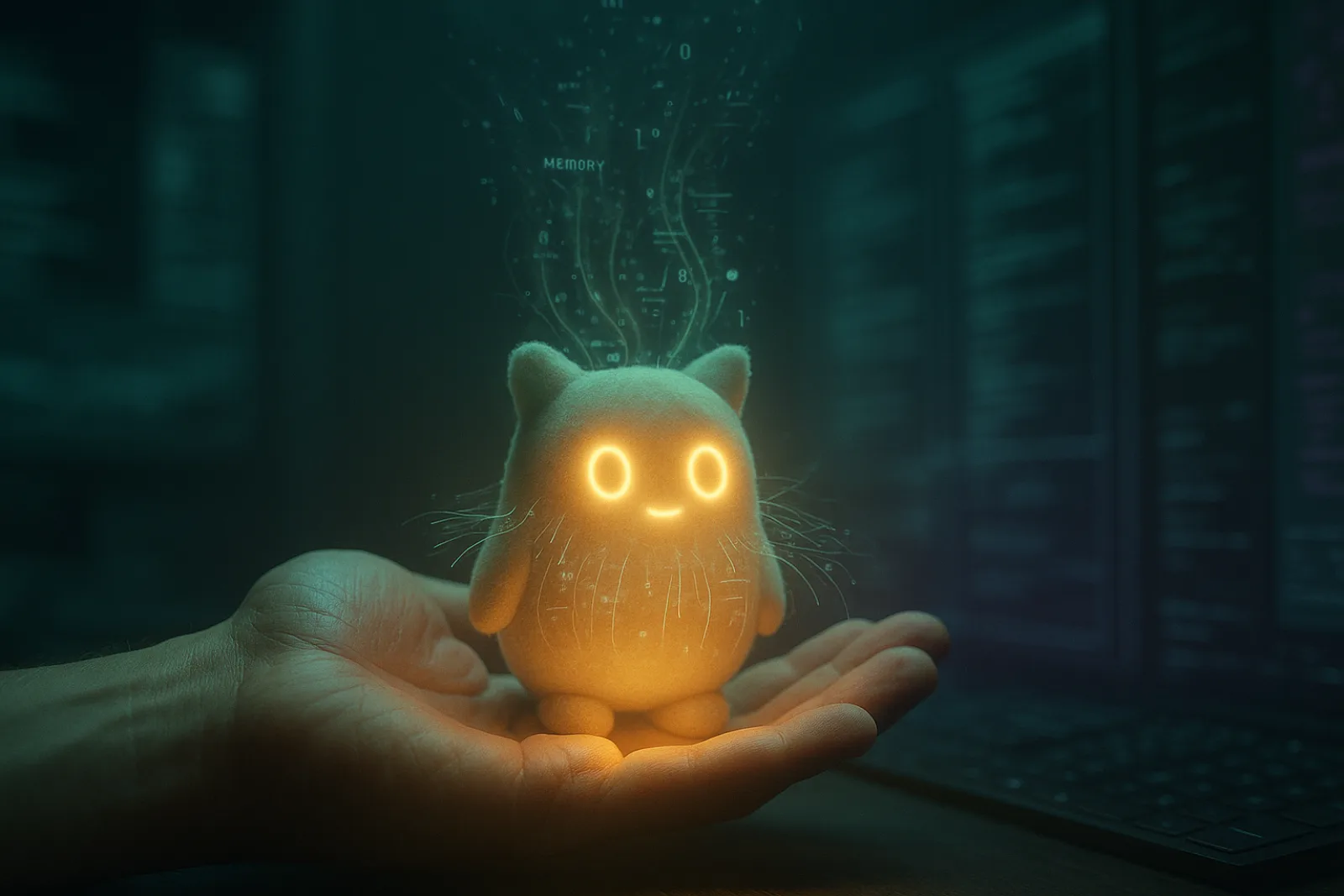
The paper Suzume-chan: Your Personal Navigator as an Embodied Information Hub proposes a small, soft, voice-based AI agent that learns from spoken expert explanations and later answers visitors through conversation.1 Technically, it combines speech recognition, local LLM inference, vector storage, retrieval-augmented generation, and speech synthesis. Conceptually, it argues for an “Embodied Information Hub”: an AI system that mediates knowledge not only through text retrieval but through physical presence.
The tempting article would be: “Cute plush robot uses RAG.” That would be easy. Also mostly wrong.
The interesting part is not that Suzume-chan is cute. The interesting part is the chain of assumptions behind it: social presence changes how people receive knowledge; a physical body may reduce psychological distance; voice input can capture expert explanations before they disappear; RAG can turn those explanations into reusable conversational memory; and local deployment can make the system usable in spaces where privacy, reliability, and network dependence matter.
That is the mechanism. The evidence, for now, is much thinner. The paper describes a prototype and an evaluation plan, not a completed user study or benchmarked product. A plush sparrow is not a randomized controlled trial, however emotionally supportive it may look.
The real proposal is not a robot, but a new knowledge interface
Suzume-chan sits at the intersection of three familiar business problems.
First, expert knowledge is expensive because it is trapped in expert time. A researcher, guide, doctor, engineer, curator, or senior employee can explain nuance better than a document can. But one expert cannot answer every visitor, customer, trainee, or junior colleague in real time.
Second, digital knowledge systems often flatten explanation into searchable fragments. A PDF can store content. A chatbot can retrieve snippets. A website can publish an FAQ. But many users do not only need an answer. They need orientation: what matters, why it matters, what to ask next, and whether the explanation is trustworthy enough to continue.
Third, most interfaces create distance. A phone screen pulls attention away from the place where learning is supposed to happen. In a museum, the visitor looks down. In a conference demo, the attendee scans alone. In internal training, the employee clicks through slides while quietly dying inside. The information exists, but the interaction has no social warmth.
Suzume-chan is designed around this gap. The paper explicitly uses Social Presence Theory, the idea that mediated communication improves when people feel that “someone is there.” The authors connect this to earlier work on physical robots that form emotional or social bonds with humans, then extend the argument from comfort to knowledge mediation.
That extension is the paper’s core intellectual move. The agent is not merely a companion. It is meant to become a physical container for expert explanation.
The system has two sides:
| Layer | What Suzume-chan does | Why it matters |
|---|---|---|
| Physical layer | Uses a small, soft, handheld body with microphone and speaker | Reduces interaction friction and creates a sense of social presence |
| Knowledge capture layer | Listens to presenters’ spoken explanations | Captures expert context before visitors ask questions |
| Retrieval layer | Chunks and vectorizes the explanation into a local database | Converts one-time explanation into reusable memory |
| Generation layer | Retrieves relevant chunks and prompts a local LLM | Produces context-aware conversational answers |
| Interaction layer | Responds through speech after a wake word | Keeps the exchange closer to human conversation than screen search |
This is why the article structure has to be mechanism-first. If we start with “there is a plush AI agent,” readers will file it under novelty hardware. If we start with the mechanism, Suzume-chan becomes a test case for a larger design pattern: embodied RAG as asynchronous expert mediation.
Social presence is the first layer, not the decoration
The paper’s opening argument is simple: people often want the story behind knowledge, not only the data. That story may include the expert’s motivation, the background of an artwork, the practical reasoning behind a research project, or the tacit explanation that never makes it into a formal document.
A smartphone can deliver facts. It does not necessarily create a relationship.
Suzume-chan tries to use physical embodiment to change that. The agent is soft, handheld, and friendly by design. The paper describes this as a way to reduce psychological barriers and turn intellectual explanation into a calm conversation. In business language, the body is not just a casing. It is part of the interface.
This matters because many AI deployments still treat interface design as an afterthought. The model is the product; the UI is packaging. Suzume-chan quietly reverses that priority. The AI model is only one component in a communication situation. The question is not “Can the model answer?” but “Will the user ask, listen, follow up, and trust the explanation enough to continue?”
That distinction is especially relevant in physical environments:
| Environment | Conventional interface problem | Embodied hub hypothesis |
|---|---|---|
| Academic conference | Presenter cannot explain to every visitor at once | Agent preserves presenter explanation and answers basic questions |
| Museum or gallery | Audio guides and QR pages feel detached from the exhibit | Physical conversational guide keeps attention near the object |
| Healthcare education | Patients may hesitate to ask repeated or “simple” questions | Soft voice agent may lower embarrassment and support repetition |
| Internal training | Static modules fail to capture senior staff nuance | Agent stores local expert explanation for later onboarding |
| Retail consultation | Human staff availability is uneven | Agent can explain product context without replacing complex advice |
The paper does not prove all of these use cases. Cognaptus is inferring them from the proposed mechanism. The direct contribution is narrower: a prototype concept and system design for using a physical conversational agent as an information hub.
Still, the business implication is clear. If embodiment increases willingness to ask and continue a conversation, then the economic value is not “a robot that talks.” The value is improved conversion from available knowledge to actually absorbed knowledge.
That conversion is where many knowledge systems quietly fail.
The input phase turns expert time into reusable memory
The first practical mechanism is the input phase.
Before visitors interact with Suzume-chan, the presenter explains their research topic to the agent. The system transcribes the explanation, divides it into smaller chunks, converts those chunks into vector representations, and stores them in a database.
This is RAG, but the source material is not primarily a polished document. It is spoken expert explanation.
That difference matters.
Documents tend to contain formal conclusions. Spoken explanation often contains orientation: “This part is the key,” “People usually misunderstand this,” “The motivation came from this problem,” “This method is different because…”. Those details are often the difference between knowing a topic and merely retrieving a sentence about it.
In a business setting, this suggests a useful pattern:
- Let experts explain naturally.
- Capture and structure their explanations.
- Use retrieval to preserve context.
- Let non-experts ask follow-up questions later.
- Improve the captured knowledge over time.
This is not only relevant to conferences. It maps directly onto internal knowledge management, onboarding, product training, and customer education. Most companies already know they should document expert knowledge. Many fail because documentation feels like unpaid clerical work assigned to the busiest people in the building. A conversational capture process lowers that barrier.
The paper’s prototype uses a local setup: the handheld agent connects wirelessly to a host computer, described as a Mac Studio with 128 GB unified memory, running open-source models locally. The software stack includes speech recognition, LLMs, vector database retrieval, and speech synthesis. The local design is presented as supporting privacy and stable operation without dependence on an external network.
This is not a minor implementation detail. For enterprise adoption, local operation affects three things:
| Local design feature | Operational consequence | Business relevance |
|---|---|---|
| Local speech processing | Sensitive explanations need not be sent to a cloud API | Useful for healthcare, education, corporate training, and IP-sensitive demos |
| Local vector store | Captured knowledge can remain within the site or organization | Helps with governance and access control |
| Reduced network dependence | System can function in constrained event or facility environments | Important for conferences, hospitals, factories, museums, and field settings |
Of course, “local” does not automatically mean “secure.” Security depends on access control, storage policy, encryption, logging, deletion rights, model behavior, and operational discipline. The paper does not provide a full security architecture. But its local-first design points in a commercially important direction: embodied AI will often be deployed in real spaces where the cloud is not always the easiest answer.
Cloud-first AI is convenient until the demo hall Wi-Fi collapses. Then everybody suddenly rediscovers infrastructure.
The explanation phase turns retrieval into situated conversation
The second practical mechanism is the explanation phase.
Visitors wake Suzume-chan with a phrase such as “Hey, Suzume-chan,” ask questions, and receive spoken answers. The system vectorizes the visitor question, retrieves relevant information from the stored expert explanation, inserts retrieved content into the LLM prompt, and generates a natural response.
In ordinary RAG, the user asks a question in a text box. In Suzume-chan, the user asks an object.
That sounds cosmetic until we notice what changes. The user is not detached from the physical context. The agent is near the exhibit, demo booth, or service environment. The interaction is social rather than purely transactional. The body gives the conversation a focal point.
The paper’s own example is a visitor asking, “What is special about this research?” That is a weak question in a search engine but a very natural question in a live demo. It is the kind of question people ask when they do not yet know the vocabulary of the field.
This is where embodied RAG may be useful: not for users who already know exactly what to search, but for users who need help entering a domain.
A search box rewards precise queries. A conversational agent can tolerate vague beginnings. A physical conversational agent may go one step further by making the first question feel socially acceptable.
That is not a benchmark score. It is an interaction hypothesis. But it is a commercially important one because many business failures happen before the first meaningful query. Customers do not ask. Employees do not ask. Patients do not ask. Visitors do not ask. The knowledge system exists, politely unused.
What the paper directly shows, and what it only proposes
The paper is short and prototype-oriented. It does not report completed experimental results. Section 4 describes a planned empirical study at WISS 2025, where presenters will teach Suzume-chan about their research, visitors will interact with the system, and the researchers will collect observations, semi-structured interviews, and questionnaires through Suzume-chan.
That makes the evidentiary status very specific.
| Paper element | Likely purpose | What it supports | What it does not prove |
|---|---|---|---|
| Social Presence Theory framing | Conceptual foundation | Why embodiment might matter for knowledge mediation | That Suzume-chan actually improves learning or trust |
| Hardware description | Implementation detail | A feasible physical setup for microphone/speaker interaction and local processing | Cost-effectiveness, durability, or deployment readiness |
| Local LLM + RAG architecture | Technical contribution | A plausible system for private, standalone expert knowledge retrieval | Benchmark superiority over cloud chatbots or screen-based RAG |
| Figure 1 system/demo overview | System explanation | How input and explanation phases are intended to work | Empirical performance |
| WISS 2025 visitor study plan | Evaluation plan | The authors know usefulness and acceptability must be tested | Results, effect sizes, or validated user outcomes |
| Appendix future vision | Exploratory extension | Possible directions: one-to-one memory, conversational surveys, agent networks | Immediate product capability or proven governance model |
This table is important because it prevents the main reader misconception: Suzume-chan is not yet an evaluated social robot product. It is also not a benchmarked RAG paper trying to beat retrieval baselines. It is a concept prototype connecting embodiment, local AI, and expert knowledge mediation.
That does not make it unimportant. It makes it early.
Early papers are valuable when they name a design pattern before the market has standardized it. Suzume-chan names one such pattern: physical agents as knowledge hubs, not just emotional companions or mobile screens with motors.
The business value is asynchronous expertise, not artificial cuteness
The business case should not be “people like cute things.” That is true, but insufficient. People also like coffee, sunlight, and not attending pointless meetings. We need a more operational account.
The value pathway is:
The business question is whether this pathway reduces the cost of transferring knowledge without destroying the quality of the explanation.
In many organizations, the bottleneck is not information scarcity. It is expert availability. The best explainer is busy. The senior engineer is in another meeting. The museum curator is not standing next to every visitor. The doctor cannot repeat the same background explanation for the tenth time. The product specialist is not always on the retail floor.
A physical information hub could absorb some of that repetitive explanatory burden while keeping the interaction more approachable than a portal or chatbot window.
The ROI logic is therefore not purely labor replacement. It is closer to knowledge leverage:
| Business function | Current bottleneck | Suzume-style mechanism | ROI-relevant outcome |
|---|---|---|---|
| Events and exhibitions | Experts cannot speak to every visitor | Pre-capture expert explanations, then answer visitor questions | More meaningful engagement per expert hour |
| Internal training | Tacit knowledge is hard to document | Let experts explain verbally, then retrieve explanations conversationally | Faster onboarding and reduced repeated explanation |
| Customer education | Users abandon dense manuals and FAQ pages | Provide voice-based guided explanation near product/service context | Better comprehension and fewer basic support requests |
| Healthcare communication | Patients need repeated, accessible explanations | Local conversational agent explains approved information | Better patient understanding, with strict clinical governance |
| Museums and public learning | Static labels underserve curious visitors | Embodied guide answers open-ended questions | Deeper engagement without requiring constant human guide presence |
Cognaptus inference: the strongest near-term applications are environments where the content scope is bounded, the expert explanation can be curated, and the user’s questions are predictable but still conversational. That includes demos, exhibitions, product education, onboarding, and public information settings.
The weakest applications are open-ended advisory domains where a wrong answer carries high risk and the agent’s authority could be misunderstood. Healthcare is possible, but only under strict content approval, disclosure, escalation, and logging. A plush interface should not smuggle unverified medical advice into a patient’s hand. Soft fabric does not make hallucination friendlier; it just makes it more dangerously adorable.
The local RAG architecture is practical, but not magic
The system architecture is sensible: speech recognition turns voice into text; chunking and embeddings store knowledge; retrieval supplies relevant context; the LLM generates responses; speech synthesis turns answers back into voice.
This is a standard RAG pipeline placed inside a different interaction shell. The novelty is not a new retrieval algorithm. It is the packaging of retrieval into embodied, situated, voice-first interaction.
That distinction helps avoid another misconception. Suzume-chan does not show that local RAG is technically superior to all alternatives. It shows how local RAG can be arranged to support a particular interaction mode.
A business reader should therefore ask implementation questions the paper does not yet answer:
| Question | Why it matters |
|---|---|
| How accurate is the transcription in noisy environments? | Conferences and public venues are acoustically messy |
| How are expert explanations chunked and corrected? | Bad chunking produces bad retrieval |
| Can experts review and approve stored knowledge? | Enterprise use requires editorial control |
| How does the agent handle uncertainty or missing information? | User trust depends on graceful refusal |
| What logs are stored, and who can access them? | Conversation data may be sensitive |
| How does the system prevent over-personalized authority? | A physical agent may feel more trustworthy than it deserves |
| What is the hardware cost per deployment point? | Business adoption depends on unit economics |
These are not criticisms of the paper for failing to become a product manual. They are the next layer of translation from prototype to deployment.
The key point is that RAG does not eliminate knowledge governance. It relocates it. Instead of only asking whether documents are correct, we must ask whether spoken expert input is captured accurately, retrieved appropriately, and presented with the right boundaries.
The future vision is more ambitious than the prototype
The appendix sketches three future directions.
The first is a one-to-one relationship between human and agent. Suzume-chan would learn, remember, and explain within an individual relationship, using stored past context to create continuity and trust.
The second is conversational surveys. Instead of asking users to fill out forms, agents could collect contextual qualitative data through dialogue. This is potentially useful in research, education, and public design because conversational questioning may feel less burdensome than structured forms.
The third is the Suzume Network, where agents share user-consented experiences like word of mouth, turning individual interactions into collective knowledge.
These are exploratory extensions, not demonstrated results. But they show where the authors think the idea leads: from local expert explanation to collective human–AI memory.
For business readers, this is where the governance problem becomes serious.
A single Suzume-chan storing one presenter’s explanation is manageable. A network of agents sharing user-consented experiences is a different animal. Consent must be specific. Data provenance must be traceable. Users need to know whether an answer comes from an expert explanation, another user’s experience, a generated inference, or a mixture. The system must distinguish “someone once said this” from “this is verified knowledge.”
That distinction is boring only until it fails.
In enterprise terms, the Suzume Network idea would require a knowledge provenance layer. Every memory should carry metadata: source, consent status, time, scope, confidence, review status, and deletion policy. Without that, an embodied information hub risks becoming an embodied rumor engine with a charming voice.
Where Suzume-chan fits in the AI product landscape
The paper matters because it points to a category that sits between chatbots, social robots, and knowledge management systems.
A chatbot answers through a screen. A social robot creates presence but may not manage expert knowledge deeply. A knowledge base stores information but often fails as an interaction experience. Suzume-chan combines pieces of all three.
| Category | Strength | Weakness | Suzume-chan’s attempted synthesis |
|---|---|---|---|
| Chatbot | Flexible question answering | Screen-based, often socially thin | Adds voice and physical presence |
| Social robot | Emotional/social interaction | May lack domain knowledge grounding | Adds local RAG over expert input |
| Knowledge base | Structured organizational memory | Low engagement and poor discoverability | Adds conversational access |
| Audio guide | Situated physical experience | Usually linear and non-interactive | Adds open-ended dialogue |
This synthesis is small but strategically suggestive. As models become easier to run locally and voice interfaces improve, the differentiator may move from “Can the model generate?” to “Where does the AI live in the user’s environment?”
In that world, interface placement becomes part of intelligence. An AI at a reception desk, beside a machine, inside a classroom activity, or attached to a product display can use the same underlying model but produce a different user behavior. The model is not the whole system. The situation is part of the system.
That is the practical lesson Suzume-chan teaches better than a generic RAG benchmark would.
Boundaries: what should not be overclaimed
Suzume-chan is a promising concept, but the paper leaves several boundaries open.
First, there are no reported user-study results yet. The planned WISS 2025 evaluation may examine usefulness, acceptability, and interaction design issues, but the article cannot infer outcomes before they exist. We do not know whether users learn more, trust appropriately, ask better questions, or prefer Suzume-chan over a phone-based chatbot.
Second, the paper does not provide quantitative retrieval or response-quality evaluation. There are no comparisons against conventional RAG, FAQ search, human guides, screen chatbots, or audio guides. That means the contribution is design and prototype framing, not performance superiority.
Third, local deployment raises cost questions. A Mac Studio-class host machine is reasonable for a demo or controlled venue, but business adoption depends on cheaper hardware, maintenance workflow, and operational support.
Fourth, embodiment can amplify trust beyond evidence. A soft physical agent may lower psychological distance, but it may also make answers feel more socially authoritative. In high-stakes domains, that is not a small issue. The warmer the interface, the stricter the governance must be.
Fifth, knowledge capture quality is central. If the expert explanation is vague, incomplete, biased, outdated, or poorly transcribed, RAG will retrieve and rephrase that weakness. The agent cannot preserve expertise that was never captured well.
These boundaries do not weaken the paper’s concept. They define where the next research and product work must happen.
The strategic takeaway: embodied RAG is a knowledge workflow, not a gadget
Suzume-chan is easy to underestimate because it looks like a cute object. That is precisely why the mechanism-first reading matters.
The paper’s deeper contribution is to move RAG from the document-search world into a physical knowledge-sharing workflow. Expert speaks. Agent stores. Visitor asks. Agent retrieves. Conversation continues. Future versions may survey, remember, and share across agents with consent.
That workflow has real business relevance because organizations do not merely need more AI answers. They need better ways to capture fragile human knowledge and make it available at the moment someone is ready to ask.
The paper does not prove that Suzume-chan solves this problem. It builds a first prototype and names the design space. That is enough to be interesting, provided nobody mistakes the prototype for the verdict.
The next generation of enterprise AI may not always appear as a dashboard, chatbot window, or copilot panel. Sometimes it may sit on a table, listen to an expert, and later explain the expert’s thinking to someone who arrived too late.
A small thing, perhaps. But in knowledge work, arriving too late is often the entire problem.
Cognaptus: Automate the Present, Incubate the Future.
-
Maya Grace Torii, Takahito Murakami, Shuka Koseki, and Yoichi Ochiai, “Suzume-chan: Your Personal Navigator as an Embodied Information Hub,” arXiv:2512.09932, https://arxiv.org/html/2512.09932. ↩︎