Opening — Why this matters now
AI systems are getting smarter, but not necessarily more adaptable. In an economy leaning heavily on autonomous agents—from fraud-detection bots to process‑automation copilots—static, pre-trained intelligence is fast becoming a liability. Businesses want systems that react, revise, and self-improve in deployment, not months later in a training pipeline.
Enter a new research direction: giving AI something approximating metacognition—a way to monitor its own reasoning, update its strategies, and learn continuously from real-world experience. The paper “Adapting Like Humans: A Metacognitive Agent with Test-Time Reasoning” fileciteturn0file0 pushes this idea one step closer to practicality.
Background — The lineage of adaptive intelligence
Traditional large models excel at pattern recognition but buckle when distributions shift. Test‑time training attempted to patch this by injecting gradient updates during inference; test‑time reinforcement learning allowed models to improve from interaction without labels; retrieval-augmented prompting tried to fake adaptation with external memory.
None of these feel truly “human.” Humans adjust strategies on the fly: they hypothesize, test, revise, and consolidate new rules. In cognitive science, this sits under the umbrella of metacognition—a separation between the object level (doing the task) and the meta level (monitoring and improving how the task is done). The paper turns this theory into an engineering blueprint.
Analysis — What the paper actually does
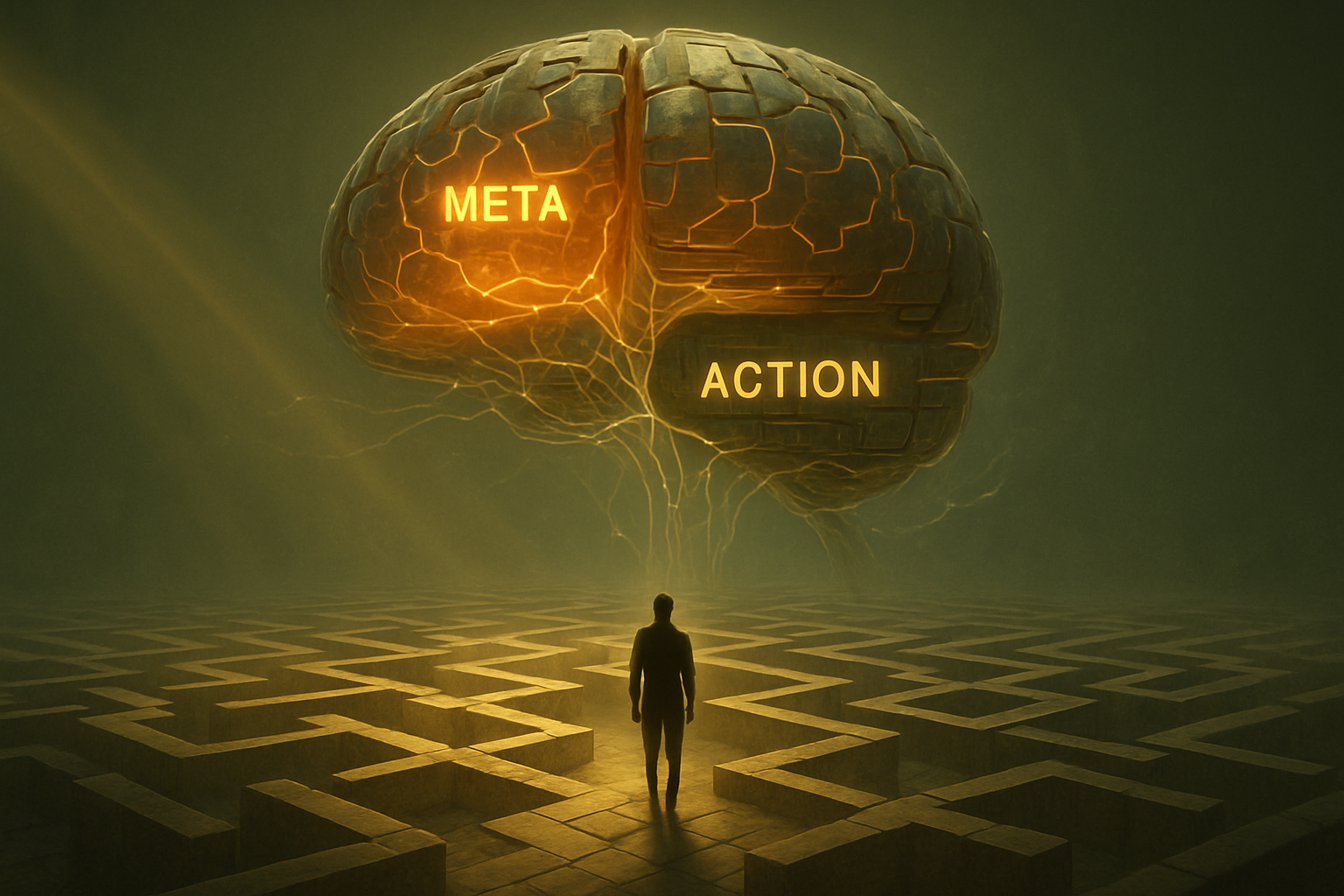
The proposed framework, MCTR (Metacognitive Test-Time Reasoning), implements a two-layer reasoning architecture reminiscent of human meta‑level control.
1. Meta‑Reasoning Module (the “strategist”)
- Looks back at recent trajectory slices.
- Extracts patterns like rules, game mechanics, and useful heuristics.
- Writes these into a knowledge memory as natural‑language entries.
- Deletes or updates rules as the environment changes.
- Adjusts its own invocation frequency through an adaptive scheduler.
2. Action‑Reasoning Module (the “executor”)
- Perceives the current state using structured visual parsing.
- Injects the knowledge memory into its reasoning chain.
- Produces the next action via multi-step deliberation.
- Refines its policy using MCT‑RL—a reinforcement-learning loop using majority‑vote self-consistency instead of environment reward.
In business English
It’s an agent that:
- Watches what it’s doing.
- Explains to itself why it failed or succeeded.
- Stores generalizable lessons.
- Uses those lessons to make better decisions.
- Continuously updates its policy as the lessons change.
This is much closer to the way a human junior analyst improves in their first month on the job.
Findings — What actually improves
Across 45 Atari games, MCTR significantly outperforms baseline models, especially on unseen tasks where adaptability matters.
Summary of results
| Setting | Baseline (SFT only) | MCTR | Improvement |
|---|---|---|---|
| Seen games (33) | 23 top-1 scores | 23 top-1 | — (as expected) |
| Unseen games (12) | 1 top-1 score | 9 top-1 scores | +800% |
Why this matters
MCTR’s advantage shows up precisely where real-world systems fail today—in novel, long-horizon tasks where rules are unclear and feedback is sparse.
Key dynamics
- Majority-voting consistency rises over time, meaning the model becomes more confident and internally coherent.
- Agreement with older behavior declines, indicating genuine strategy updates rather than rote repetition.
- Meta-reasoning transitions from vague hypotheses (“identify enemy types”) to precise, actionable playbooks (“time lateral movements to evade projectiles”).
This is the hallmark of real adaptation: not just better answers, but better methods.
Implications — Why enterprises should care
1. AI copilots that improve themselves during deployment
Think of workflow automation agents that notice bottlenecks, rewrite their own rules, and optimize processes autonomously. MCTR shows the recipe.
2. Dramatically lower fine‑tuning costs
Instead of the expensive loop of retrain → redeploy, metacognitive systems adjust online with local LoRA adapters.
3. Safer, more interpretable adaptation
Because knowledge is stored in natural language rules—additions, deletions, edits—governance teams can audit why a system changed its behavior.
4. The rise of “metacognitive guardrails”
Enterprise AI governance may evolve to supervise not only model outputs but also the model’s self‑modification logic.
5. Better alignment under distribution shift
Self-reflective reasoning prevents the silent degradation of performance that haunts many deployed AI systems.
Conclusion — Toward self‑aware enterprise AI
MCTR doesn’t give AI consciousness (thankfully), but it hands models an internal feedback loop that looks suspiciously like human learning. For businesses, this signals a shift from static intelligence to continually adaptive intelligence—the kind of systems that don’t just survive change but thrive on it.
Cognaptus: Automate the Present, Incubate the Future.