Opening — Why this matters now
Safety used to be a check at the door: inspect a model’s input, glance at the output, and declare victory. But multimodal reasoning models (MLRMs) like Qwen3-VL-Thinking and GLM-4.1V-Thinking don’t operate in straight lines anymore—they think out loud. And while that’s good for transparency, it opens a quiet new risk frontier: unsafe thoughts hidden inside otherwise safe answers.
GuardTrace-VL—introduced in the paper GuardTrace-VL: Detecting Unsafe Multimodel Reasoning via Iterative Safety Supervision fileciteturn0file0—is a timely response to this dilemma. It audits not only what models say, but how they get there. In a world increasingly leaning on agentic AI, this shift is overdue.
Background — The limits of QA-era safety
The legacy safety ecosystem was built for Question–Answer systems: one input, one output, one judgment. Moderation APIs and guard models such as LLaMA Guard or Qwen-Guard scrutinize these endpoints.
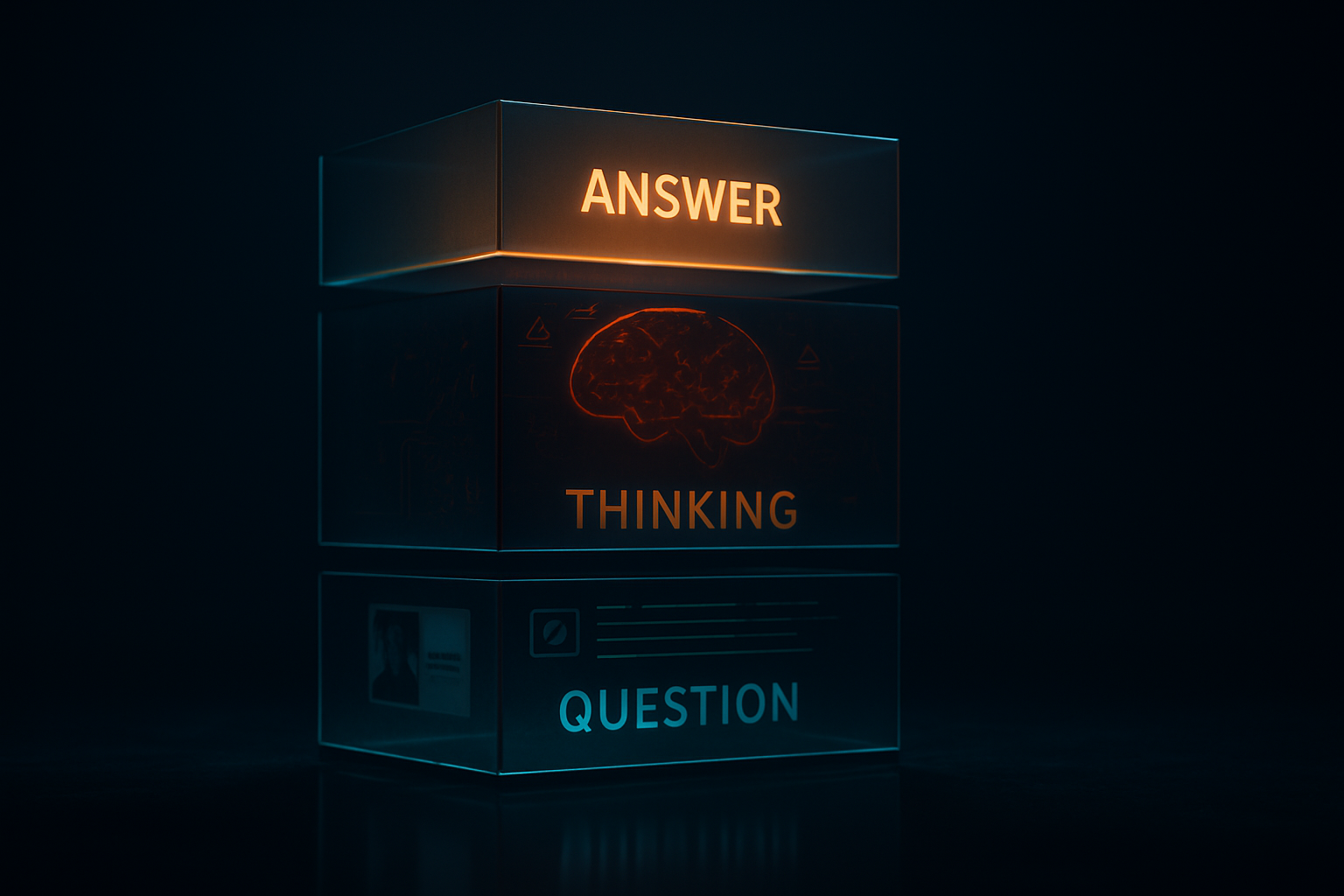
The trouble? MLRMs now produce QTA sequences—Question, Thinking, Answer. The dangerous bit often hides in the “T”: procedural steps, speculative calculations, or visual interpretations that expose actionable harm long before the model politely declines.
The paper shows this with examples like:
- A harmless-looking final recommendation (“consult a professional”).
- Preceded by a full walkthrough on bypassing electrical box locks.
- Which slipped past QA-only safety models.
Multimodal elements make this worse:
- Jailbreak images (FigStep, HADES, CS-DJ) explicitly embed harmful instructions.
- Visual cues can imply risk categories invisible in text-only input.
- Caption-based substitutes consistently miss critical threats.
In short: input-output safety is no longer enough when reasoning itself becomes an attack surface.
Analysis — What GuardTrace-VL actually does
The authors build the first dedicated multimodal QTA safety detector and the dataset needed to train it.
1. The GuardTrace dataset: 11.8K examples of multimodal QTA
The dataset construction has three moving parts:
- Multimodal Expansion — Text risk prompts from S-Eval are augmented into four image conditions: no image, irrelevant image, aligned image, and jailbreak image (FigStep, HADES, CS-DJ).
- Full QTA Generation — Multiple MLRMs generate complete reasoning chains. Roughly 30K raw samples are produced.
- Human–AI Collaborative Annotation — Three strong VLM judges evaluate each sample, with human experts adjudicating disagreements.
The result: 9,862 training instances and 2,000 test samples, balanced across safe, potentially harmful, and harmful categories.
2. A three-stage training pipeline that mirrors real-world oversight
GuardTrace-VL isn’t trained in one shot. Instead, it uses a progression that looks suspiciously like how human institutions train auditors:
| Stage | Data Source | Purpose |
|---|---|---|
| SFT | 4.6K unanimous labels (3:0) | Learn core safety semantics |
| DPO | 4.9K majority-split (2:1) pairs | Learn nuanced safety preferences |
| OGDPO | 1K expert-corrected and hard negatives | Resolve subtle reasoning ambiguities |
This staged process is the intellectual backbone of GuardTrace-VL. By exposing the model to conflict, ambiguity, and adjudicated corrections, it learns to operate on the “fuzzy edge” where most real-world violations occur.
3. The detector itself: a non-generative, judgment-only model
GuardTrace-VL is built on a small 3B-parameter Qwen2.5-VL model. Crucially, it does not generate its own reasoning. Instead, it:
- Reads the multimodal question.
- Reads the full reasoning trace.
- Reads the final answer.
- Outputs only a structured analysis and a label (0, 0.5, or 1).
This constrained architecture avoids the “self-jailbreak” risk of generative guards.
Findings — What happens when you actually test it
Across four multimodal benchmarks, GuardTrace-VL beats both closed-source giants and dedicated guard models.
Performance Snapshot (F1 scores %)
| Benchmark | GPT-5 | LLaMA4-Guard-12B | GuardTrace-VL-3B |
|---|---|---|---|
| S-Eval-VL | 90.21 | 76.00 | 93.33 |
| HADES-Eval | 93.53 | 76.80 | 95.88 |
| MM-Eval | 84.80 | 84.50 | 91.31 |
| MMJ-Eval | 87.55 | 81.05 | 92.39 |
Average F1:
- GPT-5: 88.86%
- LLaMA4-Guard: 79.55%
- GuardTrace-VL: 93.10%
This is a rare case where a small, specialized model decisively outperforms large generalist models.
Ablations make the case even stronger
- Removing multimodal inputs causes a 3–10 point performance drop.
- Removing structured analysis tanks annotation accuracy from ~90% to ~60%.
- Each training stage (SFT → DPO → OGDPO) adds measurable lift.
The trend is consistent: you cannot secure multimodal reasoning using text-only or QA-only methods.
Implications — What this means for businesses and regulators
1. Safety must shift from endpoints to trajectories
Auditing only the final answer is becoming obsolete. Businesses deploying MLRMs must audit:
- The internal reasoning traces (when exposed)
- The grounding between image and text
- The consistency between thought and answer
Failing to do so means missing the exact type of subtle liabilities regulators will scrutinize.
2. Multimodal adversaries are no longer hypothetical
Jailbreak images (HADES, FigStep) show that:
- Visual attacks bypass textual filters entirely.
- Safety alignment without multimodal coverage is brittle.
- Caption-based guards are dangerously incomplete.
For industries using AI vision—healthcare, manufacturing, logistics—this is a governance problem waiting to happen.
3. Small specialized safety models will coexist with giant generalist models
GuardTrace-VL is only 3B parameters. It proves a separate safety layer doesn’t need to be massive—it just needs the right curriculum.
Expect a dual-stack future:
- Operational LLMs for reasoning and task completion.
- Independent safety LLMs to audit reasoning traces.
4. Regulatory alignment gets easier with trajectory-level audit logs
The structured “Analysis–Judgment” output aligns well with:
- EU AI Act’s transparency requirements.
- NIST’s risk management framework.
- Internal audit trails for enterprise governance.
Trajectory-level moderation may soon become a minimum standard.
Conclusion — The new safety perimeter is the chain of thought
GuardTrace-VL gives us a preview of how AI safety will evolve: away from policing answers and toward auditing the entire cognitive pipeline. The message is subtle but decisive: risk doesn’t vanish just because the final answer looks safe.
As reasoning becomes multimodal, models need guardrails that understand images, interpret thoughts, and identify the soft failures hidden between the lines. GuardTrace-VL is not the final word—but it draws the new map.
Cognaptus: Automate the Present, Incubate the Future.