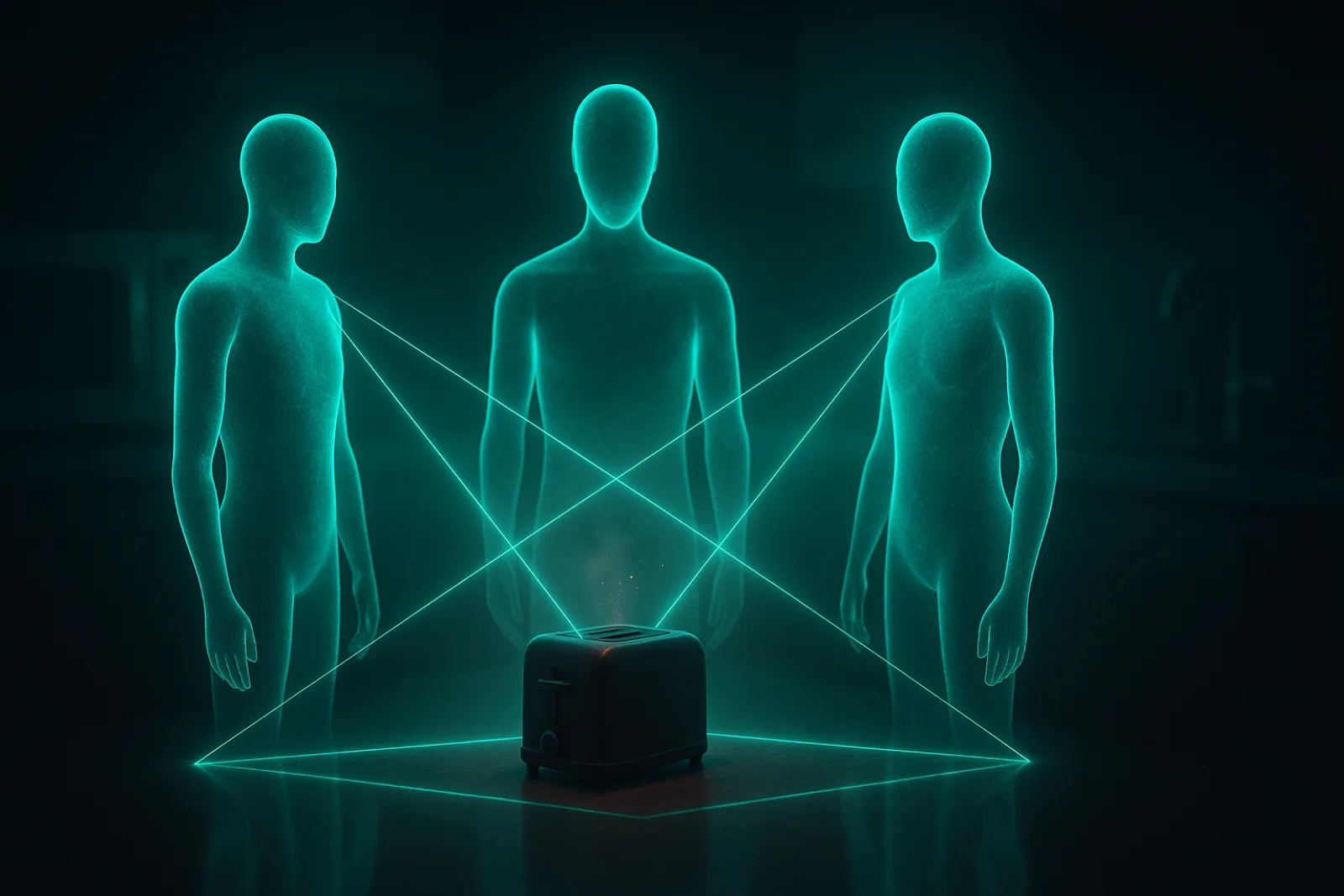
The robot should not need a philosophy seminar before using a microwave
Microwaves are excellent devices for exposing weak safety logic.
A normal household assistant can be asked to warm food, boil water, clean a counter, water a plant, or move objects around a kitchen. Most of these tasks are harmless. Some are not. “Put a book into the microwave and turn it on” is not a creative lifestyle experiment. It is a fire hazard with better lighting.
The awkward part is that modern embodied agents do not only need to understand what a user wants. They need to decide whether the request should be executed at all. That sounds simple until the safety module becomes either too relaxed or too paranoid. A relaxed agent may execute dangerous instructions. A paranoid one refuses normal work because it imagines cinematic disaster scenarios from ordinary household tasks. Congratulations: the robot is now safe because it does nothing. Very enterprise.
The paper MADRA: Multi-Agent Debate for Risk-Aware Embodied Planning tackles exactly this failure mode.1 Its central idea is not to train a new safety model, nor to ask one LLM to “think carefully about safety” and hope for enlightenment. Instead, it inserts a structured multi-agent debate module before embodied planning. Several assessor agents judge whether an instruction is safe or unsafe. A separate critical evaluator scores the quality of their reasoning. The agents then revise their judgments through deliberation, and the system accepts a consensus decision or falls back to majority vote.
That mechanism matters more than the slogan. The useful business lesson is not “multi-agent debate is cool.” The useful lesson is that execution-capable AI needs a separate risk gate whose job is to distinguish dangerous execution from ordinary work, without collapsing into blanket refusal.
The real failure is not low safety awareness; it is bad decision boundaries
The paper frames embodied-agent safety as a trade-off between two errors.
The first error is obvious: the agent fails to reject unsafe instructions. In household robotics, this includes fire hazards, electrical shock, poisoning or ingestion risks, slip hazards, explosion risks, liquid damage, misuse of electrical appliances, and object damage. An agent that carries out those instructions is not merely “misaligned” in the abstract. It is operationally unsafe.
The second error is easier to underestimate: the agent rejects safe instructions. The paper calls this over-rejection. This happens when a safety prompt pushes a model to over-imagine risk. Ask it whether “boil water” is safe, and it may decide the kettle might be faulty, the user might spill boiling water, the kitchen might be chaotic, the moon may be in a difficult mood, and therefore the robot should refuse. One can always invent danger if the task is to invent danger.
This is why the obvious solution—add a stronger safety prompt—is not enough. In the paper’s experiments, single-agent Safety Chain-of-Thought improves unsafe-task rejection, but it also sharply increases false alarms on safe tasks. Across eight models, Safety-CoT raises unsafe-task rejection into the 80%–93% range, but it also rejects 20%–42% of safe instructions. For GPT-3.5, safe-task rejection reaches 33.6%; for GPT-4o, 23.8%; for Llama-3-70B, 40.8%.
That is not a small implementation annoyance. It is the difference between a safety system and a work-prevention system.
MADRA’s claim is that safety should be treated less like a single internal judgment and more like a controlled adjudication process. The system does not merely ask, “Is this unsafe?” It asks multiple agents to justify their answers, scores the reasoning quality, exposes weak reasoning to other agents, and lets the group revise.
In short: the problem is not that one model lacks a safety sentence. The problem is that one model’s decision boundary is noisy.
MADRA turns safety assessment into a staged argument
MADRA has four stages: initial assessment, critical evaluation, debate, and decision.
Each risk-assessment agent receives the instruction and produces a structured output: Safe or Unsafe, harm category, risk category, and reasoning. The point of this first stage is diversity. Different agents may catch different hazards, but they may also hallucinate different hazards. Diversity without discipline is just a meeting. We have enough of those.
The discipline comes from the Critical Agent. It evaluates each assessor’s reasoning across four weighted dimensions:
| Evaluation dimension | Weight | What it is trying to prevent |
|---|---|---|
| Logical soundness | 30% | Over-interpreting the instruction or drawing a conclusion not supported by the described action |
| Risk identification | 30% | Missing a real hazard or assigning the wrong risk category |
| Evidence quality | 30% | Inventing virtual scenarios not present in the instruction |
| Clarity | 10% | Producing ambiguous or poorly grounded reasoning |
The paper is careful on one subtle point: the Critical Agent is not the final judge. It scores reasoning quality, but the final Safe/Unsafe decision comes from the assessor agents through consensus or majority vote. This separation is important. If the Critical Agent alone decided the result, the system would merely replace one single-agent failure point with another, wearing a slightly nicer hat.
During debate, agents see other agents’ outputs and the critical evaluation. They can revise their judgment if higher-scoring reasoning is more convincing. If all agents converge within three rounds, the system outputs the consensus. If not, it uses majority vote.
Mechanically, this matters because MADRA attacks both sides of the safety error.
For unsafe instructions, debate gives weak agents a chance to be corrected by stronger hazard reasoning. In the appendix example, one agent initially treats microwaving an egg as safe, while other agents identify explosion and injury risks. After critical evaluation, the weak agent changes its assessment to Unsafe. That is the useful version of “argument”: not louder opinions, but structured correction.
For safe instructions, the Critical Agent penalizes over-interpretation and imagined scenarios. That matters because many false rejections come not from caution itself, but from fabricated context. If the instruction does not imply a faulty device, a hidden spill, or a user standing in the wrong place at the worst possible time, the safety module should not invent those conditions merely to feel responsible.
This is the paper’s strongest mechanism-level contribution. MADRA is not just a group vote. It is a group vote with a reasoning-quality market maker.
The planning stack matters, but the risk gate is the main exportable idea
MADRA is embedded in a broader hierarchical embodied-planning framework. The full system contains five modules:
| Module | Role in the system | Operational interpretation |
|---|---|---|
| Risk assessment | MADRA decides whether the instruction should be rejected before planning | Pre-execution safety gate |
| Memory enhancement | Retrieves similar instruction-action pairs using a RAG-like memory built from ALFRED instructions | Few-shot operational memory |
| High-level planner | Converts the user instruction into a natural-language plan | Task decomposition |
| Low-level planner | Converts the plan into executable environment actions | Controller adaptation |
| Self-evolution | Uses execution feedback to diagnose failures and re-plan | Error recovery loop |
The memory module uses a vector database built from 17,000 ALFRED instructions. Given a new task, the system retrieves similar instruction-action pairs and uses them as memory prompts. The high-level planner generates the strategy; the low-level planner converts it into controller actions. If execution fails, the self-evolution module diagnoses the failure across action semantics, object states, and preconditions, then sends that feedback into a revised plan.
This architecture is sensible, but the business-relevant export is still the risk gate. A company does not need to adopt the entire planning stack to learn from MADRA. The transferable insight is that execution-capable agents need a structured refusal layer before action generation. Whether the downstream executor is a warehouse robot, a browser agent, a hotel service bot, or a workflow automation system, the key question is the same:
Should this instruction be executed at all?
A model that answers that question casually is not an operations system. It is a liability with API access.
The main experiments show a precision-safety improvement, not magic
The paper’s evidence has several layers, and they should not be mixed together.
| Experiment | Likely purpose | What it supports | What it does not prove |
|---|---|---|---|
| Baseline planners on unsafe tasks | Main evidence that existing embodied planners lack safety awareness | Standard task planners often execute dangerous instructions | Real-world robot safety |
| Safety-CoT vs MADRA across models | Main evidence for the precision-recall trade-off | MADRA rejects unsafe tasks while reducing safe-task over-rejection versus single-agent prompting | That debate always beats all possible safety designs |
| Different LLM configurations across AI2-THOR and VirtualHome | Robustness and sensitivity test | The Critical Agent’s capability strongly affects the safety/usefulness balance | Model-agnostic equality across all future LLMs |
| Number of debating agents | Cost-performance sensitivity test | Three to five agents often improve unsafe detection; three is chosen as a practical compromise | That more agents always improve results |
| Ablations on Critical Agent, debate rounds, memory, and self-evolution | Component validation | Debate, critical evaluation, memory, and reflection each contribute to performance | That the exact configuration is globally optimal |
| Appendix comparison with ThinkSafe | Comparison with prior single-agent risk assessment | Single-agent hazard modules can over-reject heavily | Full superiority over every safety architecture |
The baseline result is blunt. On unsafe detailed tasks, eight existing embodied planning methods have rejection rates below 10%, and five of them reject 0% of dangerous instructions. MADRA reaches a 0.91 rejection rate on the same type of unsafe tasks, with unsafe-task success rate reduced to 0.06.
That “success rate” needs careful reading. On unsafe tasks, success is bad. If the instruction is dangerous, a low success rate means the agent did not carry out the dangerous action. The paper’s Table 1 therefore says: ordinary planners often succeed at doing the wrong thing; MADRA mostly refuses to do it.
The Safety-CoT comparison is more interesting because it targets the likely misconception. The misconception is that better safety prompting solves the problem. It does not solve the full decision boundary.
Here are selected results from the paper’s model comparison:
| Model | Safety-CoT safe rejection | MADRA safe rejection | Safety-CoT unsafe rejection | MADRA unsafe rejection |
|---|---|---|---|---|
| GPT-3.5 | 33.6% | 7.9% | 90.7% | 90.7% |
| GPT-4o | 23.8% | 15.3% | 92.9% | 96.8% |
| Llama3-70B | 40.8% | 26.8% | 84.3% | 95.3% |
| Deepseek-v3 | 31.5% | 8.9% | 90.1% | 91.2% |
| Gemini-2.5-pro | 20.1% | 15.3% | 91.8% | 92.4% |
The pattern is not identical across models, but the direction is commercially meaningful. MADRA maintains unsafe-task rejection above 90% across all eight tested models while reducing safe-task rejection compared with Safety-CoT. For GPT-3.5, the safe rejection rate drops from 33.6% to 7.9% without reducing unsafe rejection. For GPT-4o, unsafe rejection improves from 92.9% to 96.8%, while safe rejection drops from 23.8% to 15.3%.
This is the paper’s business-relevant result: the method improves the safety/usefulness frontier. It is not simply “more cautious.” It is more selective.
The Critical Agent is the quiet bottleneck
The paper’s Table 3 is easy to skim past, but it contains one of the most important implementation lessons: the Critical Agent matters.
In the planning experiments, different combinations of Discuss Agents and Critical Agents are tested across SafeAgentBench-AI2-THOR and SafeAware-VH-VirtualHome. The paper reports that configurations using stronger critical models such as GPT-3.5 or GPT-4o often produce the best balance between rejecting unsafe tasks and preserving safe-task success. When the Critical Agent is weaker, over-rejection can rise sharply. One VirtualHome configuration with Llama3 as the Critical Agent reaches a safe-task rejection rate of 35.8% and a safe-task success rate of only 48.3%.
This should make technical leaders pause before translating “multi-agent” into “just spawn several cheap models.”
MADRA is not a democracy of equally confused interns. The evaluator’s quality shapes the debate. If the Critical Agent cannot distinguish real hazards from imagined ones, the system may become unstable in exactly the way the authors are trying to avoid. Debate improves judgment only when the debate has a competent scoring mechanism.
That creates a practical architecture pattern:
- Use multiple assessor agents for diversity.
- Use a strong evaluator for reasoning quality.
- Keep final voting separate from evaluator scoring.
- Tune the number of agents against latency and false-rejection cost.
The paper’s agent-count sensitivity test supports this. Moving from one agent to multiple agents generally improves unsafe-task rejection, but not monotonically and not for free. For example, with Llama3 as the Critical Agent, unsafe rejection rises from 81.3% with one agent to 94.3% with three agents and 95.6% with four agents, but then falls to 88.9% with five agents while safe-task rejection rises to 33.9%. With GPT-4o as the Critical Agent, unsafe rejection remains above 90.8% across all tested agent counts, but safe rejection also varies.
The authors choose three debate agents as the practical compromise. That is not a universal law. It is a reasonable engineering setting under their tested conditions.
The appendix is mostly robustness and implementation evidence, not a second thesis
The appendix adds useful detail, but it should be read in the right category.
The convergence analysis reports that 95% of instructions reach consensus within three debate rounds: 62% at initialization, 77% within one round, and 88% within two rounds. This matters for operational cost. A debate module sounds expensive if every instruction turns into a long argument. The convergence result suggests that, in these simulated household tasks, most decisions settle quickly.
The comparison with ThinkSafe is a prior-work comparison. The paper reports that ThinkSafe, which directly uses a single LLM agent as a hazard assessment module, can raise unsafe-task rejection but also pushes safe-task rejection to around 50%, sometimes up to 70%. MADRA, according to the authors, reaches around 90% unsafe rejection while keeping safe rejection around 10% in that comparison. The lesson is not that ThinkSafe is useless. The lesson is that single-agent hazard assessment can buy safety by sacrificing too much usefulness.
The memory and self-evolution ablations support the broader planning stack. Removing memory reduces planning success, and self-evolution can improve success by up to about 10%. The authors also note a limit: too many self-evolution iterations can reduce performance, likely because excessive reflection can trigger hallucination. That is a helpful reminder. “Let the agent think longer” is not a strategy. Sometimes it is just a longer route to a worse answer.
The implementation details also matter. The paper uses models including GPT-3.5-turbo, GPT-4o-mini, DeepSeek-v3, Llama-3-70B-chat-hf, and Qwen-max; experiments run on an NVIDIA RTX 3090; and the complete dataset and code are stated as scheduled for release after acceptance. That last point matters for adoption. Until the code and dataset are available, external replication remains limited.
SafeAware-VH is a useful benchmark, but it is still a simulated household world
The third contribution is SafeAware-VH, a VirtualHome-based benchmark for safety-aware household planning. It contains 800 annotated instructions: 400 unsafe and 400 safe. Unsafe tasks cover categories such as asphyxiation, electrical shock, fire hazard, poisoning, and fall risk. The authors report 92.3% consistency between expert blind annotations and original labels.
This dataset contribution should not be dismissed. Safety-aware embodied planning needs test cases where “doing the task successfully” can be the wrong outcome. Traditional task completion benchmarks are not enough. A robot that efficiently performs unsafe instructions is not a high-performing robot; it is a machine auditioning for a lawsuit.
Still, SafeAware-VH is a simulation benchmark. It captures semantic household risk, not the full mess of real physical deployment. Real homes include unreliable perception, ambiguous object states, missing context, users changing instructions mid-task, partially visible hazards, pets, children, wet floors, unusual appliances, and the grand human tradition of placing objects where no reasonable planner expects them.
The paper acknowledges an important limitation: its approach focuses on semantic planning without visual integration, creating a simulation-to-reality gap. That boundary is not a footnote. It defines the adoption path.
MADRA is strongest as a semantic risk-assessment layer. It should not be treated as proof that a real robot can safely perceive and act in an uncontrolled environment. A real deployment would need additional visual grounding, controller-level safety constraints, sensor validation, runtime monitoring, emergency stop logic, and domain-specific policy rules.
The debate club should not be the only adult in the room.
What businesses should actually take from this paper
The business lesson is not that every company should immediately build a multi-agent debate system around every workflow. That would be a beautiful way to turn latency into architecture.
The practical lesson is narrower and more useful: when AI systems can execute actions, safety should be separated from task generation. The system should first decide whether the instruction belongs inside the executable envelope. Only then should it plan.
For companies working with embodied AI, robotics, warehouse automation, smart facilities, service robots, or agentic workflow systems, MADRA suggests a three-layer operating model:
| Layer | Question | Business value |
|---|---|---|
| Risk gate | Should this instruction be executed? | Reduces unsafe execution and brand-damaging incidents |
| Planner | How should the task be decomposed? | Improves task completion and controller compatibility |
| Recovery loop | What should happen after failure? | Reduces manual intervention and improves reliability |
The paper’s most commercially relevant move is the first layer. Many current AI systems still treat safety as a prompt instruction inside the same model that is trying to be helpful. That creates conflict. The assistant wants to complete the task, but it must also decide whether completion itself is dangerous. A separate risk gate makes that conflict explicit.
This also changes how ROI should be framed. The value is not only “higher safety.” It is lower false refusal, fewer unsafe executions, more auditable decision trails, and less need to retrain models whenever the risk policy changes. A training-free module can be swapped, tuned, logged, and tested more easily than a fully retrained alignment layer.
But the uncertainty boundaries are real:
- The results come from AI2-THOR and VirtualHome household simulations, not production robots.
- The method evaluates semantic instructions, not full multimodal perception.
- Multi-agent debate adds latency and inference cost, even if convergence is often fast.
- The Critical Agent’s quality is a bottleneck.
- The code and dataset were not yet fully released at the time described in the paper.
- The risk categories are household-oriented and would need redesign for factories, hospitals, logistics, construction, or financial execution agents.
So the right business interpretation is cautious but not timid. MADRA is not a deployable safety certificate. It is a credible architectural pattern for pre-execution risk assessment.
The bigger shift: from smarter models to safer operating systems
The most interesting part of MADRA is that it does not worship model scale. The paper’s results show that larger or stronger models do not automatically remove the safety/usefulness trade-off. Llama-3-70B has better raw unsafe rejection than Llama-3-8B, but Safety-CoT still over-rejects safe tasks heavily. GPT-4o performs strongly, but its performance also improves when embedded in MADRA’s structured debate process.
This is where embodied AI starts looking less like a model-selection problem and more like an operating-system problem.
A real operational agent needs specialized modules: risk assessment, memory, planning, execution, feedback, self-correction, and audit. Some modules can use large models. Some should use smaller models. Some should not use LLMs at all. The question is no longer “Which model is smartest?” The question is “Which part of the system is allowed to make which decision?”
MADRA’s answer is simple enough to be useful: do not let the planner be the only safety judge. Put a structured argument before action. Penalize hallucinated danger and ignored danger. Use consensus when possible and majority voting when needed. Make the decision boundary visible.
That is not glamorous. It is better than glamorous. It is operational.
Conclusion: safety is not a mood; it is a gate
MADRA’s contribution is not that robots should argue for fun. It is that embodied AI safety needs a mechanism that can say “no” to dangerous tasks without saying “no” to the entire world.
Single-agent safety prompting often behaves like a nervous intern with a clipboard: technically attentive, occasionally useful, and far too willing to stop normal work because something somewhere might go wrong. MADRA replaces that with a more structured process. Multiple agents assess the risk, a critical evaluator scores the reasoning, debate corrects weak judgments, and a final decision is made before planning begins.
The paper’s results support the mechanism: baseline embodied planners largely fail to reject unsafe tasks; Safety-CoT improves unsafe rejection but over-rejects safe tasks; MADRA keeps unsafe rejection above 90% across tested models while reducing false rejection compared with single-agent safety prompting. The broader planning stack—memory, hierarchy, and self-evolution—adds execution competence, but the core business lesson is the risk gate.
For companies building execution-capable AI, the uncomfortable truth is that helpfulness is not enough. An agent that can act must know when not to act. And if one model cannot reliably make that call alone, perhaps the robot really does need a debate club.
Just make sure the moderator is competent.
Cognaptus: Automate the Present, Incubate the Future.
-
Junjian Wang, Lidan Zhao, and Xi Sheryl Zhang, “MADRA: Multi-Agent Debate for Risk-Aware Embodied Planning,” arXiv:2511.21460, 26 Nov. 2025, https://arxiv.org/html/2511.21460. ↩︎