Why This Matters Now
The AI industry is entering its adulthood — which means all the awkward questions about trust are finally unavoidable. Accuracy alone is no longer convincing, especially when systems operate in safety‑critical domains or face adversarial conditions. A model that says “95% confidence” tells you nothing about whether that confidence is justified.
The paper PaTAS: A Parallel System for Trust Propagation in Neural Networks Using Subjective Logic proposes a refreshing (and overdue) correction: trust should be treated as a first‑class computational dimension, not an afterthought.
PaTAS doesn’t merely audit model outputs; it threads trust through the entire lifecycle — data, parameters, activations, and inference paths. In a world where AI failures can be systemic rather than incidental, this is a step toward models that explain why they should be believed.
Background — The Missing Layer in Trustworthy AI
Traditional uncertainty measures (confidence scores, entropy, calibration) assume the world behaves. But in reality:
- Datasets are noisy.
- Labels are corrupted.
- Features can be poisoned.
- Gradients can be misleading.
- Real‑world inputs rarely match training distributions.
Page 1 of the paper makes the point starkly: accuracy does not capture dataset bias, adversarial corruption, or the reliability of learned parameters. Models can remain confident even when wrong — the classic “overconfident but underinformed” problem.
Subjective Logic (SL), an established framework for reasoning under partial knowledge, offers a richer representation: every opinion is decomposed into trust, distrust, and uncertainty, plus an a priori belief. PaTAS uses SL to propagate these trust opinions across the neural network’s structure.
Analysis — What PaTAS Actually Does
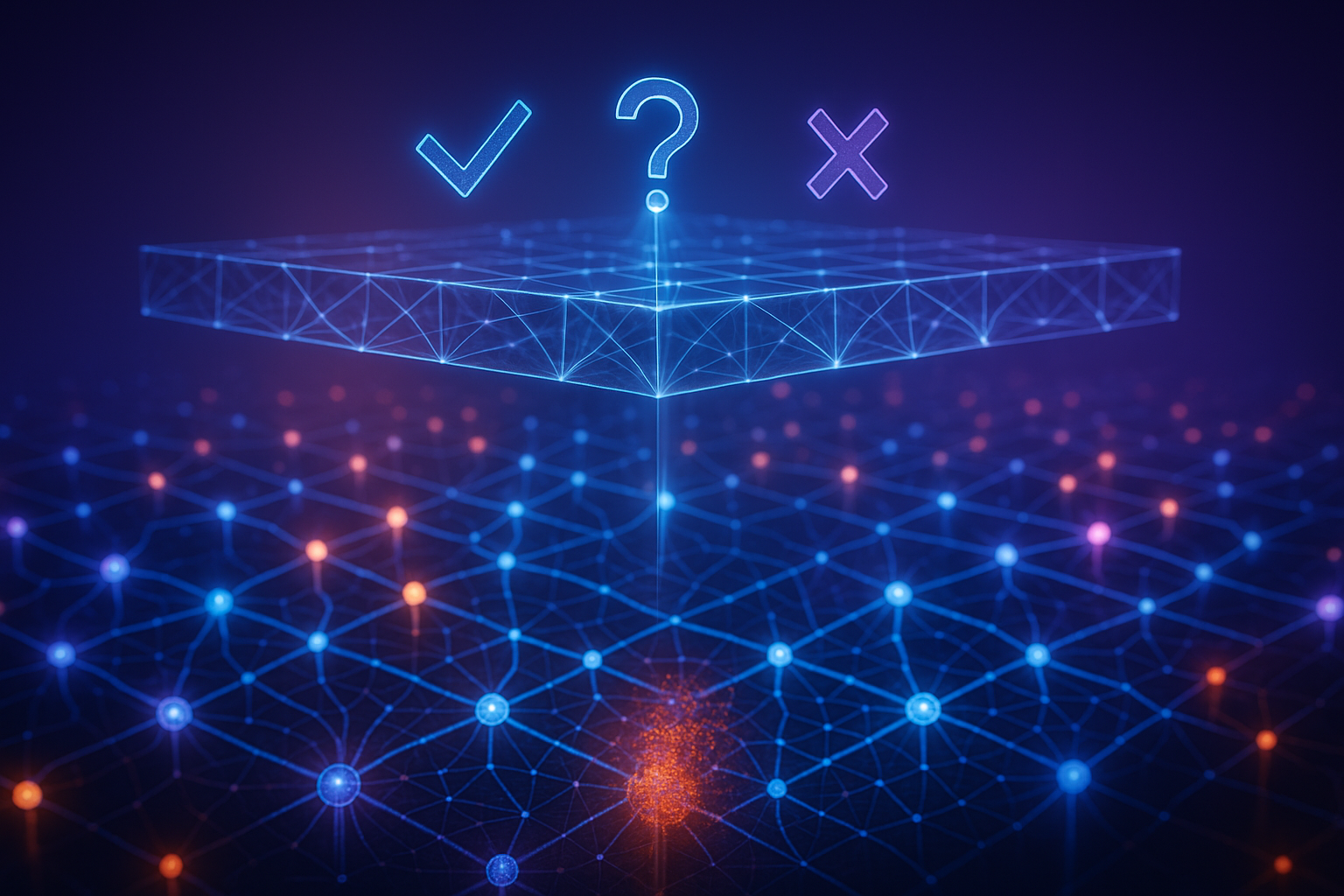
PaTAS introduces a parallel computational graph — a “Trust Nodes Network” — that mirrors the neural network’s architecture.
1. Trust Feedforward
As the model processes an input, PaTAS computes trust values for each layer, based on:
- input feature trust,
- parameter trust,
- internal activation relevance.
This creates a layer‑by‑layer trust propagation that evolves alongside normal computation.
2. Parameter‑Trust Update (PTU)
During backpropagation, gradients behave like evidence:
- Small gradients → positive evidence → the parameter is behaving consistently.
- Large gradients → negative evidence → the parameter may be unstable.
Page 9 describes Algorithm 1: PTU revises parameter trust by combining gradient evidence, label trust, and intermediate trust from feedforward. In short: parameters “earn” their credibility.
3. Inference‑Path Trust Assessment (IPTA)
When the model makes a prediction, PaTAS creates a temporary subnetwork based on the exact activations used. This path‑specific trust estimation answers:
“Given the specific neurons fired for this decision, how trustworthy is this inference?”
Contextual awareness (page 8) is crucial — not all activations matter equally.
Findings — What the Experiments Reveal
The experimental section is surprisingly aligned with business intuition: trust is not a luxury; it’s predictive of model stability.
Below is a condensed representation of the key findings.
Table 1 — How Trust Relates to Accuracy
| Scenario | Trust Mass | Train Accuracy | Test Accuracy | Interpretation |
|---|---|---|---|---|
| Clean features + clean labels | High | High | High | Healthy learning |
| Clean features + corrupted labels | Near zero | High | Low | Model learns the wrong mapping |
| Noisy labels | Moderate | Low | Low | Uncertainty spreads everywhere |
| Fully uncertain input | ≈ 0.28–0.31 | – | – | Outputs remain uncertain |
| Fully trusted input | up to 0.90 | – | – | Confidence rises when data is reliable |
Table 2 — Behavior Under Poisoning (Patch Attacks)
| Patch Size | Clean Accuracy | Poisoned Accuracy | Trust Mass Clean | Trust Mass Poisoned | Implication |
|---|---|---|---|---|---|
| 1×1 | ~80% | ~35–39% | ~0.9 | ~0.89 | Weak detectability |
| 4×4 | ~75–88% | 17–21% | 0.83–0.9 | ~0.17 | Strong separation |
| 20×20 | ~75–78% | 0–37% | ~0.3 | 0 | Trigger dominates |
| 27×27 | ~80% | 0 | <0.05 | <0.03 | Trust collapses |
The story here is clear: trust scores degrade exactly where model reliability breaks down. PaTAS exposes problems traditional accuracy simply hides.
Graphical Summary
A conceptual visualization capturing PaTAS dynamics:
| Metric | Clean Data Trend | Corrupted Data Trend |
|---|---|---|
| Trust Mass | Steady ↑ | Early plateau or sharp ↓ |
| Uncertainty | ↓ over epochs | Remains high |
| Distrust | Near 0 | Spikes when gradients conflict |
Implications — Why Business Leaders Should Care
PaTAS is not another academic detour. It speaks directly to corporate risk, regulatory pressure, and automated decision reliability.
1. AI Governance & Compliance
Regulators increasingly demand explainability and reliability, especially under adversarial conditions. PaTAS provides:
- quantifiable trust metrics,
- interpretable reasoning paths,
- early warnings for data quality issues.
Perfect ammunition for model audits and compliance reports.
2. Safety‑Critical Automation
Industries like fintech, healthcare, automotive, and cybersecurity cannot tolerate silent failures. PaTAS surfaces:
- unreliable predictions,
- poisoned data influence,
- adversarial triggers.
It functions like an internal affairs unit — watching the model even when the model seems confident.
3. Data Supply Chain Security
The attack‑surface diagram on page 13 highlights threats across the pipeline: data collection, cleaning, labeling, assembly, model training, deployment. PaTAS helps identify where trust breaks down.
For organizations pulling data from messy or third‑party sources, this is invaluable.
4. Agentic AI Systems
For businesses deploying autonomous agents:
- A “confident but wrong” agent is catastrophic.
- A “cautious but correct” agent is manageable.
PaTAS gives agents a structured way to express uncertainty and distrust.
Conclusion
PaTAS reframes neural networks not as monolithic black boxes but as systems whose reliability can be decomposed, quantified, and monitored. Rather than measuring trust after a model fails, PaTAS embeds trust directly into computation.
In an era where businesses demand dependable automation, this isn’t just a research novelty — it’s a blueprint for resilient AI.
Cognaptus: Automate the Present, Incubate the Future.