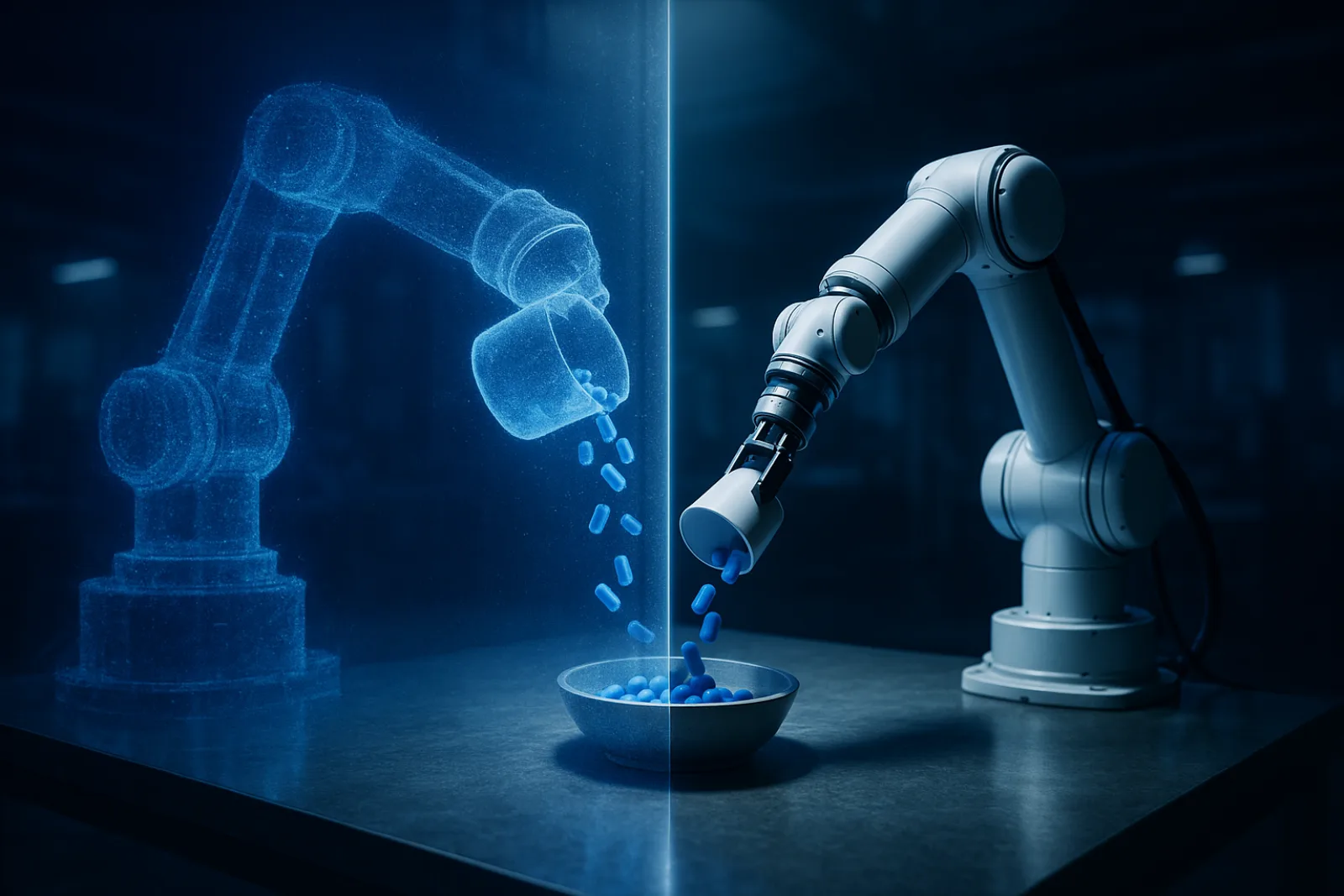
Robots are not impressed by nice videos.
A generated clip can show a hand placing a book into a shelf, pouring tomatoes from a pan, or sweeping scraps into a dustpan. It can look coherent enough to fool a casual viewer and perhaps even a product demo audience, which is not exactly the highest bar in technology. But a robot does not execute “looks coherent.” It executes poses, contacts, forces, trajectories, collisions, and failures.
That is the useful correction behind PhysWorld, a framework for learning robot manipulation from generated videos through a physical world model.1 The paper’s central claim is not that video generation has suddenly solved robotics. It is more interesting than that. It argues that generated videos can become useful task guidance only when they are converted into a physically interactable scene and then used to train a policy that corrects the video’s missing physics.
The misconception to remove early is simple: a photorealistic task video is not a robot demonstration. It is a suggestion. Sometimes a very confident suggestion. But still a suggestion.
PhysWorld’s contribution is the machinery that turns that suggestion into something closer to executable action.
The video provides intent, not physics
The system begins with a single RGB-D image and a language command. Given the scene and instruction, an image-to-video model generates a task-conditioned video showing how the task might be completed. In the paper’s examples, these tasks include wiping a whiteboard, watering flowers, putting a book into a bookshelf, pouring objects from one container to another, putting a lid on a pot, placing a shoe into a shoebox, and sweeping scraps into a dustpan.
This is the seductive part of the idea. If a general video generator can synthesize many plausible demonstrations, then robot teams might avoid collecting endless task-specific demonstrations on real hardware. The business implication is obvious: fewer bespoke robot data-collection campaigns, less teleoperation, and a faster path from “describe the task” to “test a policy.”
Obvious, however, is not the same as true.
The paper is careful about the missing middle. Generated videos are pixel-level visual guidance. They do not automatically contain metric scale, stable object geometry, contact dynamics, reliable hand kinematics, or feasible robot motions. A video can show an object moving from A to B without specifying a physically valid way for a gripper to make that happen.
So PhysWorld does not directly retarget the generated video. That is the important design decision. It treats the video as an input to reconstruction and learning, not as a script.
PhysWorld inserts a physical model between imagination and action
The mechanism is best understood as a translation stack. Each layer removes one kind of ambiguity from the generated video.
| Stage | What enters | What PhysWorld adds | Why it matters |
|---|---|---|---|
| Task-conditioned video generation | RGB-D image and language command | A visual hypothesis of task completion | Supplies task-level intent without real robot demonstrations |
| Geometry-aligned 4D reconstruction | Generated video frames | Metric-aligned depth and dynamic point clouds | Converts pixels into spatial structure that a robot can reason over |
| Textured mesh generation | Partial views of objects and background | Complete object and background meshes | Makes the scene usable in physics simulation |
| Physical scene assembly | Meshes | Estimated physical properties, gravity alignment, collision correction | Turns geometry into an interactable world, not just a pretty 3D asset |
| Object-centric residual RL | Object pose trajectories and baseline robot actions | Corrective policy trained with physical feedback | Converts visual motion into feasible manipulation behaviour |
This is not merely a technical pipeline. It is the paper’s thesis in operational form. Generated video is broad but physically unreliable. Physics simulation is constrained but actionable. PhysWorld tries to make them compensate for one another.
The reconstruction starts by estimating a 4D spatio-temporal representation from the generated video. The authors use MegaSaM to produce temporally consistent depth estimates, then calibrate those estimates using the real RGB-D observation from the first frame. In plain terms, the system anchors the generated video’s geometry to metric reality rather than trusting the video’s internal sense of scale. A robot arm, inconveniently, does not accept “roughly over there” as a coordinate system.
Then the system generates textured meshes. The background is completed by removing object pixels and inpainting the missing regions. Objects are reconstructed using an image-to-3D generator. For occluded background geometry, the method uses an object-on-ground assumption: objects are supported by the background, so hidden regions can be filled as supporting planes or bounded scene extensions.
This assumption is practical, but it also quietly defines the problem class. PhysWorld is well aligned with tabletop-style manipulation where objects sit on surfaces. It is not, from this evidence, a general solution for every messy physical environment. The elegance comes with furniture.
A physics scene needs gravity, friction, and fewer invisible explosions
Meshes alone are not enough. Many 3D assets look acceptable until a simulator tries to use them, at which point they collide, float, sink, or otherwise express their contempt for the pipeline.
PhysWorld therefore adds three physical assembly steps.
First, it estimates physical properties such as mass and friction coefficients using commonsense knowledge from vision-language models. Second, it aligns the scene with gravity by estimating the ground plane normal and rotating the reconstructed scene into a world frame. Third, it performs collision optimisation using a signed distance field so that objects are not initially intersecting the background.
This sounds mundane because physics usually does. But this is exactly the difference between a video-derived fantasy and a training environment that can give useful feedback. If an object is already penetrating the table in simulation, the robot does not learn manipulation. It learns from a broken stage set.
The business relevance is also mundane, and therefore important. In robotics, the expensive part is rarely producing an impressive one-off demo. The expensive part is building a repeatable loop that can absorb new tasks, scenes, and objects without turning every deployment into a handcrafted theatre production. PhysWorld’s physical scene reconstruction is a move toward that loop.
The robot follows the object, not the hallucinated hand
Generated videos often contain embodiment motion: hands, arms, or tools appearing to perform the task. The temptation is to copy that motion. PhysWorld largely avoids this. It focuses on object motion.
That is a sensible act of editorial restraint by the algorithm. Hands in generated videos can be inconsistent, anatomically odd, occluded, or just plain imaginary in the way video models sometimes are. The object’s motion is usually a more stable representation of task success. For many manipulation tasks, what matters is not whether the generated hand had five fingers and a plausible wrist. What matters is whether the lid ends up on the pot, the shoe ends up in the box, or the tomato ends up on the plate.
PhysWorld extracts object pose trajectories from the reconstructed scene using FoundationPose. These pose trajectories become the learning target. The robot is trained to move the object according to the video’s intended object motion, not to imitate the generated human or robot body.
The policy itself is residual reinforcement learning. A baseline grasping-and-planning system proposes actions, using tools such as a grasping model and motion planner. The RL policy then learns corrections on top of those baseline actions. The executed action is essentially:
That formula is doing more than decorating the page. It explains why the method is efficient. Training from scratch asks reinforcement learning to discover everything: how to grasp, where to move, how to avoid impossible poses, and how to complete the task. Residual RL narrows the search. The baseline gives a plausible but imperfect plan; the learned policy fixes it using feedback from the physical world model.
This is also why the method is commercially more interesting than a pure “learn from video” story. Businesses do not need robots that philosophically appreciate generated media. They need systems that can use existing planning stacks, correct their errors, and reduce the engineering burden of adding new tasks. Residual learning is an integration pattern, not just a performance trick.
The main evidence is the real-world success rate, not the reconstruction pictures
The experimental section has several components, and they do different jobs. Treating them as one undifferentiated “results” blob would miss the paper’s actual evidentiary structure.
| Evidence component | Likely purpose | What it supports | What it does not prove |
|---|---|---|---|
| Qualitative task examples | Demonstration of scope | The pipeline can be applied across varied tabletop manipulation tasks | Broad industrial generality |
| Video generator comparison | Sensitivity test for upstream quality | Downstream manipulation depends heavily on usable generated videos | That any video model is sufficient |
| Physical scene reconstruction examples | Implementation evidence | The method can build interactable scenes from generated videos | Exact reconstruction accuracy in all settings |
| Ten-task real-world comparison | Main evidence | PhysWorld outperforms zero-shot baselines without physical world modeling | Long-horizon reliability or safety certification |
| Failure mode analysis | Diagnostic evidence | Physical feedback reduces some grasping and tracking failures | That reconstruction errors are solved |
| Object-centric vs embodiment-centric comparison | Ablation / design validation | Object motion is a better supervision target than generated hand motion | That object-centric learning solves all manipulation types |
| Residual RL vs RL from scratch | Training-efficiency ablation | Residual learning improves convergence under the tested budget | That residual RL always dominates in every environment |
The headline result is the ten-task real-world comparison. The authors evaluate ten manipulation tasks with ten rollouts per task and compare PhysWorld against three zero-shot methods that do not use physical world modeling: RIGVid, Gen2Act, and AVDC. PhysWorld reaches an average success rate of 82%, while the strongest baseline, RIGVid, reaches 67%.
That 15-point improvement matters because the comparison is not against a strawman. RIGVid also uses object poses from generated videos and combines grasping with motion planning. The difference is that PhysWorld inserts a physical world model and trains residual corrections inside it. The result suggests that the added simulation feedback is not cosmetic; it reduces compounding errors in phases such as grasping, insertion, and pouring.
The failure analysis sharpens this interpretation. Compared with RIGVid, PhysWorld reduces grasping failures from 18% to 3% and tracking failures from 5% to 0%. That is the paper’s clearest mechanism-to-result bridge. The world model appears to help where direct video retargeting is brittle.
But there is a trade-off. PhysWorld introduces 7% reconstruction errors. The authors attribute these largely to reconstructing a physical scene from monocular generated video, especially where occluded regions are completed incorrectly. That is not a minor footnote. It is the cost of asking a reconstruction pipeline to infer physical geometry from partial, generated evidence. The method reduces some failure modes by creating a world model, while creating a new failure mode when that world model is wrong. Physics, as usual, sends an invoice.
The video generator is the ceiling, not the wrapping paper
One of the most useful results in the paper is not the 82% success rate. It is the video generation quality test.
The authors compare four image-to-video models and measure the ratio of generated videos that are usable, meaning videos from which object poses can be recovered robustly. The results are blunt:
| Video model | Usable-video ratio |
|---|---|
| Veo3 | 70% |
| Tesseract | 36% |
| CogVideoX1.5-5B | 4% |
| Cosmos-2B | 2% |
This is a sensitivity test, and it should be read as such. It does not say Veo3 is a universal answer for robot learning. It says the downstream system is only as good as the task-consistent video evidence it receives. Even with the strongest generator tested, 30% of generated videos were not usable by the pipeline’s criterion.
For business readers, this is where the deployment fantasy needs a haircut. PhysWorld does not mean an operations team can write any instruction, generate one video, and expect reliable execution. A practical version would need video screening, multiple generations, confidence scoring, fallback behaviours, and likely domain-specific constraints. The generated video is not a magic source of truth. It is an upstream proposal that must survive reconstruction.
That said, the usable-video result is also strategically encouraging. It suggests a clear improvement path. Better video generators, especially those trained or fine-tuned for robotics, could directly improve the feasibility of this kind of pipeline. The paper notes that Tesseract, a robotics-oriented generator, performs better than generic models such as CogVideoX1.5-5B and Cosmos-2B in this test, even though Veo3 leads overall. The lesson is not “bigger video model wins forever.” The lesson is that physical task consistency is a first-class requirement.
Object-centric learning is not a taste preference; it is a robustness choice
The paper’s object-centric design receives a focused comparison against embodiment-centric learning. The embodiment-centric variant reconstructs a human hand mesh and maps finger keypoints to robot end-effector trajectories. The object-centric variant trains policies to follow object motions.
The results are not subtle. For “put the book in the bookshelf,” object-centric learning reaches 90% success versus 30% for embodiment-centric learning. For “put the shoe in the shoebox,” object-centric learning reaches 80% versus 10%.
This ablation supports a useful principle: when the embodiment in generated video is unreliable, track the outcome-bearing object instead. The generated hand is a means; the object state is the task.
That principle has business implications beyond this paper. In many automation settings, success is defined by object state: the part is inserted, the container is filled, the item is placed, the surface is wiped. If generated or observed human motion is noisy, policy learning should privilege the physical state transition that matters to the workflow. The hand can keep its cinematic ambitions to itself.
Residual RL makes the method look less magical and more deployable
The residual RL comparison is another design validation. The authors compare residual RL with RL from scratch on the task of pouring a tomato from a pan onto a plate. Under the same physical world model and training budget, residual RL converges within a few hundred iterations and obtains higher object tracking rewards.
This is not the main real-world benchmark. It is an ablation aimed at showing why the policy-learning layer is structured as a correction system rather than a blank-slate learner.
The business interpretation is straightforward. Robots in production will not be deployed as pure learners discovering the world from nothing, unless someone has confused a factory floor with a PhD qualifying exam. They will combine perception, planning, control, simulation, and learned correction. PhysWorld fits that more plausible pattern. It uses classical or pre-trained components to get close, then learns residuals to handle the messy gap between a generated visual plan and feasible manipulation.
That is the kind of architecture that can be incrementally adopted. A company does not need to replace its entire robotics stack to explore this direction. It can begin by asking where generated task media, scene reconstruction, and residual policy learning can reduce the marginal cost of adding new manipulation behaviours.
The business value is cheaper task specification, not instant robot autonomy
What does the paper directly show?
It shows that, across ten real-world tabletop manipulation tasks with ten rollouts each, PhysWorld outperforms zero-shot baselines that rely on generated-video cues without physical world modeling. It shows that physical feedback can reduce grasping and tracking failures. It shows that object-centric supervision is more reliable than imitation of generated hand motion in the tested cases. It also shows that video generation quality is a serious bottleneck.
What can Cognaptus infer for business use?
The practical value is not “robots can now learn from any video.” The value is a possible reduction in the cost of specifying and adapting robot tasks. Instead of collecting a large dataset of real demonstrations for every new manipulation, a system could generate task-level visual hypotheses, reconstruct a simulated physical scene, train corrective policies, and test before deployment.
That points to several plausible business pathways:
| Business pathway | Why PhysWorld is relevant | Boundary |
|---|---|---|
| Faster prototyping of manipulation tasks | Generated videos provide task intent; simulated physical scenes provide training feedback | Still needs robust reconstruction and validation before real deployment |
| Lower dependence on teleoperated demonstrations | The method is designed to avoid task-specific real robot data collection | It still depends on pre-trained models, RGB-D sensing, planners, and simulators |
| More reusable automation workflows | Object-centric targets map naturally to operational success states | Best suited to tasks where object state is observable and reconstructable |
| Simulation-first deployment testing | Physical world models can expose failures before hardware execution | Sim-to-real gaps remain, especially when geometry or dynamics are wrong |
| Domain-specific robotics tooling | Video generation and reconstruction could be constrained to known objects and workcells | Evidence does not yet cover open industrial variability |
The commercial promise is therefore narrower but more credible than the marketing version. PhysWorld is not replacing robotics engineering. It is proposing a new interface between generative AI and robotics engineering: generated video as task proposal, physical reconstruction as grounding, residual learning as correction.
That is a useful architecture because it respects where generative models are strong and where they are still rather theatrical.
The boundaries are narrow enough to matter
The limitations are not generic academic modesty. They define where the result should and should not be trusted.
First, the evaluation is limited to ten real-world manipulation tasks with ten rollouts each. That is meaningful for a robotics paper, but it is not a reliability profile for industrial deployment. An 82% average success rate is impressive against the baselines, not acceptable as-is for many commercial operations.
Second, the tasks are largely tabletop-style interactions with objects that can be reconstructed and manipulated in relatively structured scenes. The object-on-ground assumption helps the reconstruction pipeline, but it also narrows the applicable environment.
Third, the method relies on RGB-D input and a chain of specialised components: video generation, depth reconstruction, inpainting, image-to-3D mesh generation, VLM-based physical property estimation, pose tracking, grasping, motion planning, simulation, and PPO-based residual learning. The phrase “no real robot data collection” should therefore be read precisely. It means no task-specific real robot demonstrations in this setup. It does not mean no infrastructure, no modelling assumptions, or no dependency on large pre-trained systems.
Fourth, the world model can be wrong. The failure analysis shows 7% reconstruction errors for PhysWorld. Better multi-view reconstruction could mitigate this, as the authors suggest, but that would also change the deployment setup. More sensing can improve reliability, but it reduces the neatness of the “single generated video” story. Tragic, but operationally familiar.
Finally, physical simulation itself has fidelity limits. If the simulator’s contact, friction, mass, or geometry assumptions diverge from reality, residual policies can inherit those distortions. PhysWorld argues that the world model is still worth introducing, and the results support that within the tested setting. They do not remove the sim-to-real problem. They move it into a more structured place.
The useful lesson is architectural, not cinematic
PhysWorld is an important paper because it refuses to confuse visual plausibility with physical executability. It treats generated video as an abundant but unreliable source of intent, then forces that intent through geometry, meshes, physical properties, gravity, collision correction, object pose tracking, and residual reinforcement learning.
That is not as glamorous as saying “AI watches a video and controls a robot.” It is also much closer to how useful automation systems are actually built.
The headline number, 82% versus 67%, is worth noting. But the deeper lesson is the mechanism behind the improvement. Generated videos become more useful when they are not trusted directly. They become useful when they are interrogated, reconstructed, constrained, and corrected.
For businesses watching the collision between generative AI and robotics, that is the right mental model. The near-term opportunity is not replacing physical engineering with synthetic imagination. It is using synthetic imagination to propose behaviours, then making physics decide which proposals survive.
Robots may one day learn fluently from generated demonstrations. For now, they still need a world that pushes back.
Good. That means someone remembered the table exists.
Cognaptus: Automate the Present, Incubate the Future.
-
Jiageng Mao, Sicheng He, Hao-Ning Wu, Yang You, Shuyang Sun, Zhicheng Wang, Yanan Bao, Huizhong Chen, Leonidas Guibas, Vitor Guizilini, Howard Zhou, and Yue Wang, “Robot Learning from a Physical World Model,” arXiv:2511.07416, 2025. https://arxiv.org/abs/2511.07416 ↩︎