TL;DR for operators
DeepScholar-Bench is useful because it turns “deep research” from a demo category into a measurable workflow: retrieve the right sources, synthesize the right facts, and attach citations that actually support the claims.1
The headline result is not flattering. No evaluated system exceeds a 31% geometric mean across all metrics. OpenAI DeepResearch leads overall with a 0.309 geometric mean, but its best-looking strengths hide serious gaps: 0.857 on organization, 0.392 on nugget coverage, 0.187 on reference coverage, and 0.124 on document importance. Translation: the report may read well while still missing the intellectual furniture.
DeepScholar-ref, the authors’ open reference pipeline, is not magic. That is the point. It uses iterative search, semantic filtering, LLM-based ranking, and aggregation. It competes surprisingly well, especially on verifiability, and the GPT-4.1 + o3 variant is reported as 4.3× cheaper and 2.28× faster than OpenAI DeepResearch in the paper’s setup. But it still leaves large gaps in source discovery and fact coverage.
For enterprise buyers, the lesson is blunt: do not buy research agents by reading a sample report and nodding solemnly at the formatting. Test them on source coverage, important-source recall, citation precision, claim coverage, latency, and cost. Elegance is not evidence. It is just typography with ambition.
The boundary is equally important. DeepScholar-Bench evaluates academic related-work generation using recent ArXiv papers and automated LLM-based judging, partially validated against human annotations. That makes it a strong evaluation pattern for research workflows, not a universal benchmark for every legal, market, medical, or internal knowledge task.
The uncomfortable number is 31%, not the logo on the research agent
Research teams already know the seductive version of AI research. A user asks a broad question. The system disappears into the web. Minutes later, a handsome report appears: sections, citations, confident synthesis, perhaps even a tasteful executive summary. Everyone relaxes because the object looks like work.
DeepScholar-Bench exists to spoil that little theatre.
The paper asks a more useful question: not whether an AI system can produce something that resembles a research report, but whether it can perform the three jobs hidden inside one. Did it retrieve the right material? Did it surface the essential facts? Did the citations actually support the claims?
That is why the 31% figure matters. Across open-source research systems, search agents using frontier models, OpenAI DeepResearch, and the authors’ DeepScholar-ref pipeline, no system surpasses a 0.31 geometric mean across the benchmark’s metrics. This is not a small stylistic defect. It is evidence that the current “deep research” stack is still uneven across the capabilities that make research valuable.
The most instructive part is the split. Systems can score well on organization while doing much worse on coverage. OpenAI DeepResearch reaches 0.857 on organization and 0.392 on nugget coverage. In other words, it is much better at arranging the answer than at capturing the essential facts. That is not surprising. Structure is cheap once the model is strong. Exhaustiveness, source judgment, and claim-level grounding remain expensive.
This is the misconception DeepScholar-Bench corrects: a polished research report is not the same thing as research synthesis. It may only be a fluent compression of whatever the retrieval layer happened to find. Very elegant. Still possibly wrong.
DeepScholar-Bench tests the workflow, not an answer box
The benchmark task is deliberately concrete. Given a paper description, systems must generate a related-work section by retrieving, synthesizing, and citing prior research. The benchmark uses recent ArXiv papers accepted at conferences, extracts their human-written related-work sections, and uses those sections and citations as expert exemplars.
The June 2025 evaluation slice contains 63 ArXiv papers across 18 computer-science domains. The pipeline filters for recent, v1 papers, conference-accepted or published papers, explicit related-work sections, and usable bibliography files. This design is trying to avoid the two classic benchmark diseases: staleness and contamination. If the task keeps refreshing with recent papers, memorization becomes less useful. How rude to the leaderboard economy.
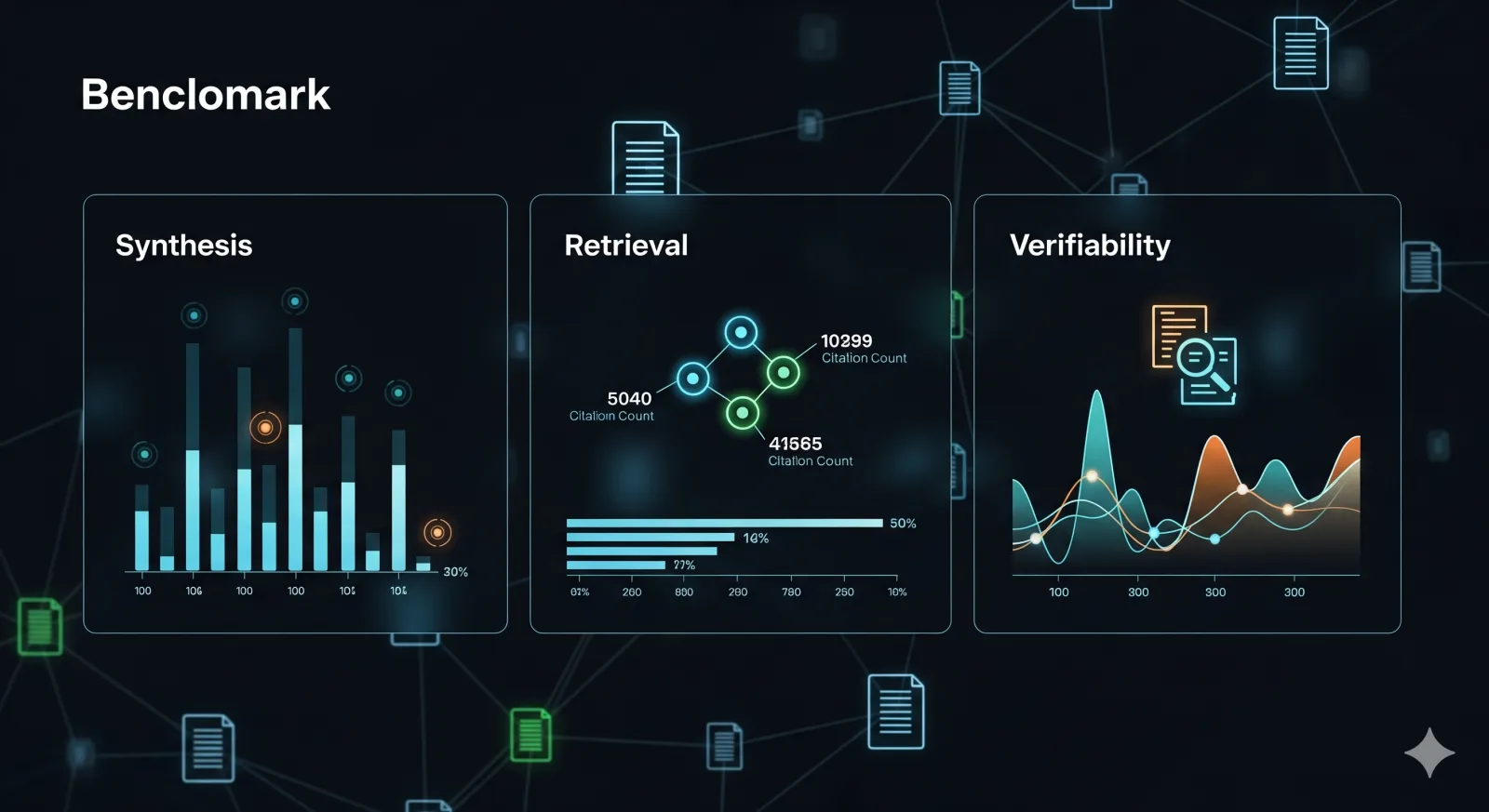
The evaluation is built around seven metrics grouped into three dimensions:
| Dimension | Metric | What it tests | Operator question |
|---|---|---|---|
| Knowledge synthesis | Organization & Coherency | Whether the output is well structured compared with the human exemplar | Does the report read like a serious synthesis? |
| Knowledge synthesis | Nugget Coverage | Whether essential facts from the exemplar appear in the generated report | Did it capture the points that matter? |
| Retrieval quality | Relevance Rate | Whether cited sources are relevant to the query | Is the reading list on topic? |
| Retrieval quality | Reference Coverage | Whether the system retrieved important references from the exemplar | Did it miss must-cite work? |
| Retrieval quality | Document Importance | Whether cited sources are notable, using citation counts | Is it citing consequential work or just nearby debris? |
| Verifiability | Citation Precision | Whether cited sources support the sentence they accompany | Are citations attached to claims properly? |
| Verifiability | Claim Coverage | Whether claims are fully supported by cited sources within a local window | Can a reader verify the report without doing the work again? |
This is a better framing than asking whether an answer “sounds good”. Research synthesis is not one skill. It is a chain. A system can retrieve relevant papers but miss the important ones. It can find important sources but fail to extract the right facts. It can say correct things but cite them badly. It can cite correctly but be incomplete. DeepScholar-Bench makes those failures visible instead of folding them into one vague score and hoping nobody asks awkward questions.
The results say “good writer”, not “good researcher”
The benchmark’s main result is a performance profile, not merely a ranking.
OpenAI DeepResearch is the strongest overall baseline, with a 0.309 geometric mean. It also leads among prior methods on several knowledge and retrieval measures: 0.857 organization, 0.392 nugget coverage, 0.629 relevance rate, 0.187 reference coverage, and 0.124 document importance. Those numbers tell a very specific story.
First, organization is relatively tractable. Strong systems can produce coherent, well-structured reports. That is what modern LLMs are good at: arranging language into persuasive order.
Second, essential fact coverage is still weak. No prior method gets above 0.40 on nugget coverage. This is the more operationally painful failure. A report can have the right headings and still omit the facts a specialist would consider central. For a business reader, this is the difference between “the assistant produced a brief” and “the assistant reduced my risk of missing something important”.
Third, retrieval quality is not solved by relevance alone. DeepResearch’s relevance rate of 0.629 is higher than the human exemplar’s 0.585, but its reference coverage and document importance remain much lower. That means the system can retrieve sources that are plausibly relevant while still failing to recover a comprehensive set of notable, must-include sources. The distinction matters. Relevance asks, “Is this source related?” Coverage asks, “Did you find the sources that cannot be absent?” The second question is where procurement departments should start sweating gently.
Fourth, verifiability remains uneven. DeepResearch scores 0.399 on citation precision and 0.138 on claim coverage. Some search-agent and DeepScholar-ref variants do better on citation support. For example, the Claude search agent reports 0.701 citation precision and 0.760 claim coverage, while DeepScholar-ref variants reach even higher citation precision or claim coverage in the table. This suggests that systems optimized around report production do not automatically optimize for auditability. Apparently “put citations nearby” and “make the claim traceable” are not the same task. Who could have guessed.
DeepScholar-ref is boring architecture with useful consequences
The authors also introduce DeepScholar-ref, an open-source reference pipeline implemented with LOTUS semantic operators. The architecture is not exotic. It iteratively generates search queries, retrieves sources, filters irrelevant documents, ranks the remaining candidates, and aggregates the selected sources into the final report.
That plainness is valuable. DeepScholar-ref is not presented as the final form of research automation. It is a baseline that makes the pipeline inspectable. Each stage corresponds to an operational control point:
| Pipeline stage | Technical function | Enterprise control point |
|---|---|---|
| Query generation | Produce search queries from the paper description and previous retrievals | Log search intent and detect narrow or drifting queries |
| Retrieval | Pull candidate papers from the configured search API | Compare vendor search, internal indexes, and domain-specific corpora |
| Semantic filtering | Remove irrelevant candidates | Audit false exclusions and tune thresholds |
| Semantic top-k ranking | Rank sources by relevance | Measure important-source recall, not just topical fit |
| Aggregation | Generate the cited report from selected sources | Check claim support, unsupported claims, and citation placement |
DeepScholar-ref performs competitively against search agents and OpenAI DeepResearch across many metrics. The GPT-4.1 + o3 version reaches a 0.285 geometric mean, close to OpenAI DeepResearch’s 0.309. The GPT-4.1 + Claude version reaches 0.286. More importantly, the reference pipeline often performs better on verifiability. The paper reports that DeepScholar-ref achieves up to 6.3× higher verifiability scores than OpenAI DeepResearch, while its GPT-4.1 + o3 configuration is 4.3× cheaper and 2.28× faster in the reported setup.
That cost-latency comparison should not be over-read. It is tied to the authors’ experimental configuration, model prices, search restrictions, and implementation choices. Still, it points to a practical lesson: research agents should be evaluated as systems, not personalities. A modular pipeline with inspectable retrieval, filtering, ranking, and aggregation may be easier to improve than a sealed “deep research” button whose main interface is theatrical patience.
The reference pipeline is not a victory lap. It still underperforms badly on source importance and knowledge coverage. But it gives builders a more useful starting point than “ask a large model to go research things and hope its citations behave”.
The oracle retrieval ablation shows where the machine is bleeding
The most useful experiment is the retrieval ablation. Its purpose is not to propose an oracle as a product feature. Oracles have poor market availability, mostly because reality continues to be inconvenient. The ablation asks: if the system were given the important references, how much of the problem would remain?
The answer is: retrieval is a major bottleneck, but not the only one.
For the GPT-4.1 + Claude DeepScholar-ref configuration, the normal ArXiv retrieval setting has a 0.286 geometric mean. Parallel.ai retrieval improves it to 0.334. Tavily retrieval drops it to 0.258. But oracle retrieval using ArXiv important references pushes the score to 0.808, and oracle retrieval using all important references reaches 0.782.
That is a dramatic diagnostic result. It says that much of the current failure comes from not finding the right sources. When the system gets a near-ideal source set, retrieval quality and verifiability nearly saturate.
But the result also refuses to be simplistic. Even with oracle retrieval, nugget coverage does not reach perfection. The best oracle setting for GPT-4.1 + Claude reaches 0.528 nugget coverage. That means source access alone does not solve synthesis. Once the right documents are available, the system still has to extract the right facts, decide what matters, and compose a useful intellectual map.
This matters for enterprise deployment because many teams treat retrieval as plumbing. It is not plumbing. It is product logic. A research agent that searches badly will write elegantly around missing evidence. A research agent that searches well may still need claim planning, source prioritization, and coverage checks to prevent it from producing a beautifully cited half-answer.
The human validation supports the benchmark, not blind faith in judges
DeepScholar-Bench uses LLM judges for several evaluation steps, so the obvious objection is that the benchmark may simply be replacing one model’s opinion with another model’s opinion and calling it science. The paper addresses this with human validation.
In the main human evaluation, 11 computer-science PhD annotators from four North American research universities provide more than 300 annotations. The paper reports 71.43% agreement for organization pairwise comparisons, 83.33% agreement for nugget labeling, and 65.9% agreement for reference-importance labeling. The appendix also reports manual validation across more than 400 annotations, with agreement scores of 78% for organization, 72% for nugget importance, 70% for nugget coverage, 70% for retrieval relevance, 82% for reference coverage, 80% for citation precision, and 80% for claim coverage.
This is enough to make the automated evaluation useful. It is not enough to make it divine.
The reference-importance task is especially instructive. Human and LLM agreement is lower there than on nugget labeling. That makes sense: deciding whether a source is essential is partly a field judgment. Two competent researchers may disagree about whether a citation is foundational or merely useful. The paper also notes that under-labeling of essential references makes reference coverage conservative, because the metric may only capture a subset of truly important references.
For business evaluation, the lesson is straightforward. LLM judges are acceptable as scalable screening tools, especially when paired with spot human audits. They are not a substitute for expert review in high-stakes domains. Use them to detect failure patterns, compare systems, and monitor drift. Do not use them as a ceremonial rubber stamp. Ceremonial rubber stamps already have enough competition.
What the paper directly shows, and what operators should infer
The paper directly shows that current research synthesis systems remain far from saturated on this benchmark. It shows that the gap is not one-dimensional. Knowledge coverage, source coverage, source importance, and citation support fail in different ways. It shows that a modular reference pipeline can compete with larger or more commercial systems, especially on verifiability and efficiency. It shows that better retrieval dramatically improves performance, but does not eliminate the synthesis problem.
Cognaptus would infer the following operational rule: a research agent should not be accepted into enterprise workflows until it has passed a multi-metric evaluation on the organisation’s own task distribution.
That evaluation does not need to be huge. But it does need to be real. A good internal benchmark should include representative questions, expert-written answers or briefs, known good source lists, and claim-level evidence checks. The output should not be a single thumbs-up score. It should look more like this:
| Buying or build decision | Metric to inspect | Failure it catches | Practical response |
|---|---|---|---|
| “Does the report read well?” | Organization | Fluent but shallow output | Keep style scoring separate from factual scoring |
| “Did it capture the essentials?” | Nugget Coverage | Missing key facts or arguments | Build task-specific fact checklists from expert briefs |
| “Did it find the right sources?” | Reference Coverage | Missing must-cite or must-read material | Maintain curated source sets and evaluate retrieval recall |
| “Are sources consequential?” | Document Importance | Citing minor or peripheral material | Add source-quality priors such as venue, citation graph, policy authority, or internal trust labels |
| “Are claims auditable?” | Citation Precision and Claim Coverage | Citations that decorate rather than support | Require sentence-level evidence snippets and unsupported-claim panels |
| “Is this deployable?” | Latency and cost | Beautiful systems nobody can afford to run | Compare pipeline variants under realistic workloads |
This is where DeepScholar-Bench becomes more than an academic leaderboard. It gives enterprises a vocabulary for rejecting shallow demos. A vendor can no longer say, “Here is a nice report.” The buyer can ask, “What was your reference coverage? Which important sources did you miss? How many claims were unsupported? What did it cost? How long did it take? Can we inspect the retrieval log?”
Suddenly the room becomes less magical. Excellent.
Where this benchmark does not travel cleanly
DeepScholar-Bench is valuable precisely because it is specific. That specificity also creates boundaries.
First, the task is academic related-work generation. This is a strong proxy for research synthesis, but it is not the same as legal due diligence, market intelligence, medical evidence review, cyber threat analysis, or internal corporate knowledge search. Those domains have different source hierarchies, evidence standards, update cycles, and liability surfaces.
Second, the main experimental setup restricts systems to ArXiv search for fairness and leakage control. That makes comparisons cleaner, but it differs from open-web or enterprise retrieval settings where sources include PDFs, websites, databases, internal documents, spreadsheets, ticket histories, and messages from that one shared drive nobody admits owning.
Third, source importance is partly operationalised through citation counts and exemplar-derived importance labels. That is sensible for academic literature, but citation counts can encode popularity, age, and field effects. In enterprise settings, the “important” document may be a two-page internal memo, not a highly cited paper.
Fourth, verifiability metrics depend on entailment judgments and citation windows. The paper uses a local window for claim coverage, which reflects how real writing often places citations near related claims rather than inside every sentence. But wider windows also make verification more forgiving. A compliance team may prefer stricter same-sentence or exact-span evidence, even if that penalises readable prose.
Finally, automated evaluation should be treated as a control system, not as final truth. The paper’s human validation is encouraging, but high-stakes deployment still requires human spot checks, especially when missed evidence can create financial, legal, medical, or operational harm.
The benchmark’s real benefit is making “deep research” falsifiable
The phrase “deep research” invites vague admiration. DeepScholar-Bench makes it harder to admire the wrong thing.
The paper’s contribution is not merely another benchmark. It is a decomposition of a product promise. If an AI system claims to conduct research, it must retrieve important sources, synthesize essential facts, and cite claims in a way readers can verify. If it fails any one of those, the final report may still look impressive. It may also be operationally unsafe.
For builders, the next step is not to chase one higher leaderboard number. It is to redesign research agents around coverage planning, retrieval evaluation, source importance, and claim-level audit. For buyers, the next step is to stop evaluating vendors through demo theatre. Ask for the logs. Ask for the missed-source analysis. Ask for unsupported claims. Ask what happens when the task is new, niche, and inconvenient.
That is the useful discomfort DeepScholar-Bench provides. It does not say research agents are useless. It says they are measurable. In enterprise AI, that is usually when the real work begins.
Cognaptus: Automate the Present, Incubate the Future.
-
Liana Patel, Negar Arabzadeh, Harshit Gupta, Ankita Sundar, Ion Stoica, Matei Zaharia, and Carlos Guestrin, “DeepScholar-Bench: A Live Benchmark and Automated Evaluation for Generative Research Synthesis,” arXiv:2508.20033, https://arxiv.org/abs/2508.20033. ↩︎