TL;DR for operators
A familiar enterprise AI failure looks like this: the model gives a confident answer, the formatting is exquisite, the explanation sounds like a gifted teaching assistant, and one equation quietly takes the project into a ditch. Physics is an unusually good place to study that failure because being clear is not enough. The system must interpret the situation, select the right principle, keep the units straight, calculate correctly, and not hallucinate a helpful-but-illegal assumption because the prompt looked lonely.
The PhysicsEval paper introduces a large open-ended physics benchmark and tests whether inference-time verification can improve LLM problem solving without retraining.1 The researchers evaluate six models on 1,962 test problems using four settings: plain baseline answering, self-refinement, a single external reviewer, and a multi-agent review pipeline. The broad headline is positive for multi-agent review: on average, it produces the highest Physics Proficiency Score across easy, medium, and hard problems.
The operational lesson is more interesting than “add agents”. Self-checking is unreliable. A model reviewing its own answer can slightly improve one dimension while damaging completeness and clarity elsewhere. A single external reviewer is also not enough in the paper’s more careful statistical analysis: for o4-mini, it shows no significant overall PPS gain and significantly worsens completeness and clarity. Multi-agent review, by contrast, produces statistically significant improvements for o4-mini in overall PPS, mathematical accuracy, and formula/principle use.
That does not make multi-agent verification a free lunch. On the main table, the average gains are modest, and some model-category combinations degrade. The category heatmap is best read as exploratory diagnosis, not as a second universal law of agentic intelligence. The paper’s actual business implication is narrower and more useful: use external verifier agents where correctness is expensive, mistakes are structured, and latency or compute cost can be tolerated. In tutoring, technical support, engineering analysis, scientific QA, and regulated workflows, that is a real design pattern. In real-time, low-margin, or weakly specified tasks, it may be theatrical overhead with invoices.
The result is not “agents win”; it is “self-correction is not quality control”
The paper’s most useful finding is a correction to a lazy belief: if an LLM can reason, surely it can also check its own reasoning. That belief has a pleasant symmetry. It is also exactly the kind of symmetry that reality enjoys vandalising.
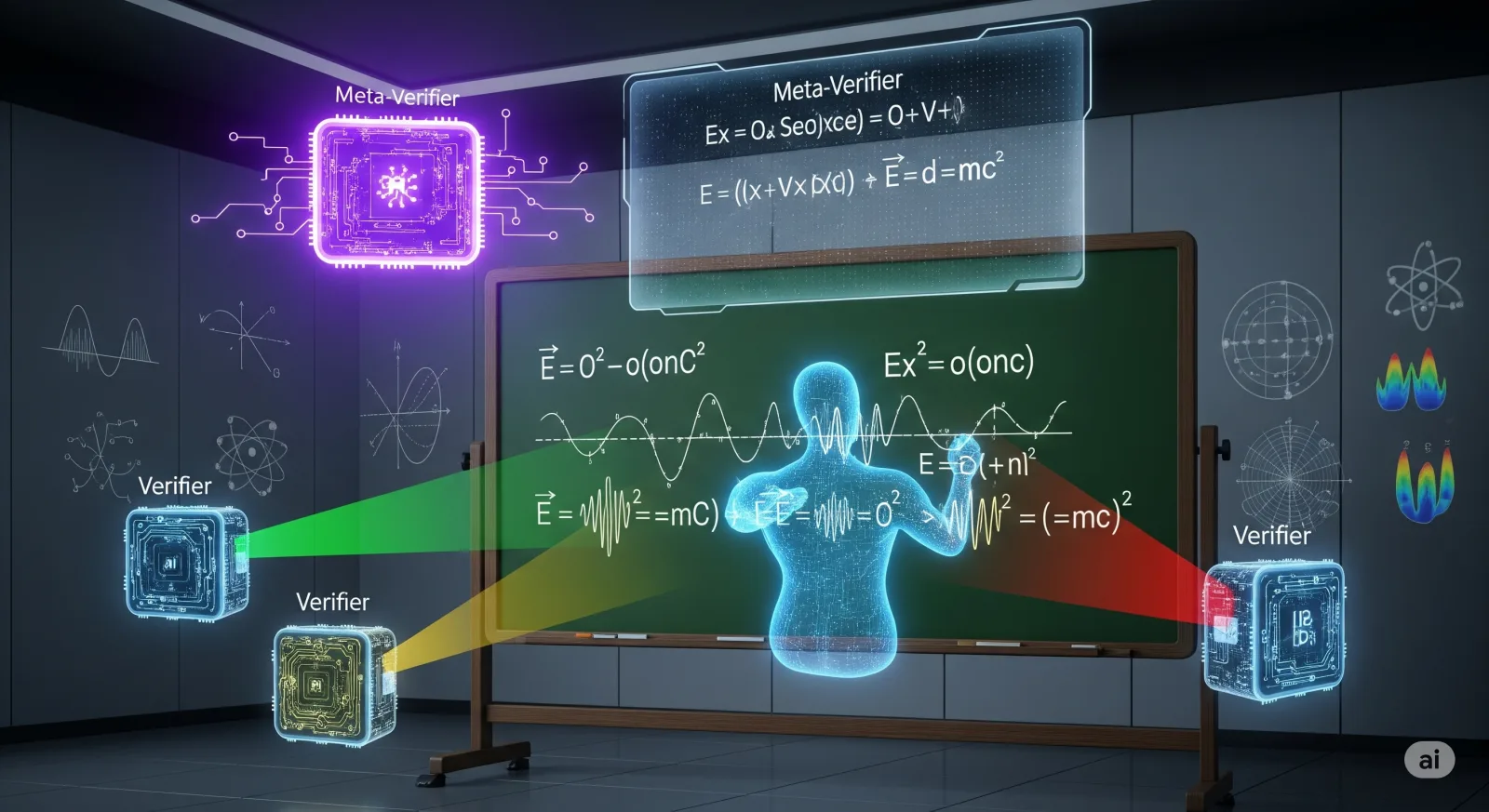
PhysicsEval tests four inference-time strategies. The baseline asks a model to solve the problem. Self-refinement shows the model its own answer and asks it to check again. Single-agent review introduces Qwen3-32B as an external reviewer that identifies likely mistakes before the original solver revises. Multi-agent review uses three independent verifier models—Phi-4-reasoning-plus, Qwen3-14B, and DeepSeek-R1-Distill-Qwen-14B—then has a Qwen3-32B meta-verifier aggregate and filter their feedback before the solver revises.
The difference sounds procedural. It is actually epistemic. Self-refinement asks the same system to escape its own framing. Single-agent review adds another perspective, but one that can inject incomplete or misleading criticism. Multi-agent review tries to turn critique into consensus: several reviewers identify problems, a meta-verifier filters false alarms, and only then does the original model revise.
That architecture matters because many physics errors are not failures of fluency. They are failures of constraint. A model may choose the wrong physical regime, miss a hidden assumption, use the right formula with the wrong variable, or compute a numerically plausible answer from an invalid setup. Asking the original model to “think again” may simply produce a more polished version of the same mistake. Very on-brand for modern software, really.
PhysicsEval raises the floor for evaluating scientific reasoning
The benchmark contribution comes first because the experiments depend on it. PhysicsEval contains 19,609 open-ended physics problems drawn from textbooks, physics forums, and educational websites. The authors report a 90:10 split, leaving 17,647 problems for training or future fine-tuning and 1,962 problems for evaluation. The dataset spans 19 categories, including classical mechanics, thermodynamics, electromagnetism, optics, relativity, quantum mechanics, astrophysics, and more specialised areas such as acoustics and instrumentation.
The benchmark is positioned against earlier physics and science datasets. Its distinguishing features are scale, open-ended answers, and stepwise solutions. Table 1 in the paper compares PhysicsEval with benchmarks such as GPQA, SciBench, OlympiadBench, PhysReason, and UGPhysics. PhysicsEval is larger than those listed comparators and contains very long step-by-step solution material: the paper reports an average solution length of 3,830.8 tokens and an average of 3.9 steps.
That length is not a decorative statistic. It tells us what the benchmark is trying to measure. Multiple-choice science QA can test recognition; open-ended physics solutions test construction. The model has to produce the path, not merely select the destination from a menu. That is where verifier systems become relevant, because a long reasoning chain creates more opportunities for local failure.
There is, however, a curation wrinkle that matters later. The authors state that the core problem and solution content is human-originated, but Gemini 2.5 Pro is used to clean, format, and organise the scraped solutions into stepwise form. They repeatedly stress that Gemini is used as an editor rather than a generator of new scientific content. The appendix provides a before-and-after example to support this claim. Still, the benchmark is not a purely human-hand-annotated gold standard. For business use, that matters: the dataset is valuable, but its ground truth has some model-mediated polish baked into it.
The scoring system rewards physics, not just eloquence
The authors evaluate generated solutions using a Physics Proficiency Score, or PPS. It combines six rubric scores:
| Component | Weight |
|---|---|
| Mathematical accuracy | 0.30 |
| Logical consistency | 0.25 |
| Formulas and principles | 0.20 |
| Completeness | 0.10 |
| Assumptions made | 0.10 |
| Clarity and coherence | 0.05 |
This weighting is sensible for physics. Clarity matters, but it is only 5% of the score. Mathematical accuracy, logical consistency, and correct use of physical principles dominate. Good. A wrong derivation written in excellent prose is still wrong. One hates to be traditional, but physics remains stubbornly attached to correctness.
The rubric is adapted from the Minnesota Assessment of Problem Solving framework, which focuses on the quality of student-written physics problem solving rather than just final answers. The authors also say the weights were informed by two experienced high school physics teachers and one university entrance examination grader.
Evaluation itself is performed by Gemini 2.5 Pro, using the ground-truth solution and a detailed scoring prompt. This is practical, but it also creates a boundary around the result. The paper is evaluating LLM outputs with another LLM. The authors attempt to reduce bias by using strict criteria and manual checks on a subset, but the result should still be read as scalable rubric-based evaluation, not as full human grading across the entire test set.
The main table shows a real pattern, but not a miracle
The headline evidence comes from Table 2: six models, three difficulty tiers, four inference methods. The average PPS values are:
| Difficulty tier | Baseline | Self-refine | Single-agent | Multi-agent |
|---|---|---|---|---|
| Easy | 88.96 | 89.98 | 90.83 | 91.78 |
| Medium | 79.21 | 80.38 | 81.10 | 81.48 |
| Hard | 66.20 | 67.06 | 67.18 | 68.23 |
The broad trend is clear. Multi-agent review has the highest average score in all three tiers. The gains are not enormous, but they are consistent in the aggregate. On easy problems, multi-agent review improves the average PPS by 2.82 points over baseline. On medium problems, it improves by 2.27 points. On hard problems, it improves by 2.03 points.
This is where interpretation needs some adult supervision. The paper argues that multi-agent gains amplify with difficulty, and it gives examples where that is true: Phi-4-reasoning-plus gains 7.5 points on hard problems, and QwQ-32B gains 7.1 points. But the average table does not show a simple monotonic increase in point gains as difficulty rises. The stronger statement is more precise: multi-agent review is especially helpful for some models on harder problems, but the aggregate effect is modest and uneven.
That unevenness is not a bug in the story. It is the story. DeepSeek-R1’s hard-problem PPS slightly drops under multi-agent review compared with baseline. Llama 4 Maverick performs worse under multi-agent review on hard problems than under baseline, while single-agent review is better for that tier. Gemma 3 27B is also not rescued on hard problems. Meanwhile, Phi-4-reasoning-plus and QwQ-32B benefit substantially.
So the paper does not prove that multi-agent review is universally better. It shows that structured external verification can raise average performance and can sharply help certain solver-reviewer combinations. That is exactly the sort of result operators should prefer: useful, conditional, and resistant to conference-poster hallucination.
Self-refinement can tidy the wrong thing
The most practically relevant negative result concerns self-refinement. In the accepted folk theory of LLM workflow design, “ask the model to check itself” is the cheap guardrail. Cheap, yes. Guardrail, sometimes. Other times it is just the car apologising before continuing through the barrier.
The main table shows several cases where self-refinement harms performance. Llama 4 Maverick drops across easy, medium, and hard tiers. o4-mini also drops across all three tiers: from 86.7 to 82.6 on easy, 87.3 to 86.4 on medium, and 83.6 to 82.3 on hard. Gemma 3 27B is mixed rather than cleanly worse, but its self-refinement does not establish a robust improvement pattern.
The o4-mini deep dive makes the mechanism clearer. The paper reports that o4-mini’s baseline PPS is 85.88, with especially strong clarity and formula/principle scores. Self-refinement lowers the overall PPS to 84.58. Mathematical accuracy rises slightly from 4.17 to 4.22, but completeness falls from 4.56 to 4.40 and clarity falls from 4.76 to 4.54.
That is a useful failure mode. The model may correct a calculation while damaging the structure of the solution. In enterprise terms, it improves a cell while breaking the spreadsheet. A self-review prompt can make the answer more anxious, more verbose, or more internally rearranged without making it more reliably correct. This is why self-refinement should not be treated as a quality assurance system. It is at best a low-cost heuristic.
Single-agent review is not enough evidence of governance
The single-agent method looks attractive because it offers separation of duties without much architectural complexity. One model solves; another model reviews; the original model revises. That sounds like a reasonable miniature audit function.
But the paper’s statistical analysis on o4-mini is not kind to this middle option. The paired t-tests compare single-agent and multi-agent methods against the o4-mini baseline. Single-agent review shows no statistically significant improvement in overall PPS, with $p = 0.996$. Worse, it significantly degrades completeness, with $p = 0.0182$, and clarity/coherence, with $p = 0.000965$.
This suggests a simple operational rule: external criticism is not automatically useful. Bad review is not governance; it is another source of noise with a blazer on. A single reviewer can over-focus on one issue, miss the real fault, or inject a critique that causes the solver to contort an otherwise adequate answer.
The multi-agent system does better because it adds a filtering layer. The three verifier models produce mistake lists and scores. The meta-verifier then tries to remove irrelevant or false mistakes and aggregate the feedback. In the paper’s setup, the verifier weights are 0.5 for Phi-4-reasoning-plus, 0.3 for DeepSeek-R1, and 0.2 for Qwen3-14B, based on a pilot review of 500 problems where the authors manually inspected verifier quality.
That weighting choice is practical but also a limitation. It is not a universal theorem about verifier competence. It is a design decision grounded in one pilot setting. For deployment, this means verifier selection and calibration are part of the product, not implementation trivia.
Multi-agent review improves the right dimensions
For o4-mini, multi-agent review raises PPS from 85.88 to 86.84. That is less than a full point, but the sub-metric movement is more informative than the headline. The paper reports targeted improvements in mathematical accuracy, logical consistency, and assumptions made, while largely preserving o4-mini’s strong baseline clarity.
The paired t-tests sharpen the point. Multi-agent review significantly improves:
| Metric | p-value | Interpretation |
|---|---|---|
| Overall PPS | 0.0405 | Statistically significant overall gain |
| Mathematical accuracy | 0.0057 | Stronger evidence of numerical/calc improvement |
| Formulas and principles | 0.0126 | Better selection/application of physics principles |
| Logical consistency | 0.278 | Not statistically significant |
| Completeness | 0.150 | Not statistically significant |
| Clarity/coherence | 0.0739 | Not statistically significant |
| Assumptions made | 0.134 | Not statistically significant |
This is exactly what one would hope from verifier agents if they work. They do not merely make the prose prettier. They improve correctness-heavy dimensions: calculations and principles. The non-significant results also matter. Multi-agent review does not conclusively improve every quality dimension. It is not an all-purpose intelligence amplifier; it is a targeted correction mechanism.
The appendix sample conversation illustrates the intended use. o4-mini solves a toroidal inductor problem by using energy density and inductance. The reviewer feedback notes that the solution assumes uniform energy density across the toroid volume, while the magnetic field in a toroid varies with distance from the centre. The feedback does not merely say “wrong”; it identifies a physical assumption that may not hold. That is the kind of critique a useful verifier should produce: specific, contextual, and tied to the physics.
The category heatmap is diagnostic, not destiny
The category-specific figure is best read as an exploratory diagnostic. It shows how multi-agent review changes o4-mini performance across physics categories, difficulty tiers, and rubric dimensions. The results are mixed: gains in some domains, losses in others, and no clean universal pattern.
The paper highlights improvements in Quantum Mechanics and Atomic Physics, Relativity and Gravitation, and Thermodynamics and Heat Transfer, especially for hard problems and rubrics such as completeness and formulas/principles. It also notes gains in clarity/coherence for some medium-difficulty categories such as Food Physics and Culinary Science, Optics, and Wave Phenomena.
But the same analysis shows negative or inconsistent effects in Acoustics and Sound Engineering and Engineering and Applied Physics. Some rubrics, including assumptions and mathematical accuracy, degrade in selected domains. The appendix’s model-by-category heatmap reinforces the message that performance depends heavily on both the solver model and the physics category.
For operators, this is the uncomfortable but useful conclusion: agentic verification should be routed, not blindly applied. Some tasks benefit from additional review; others may be harmed by verifier overreach. The right architecture is not “every output gets three reviewers forever”. It is closer to triage:
| Situation | Verification strategy |
|---|---|
| Low-risk, simple, high-confidence output | Baseline or lightweight self-check may be enough |
| Calculation-heavy answer with measurable correctness | External verifier is useful |
| High-stakes technical reasoning | Multi-agent review plus human escalation |
| Category where verifier feedback often degrades output | Disable, retrain, or route to specialised reviewer |
| Real-time workflow with tight latency budget | Use selective verification, not full review on every turn |
The business value is not the romance of many agents talking to each other. It is knowing when the extra conversation is worth paying for.
What this means for enterprise AI quality control
The paper directly shows that, on PhysicsEval, multi-agent review improves average PPS across six LLMs and produces statistically significant o4-mini gains in overall PPS, mathematical accuracy, and formula/principle use. It also shows that self-refinement and single-agent review are unreliable, and sometimes harmful.
Cognaptus would translate that into a quality-control architecture, not a product slogan.
First, verification should be externalised when the task has structured failure modes. Physics problems have known formulas, units, assumptions, and solution paths. Many business workflows have similar structure: financial modelling, compliance checks, engineering calculations, contract clause extraction, procurement validation, medical coding support, and technical troubleshooting. In these cases, a verifier can look for specific mistakes rather than merely expressing vibes in JSON.
Second, reviewer diversity matters only if it creates useful disagreement. The multi-agent pipeline is not magic because there are more models. It works because independent verifiers generate candidate critiques and a meta-verifier filters them. The operational pattern is “generate competing error hypotheses, then reconcile”. That is closer to audit practice than to brainstorming.
Third, the solver and verifier should not be optimised for the same thing. A strong solver may be fluent and fast; a good verifier may be stricter, cheaper, narrower, or better calibrated for error detection. The paper’s motivation includes reducing overhead by using commercial models for solving while delegating verification to smaller or open-source models. That is commercially relevant. The winning architecture may not be the largest model doing everything. It may be a strong proposer plus cheaper specialists, with escalation rules.
Fourth, evaluation must be multi-dimensional. A single correctness score hides failure trade-offs. In the paper, self-refinement can improve mathematical accuracy while damaging completeness and clarity. In enterprise workflows, a system can improve legal coverage while worsening readability, or improve extraction recall while introducing more false positives. A one-number dashboard will miss those trade-offs, then everyone will pretend to be surprised in the post-mortem.
The limits are not footnotes; they define the deployment boundary
The paper’s limitations are operationally important.
The first is compute cost. Multi-agent review runs several models per problem. That increases latency, cost, and energy use. For asynchronous scientific QA, tutoring feedback, or engineering review, that may be acceptable. For high-volume customer support or real-time user interaction, it may not be.
The second is dataset verification. PhysicsEval is large and diverse, but the authors state that it did not receive full manual checking. The solutions are human-derived but LLM-polished, and only a small sample was manually reviewed to confirm preservation of logic. This does not invalidate the benchmark, but it limits the certainty with which one can treat every ground-truth solution as pristine.
The third is LLM-based evaluation. Gemini 2.5 Pro scores the generated solutions using a detailed rubric. That enables scale, but it also means the evaluator is another model. In production settings, especially regulated or safety-critical ones, LLM-based review should be treated as a filter, not as final authority.
The fourth is domain transfer. Physics has a particular structure: formal principles, equations, units, and canonical solution paths. The authors explicitly note that the method may not transfer easily to other STEM domains without changes or fine-tuning. It certainly should not be assumed to transfer to open-ended business strategy, negotiation, marketing copy, or executive astrology masquerading as OKRs.
Finally, the category-specific results imply that even within physics, one verifier architecture is not uniformly optimal. The next useful step is adaptive verification: choose reviewers based on task category, confidence, difficulty, and historical verifier performance. That is less glamorous than “multi-agent AI”, but considerably more likely to survive contact with budgets.
The better takeaway: build systems that can be corrected
PhysicsEval is not just another benchmark paper with a scoreboard attached. Its more durable contribution is architectural. It asks whether LLM reasoning can be improved at inference time by separating proposal from verification. The answer is yes, but selectively.
The paper’s evidence supports three practical claims. First, open-ended scientific reasoning needs benchmarks that examine the path, not just the final answer. Second, self-correction is too brittle to serve as serious quality control. Third, multi-agent verification can improve correctness-heavy dimensions when the review process is structured and filtered.
That is enough to matter. It is not enough to declare agents solved. The more sober lesson is that reliable AI systems will look less like lone geniuses and more like review workflows: proposer, critic, adjudicator, escalation path. Less heroic, more useful. Businesses may survive the disappointment.
The next generation of AI deployment should not ask, “Which model gives the best answer on the first try?” It should ask, “Which system notices when the first answer is wrong, and what does it do next?” PhysicsEval gives one credible experimental answer: many minds can make light work, but only when someone is responsible for deciding which mind is hallucinating.
Cognaptus: Automate the Present, Incubate the Future.
-
Oshayer Siddique, J. M Areeb Uzair Alam, Md Jobayer Rahman Rafy, Syed Rifat Raiyan, Hasan Mahmud, and Md Kamrul Hasan, “PhysicsEval: Inference-Time Techniques to Improve the Reasoning Proficiency of Large Language Models on Physics Problems,” arXiv:2508.00079v2, 2025, https://arxiv.org/abs/2508.00079. ↩︎