TL;DR for operators
The practical question is not whether AI will “think itself into godhood by Tuesday”. Charming as that spreadsheet would be, this paper is doing something narrower and more useful.
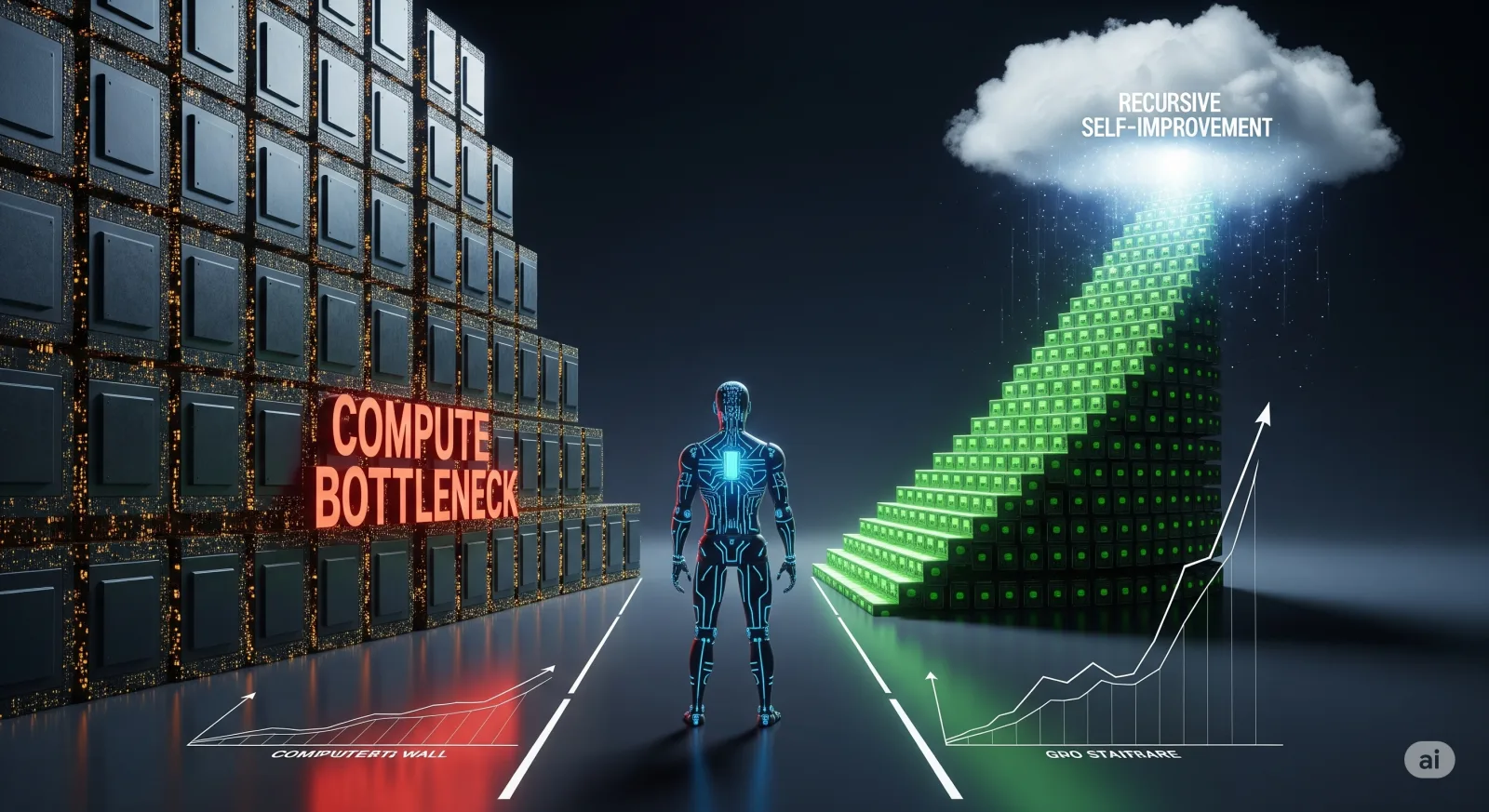
Whitfill and Wu ask whether a software-only intelligence explosion can survive a compute bottleneck: if AI systems become good enough to replace human AI researchers, can that extra cognitive labour keep improving AI without a matching increase in research compute?1
Their answer depends almost entirely on how you define the compute input.
Under the baseline model, research compute means raw research compute. In that world, research compute and cognitive labour look like strong substitutes: the estimated elasticity of substitution is $\sigma = 2.583$. That says more intelligence applied to experiment design, selection, interpretation, and smaller-scale testing can plausibly compensate for limited compute.
Under the alternative model, research compute is reframed as the number of near-frontier experiments a lab can run. In that world, the estimate flips: $\sigma = -0.103$, which is outside the economically meaningful range but statistically indistinguishable from zero. Read economically, that means near-perfect complementarity. More researchers, human or AI, do not help much if the bottleneck is the ability to validate ideas at frontier scale.
For business strategy, the paper is less a prophecy than a decision framework. If small experiments extrapolate well, software progress and AI research automation can erode the compute moat. If frontier validation remains mandatory, compute access, capital, datacentre capacity, deployment infrastructure, and model-evaluation discipline remain very real bottlenecks. Annoyingly for anyone hoping for a clean answer, both worlds are plausible.
The whole debate turns on what counts as “compute”
The familiar argument about recursive self-improvement is simple enough. AI becomes good at AI research. It helps build better AI. The better AI does more AI research. Repeat until the curve stops behaving politely.
The equally familiar objection is also simple: research is not only thinking. It requires experiments, and experiments require compute. If cognitive labour and research compute are complements, then a million digital researchers may still queue politely behind the same GPU cluster. The intelligence explosion becomes less explosion, more ticketing system.
The paper’s useful move is to avoid arguing about vibes and instead ask what kind of production function AI research appears to have. In the authors’ model, algorithmic quality improves through a combination of research compute and cognitive labour. The key parameter is the elasticity of substitution, $\sigma$:
- If $\sigma > 1$, compute and cognitive labour are substitutes.
- If $\sigma = 1$, they sit in the Cobb-Douglas middle ground.
- If $\sigma < 1$, they are complements.
- If $\sigma \approx 0$, they behave like near-perfect complements.
This matters because the model’s explosion condition changes sharply across those regimes.
When $\sigma > 1$, a software-only intelligence explosion remains plausible if self-improvement and research productivity are strong enough: the paper expresses this as $\phi + \lambda > 1$, where $\phi$ captures whether ideas get easier or harder to find as algorithmic quality rises, and $\lambda$ captures possible parallelisation penalties.
When $\sigma < 1$, the bar is much higher: explosive growth requires $\phi > 1$. That would mean ideas get easier to find fast enough that you could get explosive growth even with constant human-only research input. The authors regard that as fairly implausible, and it is not hard to see why. If ordinary research labour alone could do it, the compute-bottleneck debate would be mostly theatrical.
So the paper is not asking whether AI research automation matters. It is asking whether automated cognitive labour can keep converting into algorithmic progress once compute stops scaling with it.
That is a more disciplined question. Also a less tweetable one, which is usually a good sign.
Two models, two worlds
The paper estimates $\sigma$ using a panel dataset covering four frontier AI firms: OpenAI from 2016–2024, DeepMind from 2014–2024, Anthropic from 2022–2024, and DeepSeek from 2023–2024. The unit is firm-year, giving 27 observations.
The authors estimate two specifications.
The first specification treats research compute directly as the compute input. It asks: as labour becomes more expensive relative to compute, do labs use more compute per employee? If yes, that suggests compute can substitute for labour.
The second specification changes the compute concept. Instead of raw research compute, it asks how many near-frontier experiments a lab can run, where frontier experiment capacity depends on research compute relative to training compute. This adjustment matters because frontier models have become much larger. A quantity of research compute that once bought many useful experiments may later buy fewer near-frontier tests.
That distinction is the paper’s core comparison.
| Specification | What compute means | Main estimate | Interpretation | Business translation |
|---|---|---|---|---|
| Baseline CES in compute | Raw research compute | $\sigma = 2.583$ | Research compute and cognitive labour are strong substitutes | Better researchers, including AI researchers, may reduce dependence on extra compute |
| CES in frontier experiments | Near-frontier experiment capacity | $\sigma = -0.103$, interpreted as approximately zero | Frontier experiments and cognitive labour are near-perfect complements | More research intelligence may still need proportional frontier-scale validation |
The same underlying story therefore gives two very different operational views.
In the raw-compute world, smarter research labour is powerful because it can spend compute better. Researchers can design more informative tests, run smaller experiments, choose better ablations, and avoid wasting runs on low-value guesses. AI researchers would amplify this process.
In the frontier-experiment world, the real constraint is not whether someone can think of more ideas. It is whether the lab can test ideas at a scale close enough to the model that will actually matter. If the answer is no, then extra cognition piles up on the wrong side of the validation bottleneck.
This is why the paper does not prove or disprove an intelligence explosion. It shows that the conclusion depends on whether small-scale research remains informative as frontier systems grow.
The baseline model says labour and compute can trade places
The baseline result is the cleanest and uses the better-behaved data. The regression estimates:
with 27 firm-year observations, firm fixed effects, and $R^2 = 0.857$.
In plain language: in the baseline specification, when labour becomes more expensive relative to compute, firms appear to use much more research compute per employee. That is exactly what one would expect if research compute and cognitive labour can substitute for each other.
This result supports the pro-RSI intuition. If AI systems become cheap cognitive labour for AI research, they may generate progress without needing each additional unit of research output to be matched by the same proportional increase in human researchers or raw experimental spend. More thinking can partly replace more brute-force trialling.
But the baseline model quietly makes an important abstraction. It treats research compute as the input, not the ability to run experiments at the current frontier. That is fine if small experiments scale well. It is dangerous if frontier models behave like aircraft prototypes: you can simulate all day, but at some point the thing has to fly.
The paper itself recognises this. As frontier model size rises, a fixed amount of research compute may buy fewer meaningful near-frontier experiments. This is the crack through which the second specification enters, looking smug and carrying a larger bill.
The frontier-experiment model says validation may be the wall
The alternative specification redefines the compute input as near-frontier experiment capacity:
Here $K_{it,res}$ is research compute, $K_{it,tra}$ is training compute, and $x$ captures the productivity benefit of extrapolating from smaller experiments. If a lab can learn from experiments that are one-thousandth the size of a frontier run, then $x = 1000$.
The important point is not the exact value of $x$. If $x$ is fixed, it does not change the estimated substitution elasticity. The important point is that the compute input is now scaled by the size of frontier training runs.
That changes the estimate dramatically:
Because the CES elasticity cannot be negative in the economic model, the authors interpret this as statistically indistinguishable from zero. Economically, $\sigma \approx 0$ means near-perfect complements.
That is the compute-bottleneck argument in formal clothing. More cognitive labour does not generate much algorithmic progress unless near-frontier experiment capacity rises with it. If AI systems become researchers but frontier validation remains scarce, the bottleneck persists.
The paper’s intuition is straightforward. Over the sample period, compute prices fell dramatically relative to wages. In the baseline model, that supports substitution: cheaper compute replaces expensive labour. But once compute is measured as frontier experiment capacity, the price of each meaningful frontier experiment rises because frontier training runs have become enormous. On that basis, declining wage share can instead imply complementarity between labour and frontier experiments.
Same trend. Different denominator. Very different conclusion.
The figures are diagnostics, not decoration
The paper includes three figures, and they play different roles.
Figure 1 is mainly descriptive evidence. It shows time trends in average wages, compute price per PFLOP, organisation size, and research compute per employee across the four labs. Its purpose is to make the raw empirical setting visible: wages rise, compute prices fall, organisations grow, and compute per employee climbs sharply.
Figures 2 and 3 are regression diagnostics for the two specifications. They are added-variable plots, not independent experiments. Figure 2 visualises the baseline positive slope: after residualising by firm fixed effects, higher relative labour cost aligns with more research compute per employee. Figure 3 visualises the frontier-experiment specification: after adding training compute, the slope is nearly flat to slightly negative.
That matters because the paper’s empirical claim is not “look, one line goes up and one line goes sideways”. The figures are there to show how sensitive the fitted relationship is to whether training-compute scale enters the model.
| Paper component | Likely purpose | What it supports | What it does not prove |
|---|---|---|---|
| Figure 1 time trends | Descriptive context | Compute prices fell; research compute per employee rose; frontier labs scaled rapidly | Causal substitution between labour and compute |
| Table 1 main estimates | Main evidence | The estimated elasticity flips across specifications | Which specification is definitively correct |
| Figures 2 and 3 | Regression diagnostics | The fitted relationship differs sharply once frontier scale is included | A separate causal mechanism |
| Appendix robustness tables | Robustness and sensitivity tests | The qualitative split survives several alternative samples and price choices | That measurement error or model form is harmless |
| IV appendix | Endogeneity check | Results do not move much using local wage instruments | A fully settled causal identification strategy |
This is a helpful separation. The main evidence is Table 1. The robustness checks ask whether the same broad split survives obvious perturbations. The IV appendix addresses one potential endogeneity story, but the authors themselves do not treat it as the final word.
The robustness checks strengthen the split, not the certainty
The appendix does not introduce a second thesis. It asks whether the core contrast survives when the sample or measurement choices change.
It mostly does.
When the sample is restricted to 2020 onwards, the baseline elasticity remains above one at $\sigma = 1.486$, while the frontier-experiment estimate is negative at $\sigma = -0.769$.
When 2024 is excluded, addressing the concern that AI may already have begun assisting AI research, the baseline estimate is $\sigma = 2.638$ and the frontier-experiment estimate is $\sigma = -0.129$.
When the sample is restricted to DeepMind only, where wage data are highest quality, the baseline estimate is $\sigma = 2.297$ and the frontier-experiment estimate is $\sigma = -0.007$.
When compute-cost assumptions are adjusted, the baseline estimate falls to $\sigma = 0.893$, which is just below one, while the frontier-experiment estimate remains negative at $\sigma = -0.127$.
The last robustness check is worth reading carefully. It weakens the clean “baseline says substitutes” story because $\sigma = 0.893$ is slightly below the Cobb-Douglas threshold. But the qualitative contrast remains: the baseline model is much more substitution-friendly than the frontier-experiment model.
The IV appendix tells a similar story. The authors instrument the wage-to-compute-cost ratio using local, exchange-rate-adjusted skilled wage levels. The IV estimate is $\sigma = 2.768$ in the baseline model and $\sigma = 0.126$ in the frontier-experiment model. Again: substitution under raw compute, complementarity or near-complementarity under frontier experiments.
This is not the kind of robustness that turns a 27-observation panel into scripture. It does, however, show that the paper’s central comparison is not a one-table accident.
For operators, the question is whether small experiments still scale
The business reading is not “AI labs should buy GPUs” or “AI labs should hire fewer researchers”. That would be the sort of insight one might obtain by staring at a procurement invoice.
The sharper operational question is this:
Can your research organisation reliably learn from experiments below frontier scale?
If yes, the baseline model becomes more relevant. AI-assisted research workflows can matter enormously because they improve the quality of ideation, experiment design, pruning, replication, and interpretation. Smaller experiments become leverage. The lab that learns faster per unit of compute can challenge larger incumbents.
If no, the frontier-experiment model becomes more relevant. The organisation may generate excellent ideas and still fail to convert them into reliable frontier progress because the decisive tests require frontier-scale infrastructure. In that world, compute access is not just a cost centre. It is a strategic bottleneck.
This distinction applies beyond frontier labs.
For AI-native companies, the question is whether model improvements can be validated through cheaper proxy tasks, synthetic benchmarks, smaller models, offline evaluations, and staged deployment. If proxy validation is reliable, iteration speed beats raw scale more often. If not, capital intensity returns with a clipboard.
For enterprise AI teams, the same logic appears at a smaller scale. Can a team validate workflow improvements with limited pilots, logs, offline tests, and shadow deployments? Or does the system only reveal its failure modes in full production, with real users, real latency, real compliance constraints, and real executives asking why the bot emailed a spreadsheet to Luxembourg?
For investors, the paper suggests two competing moats. In the substitution world, the moat is research efficiency: talent, tooling, automation, evaluation culture, and the ability to learn from smaller experiments. In the complementarity world, the moat is infrastructure: compute contracts, datacentre capacity, capital access, deployment scale, and the ability to run near-frontier experiments repeatedly.
Those are different portfolios.
What the paper directly shows, and what we infer
The paper directly shows three things.
First, in a formal model, a software-only intelligence explosion depends heavily on whether research compute and cognitive labour are substitutes or complements.
Second, using the authors’ panel and baseline CES specification, research compute and cognitive labour appear strongly substitutable.
Third, after reframing compute as near-frontier experiment capacity, the estimate moves toward near-perfect complementarity.
Cognaptus infers a business framework from that contrast: AI strategy should treat “research automation” and “frontier validation capacity” as separate assets. A lab, enterprise, or AI product company can improve its cognitive research engine while still being blocked by the cost and availability of decisive experiments.
That inference is not a claim that every AI business needs frontier-scale compute. Most do not. It is a claim that every AI business needs to understand where its own validation bottleneck sits.
If your product improves through cheap offline tests, the substitution story is attractive. If your product improves only through expensive, realistic, near-production tests, the complementarity story is waiting by the door, smiling thinly.
The limitations are not cosmetic
The paper’s limitations are unusually important because the conclusion changes with specification.
The dataset is small: 27 firm-year observations across four firms. That is not a moral failing; frontier AI labs do not kindly produce long balanced panels for economists. Still, it limits inference.
The research-compute variable is especially coarse. The authors estimate research compute by taking training compute and multiplying it by a constant research-to-training compute ratio of 1:3, based on a reported OpenAI 2024 ratio. They apply this across firms and time. If that ratio has changed substantially, both models can move. The frontier-experiment model is particularly exposed because it effectively assumes the number of frontier experiments has been constant over time under that construction.
The wage data are mixed. Some come from financial statements, especially for DeepMind and early OpenAI, but much is imputed from job postings, Glassdoor, H1B Grader, levels.fyi, news sources, and BOSS Zhipin. The paper assumes salary is 40% of total compensation. Reasonable? Perhaps. Precise? Let us not get carried away.
The model assumes CES functional form and homogeneous labour. Real AI research labour is not homogeneous. A senior researcher who can turn a vague training instability into a decisive experiment is not simply “1.7 units” of a junior engineer. Production functions rarely enjoy this level of politeness in the wild.
There is also endogeneity. Rising labour productivity could increase both researcher wages and compute use per employee, making observed substitution partly a productivity story rather than a price-response story. The IV appendix addresses this with local wage instruments and finds similar results, but the paper still treats identification cautiously.
Finally, the paper does not estimate two parameters that matter deeply for actual takeoff dynamics: $\phi$, whether ideas get harder to find, and $\lambda$, the parallelisation penalty. Without those, the paper can say when a software-only explosion is structurally more plausible, but not whether the full set of conditions actually holds.
So the correct conclusion is not “compute bottlenecks are fake” or “compute bottlenecks win”. It is: the answer depends on whether research progress is bottlenecked by raw thinking, raw compute, or frontier-valid experiment capacity.
The strategic fork: better thinking or bigger tests
The cleanest way to use this paper is as a fork in strategic planning.
One branch says: invest in AI research automation because the biggest gains come from better allocation of experiments. Under this view, AI systems that generate hypotheses, design ablations, write evaluation code, compress literature search, and interpret failed runs can meaningfully substitute for compute. The winner is the organisation that learns more per unit of infrastructure.
The other branch says: invest in frontier experiment capacity because the bottleneck is validation at scale. Under this view, AI research automation increases the queue of plausible ideas faster than it increases the ability to test them. The winner is the organisation with enough compute, capital, and operational discipline to run decisive experiments repeatedly.
The uncomfortable possibility is that both are true at different layers.
Architecture search may benefit from small-scale extrapolation. Alignment failures may only show up under realistic deployment. Training stability might be diagnosable with smaller runs. Capability emergence might not be. Product-level quality improvements may validate cheaply; frontier model improvements may not.
That mixed world is probably where operators should begin. The useful question is not “are compute and labour substitutes?” It is “for this class of improvement, at this scale, under these evaluation constraints, how much can better cognition replace bigger experiments?”
The paper gives that question sharper teeth.
Conclusion: the bottleneck is conditional
“Will compute bottlenecks prevent an intelligence explosion?” sounds like it should have a dramatic answer. The paper refuses to provide one. Rude, but academically correct.
Its real contribution is to show that the compute-bottleneck debate turns on a measurable production-function question. If research compute and cognitive labour are elastic substitutes, AI-assisted AI research could plausibly accelerate without proportional increases in compute. If frontier experiments and cognitive labour are complements, then cognitive automation alone may not be enough.
For business readers, that distinction is more useful than a grand forecast. It turns AI takeoff discourse into an operating question: where does learning actually happen, and what does it cost to validate it?
If learning happens through many cheap experiments, software eats the bottleneck. If learning happens only at frontier scale, the bottleneck eats the software. Either way, the GPU invoice would like a word.
Cognaptus: Automate the Present, Incubate the Future.
-
Parker Whitfill and Cheryl Wu, “Will Compute Bottlenecks Prevent an Intelligence Explosion?”, arXiv:2507.23181v2, 16 August 2025. ↩︎