TL;DR for operators
News is only useful when it survives the journey from headline to position sizing. FinDPO, proposed by Giorgos Iacovides, Wuyang Zhou, and Danilo Mandic, is a finance-specific Llama-3-8B-Instruct sentiment model trained with Direct Preference Optimization rather than ordinary supervised fine-tuning.1 The paper’s headline result is not merely that FinDPO scores well on sentiment benchmarks. Plenty of models win benchmarks, then politely disappear when transaction costs arrive.
The more interesting result is the 5 bps test. In the paper’s historical long-short portfolio simulation, FinDPO is the only tested sentiment method that remains strongly positive at 5 basis points of transaction cost, with 458.97% cumulative return, 66.64% annualised return, and a Sharpe ratio of 2.03. FinLlama, FinBERT, LMD, VADER, and HIV-4 all turn negative at that cost level. That does not make FinDPO a money printer. It does make the paper harder to dismiss as another “we classified sentiment and called it finance” exercise. A small mercy, frankly.
The mechanism matters. The authors convert labelled financial sentiment datasets into preference pairs: the correct label becomes the preferred answer, and an incorrect label becomes the rejected answer. DPO then trains the model to prefer the correct sentiment response while penalising the wrong one. With LoRA, only 41.9 million parameters are trainable, or 0.52% of the base model, and training completes in 4.5 hours on a single A100 40GB GPU.
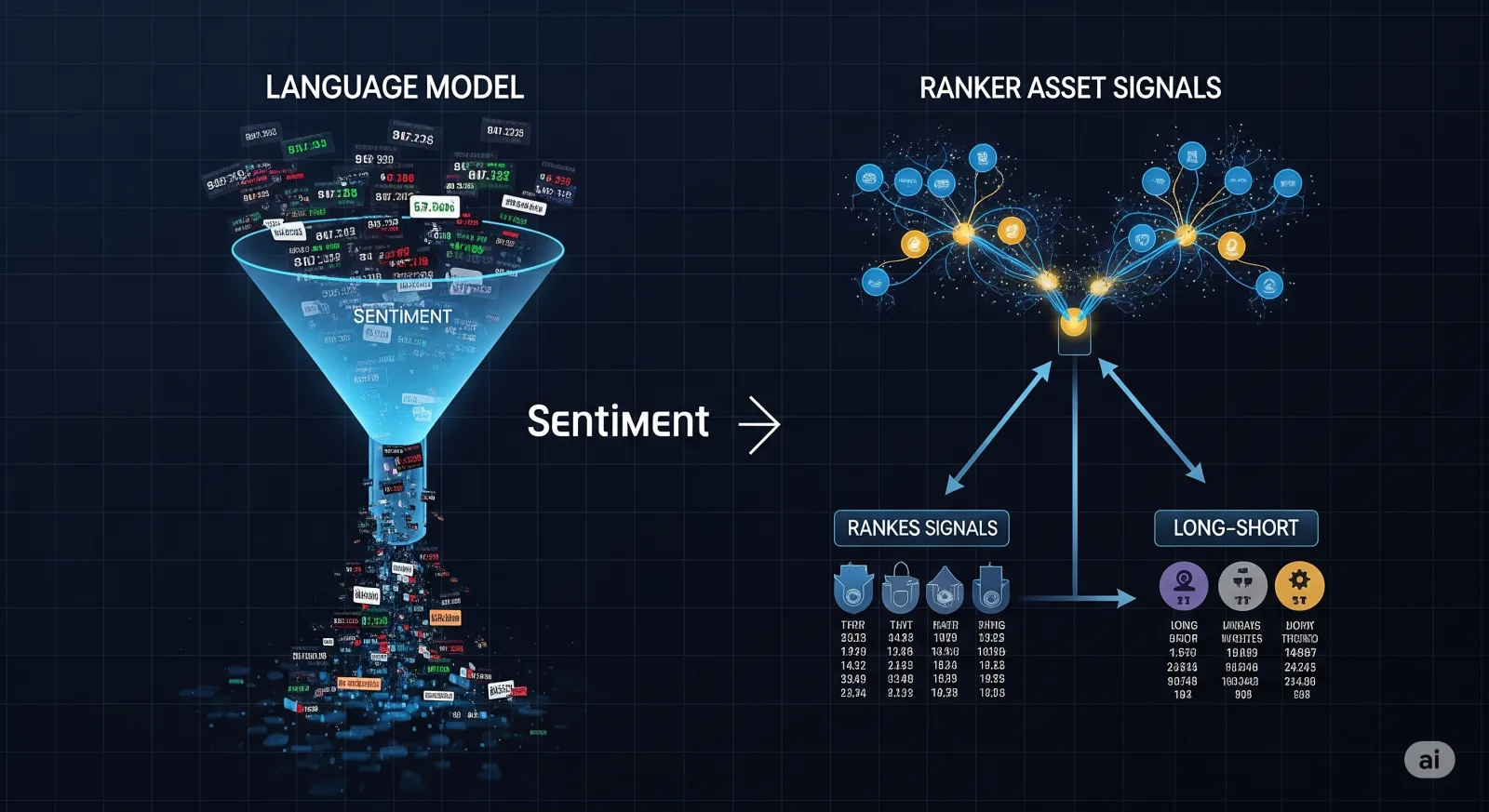
The operational bridge is the logit-to-score converter. Causal LLMs usually output labels such as positive, negative, or neutral. Portfolios need ranks, not labels. FinDPO extracts first-token logits for sentiment classes, applies softmax, and then uses temperature scaling because the preference-aligned model was initially overconfident, assigning near-1.0 probability to its chosen class. This calibration step turns sentiment into a continuous score that can rank companies for long-short selection.
Cognaptus reads the paper as evidence that preference-aligned financial sentiment models may be useful as signal components in text-heavy investment workflows. That is different from saying they are ready to trade alone. The backtest uses historical news and S&P 500 returns from February 2015 to June 2021, daily ranking, equal weighting, a 35% long and 35% short allocation, and a linear transaction-cost model. It does not settle live execution, borrow, latency, market impact, capacity, source coverage, or whether the effect survives a different regime. Operators should treat FinDPO as a promising research module, not as a replacement for risk management. A trader who outsources that part to a sentiment model deserves the P&L report they receive.
The 5 bps result is where the paper becomes operational
The easiest way to misunderstand FinDPO is to start with the model architecture. Yes, it uses Llama-3-8B-Instruct. Yes, it uses DPO. Yes, it uses LoRA. Fine. But the more expensive question is simpler: after the model reads financial text, does the signal still survive when trading costs are charged?
That is where the paper becomes useful. The authors evaluate sentiment methods not only with weighted F1 classification scores, but through historical long-short portfolio simulations. They rank companies by daily sentiment, go long the top 35%, short the bottom 35%, and calculate portfolio returns. Then they add transaction costs from 1 to 5 bps.
At zero transaction cost, most methods look respectable. This is the familiar problem with frictionless backtests: almost everyone looks clever when the market forgets to send an invoice. At no cost, FinDPO reports 747.10% cumulative return, 111.78% annualised return, and a Sharpe ratio of 3.41. FinLlama, the strongest prior sentiment-based portfolio model in the paper’s comparison, reaches 260.74% cumulative return, 39.47% annualised return, and a Sharpe ratio of 2.33.
The stronger evidence appears once costs are added.
| Cost setting | FinDPO annualised return | FinDPO Sharpe | FinLlama annualised return | FinLlama Sharpe | Operational reading |
|---|---|---|---|---|---|
| 0 bps | 111.78% | 3.41 | 39.47% | 2.33 | Main performance evidence under idealised conditions |
| 3 bps | 84.71% | 2.59 | 13.32% | 0.79 | Robustness/sensitivity test under moderate friction |
| 5 bps | 66.64% | 2.03 | -4.13% | -0.24 | The key stress point: FinDPO survives; alternatives do not |
At 5 bps, the paper reports negative cumulative returns for HIV-4, VADER, LMD, FinBERT, and FinLlama. FinDPO remains positive, with 458.97% cumulative return and a Calmar ratio of 2.21. The S&P 500 benchmark, meanwhile, reports 83.12% cumulative return and a Sharpe ratio of 0.62 over the same broad period.
The paper directly shows that, in this specific historical setup, FinDPO’s sentiment rankings generate more resilient simulated long-short returns than the baselines. Cognaptus infers a narrower business lesson: if a firm already runs text ingestion, entity linking, ranking, and cost-aware portfolio tests, preference-optimised sentiment deserves a serious slot in the research queue. What remains uncertain is whether the same signal survives live deployment. The gap between “survives 5 bps in a paper” and “survives production” is where many quant ideas go to become PowerPoint archaeology.
The benchmark win is real, but uneven in a useful way
FinDPO also performs well on standard financial sentiment classification benchmarks. The authors train and evaluate on three public labelled datasets: Financial PhraseBank, Twitter Financial News Sentiment, and GPT-labelled financial news. They compare FinDPO against lexicon-based methods, FinBERT, FinLlama, Instruct-FinGPT, FinGPT v3.3, and a supervised fine-tuned counterpart using the same base model, called FinSFT.
The average weighted F1 result is strong: FinDPO reaches 0.846, compared with 0.762 for FinGPT v3.3 and 0.771 for FinSFT. That is the reported 11% average improvement over FinGPT v3.3.
But the pattern matters. FinDPO is not best on every dataset. FinGPT v3.3 slightly beats it on Financial PhraseBank, and FinLlama / FinGPT v3.3 are slightly higher on TFNS. FinDPO’s decisive advantage comes on the NWGI dataset, where it scores 0.833 against 0.708 for FinSFT and 0.643 for FinGPT v3.3. That distinction is not a weakness. It is a clue.
| Evaluation | Likely purpose | What it supports | What it does not prove |
|---|---|---|---|
| Weighted F1 on FPB, TFNS, NWGI | Comparison with prior work | FinDPO has the best average benchmark performance among tested methods | Uniform superiority across every dataset |
| FinDPO vs FinSFT using the same base model | Method comparison / partial ablation-like contrast | DPO contributes beyond simply using Llama-3-8B-Instruct | That DPO will always beat SFT across all financial NLP tasks |
| No-cost portfolio simulation | Main evidence under idealised market assumptions | Sentiment scores can translate into strong historical portfolio rankings | Real-world deployability |
| 1–5 bps transaction-cost simulation | Robustness/sensitivity test | FinDPO is less fragile to trading frictions than tested alternatives | Full execution realism, market impact modelling, or capacity |
| LoRA parameter-efficient training | Implementation detail with operational relevance | Preference alignment can be trained without multi-GPU extravagance | Low total deployment cost once inference, monitoring, and data pipelines are included |
| Temperature calibration | Implementation detail supporting ranking | Converts overconfident class outputs into more useful sentiment scores | Perfect probability calibration under regime shift |
The useful reading is not “DPO magically wins sentiment.” The useful reading is that preference optimisation appears to improve the model’s average ability to choose among financial sentiment labels, and the improvement is large enough to matter downstream when those labels are converted into portfolio scores.
For operators, that means the classification benchmark is necessary but insufficient. A model that improves F1 but produces noisy rankings may still be useless for trading. FinDPO’s contribution is that the authors carry the signal into portfolio construction and then test it against costs. This is exactly where many sentiment papers quietly stop walking.
Preference pairs turn labelled sentiment into a correction game
FinDPO does not require human annotators to create fresh pairwise preference data from scratch. Instead, the authors transform existing labelled sentiment datasets into synthetic preference pairs.
For each financial text sample, the ground-truth label becomes the preferred response. The dispreferred response is generated from the reference model’s prediction. If the reference model predicts incorrectly, that wrong prediction becomes the rejected answer. If it predicts correctly, the authors randomly sample another incorrect sentiment label as the rejected answer. The model is then trained to prefer the correct sentiment label over the wrong one.
This is a subtle but important shift. Supervised fine-tuning says: “Produce this answer.” DPO says: “Prefer this answer over that answer, while staying close enough to the reference model.” The distinction matters because financial text is rarely clean. “Revenue fell less than expected” is not simply positive or negative unless the reader understands expectations, context, and market framing. Preference training does not give the model a Bloomberg terminal and a sixth sense. It does, however, train the model to push probability away from specific wrong alternatives, rather than merely imitating labels.
The paper’s training setup is deliberately lightweight by LLM standards. FinDPO starts from Llama-3-8B-Instruct, trains for five epochs, uses AdamW, and applies LoRA with 41.9 million trainable parameters. That is only 0.52% of the total base model parameters. Training takes 4.5 hours on a single A100 40GB GPU.
The business implication is not “cheap model, instant alpha.” The more sober implication is that finance-specific preference alignment is accessible to teams that do not own a small power station. Research teams can prototype, test, and compare this kind of model without needing the budget theatre of full-model fine-tuning.
The logit-to-score converter is the bridge from NLP to portfolio ranking
A sentiment classifier can say “positive.” A portfolio needs to know how positive, relative to every other stock in the universe today. That is the practical gap FinDPO tries to close.
Causal LLMs normally generate text token by token. For sentiment classification, the first generated token can represent the class label: positive, negative, or neutral. The authors extract the logits for those sentiment labels, apply softmax, and interpret the resulting probabilities as sentiment scores. Because the model initially showed extreme overconfidence, assigning probability 1.0 to the chosen label and 0.0 to the other classes, they apply temperature scaling. The temperature parameter is optimised on the training set by minimising negative log-likelihood, independently of the portfolio news corpus.
That calibration detail is not cosmetic. If every selected label is given probability 1.0, ranking quality collapses. The portfolio does not need a theatrical model that shouts “positive” at every bullish headline with equal certainty. It needs comparative signal strength.
The pipeline is simple enough to describe:
Financial article
  -> entity-linked company article
  -> FinDPO sentiment probabilities
  -> calibrated sentiment score
  -> daily company-level average sentiment
  -> rank companies by sentiment
  -> long top 35%, short bottom 35%
  -> calculate daily long-short return
When multiple articles appear for the same company on the same day, the paper averages their sentiment scores:
Here, $S_t$ is the average sentiment for a company on day $t$, $N_t$ is the number of relevant articles for that company on that day, and $S_{it}$ is the sentiment strength of article $i$.
This is where FinDPO becomes more than a classifier. The model’s output becomes a ranking variable. Ranking, not labelling, is the thing a portfolio can actually use.
The paper’s evidence stack is stronger because it mixes ML and market tests
The paper’s evidence is not one result. It is a stack.
First, the authors show that FinDPO improves average weighted F1 across standard sentiment datasets. That establishes classification competence. Second, they show that sentiment outputs can be converted into portfolio rankings. That establishes operational compatibility. Third, they compare portfolio performance against lexicon-based methods and prior fine-tuned models. That establishes relative usefulness. Fourth, they apply transaction costs. That tests whether the result is merely a frictionless fantasy.
This matters because financial NLP often confuses three different claims:
| Claim | Evidence needed | What FinDPO provides |
|---|---|---|
| The model understands financial sentiment labels | Classification metrics | Weighted F1 across FPB, TFNS, and NWGI |
| The model produces scores that can rank assets | Continuous sentiment outputs | Logit-to-score conversion plus temperature calibration |
| The signal has portfolio relevance | Backtested allocation | Long-short simulation over S&P 500-related news |
| The signal survives basic trading friction | Cost-aware backtest | 1–5 bps transaction-cost sensitivity |
| The signal is live tradable alpha | Production evidence | Not provided |
That last row is the important boundary. The authors’ results are impressive within the paper’s design. They are not the same thing as a live trading record.
What Cognaptus would actually do with this
For an investment or data team, FinDPO is most useful as a research component rather than a fully formed trading engine.
The immediate application is signal augmentation. If a firm already extracts news, links articles to tickers, and maintains a feature store, FinDPO-style scoring could become one input in a broader alpha model. The right comparison is not “FinDPO versus human trader.” It is “FinDPO sentiment score versus our current text feature, after costs, decay, turnover, and correlation with existing signals.”
The second application is triage. A calibrated sentiment model can help prioritise which company-news pairs deserve analyst review, especially when news volume is high. In that workflow, the model’s job is not to trade. Its job is to reduce attention waste.
The third application is risk overlay. A sudden cluster of strongly negative sentiment across multiple sources may help flag names requiring exposure review. Again, the value is not magical prediction. It is earlier, structured detection.
| Use case | Sensible deployment | What to measure |
|---|---|---|
| Alpha research | Add FinDPO-style score as one feature in a multi-signal model | Incremental information coefficient, turnover-adjusted return, decay profile |
| Portfolio overlay | Use sentiment ranks to tilt or filter existing exposures | Drawdown reduction, concentration risk, transaction cost impact |
| News triage | Prioritise articles or ticker-days for analyst review | Precision at top-k, analyst time saved, missed-event rate |
| Risk monitoring | Flag sentiment shocks by issuer or sector | False positives, event clustering, lead time before price movement |
| Model governance | Track calibration and drift over time | Probability calibration, label stability, source-level performance |
The business case is therefore not “replace the quant desk with DPO.” Charming thought, catastrophic budget meeting. The business case is cheaper, more adaptive sentiment extraction that can be tested against existing infrastructure.
The boundary: historical survival is not live permission
The paper’s strongest claim is also where interpretation needs discipline. FinDPO survives 5 bps in historical simulation. That is meaningful. It is not final.
The backtest uses daily rebalancing, equal weighting, a 417-company investable universe drawn from S&P 500 constituents with sufficient textual coverage, and a 35% long / 35% short construction. The paper uses news from sources including Reuters, The Motley Fool, and MarketWatch, applies named-entity recognition to link articles to companies, and filters entities using a high confidence threshold. Transaction costs are modelled linearly through turnover. These are reasonable modelling choices for a paper. They are not the full mess of production trading.
Several questions remain open:
- Would the result hold under stricter chronological validation, different market regimes, and later periods?
- How much of the signal comes from source coverage, entity filtering, or the selected 417-company universe?
- What happens when borrow availability, shorting costs, market impact, and capacity constraints are included?
- Does the model’s calibration drift when language changes, sources change, or market narratives rotate?
- How much incremental value remains after controlling for known price momentum, sector effects, volatility, earnings events, and other standard features?
- Can the signal be used at realistic latency after news ingestion, entity linking, model inference, scoring, portfolio optimisation, and execution?
None of these invalidate the paper. They define the next due diligence checklist. Finance is not short of clever signals. It is short of clever signals that remain clever after the plumbing is attached.
The misconception to kill early
The wrong takeaway is that FinDPO proves preference-aligned LLMs can reliably generate tradable alpha.
The better takeaway is narrower and more useful: preference optimisation may improve financial sentiment models in a way that survives a more demanding evaluation than classification accuracy alone. The paper demonstrates a path from preference-aligned sentiment classification to calibrated asset ranking to cost-aware portfolio simulation. That path is valuable because it forces the model to leave the benchmark garden and walk onto the trading floor, where the air is less friendly and everything has a fee.
That is the real contribution. FinDPO does not make an LLM “think like a trader” in the cinematic sense. It trains the model to prefer better sentiment judgements, then builds a converter that makes those judgements rankable. The trading simulation then asks whether the ranks are useful after costs. Surprisingly often in AI finance, that final question is treated as optional. It is not.
The sentiment edge is calibration, not bravado
FinDPO is a useful paper because it respects the chain of custody from text to trade. It begins with labelled financial sentiment, turns labels into preference pairs, trains a causal LLM with DPO, calibrates the model’s output into sentiment scores, ranks stocks, builds portfolios, and then charges transaction costs. Each step can still fail in production. But at least the authors make the steps visible.
The most practical lesson is not that DPO is now the universal answer for financial NLP. It is that sentiment models should be evaluated by the decisions they enable, not only by the labels they predict. A classifier that wins a benchmark but cannot produce stable ranks is a dashboard ornament. A sentiment model that produces cost-resilient rankings is a research candidate.
FinDPO clears that second bar in a historical simulation. The next question is whether it clears the harsher one: live, monitored, capacity-aware deployment across changing market language. Until then, the model is not a trader. It is a sharper reader with unusually good backtest manners.
Cognaptus: Automate the Present, Incubate the Future.
-
Giorgos Iacovides, Wuyang Zhou, and Danilo Mandic, “FinDPO: Financial Sentiment Analysis for Algorithmic Trading through Preference Optimization of LLMs,” arXiv:2507.18417, 2025. https://arxiv.org/abs/2507.18417 ↩︎