TL;DR for operators
OmniTrain’s useful claim is not that open-vocabulary object detection needs a bigger vocabulary, a more theatrical prompt, or yet another detection head with a confident acronym stapled to it. Its claim is simpler and more operational: the training interface is the bottleneck.1
Open-vocabulary detection asks a detector to find categories it may not have seen as boxed labels during training. That promise is attractive for retail shelves, industrial inspection, visual search, robotics, and any business where the object list changes faster than the annotation budget. But many systems still inherit a messy workflow: pre-train a vision-language model, fine-tune a detector, add grounding supervision, reconcile losses, then hope the pieces do not quietly disagree.
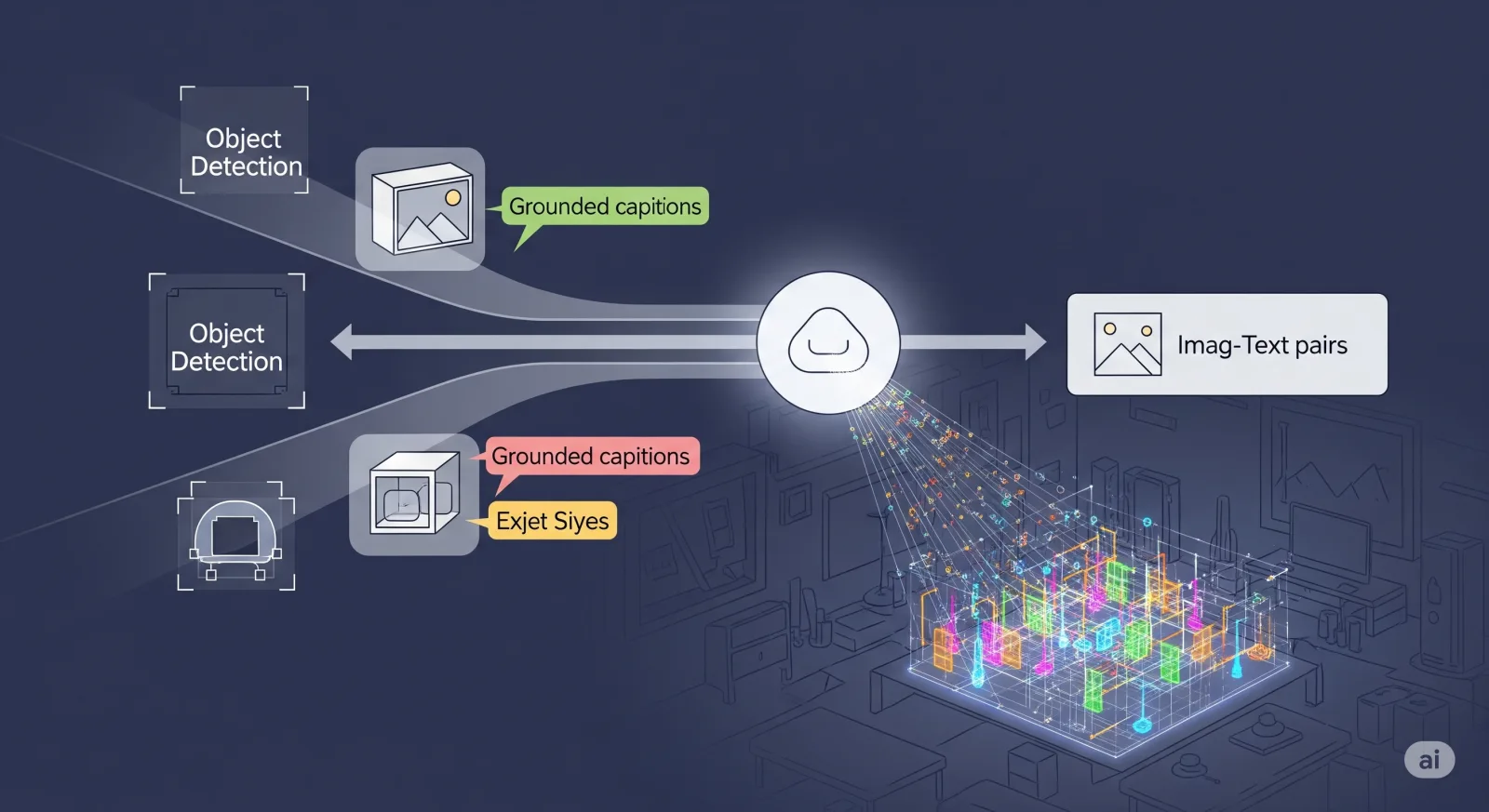
OmniTrain attacks that seam. It trains detection data, grounding data, and image-caption pairs together through a unified recipe. The interesting part is not merely “more data.” Everyone has tried that; it is the computer vision equivalent of adding more meetings to fix poor management. The paper’s contribution is making heterogeneous supervision behave like one training problem.
The reported result is a detector, OmniDet, that improves across RefCOCOg, COCO, and LVIS in the paper’s comparison setting. The business interpretation is not “deploy this tomorrow and fire the labelling team.” It is: unified training may reduce the engineering cost of maintaining separate pipelines for closed-set detection, phrase grounding, and image-text alignment. That matters because real deployment failures usually come from brittle data workflows before they come from philosophical debates about whether the model truly “understands” a forklift.
Detection teams do not run out of nouns; they run out of clean supervision
A warehouse camera does not care whether “pallet jack,” “manual pallet truck,” and “that yellow thing blocking aisle seven” are ontologically elegant. It needs to localise the object, now, under mediocre lighting, with labels written by people who have other things to do.
Classic object detection was built around fixed taxonomies. COCO has its list. LVIS has a much larger one. Internal enterprise datasets have whatever the operations team remembered to annotate before the budget ran out. This closed-list assumption works tolerably well until the business adds new SKUs, new tools, new defects, new packaging, new safety hazards, or new regional terminology. Then the model becomes less a vision system and more a monument to last quarter’s annotation plan.
Open-vocabulary detection tries to loosen that dependency by connecting visual regions to language. Earlier systems showed different paths into the problem. ViLD used vision-language knowledge distillation to transfer recognition ability from a pre-trained image-text model into a detector.2 OWL-ViT showed that a relatively simple Vision Transformer architecture could be adapted for open-vocabulary detection after large-scale image-text pre-training.3 Later work pushed harder on scale and hybrid supervision, showing that rare-category performance benefits when training data is not limited to neat detection datasets.45
That history matters because it frames OmniTrain’s actual move. The problem is no longer whether language can help detection. That argument has already left the building. The expensive question is how to train a detector across incompatible supervision formats without building a fragile tower of pre-training stages, dataset-specific heads, and loss functions that look unified only in the slide deck.
OmniTrain makes heterogeneous data look like one training problem
OmniTrain’s core design is a three-stream training recipe. Instead of treating detection, grounding, and image-caption alignment as separate lives of the same model, it mixes them into a shared end-to-end loop.
| Training stream | Typical supervision | What the model is being asked to learn | Operational meaning |
|---|---|---|---|
| Detection | Boxed categories from datasets such as COCO or LVIS | Localise known object categories | Preserve conventional detector competence |
| Grounding | Phrases or text spans linked to boxes | Connect language expressions to visual regions | Handle user- or task-specific descriptions |
| Image-text alignment | Image-caption pairs without boxes | Learn broader visual-language associations | Use cheaper web-scale supervision without demanding boxes everywhere |
This is the part worth slowing down for. A naïve reading says, “So they just mix all the data.” No. Dumping datasets together is not a method; it is how one produces a training run with excellent GPU utilisation and questionable meaning.
The paper’s more important decision is to make the supervision formats compatible. Detection data says, “This box is a bicycle.” Grounding data says, “This phrase refers to that region.” Caption data says, “This image corresponds to this text.” Those are not naturally the same task. OmniTrain’s bet is that if these signals can be routed through a shared detector backbone and prediction interface, the model can learn open-vocabulary behaviour without being passed like a slightly damaged parcel from one training stage to the next.
The business value starts here. Separate training stages are not just a research inconvenience. They create failure surfaces. One team owns pre-training. Another owns detector fine-tuning. A third patches grounding. The evaluation suite becomes a diplomatic negotiation among metrics. When the model fails on a new category, nobody knows whether the issue is vocabulary coverage, region localisation, phrase alignment, dataset imbalance, or simply Tuesday.
A unified recipe does not magically solve those problems. It makes them easier to inspect.
Token-only grounding is boring in exactly the right way
The paper’s most practical mechanism is token-only grounding. Instead of treating grounding as a separate sentence-region matching problem, OmniTrain reframes it into token-level classification over a shared vocabulary.
That sounds less glamorous than “multimodal reasoning,” which is probably why it is useful. Grounding becomes closer to detection: predict which textual token corresponds to a visual region. The model does not need an entirely separate semantic apparatus for phrases and boxes. It can reuse the same underlying machinery for category-like and phrase-like supervision.
The effect is architectural hygiene. Detection already wants region predictions. Grounding wants region-language alignment. If grounding can be expressed in token terms, the training signal can touch representations that are directly relevant to detection, rather than living in a neighbouring module and sending polite suggestions.
This distinction matters in deployment. Many open-vocabulary systems look impressive when prompted with clean object names. They become less impressive when users describe objects in natural, messy, domain-specific language. “Damaged carton near the lower-left shelf” is not a COCO class. Neither is “unsealed blister pack,” “incorrect cap colour,” or “temporary barrier blocking emergency exit.” Token-level grounding does not guarantee success on those phrases, but it gives the training loop a cleaner way to connect language fragments with visual regions.
The misconception to avoid is that OmniTrain’s unification is mainly about convenience. Convenience is the visible layer. The deeper claim is about representation contact: grounding supervision helps only if it reaches the parts of the model that localisation actually uses.
The reported gains suggest the streams are reinforcing, not cancelling
The paper reports improvements across grounding and detection benchmarks under the comparison setting used in the article’s original source. The point is not that one table settles open-vocabulary detection. It does not. The point is that the gains appear across different evaluation pressures, which is what one would hope to see if unified training is genuinely working.
| Benchmark | Metric reported | OWL-ViT | Grounding DINO | OmniDet | What the result suggests |
|---|---|---|---|---|---|
| RefCOCOg | AIGT | 67.2 | 63.4 | 72.3 | Phrase-level grounding is not being diluted by unified training |
| COCO | mAP | 39.8 | 39.1 | 43.5 | Conventional detection performance improves rather than being sacrificed |
| LVIS | mAP | 25.1 | 27.5 | 29.9 | Long-tail category detection benefits from the broader supervision mix |
The RefCOCOg result is the most direct check on the grounding argument. If token-only grounding were merely a simplification that erased phrase information, RefCOCOg would be where the bill arrived. Instead, the reported OmniDet score is higher than both cited baselines. That does not prove universal grounding superiority, but it does indicate that the unification is not obviously flattening language into useless category tokens.
COCO gives a different signal. It asks whether the model still behaves like a competent detector on conventional object categories. A common failure mode in multi-objective training is that a system improves on the new fashionable target while quietly degrading on the old boring target that customers still pay for. OmniDet’s reported COCO mAP is higher in this comparison, which supports the idea that the shared recipe is additive rather than parasitic.
LVIS is the more business-relevant test. Its larger and more uneven category space better resembles the long-tail reality of enterprise detection: many rare items, uneven visual examples, and categories that are not blessed with abundant boxes. The reported OmniDet advantage on LVIS is smaller than the RefCOCOg jump but still meaningful. In practice, that is the kind of gain that matters when a model needs to recognise the less common things without demanding a bespoke annotation campaign every time procurement changes suppliers.
There is a boundary, of course. These are paper-reported benchmark results, not a service-level agreement. Benchmarks test controlled versions of open vocabulary. Business deployments test lighting, occlusion, camera angle, inconsistent naming, operator impatience, and procurement departments with a gift for chaos.
The paper directly shows a training result; Cognaptus infers a workflow advantage
It is useful to separate evidence from interpretation. Otherwise every model paper becomes a product brochure wearing a lab coat.
| Layer | What is supported | Business meaning | Boundary |
|---|---|---|---|
| Direct paper result | Unified training across detection, grounding, and image-text streams can improve reported benchmark performance | The method is technically credible enough to merit evaluation | The result is still benchmark-bound and configuration-specific |
| Mechanistic reading | Token-only grounding makes language-region supervision more compatible with detection | Fewer specialised components may mean easier debugging | Compatibility does not eliminate data imbalance or prompt ambiguity |
| Cognaptus inference | A unified recipe could reduce pipeline maintenance cost | Teams may spend less time reconciling pre-training, fine-tuning, and grounding stages | Actual ROI depends on data volume, category churn, and internal ML maturity |
| Open question | Whether the method transfers cleanly to specialised domains | High-value use cases include inspection, safety, inventory, robotics, and media search | Domain validation remains non-negotiable |
The practical lesson is not “use OmniTrain because it wins a table.” That is how expensive disappointments begin.
The better lesson is that open-vocabulary detection is becoming less about inventing isolated model tricks and more about designing training systems that can absorb different kinds of supervision. Box labels are precise but expensive. Captions are cheap but noisy. Grounding annotations are semantically rich but uneven. A useful detector should learn from all three without forcing each into a different research project.
This is where the paper fits into the broader movement. ViLD showed that vision-language models could act as teachers for detection. OWL-ViT simplified the bridge between image-text pre-training and detection fine-tuning. DetCLIPv2 pushed word-region alignment with hybrid supervision at larger scale. OWLv2 showed the value of scaling open-vocabulary detector training through self-training. OmniTrain’s contribution sits downstream of these ideas: if the field is going to use many supervision types anyway, the training interface had better stop behaving like a customs checkpoint.
The business value is cheaper diagnosis, not just cheaper training
For operators, the main attraction is not the theoretical elegance of one training loop. It is the possibility of cheaper diagnosis.
Consider a retailer using vision models for shelf compliance. New products arrive constantly. Package designs change. Regional synonyms appear in operational notes. A closed-set detector requires frequent relabelling or accepts growing blind spots. A fragmented open-vocabulary detector may support text prompts, but when performance drops, the team has to inspect a multi-stage pipeline. Did language pre-training miss the term? Did detector fine-tuning overwrite useful representations? Did grounding fail because the phrase was too specific? Did the prompt template produce a bad embedding? Nothing says “AI transformation” like a post-mortem with five dashboards and no culprit.
A unified training recipe does not remove the need for diagnostics. It gives diagnostics a cleaner object. If detection, grounding, and image-text alignment are trained together, a team can evaluate how each data stream contributes, where category failures cluster, and whether new supervision improves one capability while damaging another. That is not glamorous. It is, however, the difference between an ML system one can operate and an ML system one merely admires.
The same logic applies in industrial inspection. The valuable categories are often rare, visually subtle, and described in domain language: “hairline crack near weld edge,” “missing washer,” “incorrect gasket orientation.” The model must connect phrases to regions, not just map images to familiar class names. OmniTrain’s token-grounding approach is relevant because these phrases contain operational meaning at the token level. The word “missing” changes the task. So does “near,” “edge,” and “incorrect.” A detector that treats text as a decorative label has already lost.
In robotics and field operations, the benefit is similar but the cost of ambiguity is higher. A robot asked to “pick up the small red valve cap behind the pipe” needs localisation grounded in language. Failure is not a funny captioning error; it is an action error. Open-vocabulary detection becomes useful only when language helps the system act on the right region.
Where OmniTrain should not be over-read
OmniTrain should not be mistaken for open-world perception in the full sense. It is still object detection mediated by training data, model capacity, tokenisation, and evaluation design. The vocabulary may be open, but the operating environment is not automatically understood.
First, prompts remain governance artefacts. A detector’s behaviour depends on the words supplied to it. In a business setting, prompt vocabulary should be versioned, reviewed, and tested like any other interface. “Safety cone,” “traffic cone,” and “temporary marker” may not behave identically. That is not a philosophical problem. It is a QA problem.
Second, domain-specific categories still need domain-specific validation. A model that performs well on LVIS is not automatically ready for semiconductor defects, medical imagery, customs inspection, or construction-site safety. The long tail is not one universal tail; every industry grows its own unpleasant little taxonomy.
Third, unified training can hide data imbalance if evaluation is lazy. Mixing streams does not mean each stream contributes equally. Image-caption pairs can dominate by scale. Detection labels can dominate localisation quality. Grounding examples can dominate phrase sensitivity. The useful question is not whether the model was trained on many data types, but whether the resulting representation behaves correctly under the task distribution that matters.
Finally, benchmark gains do not settle deployment economics. A unified recipe may reduce engineering overhead, but training large vision-language detectors still requires compute, data curation, evaluation design, and monitoring. If a team lacks those basics, OmniTrain is not a shortcut. It is a more elegant way to discover the same organisational weaknesses.
Conclusion: one loop is easier to inspect than three
OmniTrain’s appeal is not that it makes open-vocabulary detection magical. Its appeal is that it makes the training story less fragmented. Detection, grounding, and image-text alignment have been converging for years, but convergence at the concept level is not enough. The machinery has to converge too.
The paper’s reported results suggest that a unified training recipe can strengthen both grounding and detection rather than forcing a trade-off between them. The mechanism — especially token-only grounding — matters because it makes language supervision touch the detector in a more compatible way. That is the technical centre of the article, not the branding.
For business readers, the lesson is restrained but useful. Open-vocabulary detection is becoming more viable not because models have discovered the Platonic form of every object, but because training workflows are learning to absorb messy supervision more coherently. That is less romantic than artificial general perception. It is also much closer to something one can budget, test, and operate.
A single model will not train them all in the mythic sense. But one cleaner training loop may save teams from maintaining three semi-compatible pipelines and calling the result a platform. In enterprise AI, that counts as progress. Quietly heroic, even.
Cognaptus: Automate the Present, Incubate the Future.
-
OmniTrain: Scaling Up Open-Vocabulary Object Detectors via Unified Training, arXiv preprint, 2025. The available public article source identifies OmniTrain as the target paper; this revision cites the paper title rather than repeating an unverified arXiv identifier. ↩︎
-
Xiuye Gu, Tsung-Yi Lin, Weicheng Kuo, and Yin Cui, “Open-vocabulary Object Detection via Vision and Language Knowledge Distillation,” arXiv:2104.13921. ↩︎
-
Matthias Minderer et al., “Simple Open-Vocabulary Object Detection with Vision Transformers,” arXiv:2205.06230. ↩︎
-
Lewei Yao et al., “DetCLIPv2: Scalable Open-Vocabulary Object Detection Pre-training via Word-Region Alignment,” arXiv:2304.04514. ↩︎
-
Matthias Minderer, Alexey Gritsenko, and Neil Houlsby, “Scaling Open-Vocabulary Object Detection,” arXiv:2306.09683. ↩︎