TL;DR for operators
Dashboards are good at telling you where performance is today. They are worse at telling you whether the rate of improvement is itself accelerating. That is the useful business translation of David Orban’s paper on “jolting” AI capabilities: do not only monitor model scores; monitor the shape of improvement.
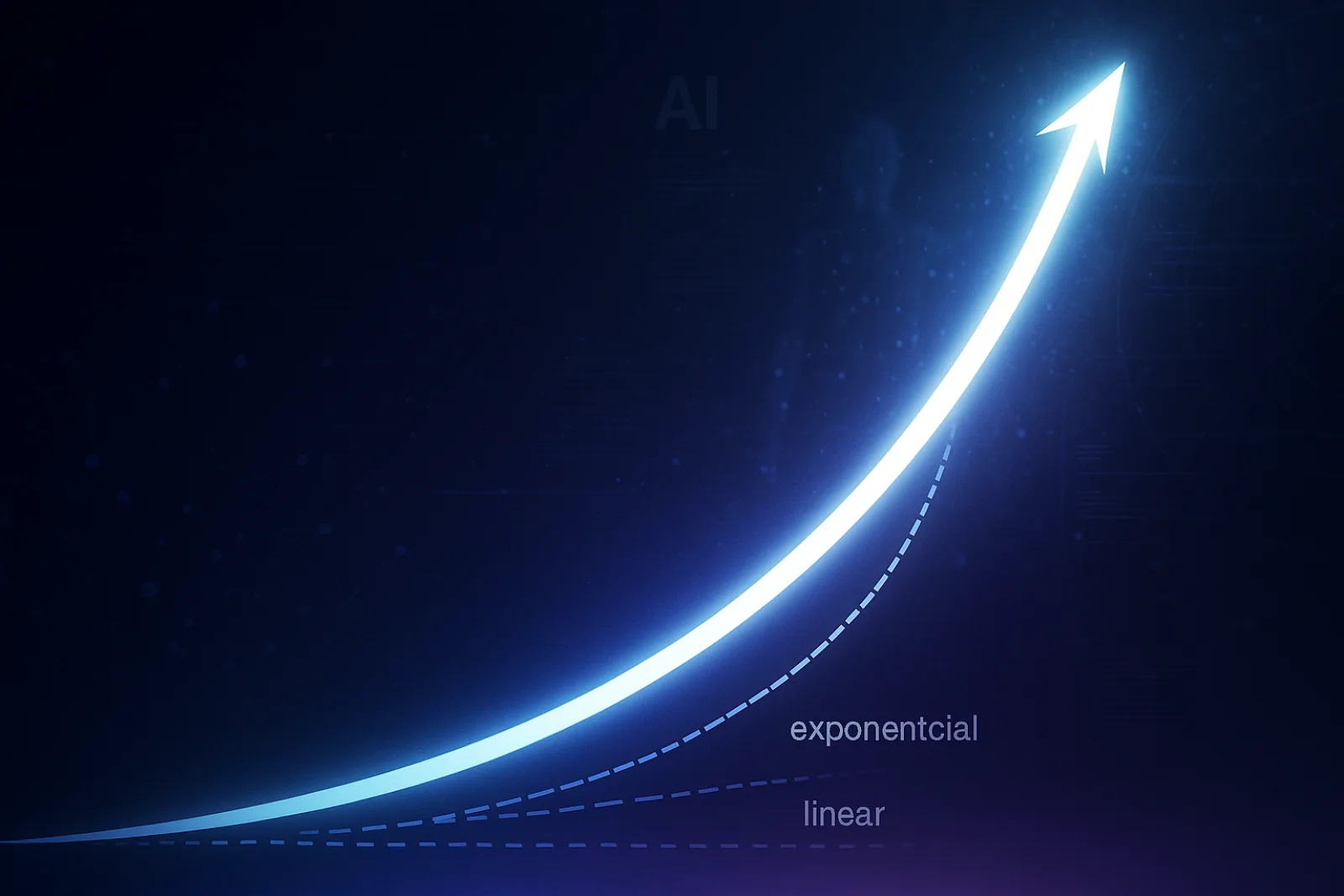
The paper defines a technological jolt as sustained positive third-derivative behaviour in a capability curve. In plain terms, AI is not merely improving, and not merely improving faster. The acceleration of improvement is itself increasing. That is a stronger claim than “things are moving quickly,” which is the standard executive summary of every AI slide deck now quietly breeding in the walls.
But the paper does not prove that current AI progress is already superexponential in the real world. Its strongest contribution is methodological: it formalises the jolt concept, proposes composite and resource-constrained models, and tests a hybrid jolt detector on synthetic Monte Carlo trajectories. The reported detector performance is strong under low and medium simulated noise, weaker under high noise, and useful mostly as a proof that the detection problem is tractable under controlled assumptions.
For business leaders, the takeaway is not “AGI is suddenly three years away.” That would be numerology wearing a lab coat. The better takeaway is this: organisations need monitoring systems that can detect when AI capability improvement begins to change curvature. That matters for automation investment, procurement, risk controls, internal deployment policy, and strategic timing.
The hard boundary is data quality. Third derivatives are fragile. Benchmarks saturate. Vendor demos are not longitudinal datasets. Internal productivity metrics are noisy. Compute, energy, data, and talent constraints can dampen apparent acceleration. The jolt framework is therefore best treated as an early-warning lens, not as a calendar.
The metric that matters is not speed, but changing acceleration
Most business discussions about AI progress are built around velocity. A model is faster. A coding assistant completes more tasks. A support bot resolves a higher share of tickets. A research agent writes better summaries, queries more tools, or survives longer before collapsing into procedural jazz.
Velocity is the first derivative: how quickly capability changes.
A more serious conversation looks at acceleration. Are improvements arriving faster than before? Are model generations compressing? Are agents becoming more reliable across task families more quickly than expected?
Acceleration is the second derivative.
Orban’s paper moves one level higher. It asks whether acceleration itself is increasing.1 That is the third derivative, sometimes called “jolt” or “jerk” in physics. If $C(t)$ is a capability metric over time, then:
- $C’(t)$ measures the rate of improvement;
- $C’’(t)$ measures whether that improvement rate is accelerating;
- $C’’’(t)$ measures whether the acceleration is itself increasing.
The paper’s proposed normalized jolt can be read as:
The normalization matters because raw third derivatives are not comparable across different capability scales. A one-point movement on a saturated benchmark is not the same as a large shift in long-horizon task completion. Normalization tries to make the concept portable across capability domains.
This is the mechanism that should frame the article. Without it, “jolting AI” sounds like a dramatic synonym for “fast AI.” It is not. It is a specific mathematical claim about curve shape.
That specificity is useful because it gives operators something sharper to ask: are we seeing steady improvement, accelerated improvement, or improvement whose acceleration is itself rising?
Those are different worlds.
A jolt is stronger than an exponential curve
A familiar exponential curve already feels dramatic because the same percentage gain compounds over time. But in a standard exponential process, the relative growth rate is constant. The doubling time remains stable.
A jolting process is more demanding. It implies that the relevant doubling intervals may compress, provided the jolt is large enough relative to the lower-order derivatives. The paper is careful on this point: a positive third derivative is related to shrinking doubling times, but it is not automatically sufficient. That caveat matters because otherwise every upward wiggle in a benchmark becomes a prophecy. The industry has enough prophecies. It could use a spreadsheet that knows shame.
The operational difference looks like this:
| Growth pattern | What the organisation sees | Planning mistake if misread |
|---|---|---|
| Linear improvement | Capability rises by roughly similar absolute increments | Overinvesting too early because normal progress is mistaken for a breakthrough |
| Exponential improvement | Capability compounds at a stable relative rate | Underestimating long-run gains, but still having some planning rhythm |
| Jolting improvement | Acceleration itself rises; capability transitions compress | Governance, procurement, staffing, and risk review cycles become too slow |
| Saturating improvement | Capability approaches a ceiling or benchmark maximum | Mistaking a mature benchmark for a mature capability |
The fourth row is the quiet assassin. Benchmark saturation can make a system look less dynamic than it is, or make late-stage improvements look deceptively small. Conversely, switching to a harder benchmark can create an apparent discontinuity that looks like a jolt even when the underlying capability process is less dramatic. Third-derivative analysis is only as credible as the measurement series beneath it.
The paper’s core move is a detection framework, not a finished AI forecast
The paper’s first major contribution is formal. It defines the Jolting Technologies Hypothesis as a claim about sustained positive normalized third derivatives in technological capability curves, especially AI.
Its second contribution is compositional. Orban argues that AI capability acceleration is not produced by one clean variable. Hardware, algorithms, data, research tooling, agent scaffolding, deployment feedback, and capital allocation can interact. A capability jolt may therefore emerge from several smaller jolts reinforcing each other.
The composite model is useful even if one does not accept the strongest AGI implications. It maps better to how AI systems actually improve. A model release does not become useful in the enterprise only because the base model improved. It may become useful because inference got cheaper, tool use got more reliable, context windows grew, orchestration improved, evaluation became more disciplined, and internal workflows were redesigned around the system. The jolt, if present, is a systems phenomenon.
The third contribution is constraint-aware. The paper adds the idea of effective jolt magnitude, where theoretical acceleration is dampened as resource limits become binding. Compute, energy, capital, data, talent, and physical infrastructure are not decorative footnotes. They are the difference between a curve and an invoice.
This matters because the naive version of the argument says: if acceleration accelerates, everything goes vertical. The resource-constrained version says: maybe, but only if the system can keep feeding the acceleration loop. That is the right instinct. Superexponential rhetoric without resource accounting is just venture capital karaoke.
The empirical section is mostly a blueprint plus simulations
The existing public conversation around AI progress often blurs three things: proposed measurement strategy, simulated validation, and real-world empirical confirmation. Orban’s paper contains all three categories, but not with equal evidentiary weight.
The benchmark analysis section lays out what a real empirical test would require: long-running capability series, smoothing methods such as Savitzky-Golay or LOESS, curve fitting through splines or polynomial regression, derivative estimation, statistical testing, and normalized jolt quantification. Candidate sources include benchmark families such as MMLU, ImageNet, AgentBench-style evaluations, and composite indices.
That is a proposed empirical programme. It is not the same as a completed demonstration that those benchmarks already exhibit sustained statistically significant jolts.
The strongest concrete result in the paper comes from Monte Carlo simulations designed to validate the jolt detection methodology. The hybrid detector combines peak ratio analysis, pattern matching, and duration metrics. On synthetically generated time series, the paper reports the following performance:
| Noise level | True positive rate | False positive rate | Likely purpose |
|---|---|---|---|
| Low | 0.95 | 0.05 | Main synthetic validation under favourable conditions |
| Medium | 0.92 | 0.08 | Robustness check under moderate noise |
| High | 0.85 | 0.15 | Stress test showing degradation under noisy measurement |
The interpretation is straightforward. The detector can identify simulated jolts with strong performance when the data-generating process is controlled. It remains reasonably effective under high noise, but false positives rise. That is not a fatal flaw. It is exactly what one should expect when estimating third derivatives from noisy data. The third derivative is not a polite statistic. It amplifies measurement problems, edge effects, smoothing choices, and benchmark weirdness.
The heatmap described in the paper serves a related purpose: it visualises detector error rates across hyperparameter settings. Its role is not to prove that AI is jolting. It shows that the detector’s performance depends on configuration and that some regions of the parameter space perform better than others. That is an implementation and sensitivity result, not a second thesis hiding in a figure.
The agent case study is useful because agents expose discontinuity
The paper’s agent section is more interesting than a generic benchmark discussion because agents create exactly the kind of multi-factor capability stack where jolts could plausibly appear.
An agent’s usefulness does not depend only on a model’s answer quality. It depends on planning depth, tool use, memory, error recovery, interface reliability, task decomposition, cost, latency, and the ability to persist over longer workflows. Improvements across these layers can combine nonlinearly.
The paper treats agent capability as a composite metric involving task completion rates, efficiency, and task complexity. Because long-term, consistent agent datasets are hard to obtain, the paper uses simulations rather than claiming mature empirical validation. It generates synthetic trajectories representing exponential, logistic, and jolting growth patterns, then applies the jolt detection method.
That makes the case study an exploratory extension. It supports the plausibility and monitoring relevance of jolt detection in agentic systems. It does not prove that current production agents are already undergoing jolting improvement.
For operators, the agent angle matters because the business consequences of agent improvement are not smooth. A chatbot that answers 70% of internal policy questions instead of 60% is useful. An agent that can suddenly complete multi-step procurement reconciliation, generate documentation, call APIs, check exceptions, and escalate edge cases is not merely “10 points better.” It crosses an operational threshold.
In enterprise automation, thresholds are often more important than averages. A model that becomes reliable enough to remove a human review layer changes cost structure, risk exposure, and organisational design. This is where the jolt lens becomes practical. It asks when improvement is not only continuing, but approaching a discontinuous operational boundary.
What the paper directly shows, and what Cognaptus infers
The cleanest way to avoid over-reading the paper is to separate direct claims from business inference.
| Layer | What the paper directly supports | Cognaptus interpretation | Boundary |
|---|---|---|---|
| Mathematical framework | A jolt can be formalised as sustained positive third-derivative behaviour in capability curves | Capability monitoring should include curvature, not just current performance | Requires stable capability metrics over time |
| Composite model | Multiple AI progress drivers may interact to produce system-level acceleration | Enterprise AI gains often come from model, tooling, data, and workflow improvements together | Interactions are hard to estimate from public data |
| Resource constraints | Compute, energy, capital, data, and talent can dampen effective jolts | Acceleration forecasts should include bottleneck analysis | Constraint parameters are rarely observable from outside labs |
| Monte Carlo detector | A hybrid detector performs well on synthetic trajectories, with degradation under high noise | Early-warning analytics are feasible in controlled measurement environments | Synthetic validation is not real-world proof |
| Agent simulation | Jolts can be simulated in agent-style capability trajectories | Agent monitoring should track task-completion thresholds and reliability jumps | Real agent benchmarks remain young and inconsistent |
This distinction is not academic fussiness. It is the difference between using the paper as a monitoring framework and using it as a fortune cookie.
The business value is early warning, not AGI date-setting
The obvious temptation is to turn the paper into a timeline argument. If capabilities are jolting, AGI arrives sooner. If AGI arrives sooner, governance must panic faster. If governance panics faster, everyone needs a task force, a dashboard, and perhaps a tastefully branded emergency workshop.
That is the lazy reading.
The business value is more immediate and less theatrical. A jolt framework can help organisations monitor whether AI performance in a specific domain is approaching a deployment threshold faster than expected.
For example:
- A customer-support agent may move from “draft reply assistant” to “autonomous Tier 1 resolution” once completion quality, escalation accuracy, and hallucination controls cross a threshold.
- A finance automation system may become viable once extraction accuracy, exception handling, and audit trail generation improve together.
- A coding assistant may shift from productivity tool to workflow orchestrator when it can plan, modify, test, document, and recover from failures across a larger codebase.
- A research agent may become operationally meaningful when it can sustain multi-hour tasks without losing context, inventing sources, or quietly eating the steering wheel.
In each case, the relevant question is not whether the global AI industry is superexponential. The question is whether the organisation’s own capability frontier is bending faster than its operating model can absorb.
That changes what should be measured.
A conventional AI dashboard tracks current performance: accuracy, latency, cost per task, human review rate, failure categories, and adoption. A jolt-aware dashboard adds time-series structure: velocity of improvement, acceleration of improvement, and possible curvature shifts. It also tracks whether improvements are coming from one source or several interacting sources.
The practical aim is not to predict the singularity. It is to avoid being surprised when a system moves from “pilot” to “economically obvious” between two quarterly planning cycles.
Procurement should watch the vendor’s learning curve, not only the product sheet
The paper’s composite model has a strong procurement implication. When buying AI systems, organisations usually compare current features. That is necessary, but insufficient.
For fast-moving AI vendors, the more valuable question may be: how quickly is this vendor improving along dimensions that matter to us?
A vendor with a slightly weaker product today but a steeper improvement trajectory may dominate later. A vendor with strong benchmark claims but unstable evaluation practices may be hard to trust. A vendor whose capability gains depend heavily on scarce compute or manual prompt-engineering labour may hit resource constraints faster than the sales team admits.
A jolt-aware vendor review would ask:
| Procurement question | Why it matters |
|---|---|
| Does the vendor provide longitudinal performance data on the same task family? | Without stable series, acceleration claims are theatre |
| Are improvements model-driven, workflow-driven, data-driven, or human-labour-driven? | Composite gains have different durability and cost structures |
| Are evaluation tasks changing over time? | Moving goalposts can mimic progress or hide stagnation |
| What resource constraints affect future improvement? | Compute, talent, integration effort, and data access can dampen acceleration |
| How often do controls need retesting after model updates? | Jolting systems can invalidate yesterday’s risk review |
This is where the paper becomes useful for enterprise governance. It suggests a way to think about AI capability as a dynamic process rather than a product snapshot.
Governance cadence becomes a design variable
If a system improves linearly, annual review may be tolerable. If it improves exponentially, quarterly review starts to look more sensible. If it jolts, governance cadence itself becomes part of system design.
That does not mean every AI deployment needs permanent executive alarm bells. It means review frequency should match capability volatility.
A narrow, stable classifier used in a low-risk workflow may not need jolt analytics. A tool-using agent connected to internal systems, customer data, finance processes, or software deployment pipelines is different. Its capability changes can alter the risk profile quickly.
The governance question becomes: what kind of capability movement would force a new review?
Examples include:
- the agent completes tasks above a defined autonomy threshold;
- tool-call success rates rise enough to reduce human intervention;
- failure recovery improves enough that longer workflows become viable;
- cost per successful task falls below a deployment trigger;
- external model updates materially change behaviour under the same prompts;
- benchmark performance improves while interpretability or auditability does not.
The paper’s policy discussion focuses on AI governance and regulatory preparedness. The enterprise version is more mundane but more actionable: define capability-change triggers before the system crosses them.
Otherwise, the organisation discovers too late that a tool approved as an assistant has become an operator.
The resource model is where hype meets accounting
The resource-constrained part of the paper deserves more attention than it usually receives. A positive jolt can be dampened by resource limits. That one sentence does a lot of work.
AI acceleration depends on inputs. Compute must be available. Energy must be supplied. Data must be usable. Talent must exist. Capital must continue flowing. Internal adoption must overcome process drag. Integration teams must not be reduced to a smoking crater.
For business planning, this means capability acceleration should be paired with bottleneck mapping.
| Acceleration driver | Possible resource constraint | Business planning implication |
|---|---|---|
| Larger or better models | Compute cost, inference latency, vendor capacity | ROI estimates must include scaling economics |
| Better agent orchestration | Integration complexity, API reliability, security review | Automation timelines depend on internal architecture |
| Better domain adaptation | Proprietary data quality, labelling, permissions | Data readiness becomes a strategic asset |
| Faster deployment learning | Change management, staff training, compliance | Human adoption can be the binding constraint |
| Lower inference cost | Vendor pricing, infrastructure availability | Previously uneconomic use cases may suddenly become viable |
This is also why a global AI jolt does not automatically translate into an enterprise jolt. The frontier model may improve dramatically while the organisation’s workflows remain stuck behind legacy systems, data silos, procurement delays, and legal review. The bottleneck is not always the model. Sometimes it is the SharePoint folder. History is cruel like that.
The main limitation is measurement, not imagination
The paper is strongest when it is formal and methodological. It is weakest if read as empirical proof of current AI superexponentiality.
The measurement challenge is substantial.
First, AI benchmarks are not clean physical sensors. They saturate, get gamed, change composition, or become less relevant as models adapt. A benchmark that once measured frontier reasoning can become a solved undergraduate obstacle course with better branding.
Second, estimating third derivatives from discrete noisy data is hard. Smoothing choices matter. Edge effects matter. Sparse time points matter. Different curve fits can imply different derivative behaviour. A detector can be robust in simulation and still fragile in public benchmark data.
Third, capability is multidimensional. Language, coding, vision, robotics, tool use, scientific reasoning, long-horizon agency, and cost-adjusted deployment may move differently. Aggregating them into one capability curve risks hiding the interesting part.
Fourth, public data is incomplete. The paper itself notes the value of partnerships with AI labs, access to detailed training logs, and better proxy metrics. Without those, many claims about jolts will remain suggestive rather than decisive.
This limitation does not make the framework useless. It defines its proper use. The framework is an early-warning instrument. It should trigger investigation, not replace it.
A better executive question: what would change our operating rhythm?
The useful managerial response to the paper is not to ask, “Is AI definitely jolting?” That question is too broad and currently under-measured.
A better question is: “What evidence would force us to change our operating rhythm?”
For an AI-native product company, that evidence might be a sudden increase in agent task horizon. For a bank, it might be reliable document processing across messy exception cases. For a hospital network, it might be clinical admin automation that reduces manual review without raising safety incidents. For a construction or hospitality group, it might be back-office automation becoming cheap and reliable enough to consolidate procurement, accounting, reporting, and customer engagement workflows.
Each organisation needs its own capability curve.
That curve does not need to be perfect. It needs to be stable enough to reveal whether improvement is linear, exponential, saturating, or bending into something more abrupt.
The paper gives a vocabulary for that monitoring problem. It does not give a universal answer. Good. Universal answers are usually where nuance goes to be monetised.
Conclusion: watch the curvature
“Jolting” is an awkwardly vivid word, but the underlying idea is useful. AI strategy should not only track where models are. It should track how fast they are improving, whether that improvement is accelerating, and whether acceleration itself is changing.
Orban’s paper contributes a mechanism-first framework for doing that. It formalises the jolt as third-derivative behaviour, proposes composite and resource-aware extensions, and validates a hybrid detector on synthetic trajectories. The detector results are promising, especially under lower-noise conditions, but they are not real-world proof that AI development has already entered a sustained jolting regime.
For Cognaptus readers, the business implication is disciplined vigilance. Monitor capability curves. Track deployment thresholds. Retest controls when systems improve. Ask vendors for longitudinal evidence. Map resource bottlenecks. Build governance cadence around capability volatility, not committee convenience.
The companies that benefit from AI acceleration will not be the ones shouting “exponential” the loudest. They will be the ones measuring when the curve changes shape.
Cognaptus: Automate the Present, Incubate the Future.
-
David Orban, “Jolting Technologies: Superexponential Acceleration in AI Capabilities and Implications for AGI,” arXiv:2507.06398, 2025. ↩︎