TL;DR for operators
Dinner plans are where elegant recommender theory goes to be quietly embarrassed. Five people do not usually open a dedicated app, rate every restaurant, agree on a utility function, and wait for a ranked list to descend from the heavens. They argue in a chat. They change their minds. Someone forgets the budget. Someone says “anything is fine” while absolutely not meaning it. Someone else proposes a venue that is closed on Mondays. Humanity, as usual, remains a hostile runtime environment.
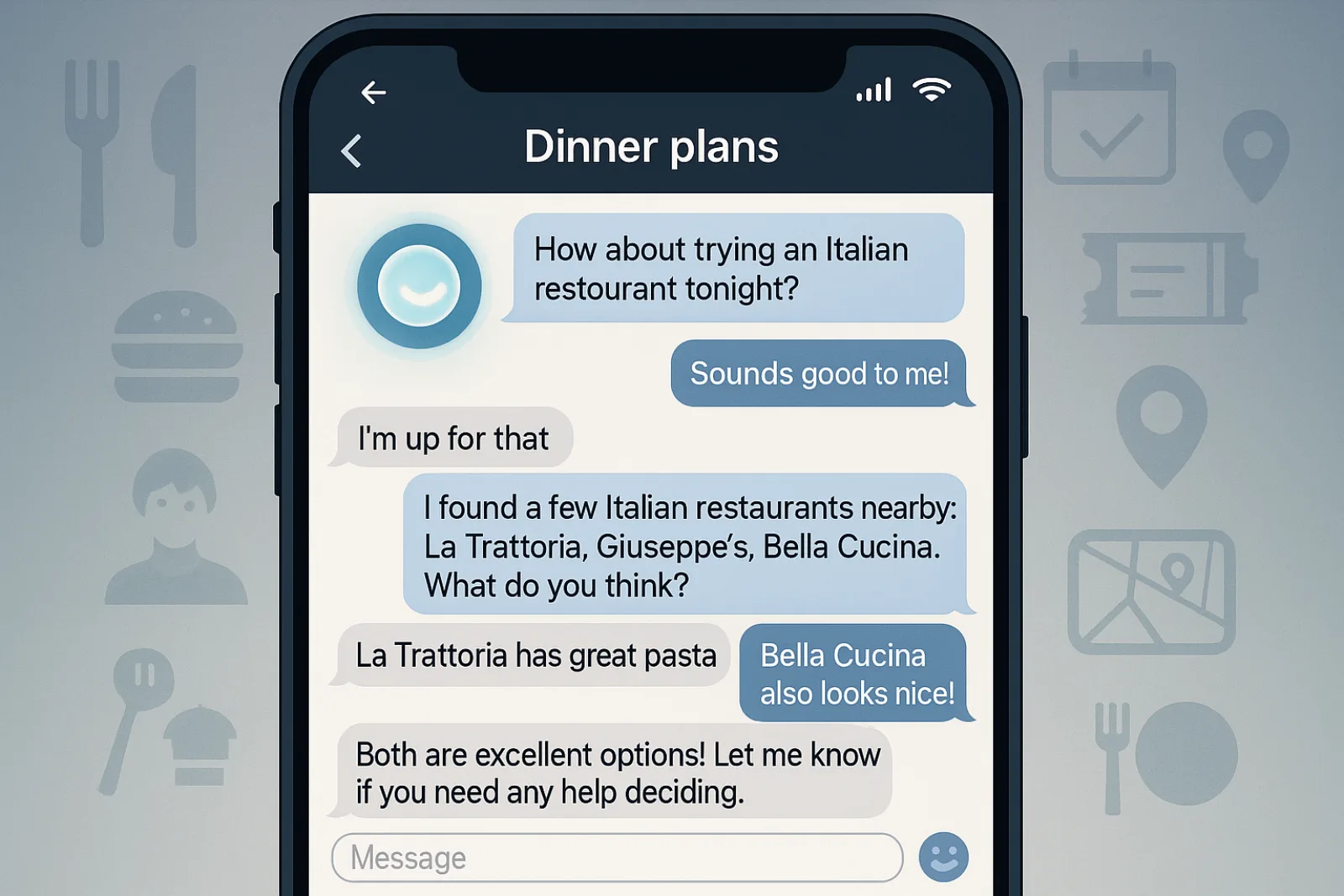
The paper behind this article argues that group recommender systems have been built around the wrong centre of gravity: preference aggregation. The authors’ sharper claim is that modern generative AI makes another product form plausible: an agent inside the group conversation that helps the group decide, not merely receive recommendations.1
For operators, the useful shift is this: the recommendation surface moves from a separate widget to the conversation itself. The AI agent observes the discussion, builds lightweight profiles, remembers prior signals, detects missing preferences, summarises consensus and disagreement, explains trade-offs, moderates participation, and may eventually execute actions such as checking availability or making reservations.
This is not a benchmark paper claiming that one model beats another by a few points on a recommendation dataset. There are no new experiments, ablations, or performance tables to worship. The paper is a perspective and research agenda. Its evidence is a structured reading of group recommender history, chat-based decision support, and LLM-agent architectures. That makes the article more strategic than empirical: useful for product direction, not sufficient for procurement.
The business opportunity is not “better ranking”, though ranking still matters. It is cheaper coordination. In travel, dining, entertainment, social commerce, and enterprise buying, the expensive part of group choice is often not discovering options. It is getting humans to converge without exhausting each other. A chatbot at the table could become the polite, tireless facilitator no one asked for but everyone eventually uses. Provided, naturally, it does not hallucinate the restaurant, misread sarcasm, over-moderate the humans, or become the most annoying person in the group.
The old model assumed the group had already become a spreadsheet
Group recommender systems are not new. The paper begins by pointing back to early systems such as MusicFX and PolyLens, where group preferences could be collected and combined to produce shared recommendations. Those early projects were interesting not only because they recommended things, but because they were deployed in real environments and forced researchers to confront interaction, fairness, privacy, group formation, and user experience.
Then the field became more technical. Much of the later literature, as the authors describe it, focused on the machinery of aggregating individual preferences into a group recommendation list. That is a legitimate problem. If three people like action films and two want a quiet drama, an algorithm needs some way to balance competing signals. The trouble is that this framing quietly assumes the hard social work has already been done.
A traditional group recommender imagines a neat pipeline:
- identify the group;
- collect individual preferences;
- aggregate those preferences;
- rank items;
- present the list.
That pipeline is attractive because it is measurable. It allows offline experiments. It gives researchers familiar metrics. It also resembles how almost nobody organises real group decisions.
The paper’s central criticism is not that aggregation is useless. It is that aggregation is too late and too narrow. By the time a system has clean preference vectors from each person, the messy part has already been sanitised out of existence. The real decision process includes negotiation, silence, persuasion, shifting constraints, emotional reactions, status dynamics, and the occasional passive-aggressive thumbs-up emoji. An algorithm that only sees final ratings is not seeing the group decision. It is seeing the residue.
This matters commercially because many consumer and enterprise products already sit next to group decisions without owning them. Travel platforms know multiple people are planning a trip. Streaming platforms know households share screens. Food delivery platforms know office orders happen socially. Enterprise software vendors know buying committees rarely behave like single rational agents. Yet most recommendation systems still address “the user”, singular. Convenient fiction. Poor product anthropology.
The paper’s real object is the decision process, not the ranked list
The most important move in the paper is to redefine what the system is supposed to support. In many recommender systems, the job is information filtering: reduce the option set. In group recommendation, the job is often decision support: help people reach a choice they can accept.
That distinction changes the architecture. A ranked list answers the question: “What should this group probably choose?” A decision-support agent answers a larger set of questions:
| Group problem | Traditional recommender response | Agentic group-support response |
|---|---|---|
| People have not stated preferences clearly | Wait for ratings or forms | Infer signals from chat, then ask targeted questions |
| The group is stuck between options | Re-rank alternatives | Summarise trade-offs and identify unresolved constraints |
| One person dominates the discussion | Usually invisible to the system | Invite quieter members to contribute |
| Preferences change mid-discussion | Often treated as data noise | Update the group state dynamically |
| The recommendation needs justification | Explain item features | Explain why the option fits the group and where compromise occurs |
| The decision implies a next step | Stop at recommendation | Check details, retrieve availability, or trigger booking workflow |
The paper is strongest when read as an architectural reframing. It says, in effect: stop treating the group as a batch-processing problem. Treat it as a live coordination problem.
This is also where generative AI enters the argument. The authors are not merely saying that LLMs can be zero-shot rankers, though they acknowledge that work exists. Their more interesting claim is that LLM-based agents can provide functions older systems struggled to implement naturally: intent recognition, summarisation, explanation, preference extraction, moderation, and tool use inside ordinary conversation.
That is why the chosen mechanism-first reading matters. If we summarise the paper as “GenAI improves group recommendations”, we miss the mechanism. The mechanism is that the interface, data source, and intervention point all move into the conversation.
The agent has four jobs: profile, remember, plan, act
The paper borrows a common LLM-agent architecture built around four modules: profile, memory, planning, and action. In a normal recommender setting, that may sound like standard agent vocabulary. In group recommendation, each module becomes more socially complicated.
Profiling means listening to live negotiation
In older group recommender systems, preferences are often assumed to be known: ratings, likes, genre preferences, item scores. The paper challenges that assumption. In real group chat, preferences appear as fragments: “somewhere not too expensive”, “I had sushi yesterday”, “as long as parking is easy”, “not that place again”, “I’m fine with either”.
An LLM agent could extract these signals from conversation. More importantly, it could distinguish explicit preference from reaction. If one member proposes a restaurant and two others react positively while one goes silent, the system has learned something. Not enough to act with divine confidence, but more than a static form would capture.
For business use, this is valuable because preference acquisition is usually friction. Forms are conversion killers. Ratings are sparse. Group chats, by contrast, already contain rich preference data. The product question is whether the system can harvest that context without becoming creepy, wrong, or legally exciting in the bad way.
Memory turns one session into a relationship
Memory matters because group preferences are not always rebuilt from zero. A family that repeatedly chooses child-friendly restaurants, a team that avoids late meetings, or a travel group that prefers museums over nightclubs should not need to explain itself every time.
The paper describes memory as a way to store prior interactions, contextual information, and emotional responses. In practice, this could support both personalisation and continuity. The agent remembers that one person dislikes spicy food, that another usually drives, and that the group previously rejected a venue because it was too noisy.
There is an obvious boundary. Memory is also where privacy risk accumulates. Group contexts are sensitive because one person’s preference may reveal another person’s constraint. A commercial implementation would need clear consent, retention controls, and boundaries between personal memory, group memory, and session-only context. Otherwise the “helpful assistant” becomes an archive of social leakage. Charming, in the way a subpoena is charming.
Planning decides when the agent should shut up
Planning is the most underrated part of the paper. A chatbot can always say something. That does not mean it should.
The authors distinguish reactive and proactive roles. A reactive agent responds when asked: “summarise the options”, “recommend a restaurant”, “compare these two hotels”. A proactive agent enters the discussion without being summoned: “It looks like budget and travel time are the unresolved constraints. Should I shortlist options under ₱1,500 within 20 minutes?”
The business temptation will be to overuse proactivity because it looks intelligent in demos. The paper’s cited discussion of chatbot-assisted decision-making points in a subtler direction: timing matters. Early intervention may improve information sharing; poorly timed intervention may interrupt the social process. Moderation is not just output generation. It is conversational judgment.
For product teams, the planning problem is therefore not only “what should the agent recommend?” It is:
- should the agent intervene now;
- whom should it address;
- should it ask, summarise, compare, suggest, or stay silent;
- should it optimise speed, fairness, satisfaction, or decision quality;
- how much uncertainty should it reveal?
That is not a ranking problem. It is orchestration.
Action connects recommendation to execution
The final module is action. In the paper’s vision, the agent does not necessarily stop once the group chooses. It may retrieve external information, check opening hours, search availability, compare prices, or perform downstream tasks such as reservation.
This is where commercial value becomes easier to see. A group recommendation agent embedded in a messaging environment could connect discovery, agreement, and transaction. The revenue model might come from booking commissions, lead generation, enterprise workflow automation, or platform retention. The operator does not need to pretend the AI is magical. It only needs to reduce enough coordination drag to become habit-forming.
The risk, again, is that actions raise the cost of errors. A hallucinated recommendation is irritating. A hallucinated booking is operational damage. Once the agent can act, verification and permissioning become product primitives, not compliance garnish.
The figures are design scaffolds, not experimental evidence
The paper includes two figures, and neither should be mistaken for proof.
Figure 1 illustrates the usage scenario: humans and an AI agent inside a shared group decision environment, centred on a messaging-style interaction. Its purpose is conceptual. It clarifies where the authors place the agent: not outside the group as a separate recommendation portal, but inside the communication flow.
Figure 2 maps the group recommendation agent onto profile, memory, planning, and action capabilities. Its purpose is architectural. It helps readers see how agentic AI capabilities could be adapted to group recommendation. It is not an implementation diagram with evaluated components, latency budgets, or failure rates.
That distinction matters because the article’s practical claims must be calibrated. The paper does not show that such an agent improves conversion, satisfaction, fairness, or speed in a deployed product. It shows why the old architecture is probably misaligned with real group behaviour and why LLM-agent capabilities create a plausible alternative.
A useful evidence map looks like this:
| Paper component | Likely purpose | What it supports | What it does not prove |
|---|---|---|---|
| History of MusicFX, PolyLens, and later GRS work | Background and problem framing | The field has long recognised group recommendation, but later work became heavily aggregation-focused | That any specific GenAI product will succeed |
| Review of human decision-making and group dynamics | Mechanism grounding | Group choice involves conformity, justification, fairness, conflict, and changing preferences | That an LLM can reliably model those dynamics |
| Review of chat-based decision support and moderator bots | Analogy and design evidence | Chat environments can support decision processes; timing, summaries, nudges, and participation prompts matter | That group recommenders can simply copy those systems |
| LLM-agent architecture | Proposed technical scaffold | Profile, memory, planning, and action map naturally onto group recommendation tasks | That current agents are robust enough for production |
| Challenge section | Boundary setting | Hallucination, planning, intent detection, role-playing data, UX, and evaluation remain open | That these problems are solved by scale |
This is a conceptual paper doing conceptual work. That is not a weakness. It is just not a leaderboard.
The business value is coordination, not recommendation theatre
The lazy business reading is: “Great, put an LLM in the recommender stack.” That would be a missed opportunity, and probably another expensive chatbot with a suspiciously cheerful tone.
The better reading is that group decisions are under-instrumented workflows. Many products treat them as external behaviour. Users leave the platform, discuss elsewhere, then return only after the decision has been made. That means the platform loses the negotiation context where intent becomes real.
An agentic group recommender could change that by becoming the coordination layer. Consider a few domains:
| Domain | Group decision pain | Agentic support mechanism | Possible business value |
|---|---|---|---|
| Travel planning | Conflicting budgets, dates, interests, locations | Summarise constraints, shortlist options, track unresolved issues, check availability | Higher booking completion, fewer abandoned planning sessions |
| Dining and local services | Repeated back-and-forth, dietary constraints, distance trade-offs | Extract preferences from chat, compare options, make reservation | More transactions, better local discovery, stronger platform stickiness |
| Entertainment | Shared viewing or event choice across households or friend groups | Identify consensus genres, explain compromises, coordinate timing | Higher engagement, better group retention |
| Social commerce | Friends or families choosing products together | Track feature priorities, compare alternatives, explain trade-offs | Better conversion for considered purchases |
| Enterprise buying | Committees with different roles and criteria | Map stakeholder concerns, document rationale, surface unresolved objections | Shorter sales cycles, clearer decision audit trail |
The common ROI logic is not that the AI finds a hidden perfect option. It is that the AI reduces the number of unresolved social and informational loops required to reach an acceptable option. “Acceptable” is doing a lot of work here. Group decisions are often not maximisation problems. They are peace treaties with receipts.
This also means the best products may not look like recommendation engines at all. They may look like chat participants, meeting assistants, planning bots, or collaborative workspaces with recommendation as one function among many. The recommender becomes less visible and more useful. A rare and welcome product evolution.
The hard part is recognising the group’s state
The paper is appropriately clear that group settings make intent detection harder. In a one-user chatbot, the system tries to infer what one person wants. In a group chat, the system must infer multiple individual preferences, the group’s current decision stage, interpersonal signals, and the difference between messages addressed to humans and messages addressed to the agent.
This is not a small complication. It is the problem.
A group may be in orientation, discussion, decision, or implementation. The correct agent behaviour depends on the stage. During orientation, it may ask clarifying questions. During discussion, it may summarise and compare. Near decision, it may identify remaining blockers. During implementation, it may execute the chosen plan.
The agent also needs to distinguish silence from indifference, politeness from agreement, humour from preference, and dominance from leadership. Current LLMs can often produce plausible interpretations of such signals. Plausible is not the same as reliable. In social settings, a confident misread can damage trust quickly.
For operators, this suggests a staged deployment path. Do not begin with full autonomous moderation and booking. Begin with lower-risk support functions:
- summarise options mentioned so far;
- list stated constraints;
- identify open questions;
- compare two or three options;
- ask the group whether it wants a recommendation;
- require confirmation before external action.
That is less glamorous than an all-knowing group concierge. It is also more likely to survive contact with users.
Evaluation has to measure the meeting, not just the model
The paper’s evaluation argument is one of its more important contributions. Traditional recommender evaluation often leans on offline metrics such as precision and recall. Those metrics may be useful when the output is a ranked list. They are insufficient when the system is trying to improve a group decision process.
A group recommendation agent should be evaluated on at least four dimensions:
| Evaluation dimension | What it asks | Why offline ranking is insufficient |
|---|---|---|
| Outcome quality | Did the group choose something suitable? | The “best” outcome may differ by member and may only become clear later |
| Process efficiency | Did the group reach a decision with less friction? | Ranking metrics do not measure negotiation time or conversational loops |
| Process experience | Was the decision process fair, transparent, and not unpleasant? | Satisfaction depends on social dynamics, not just item relevance |
| Justifiability | Can members understand and accept why the choice was made? | A high-ranked item may still feel arbitrary or politically unfair |
This is where businesses should pay attention. A/B testing click-through on the recommended item will not tell the whole story. The target metric may be planning completion, time-to-consensus, reduction in abandoned group sessions, number of unresolved constraints, perceived fairness, or post-choice satisfaction.
For enterprise use, auditability may matter even more. If an agent helps a procurement team choose a vendor, the organisation may need a record of criteria, trade-offs, objections, and final rationale. In that setting, the agent’s summary and justification functions may be more valuable than its ranking function. Nobody needs a mystical vendor oracle. They need a decision record that will not embarrass them in the next steering committee.
What Cognaptus infers, and what the paper actually says
It is worth separating the paper’s direct claims from practical inference.
| Layer | Claim | Status |
|---|---|---|
| What the paper directly argues | Group recommender research has over-focused on one-shot aggregation and under-focused on realistic decision processes | Direct argument from the paper |
| What the paper directly proposes | Future systems can be chat-based agents that support group decision-making through profiling, memory, planning, action, explanation, summarisation, and moderation | Direct proposal |
| What the paper supports through literature | Chat-based decision support, moderation bots, summaries, and participation prompts offer useful design precedents | Literature-based support |
| What Cognaptus infers | Commercial value will come from reducing coordination friction and connecting conversation to transaction | Business interpretation |
| What remains uncertain | Whether users will tolerate proactive agents, whether LLMs can robustly model group state, and whether such systems improve real outcomes at scale | Open empirical question |
This separation matters because the paper is not a product validation study. It is an argument about where research and product design should look next. That is still useful. In emerging AI categories, the first valuable papers often do not give final answers. They redraw the map so operators stop digging in the wrong place.
The boundary: agentic facilitation is powerful precisely where it is risky
The paper’s challenge section is not decorative caution. It identifies constraints that directly affect deployment.
Hallucination is the obvious one. A group agent that retrieves restaurant details, product specifications, travel rules, or vendor claims must be grounded and verifiable. The more the agent acts, the less tolerance users will have for “LLMs sometimes make things up”. Yes, they do. Customers remain curiously unmoved by this charming fact.
Planning reliability is another serious boundary. LLMs can generate plans, but consistent multi-step planning remains difficult. The paper notes possible integration with symbolic or search-based planning, which may provide more reliable feasible plans. That hybrid direction is likely important for production systems where the agent must schedule, book, compare constraints, or manage workflows.
Role-playing data is also a problem. A group moderator is not just a helpful assistant with more people in the room. It needs to understand facilitation norms, conflict, participation balance, and decision stages. The paper notes that current LLMs may lack the training basis for such behaviour in specialised group recommendation contexts. Fine-tuning, simulation, human feedback, and domain-specific policy design may be necessary.
Finally, UX is not a footnote. Small design choices determine whether the agent feels useful or intrusive. Should it speak proactively? Should it tag messages silently? Should it ask the group before summarising? Should each member see the same explanation? Should private preferences be allowed? Should the agent disclose uncertainty? These are not interface details after the “real AI” is finished. They are the product.
The likely product pattern: from recommender to participant
The most plausible near-term product is not an autonomous AI chairperson running everyone’s plans. That is a demo fantasy with excellent conference energy and questionable social survival.
The more credible pattern is progressive agency:
| Stage | Product behaviour | Risk level | Commercial readiness |
|---|---|---|---|
| Assistant | Responds when asked; summarises options and constraints | Low | Near-term |
| Analyst | Compares options, explains trade-offs, detects missing information | Moderate | Near-term with grounding |
| Facilitator | Nudges participation, identifies consensus and disagreement | Moderate to high | Requires careful UX and evaluation |
| Agent | Checks availability, books, purchases, schedules, or sends follow-ups | High | Requires permissions, verification, and recovery flows |
| Moderator | Actively manages conflict, fairness, and decision quality | Highest | Research-heavy, domain-sensitive |
This staged view is more useful than asking whether “GenAI group recommenders” will happen. Some parts are already technically feasible. Others require social trust and rigorous evaluation. The product roadmap should follow the risk gradient, not the demo script.
Conclusion: the chatbot is not the recommender; the conversation is
The paper’s contribution is not a new ranking formula. It is a useful act of product reorientation. Group recommendation has spent too much time treating the group as a set of individual preference vectors waiting to be aggregated. Real groups are not that tidy. They are conversational systems with memory, roles, conflict, compromise, and fatigue.
Generative AI matters here because it can operate inside that mess. It can read the room, or at least attempt to. It can summarise, ask, explain, compare, remember, and act. Those capabilities turn the recommender from a list generator into a decision facilitator.
That shift has obvious business relevance. The platforms that help groups reach decisions can capture intent earlier, reduce abandonment, and connect consensus to transaction. But the implementation burden is equally obvious. A useful group agent must be grounded, restrained, socially aware, privacy-conscious, and evaluated on the quality of the decision process, not just the relevance of the top item.
The old recommender asked, “What should we show them?” The better question is, “What does this group need next to make a decision?”
That question is harder. Which is why it is probably the right one.
Cognaptus: Automate the Present, Incubate the Future.
-
Dietmar Jannach, Amra Delić, Francesco Ricci, and Markus Zanker, “Rethinking Group Recommender Systems in the Era of Generative AI: From One-Shot Recommendations to Agentic Group Decision Support,” arXiv:2507.00535, 2025. https://arxiv.org/abs/2507.00535 ↩︎