TL;DR for operators
A robot that works alone is already expensive, brittle, and rude to your maintenance budget. A group of robots that must work together adds a different class of difficulty: timing, communication, role allocation, shared perception, physical interference, changing team composition, and the occasional human wandering into the scene with a clipboard.
The surveyed paper, Multi-agent Embodied AI: Advances and Future Directions, is not presenting a new model or benchmark result. It is a systematic field map: it tracks embodied AI from single-agent control and planning, through learning-based and generative-model methods, into multi-agent systems where coordination becomes the central technical and operational problem.1
For business readers, the useful takeaway is not “multi-agent robots are ready.” That would be charmingly convenient and mostly false. The useful takeaway is a decision framework. Different categories of embodied AI carry different deployment risks:
| Category | What it is good for | Main operational risk |
|---|---|---|
| Classic control and planning | Precision, constraints, real-time safety envelopes | Scaling poorly in messy, changing environments |
| Learning-based methods | Adaptation, policy discovery, complex dynamics | Sample cost, reward design, generalisation failure |
| Generative-model-assisted methods | Task decomposition, semantic reasoning, communication, data augmentation | Hallucinated plans, weak low-level control, expensive validation |
| Multi-agent benchmarks | Standardising comparison and exposing coordination gaps | Narrow scenarios, simulation bias, weak ecological validity |
| Physical deployment | Warehouse robots, autonomous vehicles, inspection drones, manufacturing cells, healthcare assistants | Verification, safety, latency, human coordination, sim-to-real transfer |
The central misconception is that multi-agent embodied AI is single-agent embodied AI plus more agents. It is not. More bodies do not just multiply capability; they multiply coupling. Each agent’s action changes the environment another agent must observe. Each communication delay changes the meaning of a plan. Each heterogeneous embodiment changes what “the team” can actually do. Welcome to management, but with motors.
The practical interpretation: treat this paper as a portfolio map. Use it to decide which coordination category your application belongs to, which benchmark family is relevant, and where the validation bill will arrive. Because it will arrive.
The paper is a map, not a trophy case
The paper’s core contribution is taxonomic. It collects the major building blocks of embodied AI, separates single-agent and multi-agent settings, reviews classic control, reinforcement learning, imitation learning, hierarchical learning, generative models, and benchmarks, then closes with open problems around theory, algorithms, sample efficiency, foundation models, general frameworks, open environments, evaluation, applications, and safety.
That matters because embodied AI is often discussed as if the field were one smooth progression: perception gets better, models get bigger, robots get smarter, and eventually your factory floor becomes a cheerful swarm of mechanical interns. The survey’s structure quietly argues against that story.
Single-agent embodied AI and multi-agent embodied AI share components, but they do not share the same failure surface. A single robot must connect perception, cognition, and action in a closed loop. A multi-agent embodied system must do that while each agent’s loop changes the others’ loops. In software terms, it is not just a bigger model. In operational terms, it is not just a bigger procurement order.
The authors organise the field around three method families:
- classic control and planning;
- learning-based methods;
- generative-model-based methods.
Then they apply the same lens to multi-agent systems. That repeated structure is useful because it lets us see what changes when the number of embodied agents increases. The answer: almost everything expensive.
Category one: classic control still owns the safety-critical basement
Classic control and planning methods are the old machinery of embodied AI: constraint-based planning, sampling-based planning, optimisation-based planning, model predictive control, optimal control, and related trajectory-generation methods. They are not fashionable in the same way as foundation models, which is probably why they keep being useful.
Their advantage is that they encode dynamics, constraints, and objectives explicitly. If a drone must avoid a wall, a warehouse robot must avoid a human, or a manipulator must stay within joint limits, classic methods provide structure. They are especially relevant where feasibility, smoothness, timing, and safety envelopes matter.
The limitation is equally clear. These methods struggle when the environment is high-dimensional, nonlinear, uncertain, or rapidly changing. Constraint-solving becomes difficult when perception is messy. Sampling can be inefficient. Optimisation can become computationally heavy. Hand-designed controllers generalise poorly outside their intended operating conditions.
For a business operator, this category is still the foundation for many deployable systems. Classic control is where you put the “do not crash into things” part of the architecture. But it is rarely enough for unstructured, changing tasks. It gives discipline; it does not magically give adaptability.
In multi-agent systems, the trade-off sharpens. Centralised planning can coordinate well but scales poorly. Fully decentralised planning scales better but can fail to resolve conflicts. The survey highlights intermediate strategies such as grouping agents by proximity or using sequential planning schemes. That is the pattern operators should notice: practical coordination often lives between centralised control fantasy and decentralised chaos. Middle management, sadly, has a mathematical use.
Category two: learning-based embodied AI buys adaptability with samples
Learning-based methods enter where classic methods become too rigid. Reinforcement learning can map perception to action through interaction. Hierarchical learning can split hard tasks into high-level decisions and low-level control. Imitation learning can bypass some reward-design pain by learning from demonstrations.
The attraction is obvious. Instead of manually specifying every action rule, agents can learn policies from experience, simulation, expert traces, or a mixture of all three. This is crucial for tasks where the objective is hard to write down but easy to recognise: navigating clutter, manipulating variable objects, coordinating with a moving partner, or responding to changing physical conditions.
The cost is also obvious, though less often included in pitch decks. Reinforcement learning can require extensive interaction. In real embodied settings, interaction is not just a row in a dataset. It consumes time, hardware, space, supervision, safety procedures, and occasionally spare parts. Imitation learning reduces some of this burden but inherits demonstration quality, coverage, and distribution-shift problems. Hierarchical approaches improve scalability, but only if the decomposition is sensible and the low-level skills actually work.
In multi-agent embodied AI, learning becomes harder for structural reasons. The paper emphasises asynchronous decision-making, heterogeneous team composition, and open environments. These are not decorative complications. They define whether a learned policy can survive outside a benchmark.
Asynchrony means agents do not act, receive feedback, or complete subtasks on the same clock. In a factory, one robot may be waiting for a conveyor, another may be delayed by a human worker, and a third may have different actuator dynamics. A policy trained under clean synchronised assumptions can become confused when the world refuses to behave like a tutorial.
Heterogeneity means the team members differ in sensors, bodies, action spaces, objectives, and communication abilities. A mobile base, a robotic arm, a drone, and a human supervisor are not interchangeable “agents.” They are different operational species. Treating them as a homogeneous policy swarm is an elegant way to create a very expensive traffic jam.
Open environments add shifting tasks, changing teammates, adversaries, noisy observations, delayed feedback, and new physical contexts. This is the real world’s preferred hobby: invalidating training assumptions.
Category three: generative models help with meaning, not physics
The survey gives substantial space to generative models: LLMs, VLMs, diffusion models, Transformers, and world models. Their role in embodied AI is not limited to direct action. In fact, the paper is careful to show several roles:
| Generative-model role | What it contributes | Where it becomes fragile |
|---|---|---|
| End-to-end controller | Maps multimodal input to actions | Fine-grained low-level control and domain mismatch |
| Task planner | Decomposes language goals into action sequences | Missing physical constraints or subtask dependencies |
| Perception assistant | Fuses multimodal sensory data and semantic context | Sensor noise, grounding errors, latency |
| Reward designer | Generates reward signals or reward functions | Computational cost, mis-specified incentives |
| Data generator / world model | Improves sample efficiency through synthetic rollouts | Sim-to-real mismatch and interaction modelling errors |
| Communication layer | Supports negotiation, clarification, and human-agent dialogue | Ambiguity, hallucination, and unclear authority |
This is a better framing than the usual “LLMs for robots” headline. Generative models are strongest where semantic abstraction, planning, language, and prior knowledge matter. They are weaker where precise continuous control, physical grounding, and safety-critical execution dominate.
In multi-agent embodied systems, generative models become especially interesting for task allocation and distributed decision-making. They can decompose tasks, assign subtasks based on agent capabilities, help agents communicate missing observations, and support human-AI coordination through natural language.
But the paper also points to the next layer of difficulty: task dependencies. It is not enough to assign “open box” to one robot and “retrieve wrench” to another if the second action depends on the first. This sounds painfully obvious because it is. Obviousness, however, has never prevented a planning system from ignoring it. Dependency graphs and structured planning matter because multi-agent execution is not merely parallel execution. It is ordered, conditional, and physically coupled.
The business implication is straightforward: use generative models as coordinators, translators, planners, and simulation helpers before trusting them as low-level physical controllers. The more directly a model touches actuators, the heavier the validation burden becomes.
Benchmarks are useful evidence, not deployment certificates
The paper’s benchmark review is one of its most practically useful components. It catalogues single-agent embodied AI benchmarks such as ALFRED, RoboTHOR, BEHAVIOR, ManiSkill2, Open X-Embodiment, OpenEQA, ReALFRED, and PhysBench, then surveys multi-agent benchmarks such as Grid-MAPF, FurnMove, SMARTS, V2X-Sim, Bi-DexHands, MRP-Bench, LEMMA, CHAIC, RoCo, MAP-THOR, REMROC, PARTNR, EmbodiedBench, MRMG-Planning, and CARIC.
These benchmark sections should not be read as experimental proof that the field is solved. Their likely purpose is comparative taxonomy: to show what kinds of tasks the field can currently standardise, what input modalities and embodiments are covered, and where evaluation remains fragmented.
A useful interpretation looks like this:
| Paper element | Likely purpose | What it supports | What it does not prove |
|---|---|---|---|
| Method tables for single-agent systems | Field taxonomy | Shows the spread of control, learning, and generative-model approaches | Does not rank methods by deployment readiness |
| Single-agent benchmark catalogue | Evaluation map | Shows how navigation, manipulation, language grounding, and physical reasoning are tested | Does not establish real-world robustness |
| Multi-agent method table | Coordination taxonomy | Shows emerging solutions for asynchrony, heterogeneity, open environments, and generative-model coordination | Does not prove general multi-agent autonomy |
| Multi-agent benchmark catalogue | Gap analysis | Shows growing but fragmented evaluation coverage | Does not remove sim-to-real risk |
| Future-work section | Research agenda | Identifies bottlenecks around theory, scaling, sample efficiency, evaluation, and safety | Does not provide a near-term product roadmap |
The most important benchmark boundary is ecological validity. Many benchmarks isolate specific capabilities: path planning, manipulation, social navigation, collaborative perception, household collaboration, traffic simulation, drone inspection, or multi-robot planning. That is necessary for scientific progress. It is also narrower than deployment.
A warehouse robot benchmark may not capture forklift behaviour during peak season. A household simulation may not capture the creativity of actual human mess. A drone inspection benchmark may encode communication limits but still not cover weather, regulation, maintenance, and site-specific geometry. Benchmarks reduce uncertainty; they do not abolish it. If they did, procurement would be a science. It is not.
The real upgrade from single-agent to multi-agent is coordination under constraint
The paper’s most useful business insight is hidden in its category structure. The field is not merely moving from “robot intelligence” to “team intelligence.” It is moving from individual action to constrained coordination.
That distinction matters because coordination introduces at least six new operating questions:
| Coordination question | Why it matters commercially |
|---|---|
| Who sees what? | Determines sensor placement, data-sharing architecture, and failure detection |
| Who decides when? | Determines latency tolerance, autonomy levels, and escalation design |
| Who can do which task? | Determines fleet composition and asset utilisation |
| Who communicates with whom? | Determines bandwidth needs, security exposure, and coordination overhead |
| Who gets credit or blame? | Determines learning signals, diagnostics, accountability, and auditability |
| Who adapts when conditions change? | Determines resilience under real operations, not demo conditions |
Single-agent embodied AI can often be evaluated through task success, path efficiency, manipulation accuracy, or policy robustness. Multi-agent embodied AI needs those metrics plus coordination quality. Did the team avoid conflicts? Did agents recover from communication loss? Did role assignment match capability? Did a human intervene at the right level? Did the system degrade gracefully when one agent failed?
This is where the business relevance becomes concrete. A multi-agent automation project should not begin with “Can the model do the task?” It should begin with “What coordination failure would make this system unsafe, uneconomic, or impossible to operate?”
For warehouses, the answer may be congestion and collision avoidance. For manufacturing cells, it may be handoff timing between mobile robots and arms. For autonomous driving, it may be collaborative perception under occlusion and V2X communication limits. For healthcare, it may be human oversight, privacy, and reliability. For smart-city infrastructure, it may be large-scale multi-agent interaction with direct public consequences. For drone inspection, it may be heterogeneous sensing, constrained communication, and mission-level coverage.
The technology stack is only half the issue. The coordination contract is the other half.
The future-work section is really a deployment risk register
The paper closes with a broad set of future directions. Read commercially, this section is a risk register for anyone planning to build or buy multi-agent embodied AI.
Theory remains underdeveloped for complex embodied interaction. Existing MARL concepts such as value decomposition, counterfactual credit assignment, and centralised training with decentralised execution help, but physical deployment adds asynchronous sensing, delayed actions, limited observability, communication constraints, and heterogeneous bodies. Foundation models may help with planning and communication, but their stability, generalisation, and interpretability remain insufficiently understood in these settings.
Algorithm design needs to move beyond idealised assumptions. Many successful multi-agent learning methods assume training access and coordination conditions that are unrealistic in physical systems. Real robots have noisy sensors, limited actuation, delayed feedback, partial observability, and different physical capabilities. This pushes research toward hierarchical coordination, agent grouping, structured priors, and hybrids of learning with classic control.
Sample efficiency is not an academic nicety. In simulation, a bad rollout is cheap. In a facility, a bad rollout can damage equipment, delay operations, or create safety exposure. Multi-agent systems worsen the sample problem because joint state and policy spaces grow quickly. World models, imitation learning, offline data, meta-learning, and sim-to-real transfer are not just research themes; they are cost-control strategies.
Foundation models need multi-agent embodiment, not just larger context windows. Models trained largely on static, single-agent, text-image distributions do not automatically understand dynamic physical coupling, asynchronous communication, or multi-agent equilibria. Adding an LLM to a robot fleet may improve planning language. It does not automatically create stable embodied coordination. The difference is not subtle, even if the demo video has pleasant music.
Evaluation and verification are still immature. The paper explicitly calls for richer benchmarks, modular evaluation frameworks, physical testbeds, interpretable metrics, robustness tests, scalability measures, energy-efficiency criteria, and formal verification for safety-critical use. Operators should hear this as: budget for validation early, or pay for surprises later.
What Cognaptus infers for business use
The paper directly shows a structured survey of methods, benchmarks, and challenges in multi-agent embodied AI. It does not prove that a specific architecture is commercially superior. It does not provide a new benchmark leaderboard. It does not claim that generative models solve robotics coordination. Good. The field has enough magic beans.
The business inference is that multi-agent embodied AI should be evaluated through categories of coordination, not through a generic “AI agent” checklist.
A practical assessment should ask:
- Embodiment mix: Are all agents physically similar, or does the system combine drones, ground vehicles, robotic arms, humans, and infrastructure sensors?
- Timing model: Are decisions synchronous, asynchronous, delayed, or event-driven?
- Observation model: Does each agent see the global state, local state, partial state, or inferred state?
- Communication model: Is communication reliable, bandwidth-limited, delayed, adversarially exposed, or sometimes unavailable?
- Task structure: Are subtasks independent, sequential, conditional, or physically coupled?
- Learning source: Is the system using expert demonstrations, online reinforcement learning, offline logs, simulation, world models, or foundation-model priors?
- Benchmark match: Which existing benchmarks resemble the task, and where do they fail to resemble it?
- Verification burden: What must be proven before deployment: safety, collision avoidance, role assignment, human override, auditability, privacy, energy efficiency, or resilience?
This is less glamorous than saying “deploy a swarm.” It is also more likely to survive contact with a loading dock.
Boundaries: where the paper should not be overread
The first boundary is that this is a survey paper. Its evidence is organisational and comparative, not experimental in the sense of introducing a new model and validating it across controlled trials. That makes it valuable for strategic orientation, but not sufficient for vendor selection or architecture commitment.
The second boundary is benchmark narrowness. The paper reviews many benchmarks, but also emphasises that multi-agent embodied AI benchmarks often remain specialised, simulated, homogeneous, or limited in ecological validity. Operators should use benchmarks to identify relevant capabilities, not to certify deployment readiness.
The third boundary is foundation-model uncertainty. Generative models can assist planning, task allocation, perception, communication, reward design, and data generation. But embodied multi-agent settings add grounding, latency, feedback, physical safety, and interaction dynamics. These are exactly the areas where language competence can look more impressive than it is.
The fourth boundary is human involvement. Human-AI coordination is treated as a key direction, especially where agents ask for missing information, infer human intentions, or adapt over time. In real deployments, this also means governance design: who can override, who is accountable, how uncertainty is communicated, and how the system behaves when human instructions conflict with safety constraints.
Conclusion: more bodies mean more organisational intelligence
The title of the paper could sound like a narrow robotics survey. It is more useful than that. It shows why embodied AI becomes a different business problem once multiple agents enter the scene.
Single-agent embodied AI asks whether one system can perceive, decide, and act. Multi-agent embodied AI asks whether a changing group of physically constrained systems can coordinate under uncertainty, partial information, communication limits, different capabilities, human involvement, and real-world cost.
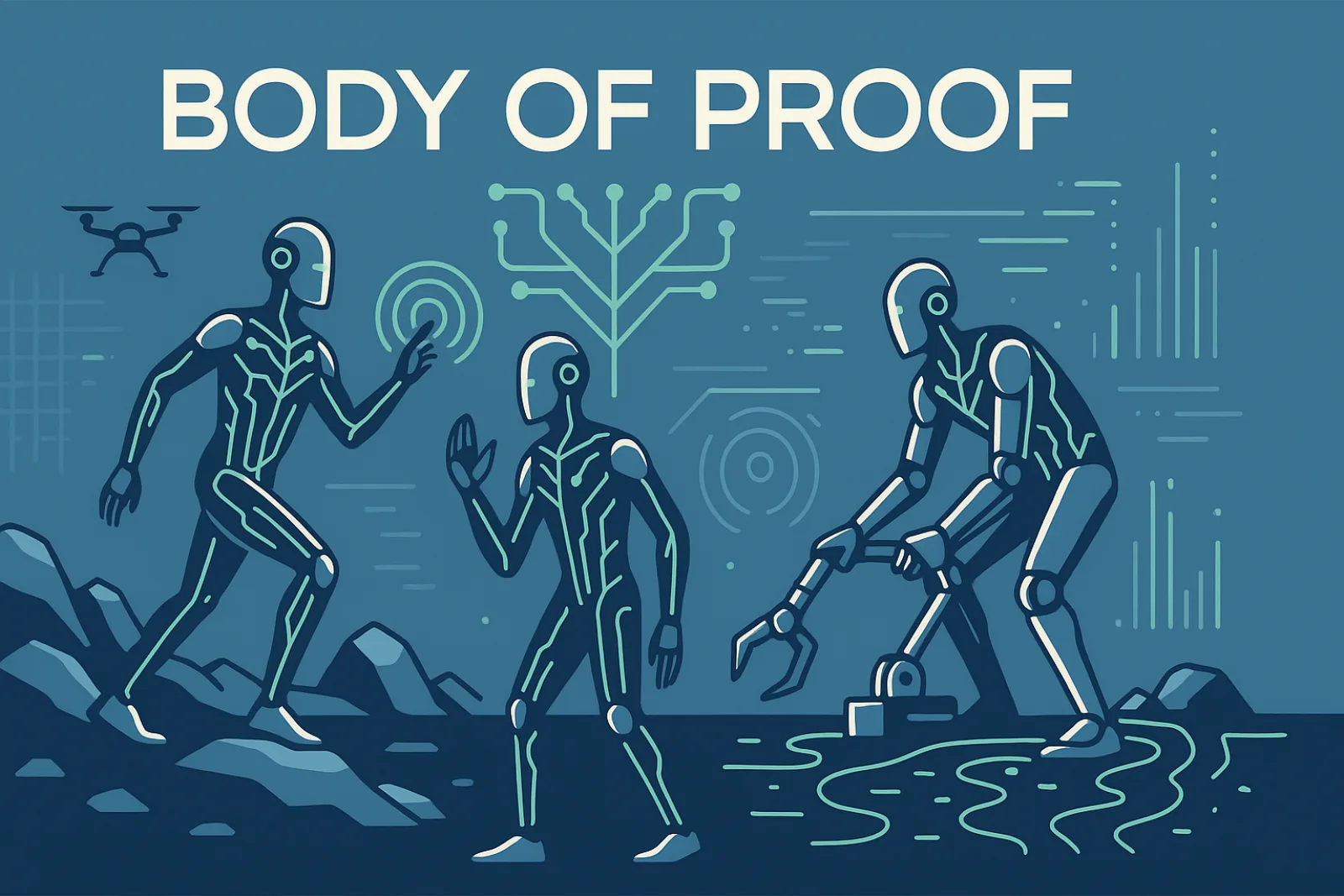
That is the body of proof. Intelligence in physical environments is not only in the model, and not only in the robot. It is in the interaction structure. Businesses that understand this will evaluate multi-agent automation as an operations architecture, not as a model demo with wheels.
The next competitive advantage will not belong to whoever says “agentic swarm” with the straightest face. It will belong to teams that know which coordination problem they are actually buying, which benchmark evidence matters, where simulation ends, and how much reality they can afford to test.
Cognaptus: Automate the Present, Incubate the Future.
-
Zhaohan Feng, Ruiqi Xue, Lei Yuan, Yang Yu, Ning Ding, Meiqin Liu, Bingzhao Gao, Jian Sun, Xinhu Zheng, and Gang Wang, “Multi-agent Embodied AI: Advances and Future Directions,” arXiv:2505.05108, 2025, https://arxiv.org/abs/2505.05108. ↩︎