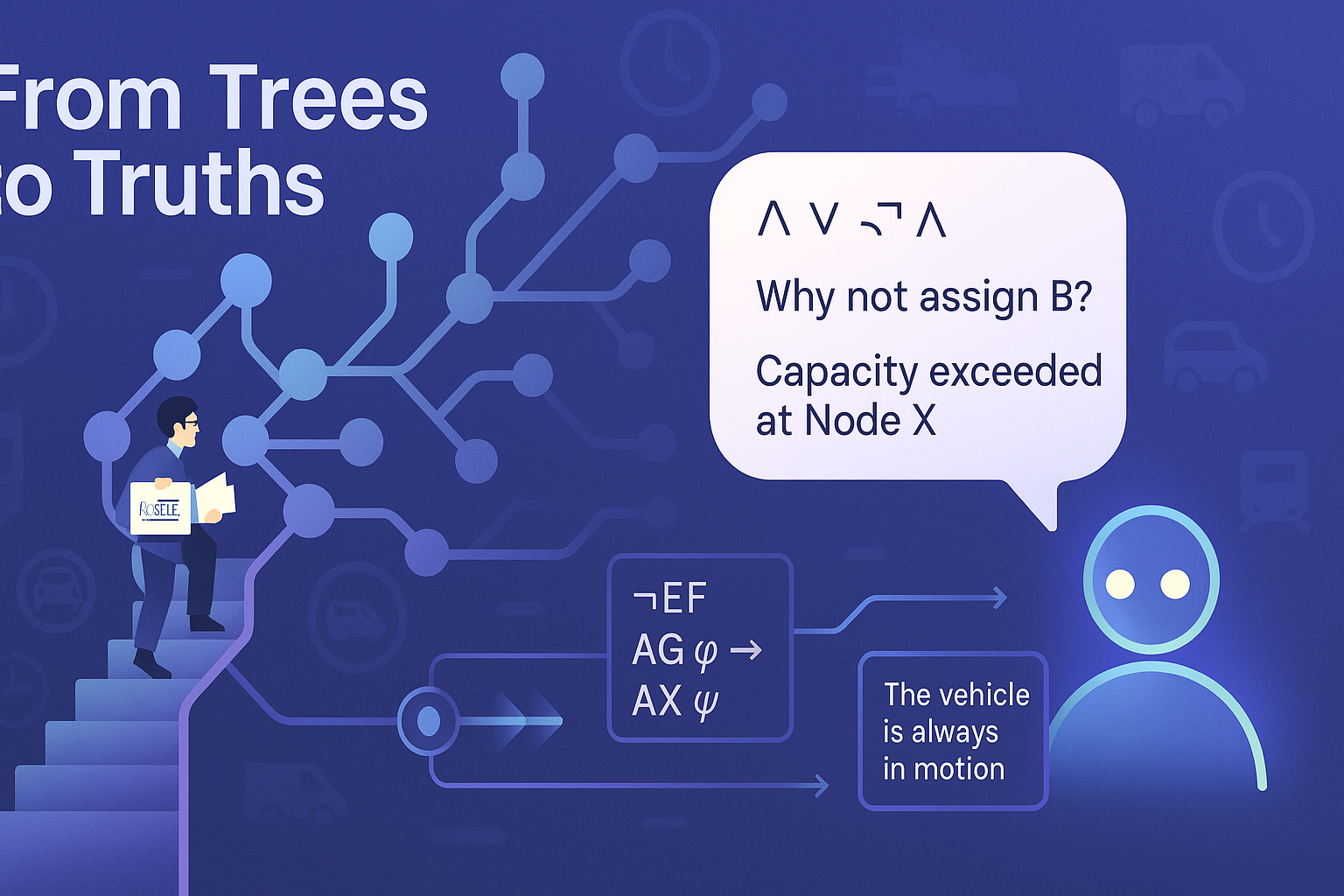
TL;DR for operators
If your optimisation system can choose the route, assign the vehicle, or schedule the job but cannot explain why, the obvious temptation is to bolt on a chatbot and call the matter solved. That is also how one gets fluent nonsense with a user interface.
The paper behind this article proposes a better pattern: let the LLM translate a user’s question into formal variables and logic, evaluate those variables against the actual Monte Carlo Tree Search tree, retrieve domain knowledge only when the question calls for it, and then generate the final natural-language explanation.1 The LLM is still useful, but it is no longer allowed to improvise the evidence. A small mercy, really.
The direct result is technical: in a paratransit planning testbed, the authors evaluate 620 manually prepared queries, each repeated three times, and report stronger factual consistency and semantic similarity than plain GPT-4o or Llama3.1 explanations. The business interpretation is narrower but useful: this is a plausible architecture for explanation layers around sequential planning systems, especially in routing, dispatch, service allocation, and capacity management.
What the paper does not prove is that the framework is ready for every production control room. The study uses a defined paratransit MDP, simulated demand, a lightweight curated knowledge base, and automated metrics. Treat it as a credible design pattern for auditable planning explanations, not as a universal trust machine.
The real problem is not that MCTS is dumb. It is that MCTS is hard to interrogate.
Monte Carlo Tree Search is not a mysterious oracle. It explores possible futures, samples action sequences, estimates value, and selects actions based on search evidence. In domains such as vehicle routing, manufacturing scheduling, transit planning, and other sequential decision problems, this is exactly why it is useful: it can reason over branching futures where a single deterministic rule would be too brittle.
The problem starts after the decision is made.
A planner says: assign this vehicle, skip that request for now, prioritise this branch, accept this trade-off. The operator then asks the only question that matters in practice: why? Not “what is the theoretical definition of MCTS?” Not “please produce a motivational paragraph about transparency.” Why this action, in this state, with these constraints, under this reward structure?
A normal LLM can answer that question in language. That is not the same as answering it from the search tree. The distinction matters. A plain model may produce a plausible explanation based on general knowledge of routing, fairness, waiting times, and capacity constraints. It may even sound correct. But unless the explanation is anchored to the actual nodes, branches, variables, and domain constraints used by the planner, it is commentary rather than evidence.
The paper’s core move is to avoid making the LLM the source of truth. The LLM becomes a translator, classifier, and narrator. The search tree remains the evidence source. The domain model remains the constraint source. Formal logic becomes the contract between them.
That is the mechanism worth understanding.
The pipeline turns a messy question into something the tree can answer
The framework is built for two broad categories of user questions.
The first category is post-hoc queries: questions about a specific MCTS decision after the algorithm has run. These are the operational questions: why did the planner choose this branch, what happened at a particular node, how did one option compare with another, which constraint shaped the outcome?
The second category is background knowledge-based queries: questions about the MCTS decision-making process, the application domain, or the MDP formulation. These are not necessarily answered by inspecting one node in the tree. They may require domain explanation: what the constraints mean, what the reward function is trying to optimise, or how paratransit planning is modelled.
The architecture handles these differently, which is exactly the point. Not every question should be force-fed into the same generative model and prayed over.
A simplified view of the pipeline looks like this:
| Stage | What it does | Operational consequence |
|---|---|---|
| Query classification | Determines whether the question is post-hoc or knowledge-based, and maps post-hoc queries to one of 26 predefined query types | Prevents every question from being treated as an open-ended chat prompt |
| Logic generation and parsing | Uses few-shot prompts associated with the query type to generate variables and logic statements | Converts language into an evaluable structure |
| Logic scoring | Traverses the MCTS tree, calculates values, and applies CTL model checking when branch comparisons are needed | Grounds the answer in actual search evidence |
| Knowledge retrieval | Retrieves relevant chunks from a curated knowledge base for domain or algorithm questions | Adds context without letting the model invent domain rules |
| Answer generation | Gives the LLM the original query, evidence variables, scorer outputs, and retrieved knowledge | Produces readable explanations from constrained inputs |
The important thing is not that there is an LLM in the loop. Everyone has an LLM in the loop now; some even survive the experience. The important thing is where the LLM is not trusted. It is not trusted to infer the evidence by vibes. It is not trusted to remember the domain constraints from pretraining. It is not trusted to decide whether a branch comparison is true without checking the tree.
The paper uses Computation Tree Logic, or CTL, because MCTS produces branching futures. Some questions are not about one state. They are about whether something happens along a path, across possible branches, or when comparing one branch against another. CTL gives the system a way to ask structured questions over that branching search process.
That is why this is a mechanism-first paper. The result is less interesting if described as “LLMs explain MCTS better.” The actual claim is sharper: LLMs explain MCTS better when they are forced to ask the tree for evidence in a form the tree can answer.
Three evidence levels keep the explanation from floating away
The authors describe a three-level hierarchy of evidence. This hierarchy is where the framework becomes more than a prompt template.
| Evidence type | What it uses | Example of the underlying question | Main risk if handled by a plain LLM |
|---|---|---|---|
| Base-level evidence | Information directly extracted from a target tree node | What was the vehicle capacity, occupancy, or action at this decision point? | The model may give a generic answer instead of reading the actual state |
| Derived evidence | Calculations across multiple nodes, depths, or branches | What was the average outcome across relevant parts of the tree? | The model may summarise a trend without computing it |
| Logic comparison evidence | Multi-level calculations and CTL-based comparisons between branches | Did one branch satisfy a condition that another branch failed? | The model may confuse plausibility with logical satisfaction |
This hierarchy matters because operator questions vary in difficulty. Some questions are lookup questions. Some are aggregation questions. Some are counterfactual or comparative questions disguised as ordinary speech.
A dispatcher asking “what was the occupancy here?” is asking for base-level evidence. A manager asking “did the policy generally reduce delay across this branch?” is asking for derived evidence. A domain expert asking “why did this alternative fail when another path succeeded?” may be asking for logic comparison evidence.
Those are not the same problem. Treating them as the same problem is how explanation systems become decorative. They produce paragraphs where what was needed was a trace, a calculation, or a branch comparison.
The paper’s design recognises this difference. It first identifies the type of evidence needed, then uses the appropriate scorer functions or CTL model checking to obtain it. Only after that does the LLM generate the final explanation.
For business systems, this is the piece to steal. Not the exact paratransit implementation. Not necessarily the exact query taxonomy. The reusable pattern is evidence typing: classify what kind of evidence an explanation requires before generating the explanation.
RAG is used for domain meaning, not as a substitute for search evidence
The framework also includes retrieval-augmented generation, but it is used in a modest, disciplined way. The authors prepare a lightweight knowledge base of about 3,000 words split into 34 chunks. It covers paratransit services, the MCTS algorithm, and MDP details such as constraints, objectives, and reward functions. The system uses OpenAI’s text-embedding-3-small model to retrieve top results, and it passes chunks to the LLM only when relatedness scores exceed a threshold.
This is not the fashionable version of RAG where a pile of documents is treated as institutional memory and then everyone acts surprised when retrieval misses the obvious document. Here, RAG has a bounded job: provide background knowledge for questions that are not directly answered by a particular search-tree computation.
That distinction is operationally important.
If the question is “what does this reward component mean?”, retrieval may help. If the question is “which branch had lower delay under this MCTS run?”, retrieval is not evidence. The tree is evidence. Mixing those two categories is a common failure mode in enterprise AI systems. A model retrieves a policy document, generates an answer about a decision, and the organisation mistakes contextual fluency for traceability.
This paper avoids that trap by separating tree-derived evidence from retrieved background knowledge. The final answer may use both, but they come from different sources and serve different purposes.
The evaluation is main evidence, not an ablation study
The paper’s quantitative table is the main empirical evidence. It is not an ablation that isolates every component. It is not a human trust study. It is a comparison between plain LLM explanation and the authors’ logic-guided framework using LLM backbones.
The authors manually prepare 620 distinct queries. Each query has a category ID, correct evidence variables and logic, and a reference narrative paragraph. Each query is repeated three times. The generated explanations are evaluated using FactCC and BERTScore. In plain terms, the evaluation asks whether the framework produces explanations that are more factually consistent and closer to the prepared reference narratives than direct LLM outputs.
The reported table is worth reading carefully:
| Method | Metric | @1 | @3 |
|---|---|---|---|
| Llama3.1 | FactCC / BERTScore | 25.77% / 6.15% | 34.62% / 12.31% |
| Ours (Llama) | FactCC / BERTScore | 67.88% / 86.54% | 83.27% / 97.50% |
| GPT-4o | FactCC / BERTScore | 42.31% / 40.00% | 51.15% / 55.77% |
| Ours (GPT) | FactCC / BERTScore | 72.12% / 88.46% | 81.35% / 94.81% |
The authors report that, under the paper’s @3 comparison, the framework improves FactCC by 2.40× with the Llama3.1 backbone and 1.59× with the GPT model. For BERTScore, the improvement is 7.92× for the Llama3.1 backbone and 1.70× for the GPT model.
The direction of the result is unsurprising but still useful. Plain LLMs struggle because the task is not merely linguistic. It is evidence retrieval from a structured planning trace. The framework improves because it changes the task given to the LLM. Instead of “explain this decision,” the model receives the original question, the evidence variables, the scorer outputs, and retrieved knowledge where relevant.
That is a very different prompt environment. Less romantic, more useful.
One caveat: the extended abstract reports @1 and @3 columns but does not deeply unpack the operational meaning of those settings. Given that each query is repeated three times, the labels appear to reflect evaluation under one versus three generated attempts or ranked outputs, but the paper does not provide enough detail to treat @3 as a production guarantee. Read the table as evidence that the framework’s constrained pipeline outperforms direct LLM generation under the authors’ evaluation setup.
What the paper directly shows, and what business should infer
The business relevance is strongest for organisations already using, or considering, sequential planning systems. These are systems where decisions unfold over time and each action changes the future state: fleet dispatch, maintenance scheduling, warehouse allocation, emergency response staging, appointment routing, inventory replenishment, field-service assignment, and similar operational machinery.
The paper does not say, “deploy this tomorrow and your operators will trust AI.” It says something narrower and more valuable: if your planning algorithm produces a searchable decision tree, and if your domain can be expressed through states, actions, constraints, rewards, and evidence functions, then a logic-guided LLM can provide more grounded explanations than a plain LLM.
That gives us a practical interpretation.
| Paper result | Cognaptus interpretation | Business boundary |
|---|---|---|
| Free-form queries are classified into post-hoc and knowledge-based categories | Explanation systems need routing before generation | Query taxonomies must be redesigned for each domain |
| Post-hoc questions are mapped to variables and logic | Operators need evidence extraction, not just fluent summaries | Requires access to structured planning traces |
| Scorer functions evaluate the MCTS tree | Explanations can become auditable artefacts | The scorer layer must be maintained as the planner evolves |
| CTL handles branch comparisons | Some “why not?” questions require formal reasoning over alternatives | CTL is useful only if the underlying process is represented appropriately |
| RAG supplies domain knowledge | Background explanation should be separated from decision evidence | A small curated knowledge base is easier to govern than a sprawling document swamp |
| Automated metrics improve over plain LLM baselines | Grounding changes explanation quality materially | Automated scores do not replace operator validation |
The ROI case, if there is one, is not “better chatbot answers.” That phrase should be locked in a drawer.
The ROI case is lower friction in human oversight. Operators can interrogate plans faster. Supervisors can audit decisions without reconstructing the entire search process manually. Engineers can diagnose whether a bad explanation came from query classification, logic generation, scorer functions, retrieval, or final wording. Compliance teams can distinguish between an explanation grounded in system traces and a narrative generated after the fact.
In complex operations, this matters because the cost of AI adoption is rarely just model accuracy. It is the cost of exception handling, escalation, retraining, supervision, and post-incident reconstruction. A planner that cannot explain itself creates work elsewhere. The work does not disappear; it migrates to meetings.
The framework is an audit layer, not a moral personality
There is a subtle but important distinction between explainability and justification. An explanation layer should show what evidence and constraints led to a decision. It should not automatically persuade the human that the decision was good.
This paper’s framework is best understood as an audit layer around MCTS. It can help answer questions such as:
- What evidence existed in the search tree?
- Which variables were relevant?
- Which branch properties held?
- What domain constraints shaped the result?
- How does the answer connect to the MDP formulation?
Those are useful questions. They are not the whole governance problem.
If the reward function encodes the wrong priority, the explanation may faithfully explain a bad objective. If the demand model is unrealistic, the tree may be internally consistent and externally naive. If the query taxonomy misses a class of operational concern, the system may classify the user’s question poorly. If the scorer functions are wrong, the final answer will be polished around bad evidence. The LLM did not create those problems; it merely makes them easier to read.
This is why logic-backed explanation should be part of a governance stack, not a substitute for one. The framework improves the reliability of explanations relative to direct LLM generation. It does not certify the underlying planner as fair, optimal, lawful, or operationally wise. Sadly, no amount of CTL turns a bad objective function into civilisation.
Where the result applies, and where it should not be stretched
The study is deliberately scoped. The testbed is paratransit planning formulated as an MDP. State transitions are driven by simulated demand for trip requests. MCTS generates vehicle assignment decisions at each decision epoch. The knowledge base is small and curated. The queries are manually prepared. The evaluation relies on FactCC and BERTScore against reference narratives.
These choices are reasonable for an extended abstract, but they shape interpretation.
First, the framework assumes that the planning process leaves behind structured evidence. If a business uses a black-box optimiser without accessible traces, the same architecture cannot simply inspect what does not exist. Trace design becomes part of system design.
Second, the approach depends on the quality of the query taxonomy and logic generation. The authors define 26 query types for post-hoc queries in this setting. Another industry would need another taxonomy. Manufacturing, logistics, healthcare scheduling, energy dispatch, and financial execution all ask different questions, even when the underlying planning structure looks similar.
Third, the evaluation measures textual consistency and relevance, not human decision quality. FactCC and BERTScore are useful proxies, especially for comparing generated explanations against references. They do not tell us whether operators became faster, whether disputes decreased, whether oversight improved, or whether users calibrated trust appropriately. Those are field questions.
Fourth, the paper does not present a component-level ablation. We do not see, for example, how much performance comes from query classification versus CTL scoring versus RAG versus evidence formatting. The whole system beats direct LLM baselines, but the extended abstract does not fully price each component. For implementation teams, that means the safest reading is architectural: the combined pattern works in this testbed; the marginal value of each module remains to be stress-tested.
The practical design lesson: explanations need a data model
The paper’s quiet contribution is that it treats explanation as a data-model problem before treating it as a language problem.
That is the right order.
In many enterprise AI projects, the team starts with the answer format. They design the chat interface, decide on tone, debate whether the assistant should be “friendly,” and only later discover that the system cannot actually retrieve the evidence needed to answer the operator’s question. This is charming in the same way as building a hotel lobby before checking whether the building has plumbing.
A planning explanation system needs at least four design commitments before the LLM enters the room:
- Trace availability: the planner must expose the states, actions, branches, values, constraints, and relevant metadata needed for explanation.
- Question taxonomy: expected user questions must be classified by evidence type, not merely by topic.
- Evidence functions: the system needs deterministic or formally checkable ways to compute the answer’s factual core.
- Narrative constraints: the final LLM response must be conditioned on verified evidence and retrieved domain knowledge, not general plausibility.
The paper gives a compact example of this sequence. It does not solve every deployment problem, but it does put the pieces in the right order.
For businesses, that order is the difference between explainability as theatre and explainability as infrastructure.
From trees to truths, with fewer hallucinated branches
The title of this article promises trees and truths, so let us be precise. The framework does not make MCTS inherently transparent. MCTS remains a complex sampling-based planning method. What the framework does is build a disciplined translation layer between the human question and the search evidence.
That translation layer has teeth. It classifies intent. It generates logic. It scores the tree. It retrieves domain knowledge when appropriate. It then allows the LLM to do what LLMs are actually good at: turning structured material into readable language.
The result is not glamorous. It is better than that. It is operationally plausible.
For any organisation deploying sequential planning systems, the lesson is straightforward: do not ask a language model to explain decisions it cannot inspect. Give it a governed path to the evidence, constrain its role, and make the explanation pipeline as auditable as the planner itself.
The future of explainable AI in operations will not be built by making models sound more confident. We have quite enough confidence already. It will be built by making systems answerable to their own traces.
Cognaptus: Automate the Present, Incubate the Future.
-
Ziyan An, Xia Wang, Hendrik Baier, Zirong Chen, Abhishek Dubey, Taylor T. Johnson, Jonathan Sprinkle, Ayan Mukhopadhyay, and Meiyi Ma, “Combining LLMs with Logic-Based Framework to Explain MCTS,” arXiv:2505.00610, 2025, https://arxiv.org/abs/2505.00610 ↩︎