Cover image

Quantum Rainbows and Resource Bottlenecks: When DQN Meets Entanglement

Quantum Rainbows and Resource Bottlenecks: When DQN Meets Entanglement Scheduling looks simple until it becomes real. One officer is faster at one task, slower at another. Events happen at different times. Moving between locations costs time. Every assignment affects the next assignment. Then management asks the system to “just optimize it,” preferably before lunch. ...


December 8, 2025 · 13 min · Zelina
Cover image

Diffusion Unchained: How SimDiff Turns Chaos Into Forecasting Clarity

Forecasting teams usually do not wake up asking for “a beautiful predictive distribution.” They ask a more brutal question: what number should we plan around? How much electricity will be needed tomorrow evening? How much traffic will hit this corridor next week? How many units should sit in the warehouse before demand discovers its theatrical side? In the business world, uncertainty is useful only if it eventually helps someone make a decision. A probability cloud that cannot produce a reliable point forecast is not strategy. It is expensive fog. ...

November 25, 2025 · 16 min · Zelina
Cover image

When Heuristics Go Silent: How Random Walks Outsmart Breadth-First Search

A planner stalls. Not because the goal vanished. Not because the system lacks compute. Not even because the heuristic is completely wrong. It stalls because the heuristic has temporarily stopped saying anything useful. Every nearby state looks equally unpromising, or worse, misleadingly unpromising. The algorithm is still running, naturally. It is very busy being lost. ...

November 13, 2025 · 4 min · Zelina
Cover image

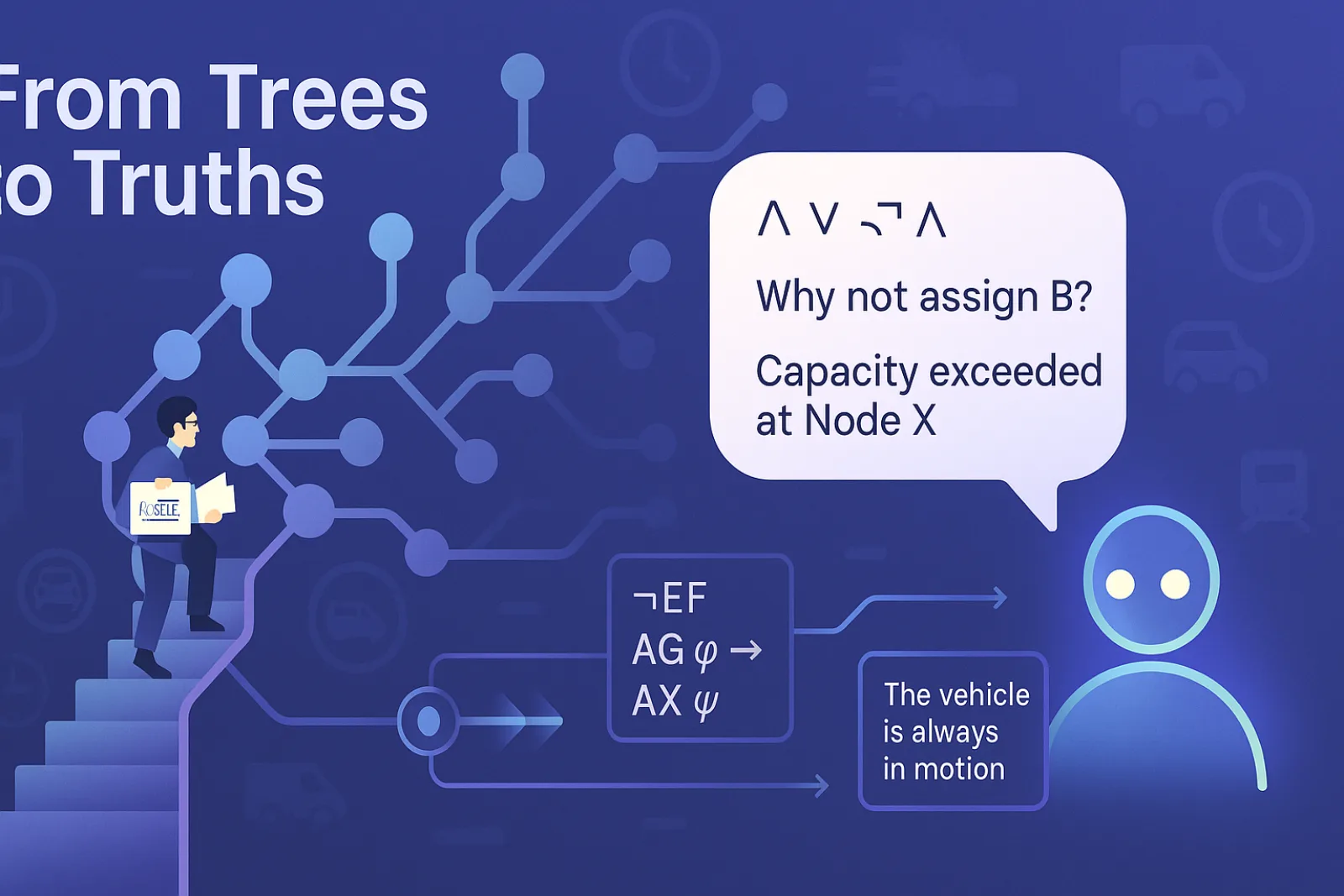
From Trees to Truths: Making MCTS Talk with Logic-Backed LLMs

TL;DR for operators If your optimisation system can choose the route, assign the vehicle, or schedule the job but cannot explain why, the obvious temptation is to bolt on a chatbot and call the matter solved. That is also how one gets fluent nonsense with a user interface. The paper behind this article proposes a better pattern: let the LLM translate a user’s question into formal variables and logic, evaluate those variables against the actual Monte Carlo Tree Search tree, retrieve domain knowledge only when the question calls for it, and then generate the final natural-language explanation.1 The LLM is still useful, but it is no longer allowed to improvise the evidence. A small mercy, really. ...

May 4, 2025 · 16 min · Zelina