TL;DR for operators
Most companies do not have an “AI agent” problem. They have an agent zoo problem.
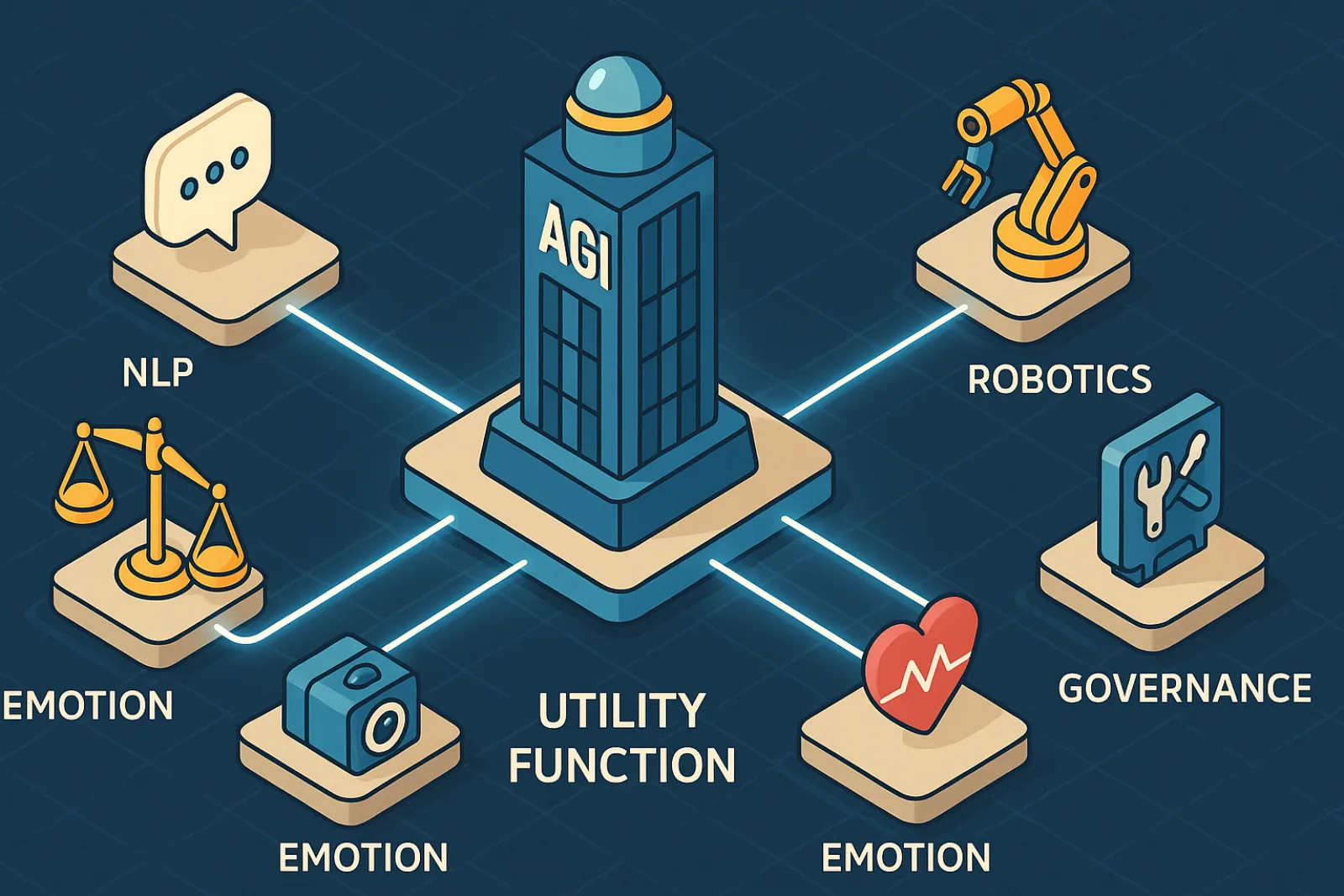
One bot answers customer questions. Another writes code. Another searches documents. Another runs workflows. Another tries to sound friendly and occasionally performs the emotional equivalent of wearing a fake moustache. The paper behind this article argues that this fragmentation is not the end state. It proposes NGENT: a next-generation AI agent that integrates multiple specialist abilities into one broadly capable system.1
The useful part is not the grand claim that AGI arrives when enough agent abilities are stuffed into the same box. That is the brochure version, and brochures are where nuance goes to be lightly embalmed. The useful part is the paper’s intermediate step: the “1.5-generation agent”, which tries to combine two capabilities that often pull against each other in deployed products — intelligent task performance and personified, emotionally natural dialogue.
The experiments do not prove a full general-purpose agent across robotics, OS control, coding, tools, vision, and reinforcement learning. They test a narrower bridge: can a model become more personified without losing too much on standard intelligence-style benchmarks? On the reported numbers, the answer is cautiously positive. NGENT scores highest overall on CharacterEval personification, with an overall score of 3.523 versus the strongest listed baseline at 3.249. On IQ-style benchmarks, it improves the reported average from 55.97 for Naive+SFT to 56.52, though it dips slightly on MMLU and CMMLU while improving GSM8K, IFEval, and AlignBench.
For enterprise use, the immediate lesson is not “replace every specialist system with one majestic general agent”. The lesson is more disciplined: when user trust, continuity, and task execution must live in the same interface, persona is not decoration. It is part of the operating surface. But the business case remains strongest for customer service, workplace copilots, role-aware assistants, training companions, and support agents. For robotics, OS agents, broad tool orchestration, and real-world multi-domain autonomy, this paper is still drawing the map, not showing the completed highway.
The agent sprawl problem is no longer theoretical
A modern enterprise AI stack can become weirdly medieval. There is a specialist for everything, each living in its own little castle.
A document assistant knows the policy archive but cannot complete the workflow. A workflow agent can trigger tools but cannot explain itself gracefully to a confused user. A coding assistant can write a function but has no idea how the customer support team talks. A persona chatbot can sustain tone but may duck factual questions because “the character would not know that”. Charming, until the user needs an answer rather than theatre.
The paper’s starting point is that current AI agents are often capable but confined. Role-playing agents can maintain personality. Tool-using agents can call APIs. Coding agents can solve programming tasks. OS agents can interact with interfaces. Robotic agents can connect perception and action. But these strengths usually remain separated by domain boundaries.
The authors want the next generation of agents to look less like a collection of specialist departments and more like a unified operator: one system capable of moving across text, vision, tools, coding, robotics, reinforcement learning, and emotionally intelligent interaction.
That is the NGENT thesis. It is ambitious. It is also where the reader needs to slow down.
There are two claims inside the paper, and they should not be treated as equally proven:
| Claim | What the paper provides | Business reading | Boundary |
|---|---|---|---|
| Future agents should integrate multiple specialised abilities | Conceptual argument based on AGI goals, user demand, architecture convergence, learning algorithms, and modular agent components | Enterprise demand does favour fewer, more capable interfaces over disconnected bots | This is a strategic argument, not a deployed multi-domain benchmark result |
| A practical first bridge is combining intelligence with personified dialogue | A training pipeline and preliminary experiments on personification and IQ-style benchmarks | Role-aware assistants can be made more engaging without obviously destroying competence | Evidence is limited to selected dialogue/persona and IQ benchmarks |
| NGENT points toward AGI | Theoretical framing and analogy to foundation models becoming broad NLP systems | Useful as a research direction, not an implementation guarantee | The paper does not demonstrate AGI or full cross-domain autonomy |
This distinction matters because “multi-domain agent” can mean three very different things in business planning: a single user interface over many tools, a router coordinating many specialist agents, or a genuinely unified model with integrated capabilities. Only one of those is close to what most companies can buy or build today. Sadly, it is usually the messier one.
Specialist agents are efficient until the task crosses a boundary
The argument for specialisation is obvious because it is often correct.
If the task is narrow, stable, high-volume, and measurable, a specialist system can be excellent. A coding assistant can be tuned for code. A claims-processing agent can be tuned for insurance documents. A warehouse robot can be tuned for a physical operating environment. The more fixed the task distribution, the more specialisation looks like good engineering rather than intellectual cowardice.
The problem appears when the user’s goal does not respect the system boundary.
A sales manager does not merely need “summarise this account”. She may need the agent to inspect CRM notes, interpret an email thread, draft a response in the right tone, update a record, schedule a follow-up, and explain the risk if the client delays. That is not one task. It is a chain of tasks held together by context.
Specialist agents can support pieces of that chain. They struggle when the value comes from continuity.
The paper frames this as a move from first-generation domain agents toward next-generation integrated agents. Its examples include intelligent assistants, role-playing systems, coding agents, tool-using agents, OS agents, and robotic systems. The comparison is useful because it prevents a common category error: judging general agents only by peak performance inside one domain.
The right question is not whether a general agent beats the best specialist on every narrow benchmark. It probably will not, at least not consistently. The more useful question is whether the cost of switching, coordinating, and maintaining many specialists becomes larger than the performance loss from integration.
That trade-off is the real business problem.
Multi-agent systems solve division of labour, then inherit coordination overhead
There is an obvious alternative to NGENT: keep specialist agents and make them collaborate.
This is attractive. It mirrors how companies already work. One agent retrieves documents, another plans, another writes, another checks compliance, another executes a workflow. If each specialist is strong, the full system might be stronger than one generalist. On a whiteboard, this looks clean. Whiteboards are famously generous environments.
In practice, multi-agent systems introduce a second problem: coordination becomes part of the workload.
Agents need to decide who owns a subtask. They need to pass context without losing critical details. They need to resolve conflicts. They need to avoid circular delegation. They need to know when to stop. A multi-agent architecture can be powerful, but every handoff is a possible failure point. The system can become less like a team of experts and more like a committee that keeps scheduling another committee.
The paper acknowledges this alternative directly. It does not dismiss multi-agent collaboration. Instead, it argues that a competent general-purpose agent could eventually reduce communication and coordination overhead by holding more of the task inside one adaptive system.
That is plausible, but not settled.
For operators, the comparison is practical:
| Architecture | Where it fits | Advantage | Failure mode |
|---|---|---|---|
| Specialist agent | Narrow, measurable, repeated task | High domain performance and easier evaluation | Breaks when the task crosses boundaries |
| Multi-agent system | Complex workflows with separable subtasks | Modular design and replaceable capabilities | Coordination overhead, context loss, brittle delegation |
| Unified NGENT-style agent | Cross-domain tasks requiring continuity | Lower switching cost and more coherent user experience | Harder training, harder evaluation, broader safety surface |
| 1.5-generation agent | User-facing assistant needing competence and persona | Better interaction without abandoning task performance | Still far from full multi-domain autonomy |
The paper’s best contribution is not that it “wins” this architecture debate. It clarifies why the debate exists.
If user value comes from one narrow output, specialisation wins. If value comes from a long, context-sensitive interaction, integration becomes more attractive. If value comes from many specialists working together, orchestration may work — but only if coordination does not eat the benefit. A small detail, apparently.
The 1.5-generation agent is the paper’s most useful idea
The NGENT vision is broad, but the paper’s operational centre is narrower: the 1.5-generation agent.
The authors argue that most agent capabilities discussed in the paper are IQ-oriented: reasoning, coding, mathematical problem-solving, tool usage, planning, and task completion. Personified interaction is different. It belongs closer to EQ: tone, empathy, conversational style, role consistency, emotional naturalness, and user engagement.
These two demands can conflict.
A high-IQ assistant is expected to be direct, accurate, concise, and efficient. A strong role-playing agent may be expressive, emotionally textured, and persona-consistent. Push too hard toward persona and the model may become evasive or theatrically ignorant. Push too hard toward task efficiency and the model may sound like a tax form that learned to blink.
The paper’s “1.5-generation” proposal is to integrate intelligent assistance with user-friendly persona before attempting full NGENT. This is a sensible bridge because many enterprise deployments already need exactly that combination.
Customer support agents need to solve problems while sounding human enough to maintain trust. Training assistants need to adapt to the learner’s style without turning into motivational wallpaper. Internal copilots need to preserve professional tone while still completing analytical tasks. Healthcare, finance, education, and HR tools all face some version of the same issue: competence without interaction design is brittle; warmth without competence is expensive decoration.
The 1.5-generation agent is therefore not merely a cute halfway label. It identifies a deployment tension that product teams already experience.
The training pipeline tries to add persona without making the model stupid
The paper’s experimental section asks whether the 1.5-generation idea is technically plausible. The authors build a pipeline with three broad stages: instruction pre-training, supervised fine-tuning, and direct preference optimisation.
The structure is important because each stage has a different likely purpose.
| Component | Likely purpose | What it supports | What it does not prove |
|---|---|---|---|
| Instruction Pre-Training (IPT) | Inject dialogue and character-style exposure more cheaply than conventional continued pre-training | Persona learning can be targeted using dialogue-rich data | It does not prove broad multi-domain integration |
| Personified Style Rewriter (PSR) | Convert overly formal generated responses into more natural, human-like style | Formal assistant tone is a bottleneck for role-aware interaction | It does not guarantee factual reliability or safety |
| Personality-oriented intelligent contrastive data | Preserve task competence while adapting responses to persona contexts | Persona training can be paired with intelligent answers rather than replacing them | It does not show general reasoning transfer across all domains |
| Iterative SFT with an ask agent | Generate more diverse single- and multi-turn interactions | Data augmentation may improve coverage of user queries | It remains synthetic and depends on filtering quality |
| DPO | Improve preference-aligned response quality, engagement, and concision | Final response style can be tuned toward product goals | Preference gains may be benchmark- and objective-dependent |
The most interesting mechanism is the personality-oriented intelligent contrastive dataset.
The authors point out a specific failure mode: training only on personality dialogue can make a model act as if the persona limits its knowledge. A model playing a character may refuse or avoid answering something it is actually capable of answering because the role-playing data taught it to privilege character consistency over usefulness.
That is a real product problem. Users do not want an enterprise assistant that says, “As a whimsical pirate accountant, I cannot calculate depreciation.” Very immersive. Also fired.
The paper’s response is to regenerate intelligent answers in personality-specific form, then include both the original answer and the persona-tailored answer in the training data. In principle, this teaches the model that persona should shape expression, not delete competence.
That mechanism is more valuable than the branding around NGENT because it points to a general design rule: in role-aware agents, style conditioning must be trained alongside task completion, not pasted on afterwards.
The personification result is strong within the reported benchmark
The main personification evidence comes from CharacterEval, where the paper evaluates conversational ability, attractiveness, persona consistency, and an overall score.
NGENT reports the best overall score among the listed models: 3.523. The strongest baseline overall is BC-NPC-Turbo at 3.249, followed by MiniMax at 3.207 and Baichuan2-13B at 3.204. GPT-4, in this table, reports 3.048 overall.
A compressed view of the reported personification result:
| Model group | Best listed overall score | Interpretation |
|---|---|---|
| General open/chat baselines | 3.204, from Baichuan2-13B | Strong general chat models can perform reasonably, but are not optimised for persona |
| Role-playing baselines | 3.249, from BC-NPC-Turbo | Dedicated role-playing systems improve persona behaviour |
| Closed-source general baselines | 3.048, from GPT-4 | General intelligence does not automatically maximise role-playing metrics |
| NGENT | 3.523 | The proposed pipeline improves the reported personification score |
This supports the narrow claim that the pipeline improves personified dialogue under the chosen evaluation.
It does not support the broader claim that NGENT already integrates coding, OS operation, robotics, tool use, multimodal perception, and reinforcement learning into one capable system. The paper’s title points toward that destination; the experiment tests the first bridge plank.
That is not a fatal flaw. It is just the difference between evidence and ambition, a distinction the AI industry occasionally misplaces under a pile of launch videos.
The IQ results show preservation with uneven gains, not universal improvement
The paper also evaluates IQ-style capability using MMLU, CMMLU, GSM8K, IFEval, and AlignBench. The comparison is between Naive, Naive+SFT, and NGENT.
The reported results are:
| Dataset | Naive | Naive+SFT | NGENT |
|---|---|---|---|
| MMLU | 68.27 | 70.83 | 69.96 |
| CMMLU | 68.00 | 71.47 | 70.37 |
| GSM8K | 68.46 | 70.81 | 74.00 |
| IFEval | 53.12 | 61.27 | 61.75 |
| AlignBench | 5.26 | 5.45 | 6.50 |
| AVG, as reported | 52.62 | 55.97 | 56.52 |
The pattern is more nuanced than “NGENT improves intelligence”.
Compared with Naive+SFT, NGENT is slightly lower on MMLU and CMMLU. It is higher on GSM8K, IFEval, AlignBench, and the paper’s reported average. That matters because the business interpretation should not be that persona training magically improves every cognitive benchmark. The more careful interpretation is that the authors’ pipeline improves personification while broadly preserving IQ benchmark performance and improving some selected scores.
That is still useful.
Many product teams worry that making an assistant more personable will reduce precision. The paper suggests this trade-off is not inevitable if the training data explicitly connects persona with competent answers. But the result should be read as preliminary evidence, not a universal law of model behaviour.
The reported average also mixes benchmarks with different scoring conventions. Operators should treat it as the authors’ aggregate comparison, not a clean unit of general intelligence. A one-number “AVG” is useful for scanning, less useful for procurement. Procurement, tragically, should remain awake.
The paper’s architecture argument is mostly a roadmap
Outside the experiments, the paper argues that NGENT is becoming feasible because several technical streams are converging.
First, Transformer-based architectures have become common across many AI systems: language models, multimodal systems, reinforcement learning variants, and robotic agents. Second, learning methods such as multi-task learning, transfer learning, self-supervision, meta-learning, reinforcement learning, and tool learning provide mechanisms for adapting across tasks. Third, agent components — perception, reasoning, planning, action, learning, and memory — are increasingly modular.
This is a reasonable strategic argument. It says the field is no longer composed of completely unrelated technologies. The same architectural grammar increasingly appears across domains, making integration easier to imagine.
But “easier to imagine” is not “already solved”.
Architecture convergence does not automatically remove data incompatibility, evaluation gaps, latency constraints, safety concerns, or the operational weirdness of real workflows. A model that can process text and images is not automatically a reliable OS operator. A tool-using language agent is not automatically a robot. A persona-aware chat model is not automatically safe in regulated advice.
The paper is strongest when it treats NGENT as a direction of travel. It is weakest if read as proof that a unified agent can already match specialist systems across all important domains.
For business, integration should be justified by workflow continuity
The business case for NGENT-style systems should not start with AGI. That is too abstract, too distant, and too convenient for people selling demos.
It should start with workflow continuity.
A unified assistant becomes valuable when the user’s task requires context to persist across multiple actions, styles, and information sources. That happens frequently in enterprise settings:
| Use case | Why specialist bots struggle | Why a 1.5-generation approach helps |
|---|---|---|
| Customer support | The bot must diagnose, explain, reassure, escalate, and maintain brand tone | Persona and competence must operate together |
| Internal copilots | Users need analysis, drafting, retrieval, and workflow execution in one thread | Context continuity reduces repeated prompting and handoffs |
| Training and onboarding | The system must adapt explanation style while preserving correctness | Personification can sustain engagement without abandoning content |
| Sales enablement | Tone, client context, CRM data, and next actions are intertwined | A role-aware assistant can combine communication and task execution |
| Executive support | The agent must summarise, prioritise, schedule, draft, and remember preferences | User-facing style becomes part of productivity, not polish |
Cognaptus’ practical inference is simple: companies should not ask whether they need “an NGENT”. They should ask where fragmented agents are causing measurable friction.
The right diagnostic questions are more concrete:
- Does the user need to repeat context across tools?
- Does the agent need to act and explain in the same interaction?
- Does tone materially affect trust, compliance, adoption, or escalation?
- Does the workflow mix factual reasoning with relationship management?
- Would a multi-agent handoff create more fragility than value?
If the answer is yes, the 1.5-generation concept becomes operationally relevant. If the task is narrow and stable, a specialist may still be the better investment. Not every workflow needs a generalist. Some just need a competent screwdriver, not a Swiss Army knife with a TED Talk.
The paper quietly reframes persona as infrastructure
A useful implication of the paper is that persona should not be treated as an interface garnish.
In many deployed systems, personality is added through prompts: “Be warm, helpful, concise, and professional.” This works until the task becomes difficult, the user becomes emotional, or the agent must balance role consistency with factual responsibility. Prompted tone is often shallow because the model has not learned the deeper pattern: how to preserve task competence while adapting expression.
The PSR and contrastive dataset strategy point toward a more serious approach. They imply that persona-aware behaviour should be built into training examples where the model sees competent answers expressed through different role profiles.
For enterprises, this matters because brand voice, professional tone, escalation sensitivity, and user trust are not separate from task performance. A support agent that gives the right answer in the wrong tone can still fail. A financial assistant that sounds confident where it should be careful can create risk. A healthcare assistant that is technically correct but emotionally clumsy may lose the user before the advice lands.
The paper does not solve these deployment problems. It does, however, identify why they belong in the training and evaluation loop rather than the final prompt template.
Where the evidence stops
The paper’s boundaries are important because the title is much larger than the experiment.
The authors argue for next-generation agents that integrate many domains. But the reported experiments focus on personification and selected IQ benchmarks. There is no demonstrated unified model that performs across all the domains named in the vision: robotics, OS control, coding, tool use, multimodal perception, reinforcement learning, and emotionally intelligent dialogue.
The experiments are also preliminary. The paper reports benchmark comparisons, but not a full ablation isolating the contribution of every pipeline component. We do not see, for example, a clean decomposition of how much improvement comes from IPT versus PSR versus iterative SFT versus DPO. The likely purpose of the pipeline section is implementation design and main evidence for feasibility, not a complete causal analysis of each component.
The evaluation also centres on benchmark performance. That is useful, but business deployment would need additional tests:
| Missing deployment test | Why it matters |
|---|---|
| Long-horizon workflow completion | Enterprise agents often fail across multi-step tasks, not single responses |
| Tool-use reliability | Integration requires action, not just dialogue |
| Persona safety under stress | A model may become overconfident, manipulative, evasive, or overly intimate |
| Domain-specific compliance | Finance, healthcare, HR, and legal assistants face constraints beyond helpfulness |
| Cost and latency | Unified agents may be more expensive than specialist systems |
| Human escalation quality | Real deployments need graceful handoff, not just benchmark scores |
These gaps do not invalidate the paper. They locate it.
The paper is best read as a strategic and preliminary technical argument for integration, with one concrete demonstration around IQ-plus-persona alignment. It is not a finished enterprise architecture.
The right takeaway is not “general agents win”
The lazy reading of this paper is that specialised agents are obsolete and the future belongs to one grand unified agent. That reading is tidy, exciting, and probably wrong.
A better reading is comparative.
Specialist agents remain attractive when task boundaries are clear. Multi-agent systems remain attractive when subtasks can be cleanly divided. Unified agents become attractive when continuity, context, and user interaction matter more than isolated peak performance. The 1.5-generation agent becomes attractive when businesses need assistants that are both useful and socially legible.
That last category is larger than it sounds.
Most enterprise AI adoption does not fail because a model lacks one more benchmark point. It fails because the system cannot live inside the messy shape of work: shifting goals, partial context, emotional users, compliance constraints, tool boundaries, and the deeply human desire not to explain the same thing six times to six different bots.
NGENT is the paper’s big destination. The 1.5-generation agent is the useful waypoint.
The research community can argue about whether this path leads to AGI. Operators have a nearer question: where does integration reduce friction enough to justify the complexity?
That is the question worth taking from the paper. The rest can wait until the agent can actually use the spreadsheet, call the API, explain the decision, preserve the tone, and not collapse into interpretive dance when asked for an invoice.
Cognaptus: Automate the Present, Incubate the Future.
-
Zhicong Li, Hangyu Mao, Jiangjin Yin, Mingzhe Xing, Zhiwei Xu, Yuanxing Zhang, and Yang Xiao, “NGENT: Next-Generation AI Agents Must Integrate Multi-Domain Abilities to Achieve Artificial General Intelligence,” arXiv:2504.21433, 2025, https://arxiv.org/abs/2504.21433. ↩︎