Cover image

Roots of Understanding: When Transformers Try to Learn the Language of Numbers

Numbers look simple until you ask a model to continue them. That is the quiet trap in Testing Transformer Learnability on the Arithmetic Sequence of Rooted Trees.1 The paper does not ask whether a transformer can chat about prime numbers, recite factorization facts, or hallucinate Euclid with confidence. It asks a cleaner question: if we translate the natural numbers into a symbolic language whose grammar is generated by prime factorization, can a GPT-2-style transformer learn that grammar from sequence data alone? ...

December 2, 2025 · 15 min · Zelina
Cover image

When Wings Meet Transformers: Neural Surrogates at Mach Speed

A wing team has one expensive habit: asking CFD again A design team is trying to improve a wing. Not the poetic version of a wing, with clean curves and heroic renderings, but the irritating engineering version: span, taper ratio, sweep angle, root chord, velocity, angle of attack, shocks, vortices, boundary layers, and drag that refuses to behave politely. ...

November 29, 2025 · 13 min · Zelina
Cover image

Maps, Models, and Mobility: GPT Goes for a Walk

The delivery route is not a sentence A delivery van does not move like a sentence. It stops. It waits. It turns left because a road exists, not because grammar allows it. Its next point depends on geography, time of day, congestion, driver behavior, business constraints, and occasionally the small civic miracle of a loading bay being available. A language model sees the world as tokens arranged in sequence. A trajectory model sees movement as a sequence too, but the symbols are less polite: latitude, longitude, timestamp, region, point of interest, dwell time, elapsed time, and missing segments. ...

November 26, 2025 · 17 min · Zelina
Cover image

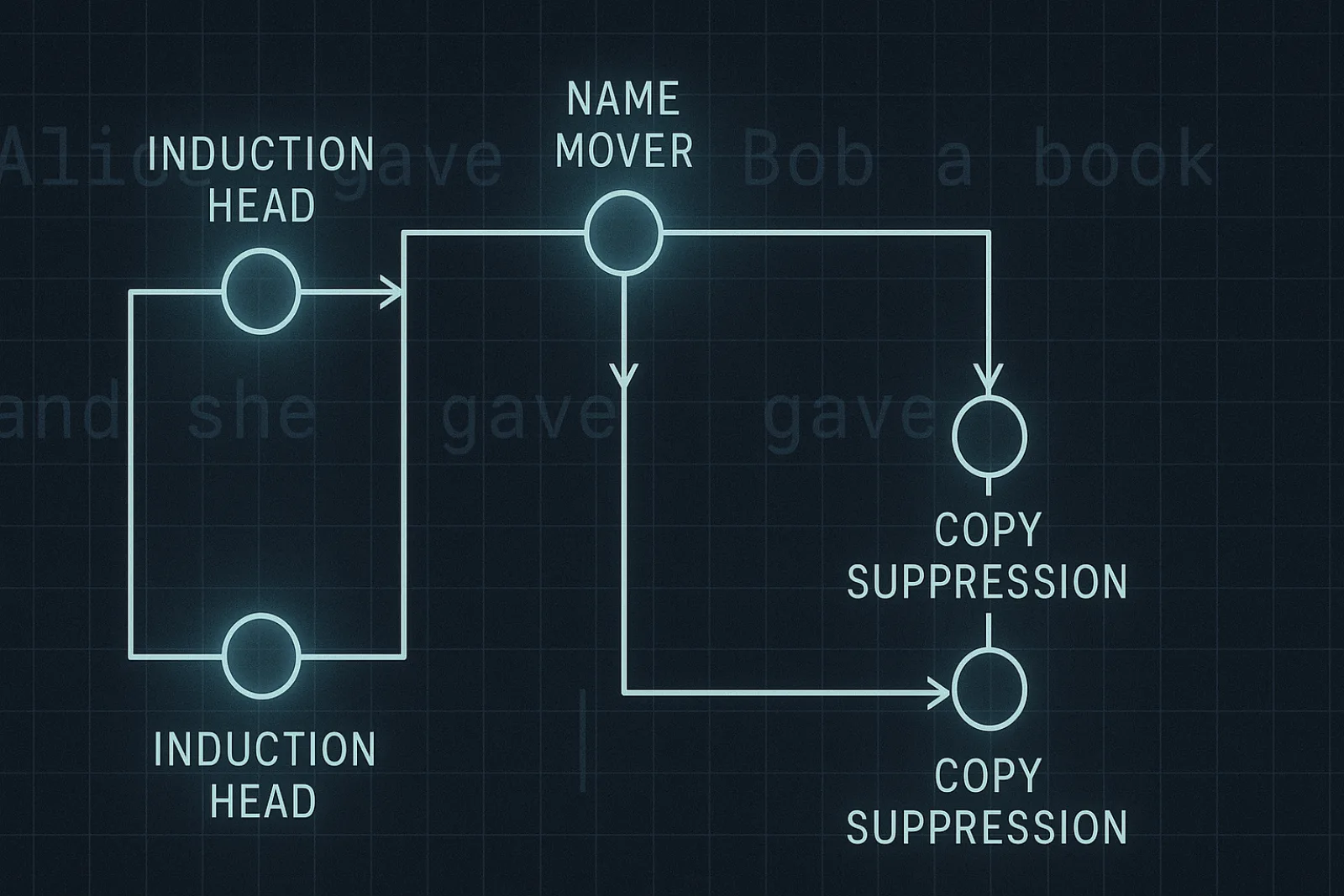
Circuits of Understanding: A Formal Path to Transformer Interpretability

TL;DR for operators Debugging. That is the useful mental entry point, not “AI transparency,” which has become a conference badge phrase with slightly better lighting. The paper at the centre of this article, Interpretability in the Wild: a Circuit for Indirect Object Identification in GPT-2 small, shows that a real linguistic behaviour in a transformer can be decomposed into a circuit of internal components, then tested using causal interventions rather than admired through colourful attention maps.1 The task is indirect object identification: given a sentence where two names appear and one is repeated, the model predicts the other name. Small grammar problem, large interpretability bill. ...

July 30, 2025 · 14 min · Zelina
Cover image

Brains with Gradients: Why Energy-Based Transformers Might Be the Future of Thinking Machines

TL;DR for operators Energy-Based Transformers are not another prompt trick, reasoning wrapper, or RL-flavoured attempt to make a chatbot show more homework. They change the model’s job. Instead of directly predicting the next token, frame, or image patch in one forward pass, an EBT learns a scalar energy function that scores whether a candidate prediction is compatible with its context. Lower energy means “this fits better.” Inference then becomes optimisation: start with a rough or random candidate, compute the gradient of the energy with respect to that candidate, and iteratively move toward a lower-energy prediction. ...

July 4, 2025 · 16 min · Zelina
Cover image

Beyond Words: How Transformer Models Are Revolutionizing SaaS for Small Businesses

TL;DR for operators Transformer models are not merely better autocomplete. Their useful contribution to small-business SaaS is that they let software handle context: the reason an invoice line matters, the connection between a customer email and an order record, the seasonal pattern inside sales history, or the hidden dependency between a field report and a compliance checklist. ...

March 21, 2025 · 17 min · Zelina