Cover image

When Tokens Become Actions: A Policy Gradient Built for Transformers

Opening — Why this matters now Reinforcement learning has always assumed that actions are atomic. Large language models politely disagree. In modern LLM training, an “action” is rarely a single move. It is a sequence of tokens, often structured, sometimes tool‑augmented, occasionally self‑reflective. Yet most policy‑gradient methods still pretend that Transformers behave like generic RL agents. The result is a growing mismatch between theory and practice—especially visible in agentic reasoning, tool use, and long‑horizon tasks. ...

December 14, 2025 · 4 min · Zelina
Cover image

When Circuits Go Atomic: Pruning Transformers One Neuron at a Time

Opening — Why this matters now Mechanistic interpretability has a scaling problem. As language models grow larger and more embedded in high‑stakes workflows, the old habit of waving at “important attention heads” is starting to look quaint. If we want to understand how models reason — not just where something lights up — we need circuit discovery methods that scale without drowning GPUs in activations or collapsing everything into blunt architectural units. ...

December 12, 2025 · 4 min · Zelina
Cover image

Circuits of Understanding: A Formal Path to Transformer Interpretability

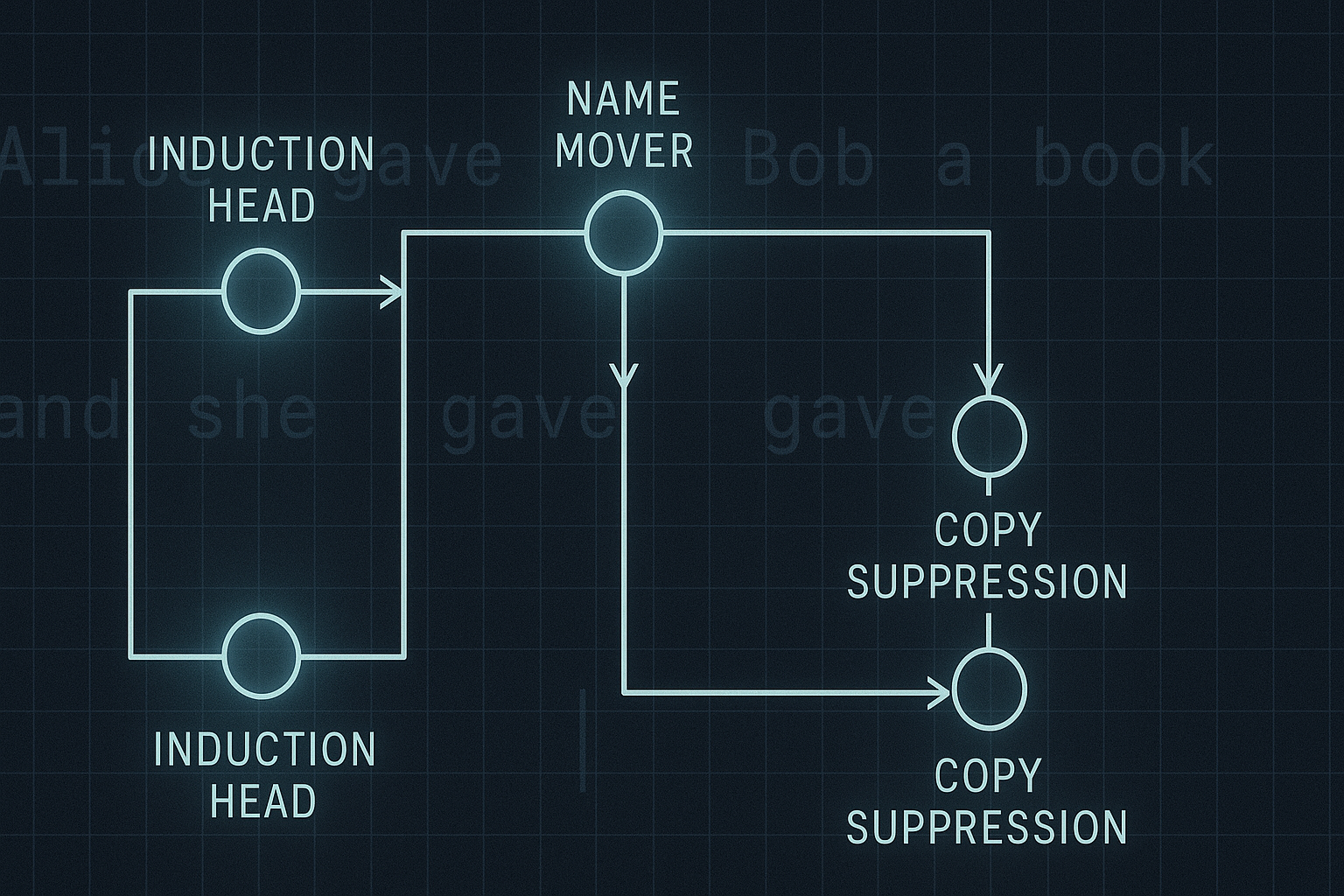
Can we prove that we understand how a transformer works? Not just describe it heuristically, or highlight patterns—but actually trace its computations with the rigor of a math proof? That’s the ambition behind the recent paper Mechanistic Interpretability for Transformers: A Formal Framework and Case Study on Indirect Object Identification. The authors propose the first comprehensive mathematical framework for mechanistic interpretability, and they use it to dissect how a small transformer solves the Indirect Object Identification (IOI) task. What results is not just a technical tour de force, but a conceptual upgrade for the interpretability field. ...

July 30, 2025 · 3 min · Zelina
Cover image

Beyond Words: How Transformer Models Are Revolutionizing SaaS for Small Businesses

Introduction In recent years, Transformer models have redefined the field of artificial intelligence—especially in natural language processing (NLP). But their influence now stretches far beyond just language. From asset forecasting to automating enterprise tasks, Transformer architectures are laying the groundwork for a new generation of intelligent, cost-effective, and reliable SaaS platforms—especially for small businesses. This article explores: The core differences between Transformer models and traditional machine learning approaches. How Transformers are being used outside of NLP, such as in finance and quantitative trading. Most importantly, how Transformer-based models can power next-gen SaaS tailored for small firms. Transformer vs. Traditional Models: A Paradigm Shift Traditional machine learning models—such as logistic regression, decision trees, and even RNNs (Recurrent Neural Networks)—typically process data in a fixed, sequential manner. These models struggle with long-term dependencies, require hand-engineered features, and don’t generalize well across different tasks without significant tuning. ...

March 21, 2025 · 5 min · Cognaptus Insights