
Cover image

Agents All the Way Down: When Science Becomes Executable

Opening — Why this matters now For years, AI for Science has celebrated isolated breakthroughs: a protein folded faster, a material screened earlier, a simulation accelerated. Impressive—yet strangely unsatisfying. Real science does not happen in single model calls. It unfolds across reading, computing, experimentation, validation, revision, and institutional memory. The uncomfortable truth is this: as AI accelerates scientific output, it is quietly breaking the human systems meant to verify it. Peer review strains. Reproducibility weakens. “It worked once” becomes the dominant success metric. ...
December 24, 2025 · 3 min · Zelina
Cover image

From DAGs to Swarms: The Quiet Revolution of Agentic Workflows

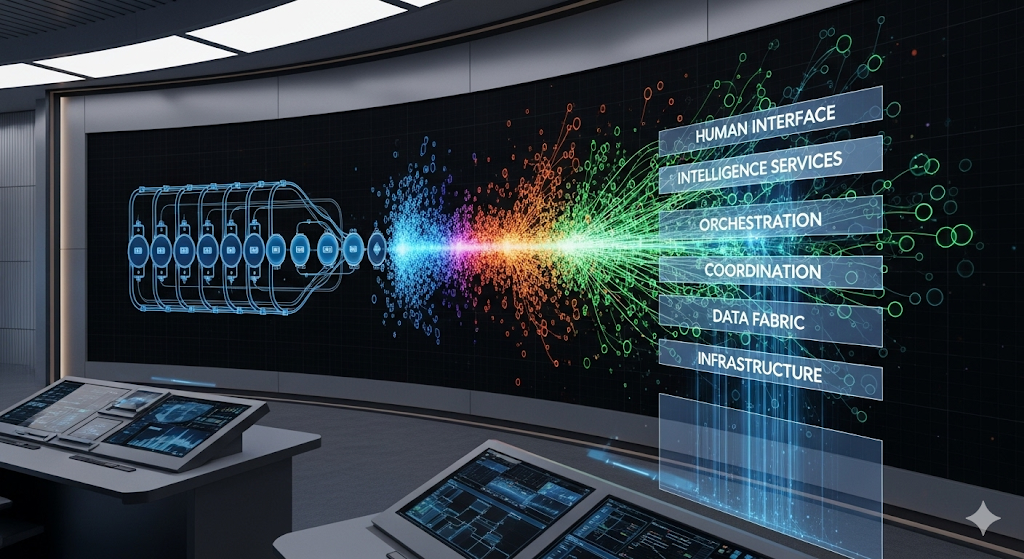
TL;DR Traditional workflow managers treat science as a frozen DAG; the agentic era treats it as a living state machine that learns, optimizes, and—at scale—swarms. The payoff isn’t just speed. It’s a shift from execution pipelines to discovery loops, where hypotheses are generated, tested, and replanned continuously across labs, clouds, and HPC. Why this matters (beyond the lab) Enterprises keep wiring LLMs into point solutions and call it “automation.” Science, under stricter constraints (traceability, causality, irreversibility), is sketching a federated architecture where reasoning agents, facilities, and data fabrics negotiate in real time. If it works in a beamline, it’ll work in your back office. The blueprint is a reusable pattern for any AI-powered operation that must be auditable, distributed, and adaptive. ...

September 19, 2025 · 5 min · Zelina