Queue.
That is still the hidden operating model of much modern science. Queue for the instrument. Queue for the simulation. Queue for the data transfer. Queue for a human to inspect the result, change the parameters, approve the next run, and remind three systems with incompatible interfaces that they are supposed to be part of the same experiment. The glamour version is “AI for discovery.” The operational version is a researcher quietly becoming a logistics coordinator with a PhD.
The paper behind this article, The (R)evolution of Scientific Workflows in the Agentic AI Era: Towards Autonomous Science, makes a useful move: it refuses to treat autonomous science as a chatbot bolted onto laboratory equipment.1 Instead, it asks how scientific workflow systems can evolve from the infrastructure they already have: directed workflows, high-performance computing, data fabrics, experimental instruments, provenance systems, and humans who quite reasonably do not want a stochastic intern vaporising rare samples in the name of innovation.
Its central claim is not “agents will replace workflows.” That would be the cheap conference-panel version. The stronger argument is that workflows and agents can be described through a shared abstraction: the state machine. Once both are put on that common footing, the future of agentic workflows becomes less mysterious. It is not a jump from Airflow-like DAGs to a magical swarm of scientific pixies. It is a controlled migration across two dimensions: how intelligent the transition logic becomes, and how richly multiple workflow units coordinate.
That may sound dry. Good. Dry is where infrastructure begins.
The problem is not the DAG; it is the frozen transition function
A directed acyclic graph is not stupid. It is disciplined.
In a traditional scientific workflow, each node represents a task: run a simulation, transform a dataset, trigger an analysis, move a file, generate a report. Each edge describes a dependency. This structure gives scientific computing much of what it needs: reproducibility, inspectability, failure handling, and the comforting ability to know what should happen before someone presses run.
The trouble starts when the world refuses to behave like a pre-approved graph.
Modern scientific campaigns increasingly span instruments, edge devices, cloud services, HPC systems, storage platforms, and human teams across different facilities. A materials-discovery campaign may move between synthesis, characterisation, simulation, and analysis. A climate or health-science workflow may mix streaming data, long-running models, and intermittent human review. The workflow no longer just executes a plan. It keeps discovering that the plan was incomplete.
The paper’s useful diagnosis is that the DAG is only one expression of a deeper mechanism: state transition. A workflow moves from one state to another when events, data, or task completions arrive. A classic DAG has a mostly predetermined transition function. That makes it reliable, but also brittle when the environment changes, hypotheses evolve, data quality shifts, instruments fail, or the next useful experiment depends on what just happened.
The question, then, is not whether to keep or abolish workflows. It is whether the transition function can become smarter without destroying the properties that made workflows valuable in the first place.
That is the article’s key doorway. Walk through it and “agentic workflow” stops meaning “LLM with tools” and starts meaning “workflow logic that can observe, learn, optimise, and sometimes reconfigure itself under constraints.”
Much less shiny. Much more useful.
The paper’s central move: workflows and agents are both state machines
The paper’s first major contribution is conceptual: it recasts both traditional workflows and AI agents as state-machine systems.
A simple workflow state machine has states, inputs, transitions, an initial state, and final states. In a DAG workflow, the nodes can be treated as states and the edges as transition rules. When a task completes, the system moves to the next state. This is familiar and deterministic.
An AI agent looks more exotic, but the authors argue that it can also be viewed through the same structure. The difference is not that the agent has escaped the state machine. The difference is that its transition function is richer. It may incorporate observations, history, learned models, cost functions, reasoning engines, or meta-optimisation that can alter the workflow itself.
This is a neat reframing because it prevents two common mistakes.
The first mistake is workflow conservatism: assuming that if a system is not fully specified up front, it cannot be scientific. The paper pushes back by showing that adaptability can be represented as a progression of transition-function sophistication, not as a collapse into chaos.
The second mistake is agentic romanticism: assuming that once a system has an LLM, the old execution discipline can be thrown away. The paper is even less patient with that fantasy. Scientific settings need validation, reproducibility, auditability, physical constraints, and governance. The state-machine lens keeps those requirements visible.
The point is not to make workflows more theatrical. It is to make their decision logic progressively more capable.
The two knobs: transition intelligence and coordination shape
The authors organise the evolution of workflows across two axes.
The first axis is intelligence: how sophisticated the transition function becomes. The second is composition: how multiple state machines are connected and coordinated.
These are not decorative categories. They are the paper’s mechanism.
| Dimension | Progression | What changes operationally |
|---|---|---|
| Intelligence | Static → Adaptive → Learning → Optimising → Intelligent | The workflow moves from predetermined transitions to feedback-aware, data-driven, goal-seeking, and eventually self-reconfiguring behaviour. |
| Composition | Single → Pipeline → Hierarchical → Mesh → Swarm | The system moves from isolated execution to staged flow, delegated control, peer coordination, and emergent collective behaviour. |
The intelligence axis begins with static workflows, where transitions are predefined. It then moves to adaptive workflows, where observations or feedback can trigger conditional behaviour. Then comes learning, where past execution informs future transitions. Optimising systems introduce explicit objective functions and search for better actions. Finally, intelligent systems can perform meta-optimisation: they may redefine states, transitions, or goals in response to context.
The composition axis starts with a single machine. It then moves to pipeline composition, where outputs feed subsequent stages. Hierarchical composition adds manager-worker delegation. Mesh coordination allows peer-to-peer interaction or shared state. Swarm coordination aims for emergent behaviour from local interactions rather than central command.
The distinction matters because many organisations confuse these axes. They add a tool-using LLM to a single workflow step and announce that they have built “autonomous operations.” No. They have moved a little on the intelligence axis, if they are lucky, and probably not at all on the composition axis. Conversely, a distributed workflow across many systems is not automatically intelligent. It may simply be a larger mess with more YAML.
A serious agentic workflow strategy must ask both questions:
- How much intelligence should the transition function have?
- How should multiple intelligent units coordinate without becoming ungovernable?
That is where the paper’s 5×5 matrix becomes useful.
The 5×5 matrix is a migration map, not a maturity badge
The paper combines the two axes into a 5×5 matrix. Static pipelines sit near the familiar world of DAG-based workflows. Intelligent swarms sit at the frontier of autonomous science. Between them are many intermediate states: conditional DAGs, ML pipelines, distributed optimisation systems, hierarchical multi-agent systems, agent societies, adaptive sampling systems, and more.
The temptation is to treat the bottom-right cell as the goal. The paper is more careful than that. Not every scientific system needs to become an intelligent swarm. Some workflows should remain static because the cost of autonomy exceeds the value. Some should become adaptive but not learning. Some should optimise locally but never rewrite their own scientific objectives. “Because we can” remains a poor architecture principle, even when wearing an AI badge.
The matrix is valuable because it creates a migration vocabulary. It lets a team describe where a workflow currently sits and what kind of transition is actually being proposed.
| Migration step | What must be added | What becomes harder |
|---|---|---|
| Static → Adaptive | Feedback signals, conditional branching, runtime monitoring | Testing paths that were previously fixed |
| Adaptive → Learning | Execution history, model updates, data infrastructure | Reproducibility of behaviour, not just outputs |
| Learning → Optimising | Objective functions, search policies, evaluation loops | Defining the right goal without gaming it |
| Optimising → Intelligent | Reasoning engines, knowledge bases, meta-planning | Verifying systems that can modify plans |
| Pipeline → Mesh/Swarm | Agent communication, shared state, capability discovery | Governance, consensus, emergent failure modes |
This is where the paper becomes practically useful. It does not merely say “add AI.” It says each movement has a cost structure. Learning requires history. Optimisation requires a cost function. Meta-optimisation requires reasoning engines and knowledge representation. Mesh and swarm coordination require communication protocols, security, distributed state, and audit trails.
In other words, autonomy is not a model upgrade. It is an infrastructure debt instrument. Someone has to pay.
The figures are conceptual machinery, not benchmark evidence
The paper does not present a benchmark suite, an ablation table, or a controlled comparison showing that one agentic architecture outperforms another. That matters.
Its figures and tables play different roles:
| Paper element | Likely purpose | What it supports | What it does not prove |
|---|---|---|---|
| State-machine figure | Mechanistic abstraction | Workflows and agents can be compared through transition logic | That a specific agent implementation is reliable |
| Intelligence table | Taxonomy | Different levels of autonomy require different infrastructure | That higher intelligence is always better |
| Composition table | Taxonomy | Coordination patterns have distinct scaling and governance properties | That swarms will outperform hierarchies in practice |
| 5×5 matrix | Classification and roadmap | Teams can locate current and target workflow designs | That the bottom-right cell is universally desirable |
| Layered architecture figure | Design blueprint | Existing workflow stacks can be extended rather than replaced | That the proposed architecture is production-validated |
| Federated deployment figures | Scenario illustration | Autonomous science requires cross-facility coordination | That federation is easy, cheap, or standardised today |
This distinction is important for business readers. The paper is not evidence that agentic swarms are ready to run high-stakes R&D without supervision. It is evidence that the migration problem can be reasoned about systematically. That is a different claim, but still a valuable one.
Framework papers are easy to underrate because they do not hand you a graph with a bigger bar. Yet in infrastructure transitions, the first scarce resource is often not performance. It is conceptual order. Without it, teams buy tools, wire together prototypes, and rediscover governance the expensive way.
Architecture: add intelligence services without torching the workflow stack
The paper’s second major contribution is architectural. It proposes an evolution of existing scientific workflow architecture rather than a replacement.
The important phrase is systematic extension. Existing workflow systems have decades of accumulated knowledge: schedulers, resource managers, provenance tools, data movement services, fault tolerance, and community practices. Throwing that away because agents are fashionable would be infrastructure vandalism with a nicer logo.
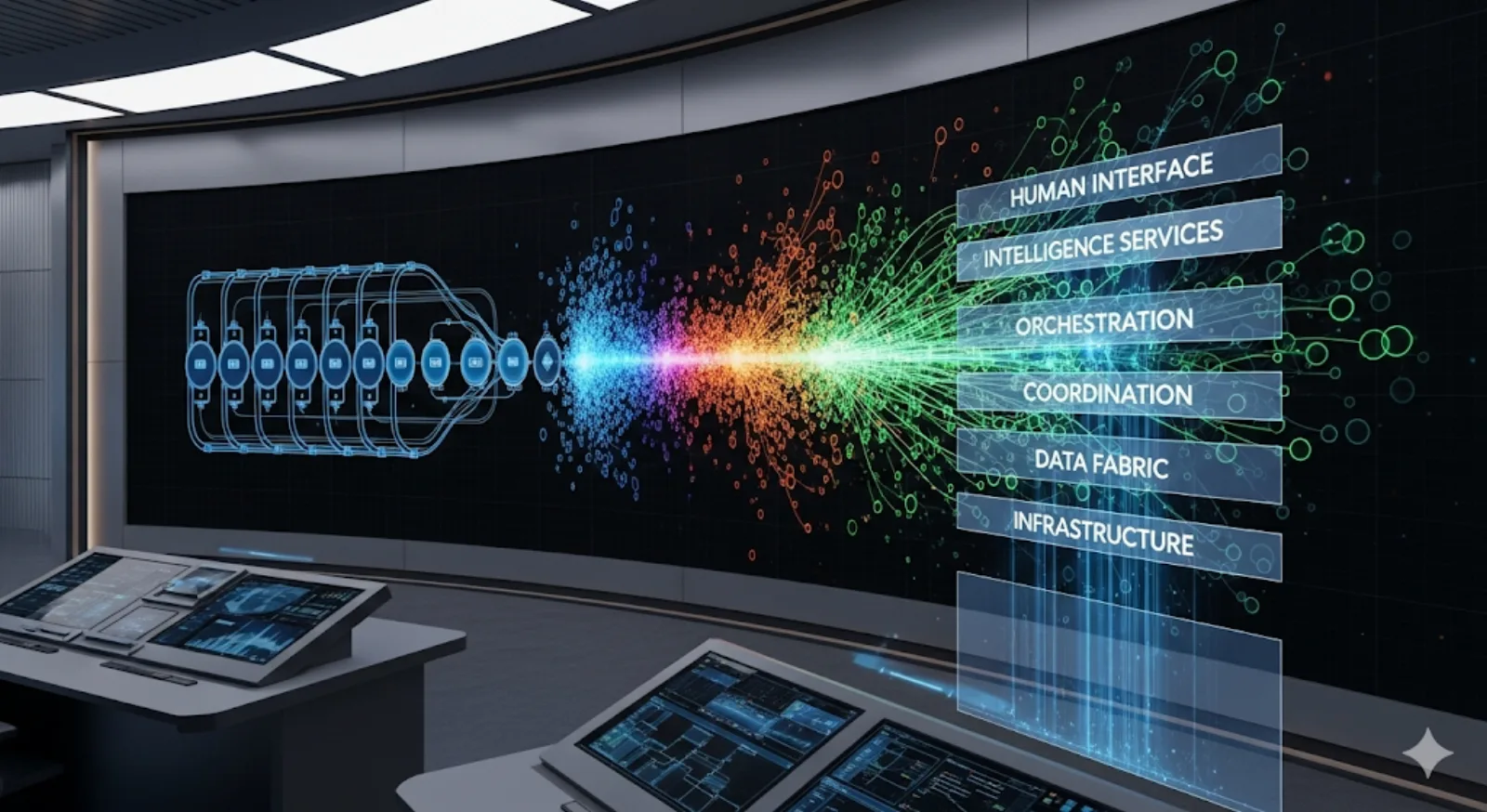
Instead, the authors describe layers that can absorb agentic capabilities.
The human interface layer moves from dashboards to interactive planning and intervention environments. Humans do not merely watch jobs complete. They steer campaigns, validate hypotheses, review decision boundaries, and intervene when the system approaches risk limits.
The intelligence service layer is the new layer. It contains hypothesis agents, design agents, analysis agents, knowledge agents, and meta-optimisers. The important design choice is that these agents are treated as services or micro-workflows, not one-off prompts. That changes the engineering discipline. Agents need identity, interfaces, versioning, logging, and operational boundaries.
The workflow orchestration layer evolves from scheduling tasks to managing dynamic state. It must support conditional execution, near-real-time results, resource optimisation, and in advanced cases workflow modification based on meta-optimisation feedback.
The coordination and communication layer becomes more than a message bus. It needs semantic negotiation: what a facility can do, under what conditions, with what constraints, and under whose authority. Authentication also changes because non-human agents are now requesting access, moving data, and coordinating actions.
The resource and data layer expands to include knowledge graphs, model registries, provenance for AI reasoning, objective specifications, and validation frameworks. Provenance is especially important. In deterministic workflows, logging what ran may be enough. In agentic workflows, the system must also log why the plan changed.
Finally, the infrastructure abstraction layer must cover HPC systems, cloud, edge devices, robotic labs, AI accelerators, specialised instruments, and eventually hybrid classical-quantum resources. This is not the glamorous layer, which is precisely why it matters. Most “autonomous” demos become less autonomous when the instrument API looks like it was designed by a committee in 2007 and then abandoned for spiritual reasons.
The architecture’s implication is blunt: agentic science is not a prompt-engineering problem. It is a distributed systems problem with scientific constraints.
Federation is the boring part that makes autonomy possible
The paper is especially strong when it talks about federation.
A fully centralised autonomous science platform is attractive in a slide deck and suspicious in reality. Scientific facilities have different instruments, policies, funding models, security constraints, data rules, and local priorities. They cannot simply be absorbed into one master scheduler.
The proposed direction is federated autonomy. Each facility retains operational independence while exposing capabilities through shared protocols. Agents can discover services, negotiate access, submit work, receive results, and coordinate across boundaries.
This matters because autonomy at one site is merely local optimisation. Scientific discovery increasingly depends on chains of capability: synthesis here, characterisation there, simulation elsewhere, analysis in another environment, and knowledge integration across the whole loop. If those handoffs remain manual, the “autonomous lab” is just a very clever island.
The paper’s materials-discovery scenario illustrates the intended loop. A scientist initiates a campaign through a science interface. Planning agents generate hypotheses and design experiments. Execution agents coordinate synthesis, beamline characterisation, simulation, and analysis. Results flow into a data fabric and knowledge graph. A meta-optimisation agent updates the strategy. Humans monitor and intervene when needed.
That is the workflow shift: from executing a predefined sequence to maintaining a live discovery loop.
For enterprises, the analogy is not hard to see. Replace synthesis labs with manufacturing cells, beamlines with inspection systems, HPC with forecasting engines, and scientific hypotheses with product, risk, or process hypotheses. The pattern remains: distributed capabilities, dynamic decisions, provenance, objective functions, and bounded autonomy.
The lesson is not “every business should build a swarm.” Please do not let the swarm people near procurement unsupervised. The lesson is that high-value operations increasingly need coordination infrastructure that lets intelligent services negotiate work across organisational boundaries.
The real business value is reducing coordination latency
The paper’s most business-relevant insight is not the 10–100x acceleration claim. That number is directionally interesting, but the paper does not validate it as a universal benchmark. Treat it as an aspiration grounded in autonomous-lab examples and community roadmaps, not as a procurement KPI.
The more useful concept is coordination latency.
In R&D-heavy organisations, delay often hides between steps rather than inside steps. The experiment finishes, but analysis waits. The model updates, but the next run is not scheduled. A facility has capacity, but another team does not know. A result invalidates the original plan, but the workflow cannot replan. A human becomes the API between systems.
Agentic workflows attack that problem by closing loops.
| Paper mechanism | Business interpretation | Boundary |
|---|---|---|
| Adaptive transition logic | Operations respond to real-time signals instead of waiting for manual triage | Requires reliable feedback channels |
| Learning from history | The process improves from accumulated execution data | Requires clean history and stable context |
| Objective-driven optimisation | Systems can search for better next actions | Requires well-specified goals and constraints |
| Meta-optimisation | Workflows can suggest or enact plan changes | Requires governance, simulation, and approval gates |
| Mesh/swarm coordination | Distributed teams or systems explore in parallel | Requires communication standards and failure containment |
| Provenance of decisions | Auditors can inspect why the system changed course | Requires logging beyond task execution |
The business value is not simply cheaper labour. That framing is too small and, frankly, a little tired. The value is faster iteration under control. In pharma, materials, energy, aerospace, advanced manufacturing, logistics, and financial operations, the expensive part is often not one task. It is the handoff-rich chain of decisions around the task.
Agentic workflows become interesting when they reduce the waiting time between observation and next action while preserving traceability.
That final clause matters. Without traceability, autonomy is just speed with plausible deniability.
What executives should build before they say “swarm”
The paper’s roadmap implies a practical sequence. It is not fashionable, which is a point in its favour.
First, map existing workflows as state machines. Identify states, transition rules, feedback signals, human approvals, failure modes, and decision points. This exercise is less exciting than launching an agent pilot. It is also how one discovers whether the agent pilot has anywhere useful to live.
Second, add provenance for decisions, not only tasks. Traditional logs capture what ran. Agentic logs must capture what was observed, what options were considered, which objective was used, why the plan changed, who approved it, and what constraints applied. In regulated or high-stakes environments, this is not optional garnish.
Third, introduce adaptive and learning behaviour before meta-planning. A workflow that cannot safely handle conditional execution has no business letting an agent rewrite its structure. Start with feedback channels, anomaly detection, learned parameter selection, and bounded optimisation.
Fourth, define objective functions with policy constraints. Optimisation without constraint design is how systems learn to win the wrong game. Scientific workflows worry about physical validity, sample scarcity, uncertainty, and reproducibility. Businesses have their own equivalents: credit risk, compliance, customer harm, inventory loss, safety, brand damage, and cash exposure.
Fifth, expose capabilities through registries and protocols. An agent cannot coordinate across facilities, departments, or systems unless it knows what exists, what each service can do, what it costs, what rules apply, and how to request it.
Sixth, move from hierarchy to mesh only where the coordination gain justifies the governance cost. Hierarchies are not primitive. They are often sensible. Mesh and swarm structures become useful when the problem space is too distributed, uncertain, or fast-changing for central planning.
The executive summary is therefore simple: do not buy “agentic AI.” Build the substrate that lets bounded intelligence enter existing workflows without making audit, control, and integration worse.
Admittedly, that sentence is less fun than a demo. It is also less likely to bankrupt the architecture team.
The boundary: no benchmark, no magic swarm, no free governance
The paper’s limitations are not defects; they define how it should be used.
First, this is a conceptual and architectural paper, not an empirical validation of a deployed autonomous-science stack. It gives a taxonomy, roadmap, and blueprint. It does not prove that a specific implementation can safely deliver the full vision.
Second, the 10–100x acceleration framing should be handled carefully. The paper cites existing autonomous-lab successes and argues that removing human bottlenecks could radically compress discovery cycles. That is plausible in some domains and wildly domain-dependent in others. Physical experiments, regulatory validation, safety reviews, data rights, equipment availability, and institutional governance can all cap the speedup.
Third, “intelligent” is not automatically better than “optimising,” and “swarm” is not automatically better than “hierarchical.” More autonomy increases verification complexity. More coordination increases communication, security, and governance requirements. Some workflows should remain boring because boring is what correctness looks like at scale.
Fourth, scientific agents face constraints that generic enterprise agents often avoid. They must reason about causal structure, physical feasibility, uncertainty, multimodal data, and irreversible actions. A model that can write a plausible plan is not necessarily a system that should control a robot, schedule a beamline, or redirect an expensive campaign.
Fifth, reproducibility changes shape. In deterministic workflows, reproducing the output may mean rerunning the same steps. In adaptive workflows, reproducibility may require reconstructing the decision context: observations, learned state, policy constraints, objective functions, model versions, and human interventions. This is a deeper provenance problem than many current stacks are ready to handle.
That is the uncomfortable part of the paper. Autonomy does not reduce the need for infrastructure discipline. It raises the price of not having it.
The quiet revolution is an operating-model change
The article title says “from DAGs to swarms,” but the real movement is subtler. It is from workflows as execution plans to workflows as governed decision loops.
A DAG says: here is the path.
An adaptive workflow says: here is the path, unless the world gives us evidence to branch.
A learning workflow says: here is the path, and we will improve our transitions from experience.
An optimising workflow says: here is the objective, and we will search for better actions.
An intelligent, federated, swarm-like workflow says: here is a distributed scientific environment with many capabilities, constraints, and uncertainties; let coordinated agents explore, adapt, negotiate, and update the campaign while humans retain strategic control.
That last version is not merely a faster pipeline. It is a different operating model for discovery.
For Cognaptus readers, the business implication is clear. The serious future of agentic AI will not be built by sprinkling assistants across existing processes and hoping the dashboards look modern. It will be built by turning brittle workflows into state-aware, provenance-rich, capability-discovering, policy-constrained systems that can absorb intelligence one layer at a time.
The paper’s best contribution is giving that transition a map. Not a finished city. Not a guaranteed route. A map.
And in infrastructure, a good map is already an advantage. It tells you where the cliffs are before the innovation team starts running.
Cognaptus: Automate the Present, Incubate the Future.
-
Woong Shin, Renan Souza, Daniel Rosendo, Frédéric Suter, Feiyi Wang, Prasanna Balaprakash, and Rafael Ferreira da Silva, “The (R)evolution of Scientific Workflows in the Agentic AI Era: Towards Autonomous Science,” arXiv:2509.09915, 2025, https://arxiv.org/abs/2509.09915. ↩︎