Cover image

The Shock Doctrine of Portfolio Optimization

TL;DR for operators Shi and Xu’s paper asks a deceptively simple question: what if a market regime change is not just a new label on the same price process, but a price shock in its own right?1 That matters because many portfolio systems treat regimes as parameter containers. In regime 1, volatility is low, drift is healthy, jump intensity is manageable. In regime 2, the numbers change. The model switches shelves, picks a new parameter set, and carries on. Fine, as far as it goes. The market, being less polite than the model, often gaps before anyone has finished updating the spreadsheet. ...

August 3, 2025 · 16 min · Zelina
Cover image

Volume Shock Therapy: Why Markowitz Risk Might Be Lying to You

TL;DR for operators Markowitz variance is usually treated as the clean mathematical backbone of portfolio risk. Olkhov’s paper asks a narrower and more awkward question: what if that familiar covariance formula is only what remains after trade-volume randomness has been quietly set to zero?1 The paper’s answer is mechanism-first. It constructs a buy-and-hold portfolio as if it were a synthetic single traded security. To do that, it rescales the observed market trades of each constituent so their normalised volumes match the investor’s actual holdings, then aggregates those normalised trade values and volumes into portfolio-level trade series. Once the portfolio has its own synthetic trade values $Q(t_i)$, volumes $W(t_i)$, and implied prices $s(t_i)$, its variance can be computed in the same market-based way as the variance of any single security. ...

August 3, 2025 · 17 min · Zelina
Cover image

When Mortality Meets Memory: Pricing Risk in the Long Haul

TL;DR for operators Pandemics do not behave like polite spreadsheet shocks. They arrive, damage the mortality curve, interact with interest-rate conditions, and then leave traces. The paper studied here builds a joint model for excess mortality and interest rates using mixed fractional Brownian motion, a stochastic process designed to capture both short-term noise and long-range dependence.1 ...

August 3, 2025 · 19 min · Zelina
Cover image

Noisy by Nature: Rethinking Financial Time Series Generation with GBM-Inspired Diffusion

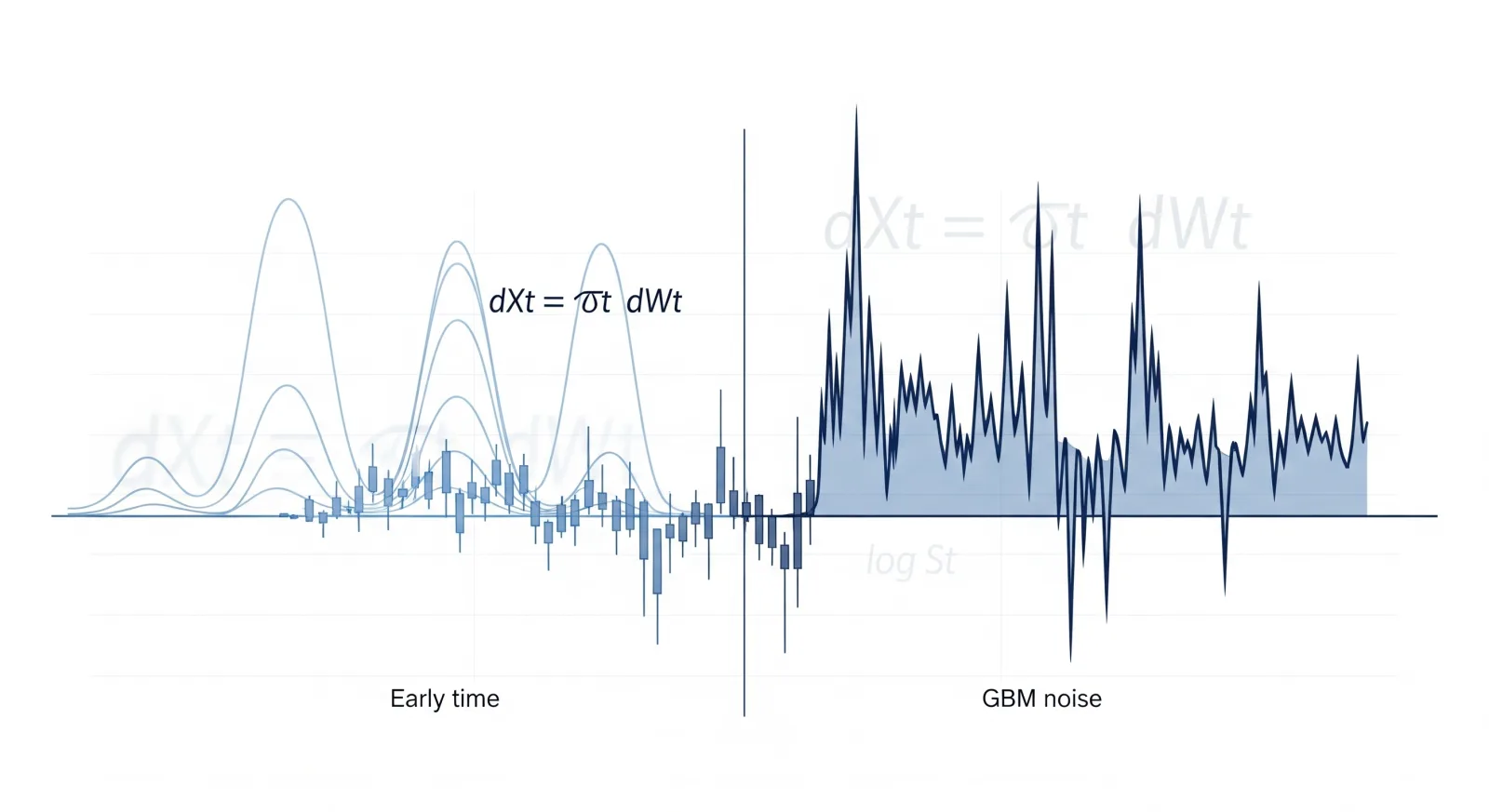
TL;DR for operators Financial time series generation has a surprisingly basic problem: many models corrupt market data as if prices were pixels. Add Gaussian noise, train a neural network to remove it, admire the architecture, and then wonder why the generated series behave like polite laboratory specimens rather than markets. Kim, Choi, and Kim’s paper proposes a more finance-native diffusion design: use geometric Brownian motion (GBM) as an inductive bias in the forward noising process.1 The point is not to revive Black–Scholes as a complete market simulator. The point is narrower and more useful: make the noising process respect the fact that asset prices move multiplicatively and volatility scales with price level. ...

August 2, 2025 · 16 min · Zelina
Cover image

Trained on Tickers, Tuned for Trust: The New Frontier of FinTech AI

TL;DR for operators Financial foundation models are not one product category. They are three partly overlapping tool families, and confusing them is how firms end up buying a chatbot and expecting a risk engine. The paper reviewed here offers a useful taxonomy of financial foundation models across language, time-series, and visual-language systems, covering architectures, training methods, datasets, applications, and deployment challenges through June 2025.1 Its practical value is not that it declares a winner. It does something more useful: it shows which parts of financial AI are mature enough for workflow adoption, which are still research-shaped, and where the real bottlenecks sit. ...

July 25, 2025 · 21 min · Zelina
Cover image

Simulate First, Invest Later: How Diffusion Models Are Reinventing Portfolio Optimization

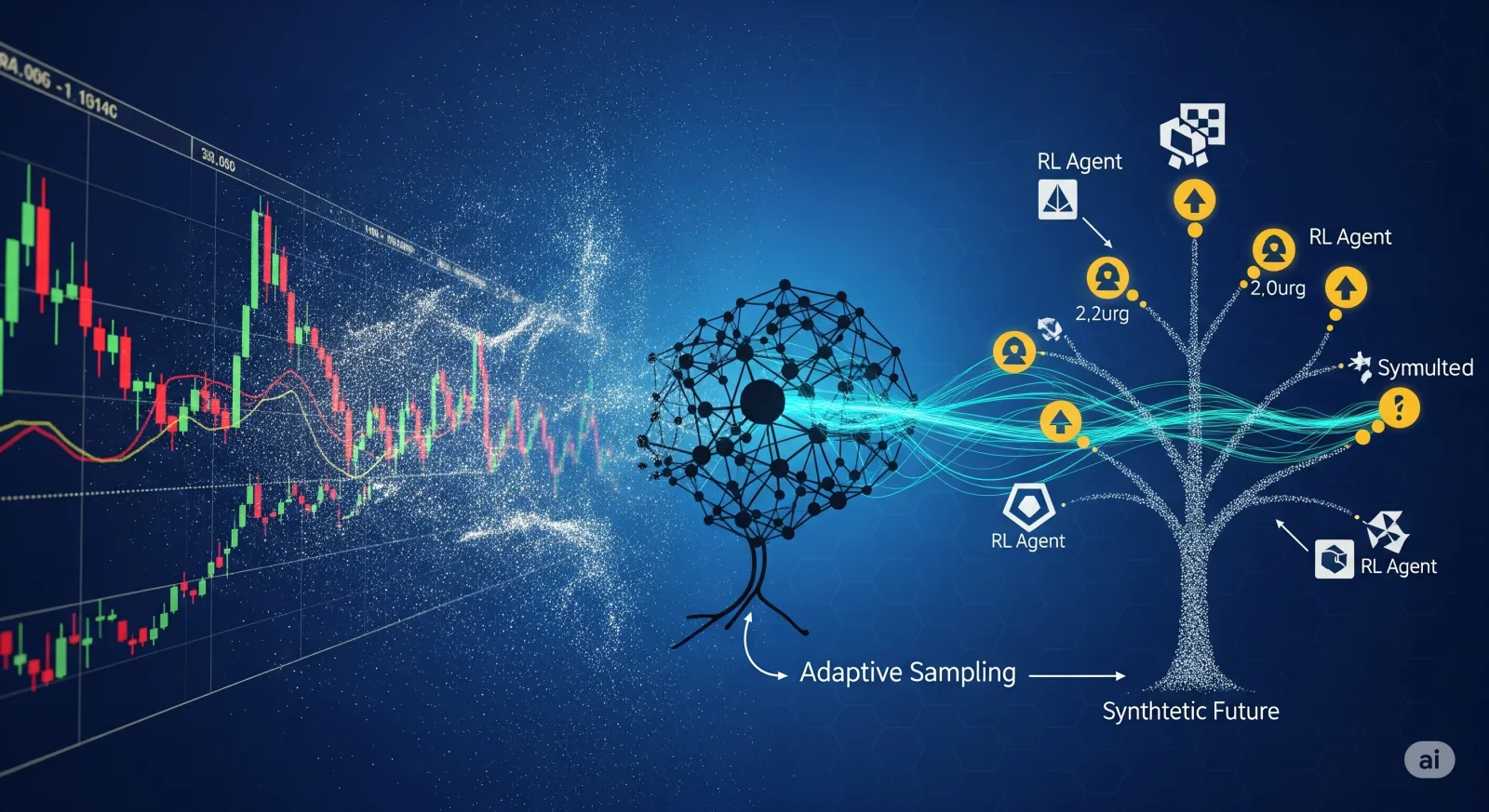
TL;DR for operators Portfolio teams do not lack optimisation formulas. They lack enough relevant future scenarios. That is the problem this paper attacks. The paper proposes a diffusion-based market simulator that learns from historical time-series data, then generates conditional future paths based on the current market state.1 Those generated paths become the training environment for a reinforcement-learning portfolio agent. In plain terms: instead of asking an RL policy to learn from a thin archive of market history, the system first builds a synthetic scenario engine and lets the policy practise there. Sensible. Also dangerous, if the simulator hallucinates a market that conveniently rewards your model. ...

July 20, 2025 · 16 min · Zelina
Cover image

The Bullshit Dilemma: Why Smarter AI Isn't Always More Truthful

TL;DR for operators Most AI quality programmes still treat truthfulness as a factual accuracy problem: did the model get the answer right, cite the source, or hallucinate a feature that does not exist? That is necessary. It is not sufficient. The paper behind this article argues for a nastier category: “machine bullshit,” meaning model output produced with indifference to truth rather than simple ignorance or random hallucination.1 The key point is not that models become stupid. It is that, under some incentives, their outward claims stop tracking what they appear to know. ...

July 11, 2025 · 17 min · Zelina
Cover image

Sharpe Thinking: How Neural Nets Redraw the Frontier of Portfolio Optimization

TL;DR for operators This paper is about risk estimation, not market prophecy. The neural network does not try to forecast returns, detect tomorrow’s winners, or become a portfolio manager with a hoodie and a GPU budget. It learns how to clean covariance information so that a global minimum-variance portfolio behaves better out of sample.1 ...

July 3, 2025 · 19 min · Zelina
Cover image

Overqualified, Underprepared: Why FinLLMs Matter More Than Reasoning

TL;DR for operators Finance AI is moving past the parlour trick stage. The interesting question is no longer whether a large language model can read a financial headline and produce a plausible answer. Of course it can. The useful question is whether that answer can be converted into a measurable, governed, risk-aware decision process without accidentally building a very expensive rumour amplifier. ...

April 20, 2025 · 16 min · Zelina