Cover image

Two Heads, One Error Budget

TL;DR for operators Adding a second model does not automatically make an AI workflow safer. It creates another opportunity to correct an error—and another opportunity to introduce one. In the paper’s cybersecurity experiment, giving Gemma-2’s reasoning to Phi-3 raises Phi-3’s accuracy from 60.34% to 93.10%. In networking, the direction reverses for the stronger model: Gemma-2 falls from 90.82% to 89.80% after reasoning exchange. Passing the outputs to a Llama 3.2 judge reduces networking accuracy further, to 88.78%. ...

July 14, 2026 · 17 min · Zelina
Cover image

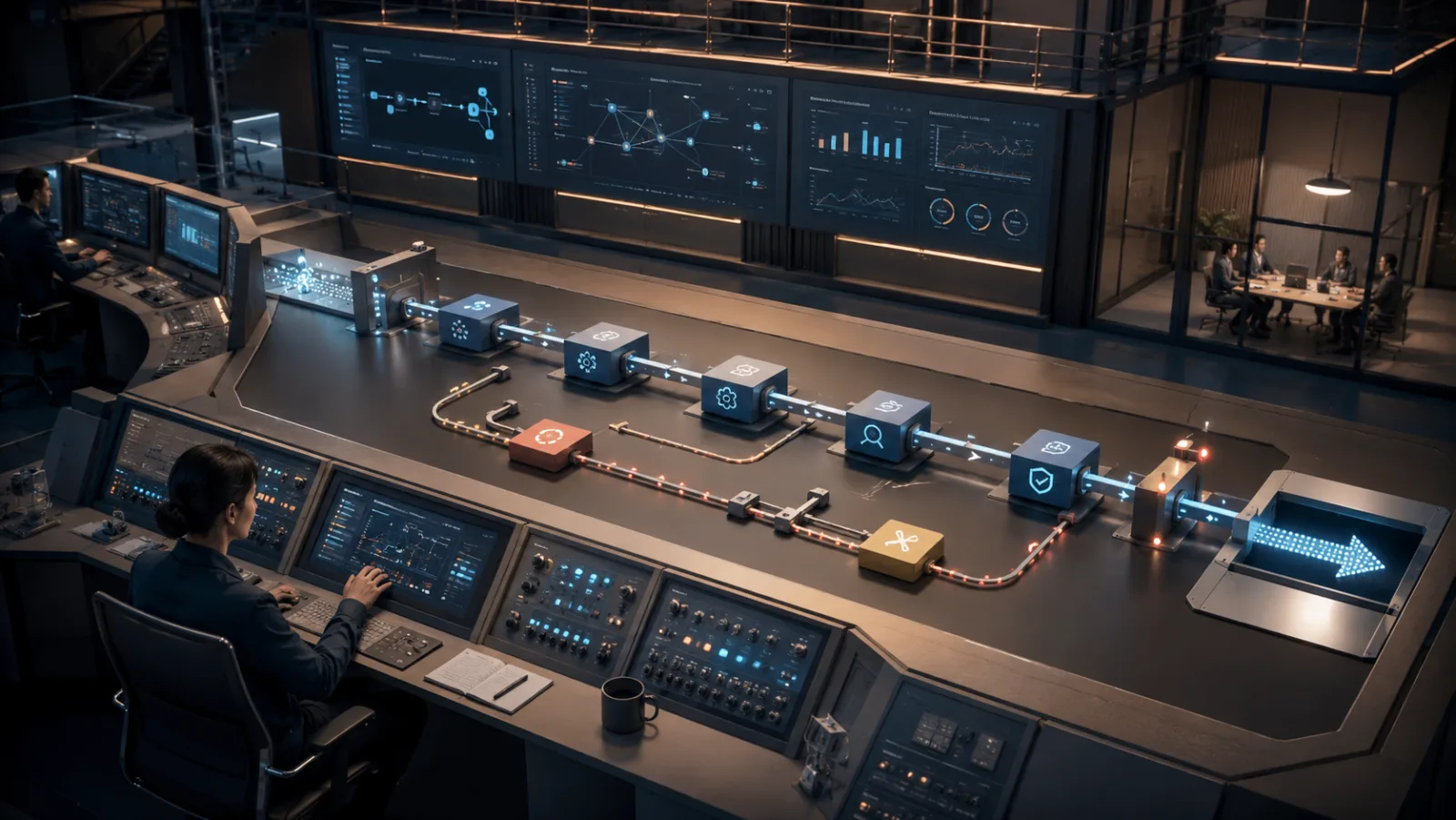
Step Right Up: Why Multi-Agent AI Needs Process Control, Not Just More Agents

Multi-agent AI has entered its “surely more agents will fix it” phase. This is an understandable phase. Also a dangerous one. When a single model struggles with a hard reasoning task, the obvious enterprise instinct is to add another model: one to plan, one to solve, one to check, one to summarize, one to look professional in the architecture diagram. The diagram improves immediately. The system may not. ...

June 6, 2026 · 15 min · Zelina
Cover image

Braiding the Future: Why Autonomous Systems Need Topology, Not Just Trajectories

Traffic is not a geometry exam. A vehicle entering a crowded intersection does not only need to know where the surrounding cars might be in three seconds. It needs to know who is likely to yield, who is likely to overtake, who is committed to a turn, and which apparently separate movements are actually part of the same coordination pattern. Coordinates matter, of course. Nobody wants an autonomous car that has a philosophical appreciation of traffic but still parks itself inside a delivery van. But coordinates are only the surface. ...

March 24, 2026 · 20 min · Zelina
Cover image

From Shapefiles to Self‑Driving Spatial Analysis: When GIS Meets Multi‑Agent AI

Shapefiles are not glamorous. They do not trend on X. They do not arrive with a cinematic demo video. They sit quietly inside urban planning departments, logistics dashboards, agricultural surveys, disaster response systems, environmental studies, real estate models, and public health maps. Then someone needs to clip a layer, create buffers, run an overlay, calculate spatial relationships, or generate Voronoi polygons, and suddenly the supposedly simple data task becomes a small pilgrimage through GIS software, file formats, coordinate systems, geometry types, and attribute tables. ...

February 22, 2026 · 14 min · Zelina
Cover image

From Guesswork to Generative Foresight: Why Diffusion Models May Fix Multi-Agent Blind Spots

A warehouse robot turns a corner and sees three things: a shelf edge, a moving cart, and another robot’s partial path. It does not see the blocked aisle behind the shelf. It does not see whether the cart will stop or continue. It does not see the supervisor system’s full map. Still, it must act. ...

February 18, 2026 · 15 min · Zelina
Cover image

When LLMs Invent Languages: Efficiency, Secrecy, and the Limits of Natural Speech

Chatbots are trained to sound human. Enterprise AI agents are increasingly asked to behave like colleagues: pass information, coordinate actions, summarize context, and explain what they are doing in language people can read. That arrangement feels safe because natural language is familiar. It also feels efficient enough, at least until agents start talking to other agents. ...

January 31, 2026 · 15 min · Zelina
Cover image

Many Minds, One Solution: Why Multi‑Agent AI Finds What Single Models Miss

Review meeting. That is the easiest way to understand why multi-agent AI sometimes works better than one impressive model asked to “think harder.” In a good review meeting, the finance person does not merely contribute another opinion. The compliance person does not merely add vibes. The operations person does not simply vote. Each participant keeps pulling the same proposal back toward a different kind of admissibility: budget realism, regulatory safety, technical feasibility, customer usefulness, operational maintainability. ...

January 22, 2026 · 17 min · Zelina
Cover image

Flip the Switch: How Heterogeneous Agents Learn to Restore the Grid

A power outage is not one problem. It is a queue of smaller, uglier problems pretending to be one. Which switches can be closed? Which loads should come back first? Which distributed generators are available? Which lines will overheat if a local microgrid gets too ambitious? Which voltage limits will quietly make the elegant restoration plan unusable? In a control room, these questions arrive together, under time pressure, with the usual helpful accompaniment of incomplete information and operational consequences. ...

November 20, 2025 · 15 min · Zelina
Cover image

Ghostwriters in the Machine: How Multi‑Agent LLMs Turn Raw Transport Data Into Decisions

A bus operator does not usually suffer from a shortage of charts. It suffers from the more irritating problem: charts that explain themselves only to the person who made them. The fuel-efficiency analyst has a histogram. The data scientist has a clustering plot. The operations manager has a timetable to defend, a fuel bill to reduce, and perhaps a driver-training programme to justify. Somewhere between those roles, insight quietly evaporates into a PDF appendix. ...

November 18, 2025 · 14 min · Zelina
Cover image

Reason, Reveal, Resist: The Persuasion Duality in Multi‑Agent AI

Meetings are already persuasive systems. Someone speaks first, someone sounds confident, someone produces a spreadsheet with just enough decimal places to look holy, and suddenly the room has moved. Multi-agent AI systems are not so different. They are becoming small artificial committees: one agent retrieves, another proposes, another critiques, another decides. The optimistic version says this gives us productive disagreement. The less adorable version says we have built a machine for circulating influence, and we are only now asking what makes one agent cave to another. ...

October 2, 2025 · 14 min · Zelina