Cover image

Echoes, Not Amnesia: Teaching GUI Agents to Remember What Worked

Opening — Why this matters now GUI agents are finally competent enough to click buttons without embarrassing themselves. And yet, they suffer from a strangely human flaw: they forget everything they just learned. Each task is treated as a clean slate. Every mistake is patiently re‑made. Every success is quietly discarded. In a world obsessed with scaling models, this paper asks a simpler, sharper question: what if agents could remember? ...

December 23, 2025 · 3 min · Zelina
Cover image

Memory Over Models: Letting Agents Grow Up Without Retraining

Opening — Why this matters now We are reaching the awkward teenage years of AI agents. LLMs can already do things: book hotels, navigate apps, coordinate workflows. But once deployed, most agents are frozen in time. Improving them usually means retraining or fine-tuning models—slow, expensive, and deeply incompatible with mobile and edge environments. The paper “Beyond Training: Enabling Self-Evolution of Agents with MOBIMEM” takes a blunt stance: continual agent improvement should not depend on continual model training. Instead, evolution should happen where operating systems have always handled adaptation best—memory. ...

December 20, 2025 · 4 min · Zelina
Cover image

The Memory Illusion: Why AI Still Forgets Who It Is

Opening — Why this matters now Every AI company wants its assistant to feel personal. Yet every conversation starts from zero. Your favorite chatbot may recall facts, summarize documents, even mimic a tone — but beneath the fluent words, it suffers from a peculiar amnesia. It remembers nothing unless reminded, apologizes often, and contradicts itself with unsettling confidence. The question emerging from Stefano Natangelo’s “Narrative Continuity Test (NCT)” is both philosophical and practical: Can an AI remain the same someone across time? ...

November 3, 2025 · 4 min · Zelina
Cover image

Layers of Thought: How Hierarchical Memory Supercharges LLM Agent Reasoning

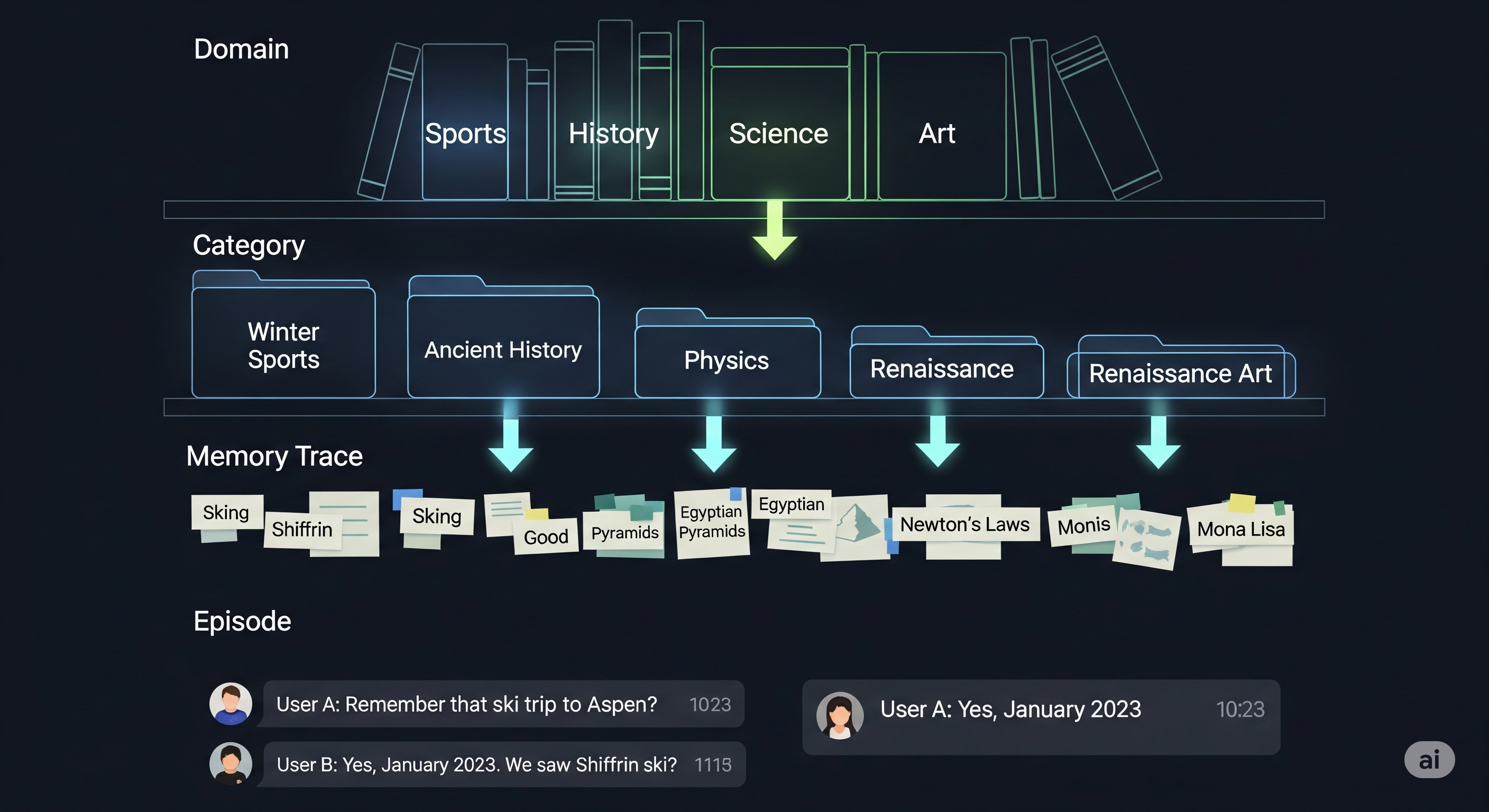
Most LLM agents today think in flat space. When you ask a long-term assistant a question, it either scrolls endlessly through past turns or scours an undifferentiated soup of semantic vectors to recall something relevant. This works—for now. But as tasks get longer, more nuanced, and more personal, this memory model crumbles under its own weight. A new paper proposes an elegant solution: H-MEM, or Hierarchical Memory. Instead of treating memory as one big pile of stuff, H-MEM organizes past knowledge into four semantically structured layers: Domain, Category, Memory Trace, and Episode. It’s the difference between a junk drawer and a filing cabinet. ...

August 1, 2025 · 3 min · Zelina