TL;DR for operators
An enterprise agent does not fail only because it forgets. Often, it fails because it remembers like a hoarder with a search bar.
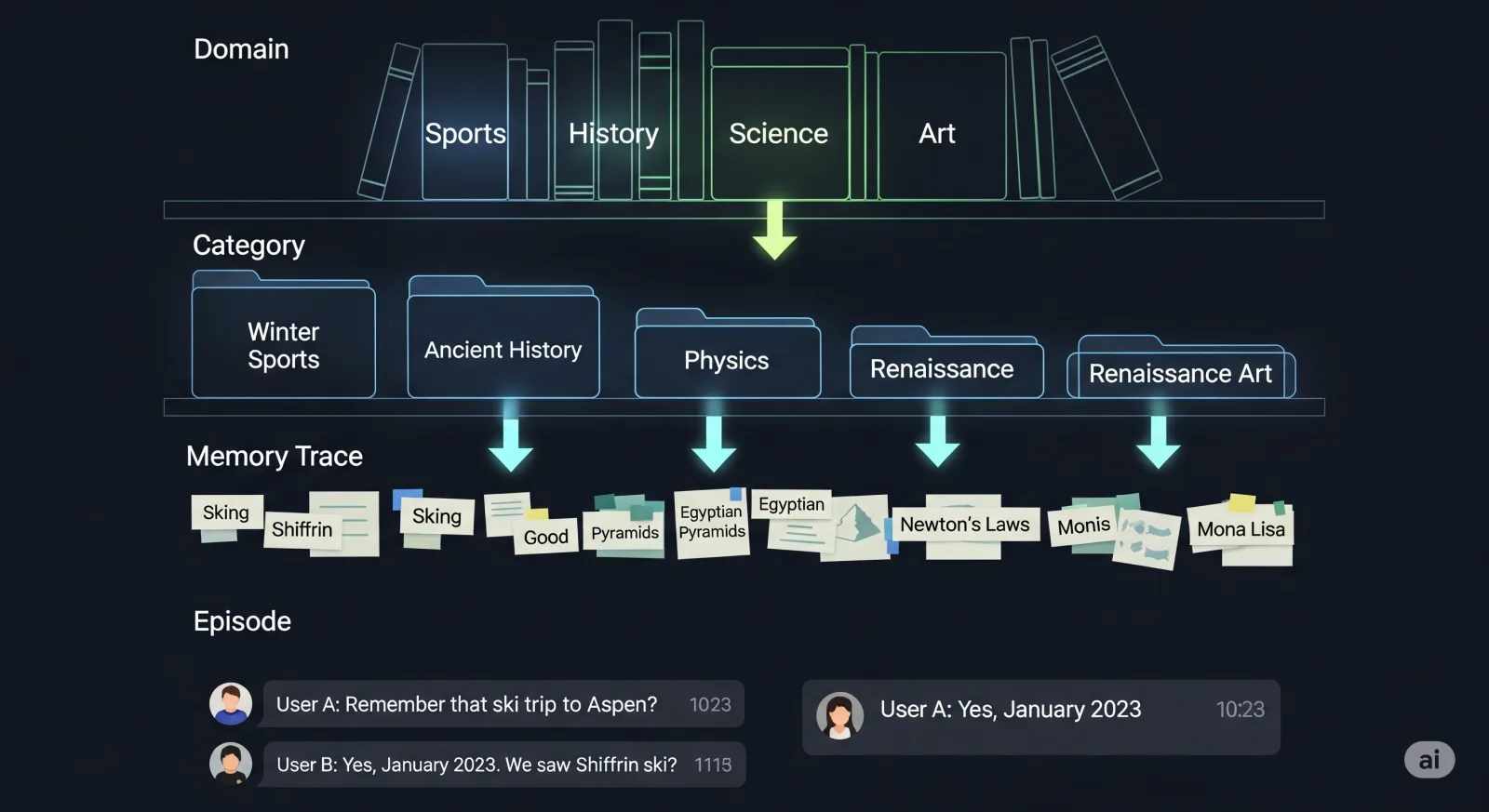
The H-MEM paper proposes a hierarchical memory system for LLM agents: Domain, Category, Memory Trace, and Episode layers, connected by positional child indices so retrieval can move from broad meaning to specific memory instead of scanning a flat pile of stored vectors.1 That sounds like software housekeeping. It is actually the main point.
The paper’s practical message is simple: long-term agent memory is not just a storage problem. It is an information architecture problem. If every past interaction competes equally for retrieval, memory grows into noise, latency, and cost. H-MEM tries to solve that by turning recall into a top-down directory walk.
The strongest business-relevant evidence is not merely that H-MEM improves LoCoMo F1 and BLEU-1 scores across several small and mid-sized local models. The more operationally interesting result is that, as irrelevant memory accumulates, H-MEM keeps retrieval latency below 100 ms in the reported efficiency experiment, while MemoryBank rises above 400 ms at the heaviest checkpoint. That is the difference between “personalised assistant” and “please wait while your assistant rummages through its attic.”
The caution is equally important. The paper supports the hierarchy-and-routing mechanism more strongly than it validates every part of the proposed system. The feedback-weighted memory update is plausible and useful, but it is not isolated as a causal driver in the experiments. The evaluation is text-only, benchmark-based, and run locally on a two-RTX-4090 setup. Useful signal, not a production certificate.
The real bottleneck is not memory size; it is memory shape
Most LLM memory systems begin with an innocent idea: save useful past interactions, embed them, and retrieve similar items later. At small scale, this works well enough. At larger scale, it becomes a corporate inbox with a cosine-similarity addiction.
The usual options are familiar. Concatenate previous turns into the prompt until the context window groans. Store memories in a vector database and search across them. Build a graph of memory nodes and let connections emerge. Each approach buys time, but each has a failure mode. Long prompts are bounded by context length and cost. Flat vector retrieval gets noisier as the memory pool expands. Graph-like systems can become expensive to maintain because relationships themselves become state.
H-MEM’s contribution is to ask a less glamorous question: what if memory should look less like a bucket and more like a structured document?
The architecture divides stored information into four levels:
| H-MEM layer | What it stores | Practical analogy | Operational role |
|---|---|---|---|
| Domain Layer | High-level area of interest | Chapter | Narrows the search universe |
| Category Layer | More specific subdomain | Section | Refines semantic intent |
| Memory Trace Layer | Keywords or compact trace summary | Paragraph heading | Bridges topic to event |
| Episode Layer | Full interaction, timestamp, user profile details | Paragraph content | Supplies final grounding text |
This hierarchy matters because only the bottom layer contains the full episodic content. The upper layers act as progressively refined indices. H-MEM does not merely remember that a user once discussed skiing, films, or investment strategy. It tries to file those interactions under increasingly precise semantic headings, then routes future queries through the relevant path.
That is a small architectural difference with a large behavioural implication. A flat vector store asks, “Which of all my memories look similar to this query?” H-MEM asks, “Which broad domain is relevant, which category inside it matters, which trace points to the right event, and only then which episode should be used?”
The first question invites everything to compete. The second tries to stop irrelevant memories from entering the contest in the first place.
H-MEM turns recall into a directory walk
The mechanism has three connected pieces.
First, after each interaction, a memory extraction model parses the exchange into the four semantic layers. The paper describes a prompt-guided process: identify the high-level domain, extract categories or subdomains, summarise keywords, and then store specific events plus user profile information as structured JSON. The episode layer keeps both vector and text forms: the vector supports similarity calculation, while the text is later inserted into the LLM prompt as grounding material.
Second, each memory entry carries positional information. A memory vector at one layer includes its own index and pointers to semantically related child memories in the next layer. During similarity search, the semantic vector is compared, while the positional indices serve as routing links.
Third, retrieval proceeds top-down. The query is embedded, compared against the highest abstraction layer, and the top-$k$ relevant entries are selected. Their child indices determine which entries in the next layer are eligible for search. The process repeats until the system reaches fine-grained episodes. H-MEM uses FAISS for similarity computation and retrieves top-$k$ memories, with $k=10$ in the reported setup.
The paper formalises the difference through computational complexity. In a flat memory store with $a$ domains, 100 categories per domain, 100 traces per category, and 100 episodes per trace, the total number of fine-grained entries is:
A flat method searching over all fine-grained entries has complexity approximately:
where $D$ is the embedding dimension.
H-MEM instead searches at the top level, then only within selected child groups. The paper approximates its retrieval complexity as:
The exact constants are less important than the design principle. H-MEM reduces the number of candidate memories that participate in retrieval. It is not trying to make similarity search magically free. It is trying to ensure most irrelevant memories never get compared.
That is the unsexy part of agent design that tends to become expensive later. The retrieval layer is not just an implementation detail. It determines whether memory improves reasoning or gradually turns the agent into a latency machine with a personality.
Feedback makes memory less sacred, but the paper tests it less directly
H-MEM also adds a dynamic memory update mechanism. The idea builds on forgetting-curve-inspired memory systems, but adds feedback from user reactions. If the agent uses a memory and the user approves, the memory weight is reinforced. If the user gives no clear feedback, the memory naturally shrinks. If the user rebuts the memory, the weight is reduced because the memory may be outdated or wrong.
Conceptually, this is sensible. Preferences decay. Context changes. A user who once loved skiing may later dislike it. A customer who used to approve a workflow may now operate under a new policy. Treating memory as permanent truth is how assistants become politely obsolete.
But the evidence should be read carefully. The paper describes the feedback-weighted update as part of the architecture, yet the experiments mainly validate hierarchical storage and retrieval. The ablation study removes retrieval and then removes both hierarchy and retrieval; it does not isolate the feedback update as its own experimental condition.
So the right reading is:
| Component | What the paper proposes | Evidence strength in the paper | Business reading |
|---|---|---|---|
| Four-layer hierarchy | Memory organised by semantic abstraction | Strongly represented in method and ablation | Useful architectural pattern for scalable agent memory |
| Positional child-index routing | Layer-by-layer retrieval through linked submemories | Strongly tested through retrieval and efficiency experiments | Directly relevant to latency and cost control |
| Feedback-weighted updates | Reinforce, decay, or weaken memories based on user response | Described, but not isolated as a causal factor | Promising governance feature, but needs separate validation |
| Adaptive hierarchy depth | Users can adjust hierarchy complexity | Mentioned as design interface | Interesting, but not central to the reported evidence |
This is not a criticism. It is bookkeeping. And bookkeeping is how one avoids accidentally turning every design feature into a proven result, which is very fashionable and usually wrong.
The experiments test memory under long dialogue, not general intelligence
The paper evaluates H-MEM on LoCoMo, a benchmark for long-term conversational memory. LoCoMo contains 50 dialogues, each averaging 300 turns, spanning up to 35 sessions, with an average of 9,000 tokens per dialogue. It includes 7,512 question-answer pairs across five types: single-hop, multi-hop, temporal, open-domain, and adversarial questions.
That task design is well aligned with the paper’s thesis. H-MEM is not being tested as a better base model. It is being tested as a memory architecture wrapped around base models.
The authors use Qwen2.5 1.5B/3B, LLaMA 3.2 1.5B/3B, and DeepSeek-R1 1.5B/7B as base QA models. BERT is used as the memory encoder, FAISS for similarity computation, and DeepSeek-R1-8B for memory analysis and information extraction. The models are deployed locally via Ollama on a system with two NVIDIA RTX 4090 GPUs.
The baselines include the original LoCoMo evaluation method, ReadAgent, MemoryBank, MemGPT, and A-MEM. The evaluation uses F1 and BLEU-1. F1 is more useful for answer correctness because it balances precision and recall. BLEU-1 is a lexical overlap metric, useful but blunt; it can reward wording similarity without fully capturing reasoning quality. Old metric, still invited to parties.
Here is the evidence map:
| Test | Likely purpose | What it supports | What it does not prove |
|---|---|---|---|
| LoCoMo comparison against five baselines | Main evidence | H-MEM improves average long-dialogue QA performance across multiple base models | That H-MEM generalises to all agent tasks or enterprise workflows |
| Efficiency comparison with MemoryBank | Comparison with prior vector-memory work | Hierarchical retrieval reduces latency and compute as irrelevant memory accumulates | That it will remain optimal under every database, index, or hardware setup |
| Ablation removing retrieval and hierarchy/retrieval | Ablation | Hierarchical storage and position-index retrieval work together | The independent value of feedback-based memory updating |
| Local deployment on small models | Implementation detail with practical relevance | Gains can appear without frontier-scale models | That production reliability, privacy, and governance are solved |
This is a reasonably coherent experimental package. Its core evidence matches its core claim: the architecture changes retrieval behaviour.
The benchmark result is strong on average, with one useful caveat
Across the LoCoMo experiments, H-MEM reports the highest average F1 and BLEU-1 across the six evaluated base-model settings. The authors report overall improvements of 14.98 F1 points and 12.77 BLEU-1 points over the baselines.
The multi-hop and adversarial categories are especially important. Multi-hop questions require synthesis across sessions. Adversarial questions test whether the model can identify unanswerable queries rather than confidently laundering irrelevant memory into an answer. In those categories, the paper reports average gains of 21.25 F1 and 17.65 BLEU-1 on multi-hop tasks, and 16.71 F1 and 12.03 BLEU-1 on adversarial tasks.
That pattern matters. If H-MEM only improved simple single-session recall, the architecture would be less interesting. The stronger signal is that structured retrieval appears to help when the answer depends on connecting distributed information or refusing an answer when memory does not support it.
A few representative averages from Table 1:
| Base model | Best baseline average F1 / BLEU-1 | H-MEM average F1 / BLEU-1 | Interpretation |
|---|---|---|---|
| Qwen2.5 1.5B | A-MEM: 25.73 / 21.70 | 30.37 / 26.14 | Clear average gain on a small model |
| Qwen2.5 3B | A-MEM: 18.13 / 15.53 | 25.67 / 21.67 | Larger relative improvement because baselines are weak |
| LLaMA 3.2 1.5B | A-MEM: 28.35 / 23.01 | 30.87 / 25.68 | Smaller but still positive average lead |
| LLaMA 3.2 3B | A-MEM: 24.51 / 20.46 | 28.70 / 23.29 | Consistent average improvement |
| DeepSeek-R1 1.5B | MemGPT: 27.97 / 25.26 | 38.78 / 35.42 | Strong gain, especially on adversarial tasks |
| DeepSeek-R1 7B | A-MEM: 31.57 / 27.58 | 39.43 / 34.74 | Highest average, despite not winning every category |
The caveat is worth spelling out. H-MEM is not best in every individual cell. For example, in the DeepSeek-R1 7B open-domain category, MemGPT and A-MEM report higher F1 than H-MEM. That does not break the paper’s claim, because the average pattern remains favourable. It does prevent a lazy reading: H-MEM is not a universal retrieval wand. It is a strong architecture for long-term dialogue memory, especially where structured recall matters.
The speed result is the more operationally interesting result
Accuracy improvements are nice. Latency improvements are sellable. The efficiency experiment is therefore the most operator-relevant part of the paper.
The setup deliberately accumulates memory across task types. Single-hop, multi-hop, temporal, open-domain, and adversarial tasks are run sequentially without clearing stored memory. This simulates a more realistic setting: memory keeps growing, including irrelevant memories. The comparison is limited to H-MEM and MemoryBank because both use vector-encoded memory with similarity-based retrieval.
The results are sharp. At the final adversarial checkpoint, MemoryBank reports 461.54 ms retrieval time and $7.34 \times 10^9$ compute operations. H-MEM reports 80.07 ms and $4.38 \times 10^7$ compute operations. That is about 5.8× faster by time and roughly 168× lower by reported compute operations at that checkpoint.
The performance gap also grows as memory accumulates:
| Task checkpoint | MemoryBank time | H-MEM time | MemoryBank compute ops | H-MEM compute ops |
|---|---|---|---|---|
| Single-hop | 21.21 ms | 14.55 ms | $3.81 \times 10^7$ | $1.45 \times 10^7$ |
| Multi-hop | 47.22 ms | 19.88 ms | $6.78 \times 10^7$ | $2.13 \times 10^7$ |
| Temporal | 128.34 ms | 36.74 ms | $2.21 \times 10^8$ | $2.94 \times 10^7$ |
| Open-domain | 247.28 ms | 41.27 ms | $9.00 \times 10^8$ | $3.46 \times 10^7$ |
| Adversarial | 461.54 ms | 80.07 ms | $7.34 \times 10^9$ | $4.38 \times 10^7$ |
This is where H-MEM becomes more than an academic memory taxonomy. In production systems, latency compounds. Every memory lookup sits inside a wider chain: user request parsing, tool calls, retrieval, reranking, generation, validation, logging, policy checks, and sometimes another tool call because agents do enjoy making life recursive.
A memory system that scales poorly does not merely cost more. It changes the product. Users tolerate a little delay for deep analysis. They do not tolerate a “smart” assistant that pauses every time it recalls whether they prefer PDF summaries or spreadsheet exports.
The paper’s efficiency result supports a business inference: memory architecture is part of unit economics. If retrieval cost grows with every retained interaction, personalisation becomes a liability. If retrieval stays bounded by hierarchy and routing, long-term memory becomes more deployable.
That inference is not the same as proof of production economics. The experiment uses a specific benchmark, local hardware, BERT embeddings, FAISS Flat retrieval, and selected models. But it points at the right operational variable: the cost of relevance under memory growth.
The ablation says hierarchy and routing are a pair
The ablation study removes key H-MEM components using Qwen-1.5B. It compares full H-MEM against two degraded variants: one without the memory retrieval component, and one without both hierarchical memory storage and retrieval.
The result is exactly what the mechanism predicts. Removing retrieval sharply reduces performance. Removing both hierarchy and retrieval reduces it further.
Examples from the F1 ablation:
| Task | Full H-MEM | Without retrieval | Without hierarchy and retrieval |
|---|---|---|---|
| Single-hop | 21.44 | 14.23 | 7.03 |
| Multi-hop | 32.43 | 12.12 | 3.23 |
| Temporal | 19.23 | 8.34 | 4.57 |
| Open-domain | 28.47 | 16.32 | 10.12 |
| Adversarial | 50.27 | 21.40 | 8.36 |
The multi-hop and adversarial drops are particularly telling. These are the categories where memory structure should matter most. Multi-hop reasoning needs the agent to connect information across sessions. Adversarial answering needs the agent to avoid pulling in irrelevant or unsupported memory. When the structured retrieval path is removed, the system loses much of that advantage.
The ablation does not say that every H-MEM detail is essential. It says the central pair — hierarchical storage plus position-index retrieval — is doing meaningful work. That is enough. A paper does not need every accessory to be heroic. Sometimes the filing cabinet really is the invention.
What Cognaptus infers for business use
The paper directly shows benchmark performance and retrieval efficiency in a controlled long-dialogue setting. Business interpretation requires one extra step: translating memory architecture into operating consequences.
| Paper result | Cognaptus inference | Where it applies | Boundary |
|---|---|---|---|
| H-MEM improves average LoCoMo F1 and BLEU-1 | Structured memory can improve answer grounding in long-running interactions | Customer support, executive assistants, education tutors, research copilots | Benchmark QA is not the same as live workflow execution |
| Top-down routing reduces retrieval time as memory grows | Memory architecture can reduce latency and infrastructure cost | High-volume agents with persistent user or account histories | Requires careful implementation, indexing, monitoring, and storage design |
| Ablation shows performance drops without hierarchy/retrieval | Memory organisation is not cosmetic; it changes reasoning inputs | Agent platforms choosing between flat vector stores and structured memory | Does not prove the exact four-layer schema is always optimal |
| Feedback-weighted updates weaken or reinforce memories | Agents need memory lifecycle management, not just recall | Personalised systems where preferences change | The feedback mechanism needs separate empirical validation |
| Text-only limitation is acknowledged | Multimodal assistants need additional memory layers or modality-specific stores | Voice agents, visual inspection agents, healthcare intake, field operations | H-MEM as tested does not solve multimodal memory |
The most immediate application is not “make agents humanlike.” That phrase has been worked to death and should probably be allowed to rest.
The more useful application is: make agents less wasteful when they remember. A support assistant that has handled a customer for months needs to recall product history, prior issues, billing context, tone preferences, escalation rules, and unresolved commitments. A flat memory store can retrieve something similar and still be operationally wrong. “Similar” is not the same as “currently relevant, authorised, and scoped.”
H-MEM’s hierarchy suggests a design pattern for enterprise memory:
- Separate broad domains from specific episodes.
- Use upper layers to narrow retrieval before expensive or noisy similarity search.
- Preserve textual grounding only at the point where it is actually needed.
- Attach confidence or memory weights so the generator can treat recalled content as graded evidence, not gospel.
- Build deletion, expiry, and correction into the memory lifecycle from the beginning.
The last point is where many agent prototypes quietly fall apart. A memory that cannot be corrected is not memory. It is technical debt with embeddings.
Where H-MEM stops being enough
The paper’s own limitation section identifies three important boundaries: multimodal memory, memory capacity, and privacy/security. These are not polite end-of-paper decorations. They change how the architecture should be adopted.
First, H-MEM is text-focused. The storage and retrieval process does not directly handle images, audio, or video. That matters because many valuable enterprise interactions are multimodal: call recordings, scanned forms, site photos, product images, meeting audio, screen recordings. A text-only memory system can still store transcriptions and descriptions, but that is not the same as native multimodal recall.
Second, memory capacity remains a lifecycle problem. Hierarchical retrieval reduces search cost, but it does not remove the need to expire, compress, delete, archive, or consolidate memory. A company deploying long-term agents will eventually need policies for what should be remembered, for how long, under which consent basis, and in what form.
Third, privacy and security are central. H-MEM stores user interaction information, inferred preferences, emotional states, behavioural patterns, and profile details. That is not harmless metadata. In an enterprise context, it may be regulated, confidential, or simply embarrassing when mishandled. Role-based access, tenant isolation, encryption, audit trails, retention policies, redaction, and user-facing memory controls are not optional add-ons. They are the difference between personalisation and a future incident report.
There is also an evaluation boundary. LoCoMo is appropriate for long-term conversational memory, but production agents often need to use tools, follow policies, interact with databases, manage permissions, and recover from partial failures. H-MEM could help those systems. The paper does not prove it will.
Memory architecture is product architecture
H-MEM is valuable because it moves the agent-memory conversation away from the laziest assumption: that better memory means more memory.
For operators, the lesson is sharper. The next generation of useful agents will not be distinguished only by larger models or longer context windows. They will be distinguished by how they organise state: what gets stored, how it is abstracted, how it is routed, how it decays, how it is corrected, and how cheaply it can be retrieved when the user asks a question that depends on six months of scattered history.
H-MEM’s four-layer structure may not be the final answer. It probably is not. Real businesses will need domain-specific schemas, compliance-aware memory controls, hybrid symbolic and vector retrieval, and multimodal extensions. But the paper’s core claim is hard to ignore: memory is not a pile. It is an architecture.
And once an agent starts operating across months of customer interactions, project history, research notes, or advisory context, that architecture becomes part of the product’s intelligence.
Not because it “remembers everything.” That would be the disaster version.
Because it remembers through structure.
Cognaptus: Automate the Present, Incubate the Future.
-
Haoran Sun and Shaoning Zeng, “H-MEM: Hierarchical Memory for High-Efficiency Long-Term Reasoning in LLM Agents,” arXiv:2507.22925, 2025. https://arxiv.org/abs/2507.22925 ↩︎