Cover image

The Reasoning Gymnasium: How Zero-Sum Games Shape Smarter LLMs

TL;DR for operators SPIRAL is not interesting because it teaches language models to play TicTacToe, Kuhn Poker, and negotiation games. That would be charming, but not exactly a boardroom emergency. Its real contribution is showing that adaptive competitive pressure can train reasoning behaviours that transfer beyond the game environment.1 The paper’s central lesson is mechanism-first: self-play creates a moving curriculum. The model does not merely imitate expert trajectories or exploit a fixed opponent. It faces a continuously improving version of itself, so yesterday’s shortcut becomes today’s liability. That pressure appears to produce reusable reasoning patterns: case-by-case analysis, expected value calculation, and pattern recognition. ...

July 1, 2025 · 15 min · Zelina
Cover image

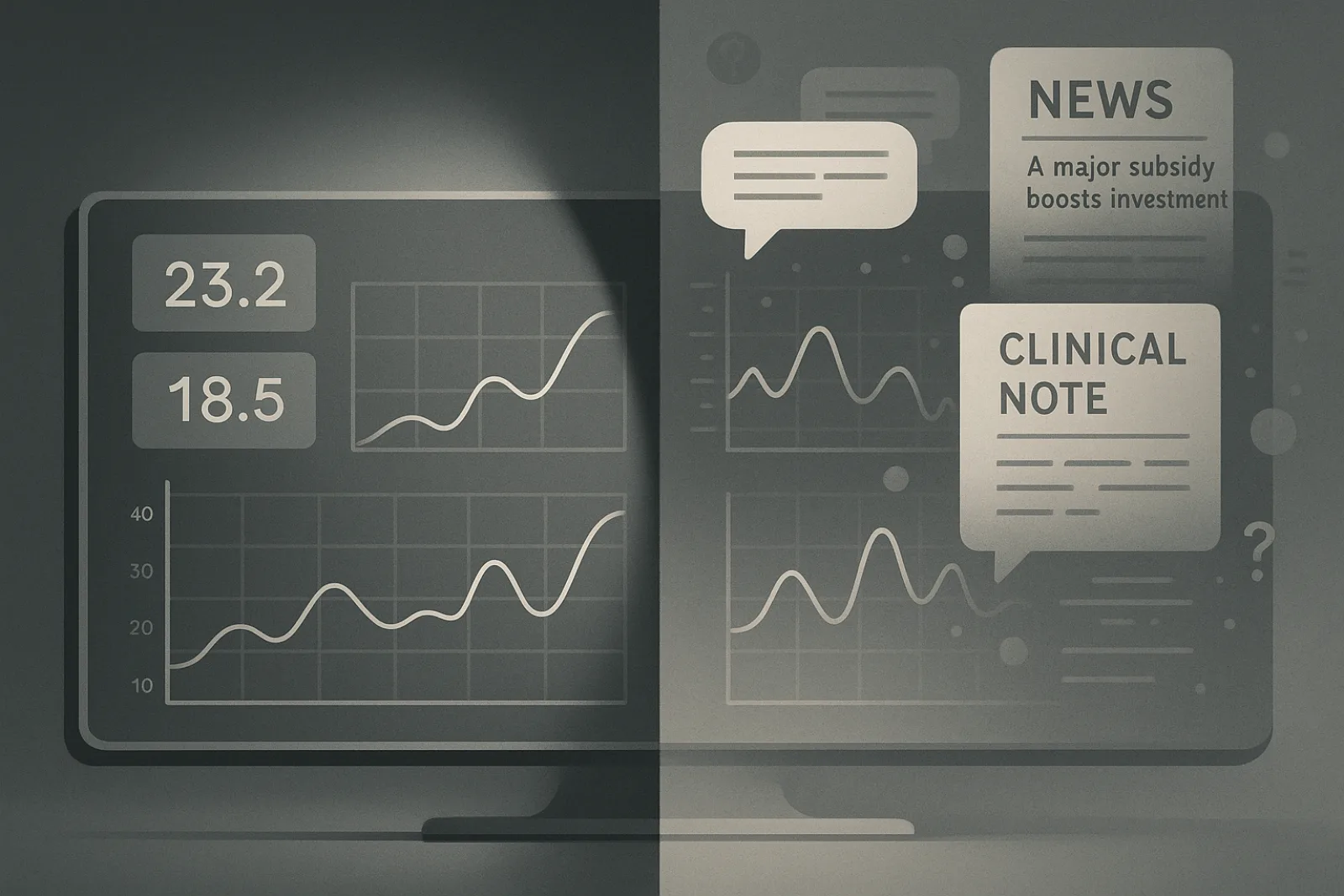
When Text Doesn’t Help: Rethinking Multimodality in Forecasting

TL;DR for operators Text does not automatically make forecasts smarter. It often just makes the pipeline heavier. A new AWS study benchmarks multimodal time-series forecasting across 16 datasets and 7 domains, comparing time-series-only models, alignment-based multimodal models, and direct LLM prompting.1 The uncomfortable result is that multimodality is not a universal upgrade. Strong unimodal models still win on a substantial share of the benchmark, and the paper’s statistical tests do not support a blanket claim that adding text reliably improves accuracy. ...

June 30, 2025 · 15 min · Zelina
Cover image

Playing with Strangers: A New Benchmark for Ad-Hoc Human-AI Teamwork

TL;DR for operators Teamwork is the awkward part of agentic AI. It is easy to show a model completing a task when the environment is clean, the instructions are explicit, and the other “teammates” behave exactly as expected. Real deployments are less polite. Humans omit context, follow local conventions, adapt unevenly, and occasionally do something that looks wrong only because the system has misunderstood the room. ...

June 27, 2025 · 15 min · Zelina
Cover image

The Memory Advantage: When AI Agents Learn from the Past

TL;DR for operators Memory is usually sold as a comfort feature for AI agents: the assistant remembers your preferences, your workflow, your charming habit of naming files final_final_v7. Fine. But operationally, memory matters less as storage and more as control. The hard question is not whether an agent can remember. It is whether the agent knows when a remembered episode should override fresh exploration. ...

June 3, 2025 · 17 min · Zelina
Cover image

The Right Tool for the Thought: How LLMs Solve Research Problems in Three Acts

TL;DR for operators Generative AI is useful for data processing when the work is painfully simple for a human and painfully awkward for software. That sounds like a joke until you meet the actual enterprise data stack: PDFs with shifting layouts, scanned documents with OCR scars, multilingual reports, product descriptions pretending to be industry classifications, and a graveyard of “temporary” spreadsheets that somehow became critical infrastructure. ...

April 24, 2025 · 18 min · Zelina
Cover image

The Crossroads of Reason: When AI Hallucinates with Purpose

TL;DR for operators Do not ask, “Can the model do the task?” Ask, “Does the model use the capabilities it already has when the task becomes messy?” Hallucination is not one thing. In a medical, legal, financial, or investment workflow, it is a defect. In a labelled creative mode, it can be a feature. Revolutionary stuff: context matters. Goal-directedness is also not one thing. More goal pursuit can improve execution, but it also raises safety and governance questions. The sensible business pattern is not “deploy an autonomous AI analyst and hope it behaves”. It is mode governance: separate factual, creative, and decision-support modes with different metrics, interfaces, and controls. High-stakes workflows need scaffolding: memory, rule extraction, refinement loops, ensemble checks, scoring, audit trails, and humans who can edit policy rather than merely admire the model’s prose. AI products are currently being sold with a suspiciously convenient promise: one conversational interface will reason, search, write, create, decide, advise, analyse, and maybe spiritually support the quarterly planning meeting if procurement approves the invoice. ...

April 18, 2025 · 16 min · Zelina
Cover image

How Ultra-Large Context Windows Challenge RAG

TL;DR for operators Ultra-large context windows are not a ceremonial funeral for retrieval-augmented generation. They are a price renegotiation. If your task is to analyse a bounded, self-contained document set — a contract bundle, diligence folder, policy manual, code repository, or technical appendix — a long-context model may now be the cleaner first option. The main benefit is not that it “knows more”. It is that it can inspect more of the original evidence without depending on a retriever to guess which passages matter. ...

March 29, 2025 · 12 min · Zelina