Cover image

Beyond the Pull Request: What ChatGPT Teaches Us About Productivity

Beyond the Pull Request: What ChatGPT Teaches Us About Productivity In April 2023, Italy temporarily banned ChatGPT. To most, it was a regulatory hiccup. But to 88,000 open-source developers on GitHub, it became a natural experiment in how large language models (LLMs) alter not just code—but collaboration, learning, and even the pace of onboarding. A new study by researchers from UC Irvine and Chapman University used this four-week ban to investigate what happens when developers suddenly lose access to LLMs. The findings are clear: ChatGPT’s influence goes far beyond code completion. It subtly rewires how developers learn, collaborate, and grow. ...

July 1, 2025 · 3 min · Zelina
Cover image

The Outlier Is a Lie: Quantization Breakthroughs with OSP

When it comes to deploying large language models (LLMs) efficiently, few challenges are as stubborn—and misunderstood—as activation outliers. For years, engineers have treated them like a natural disaster: unpredictable but inevitable. But what if they’re more like bad habits—learned and fixable? That’s the provocative premise behind a new framework called Outlier-Safe Pre-Training (OSP). Developed by researchers at Korea University and AIGEN Sciences, OSP proposes a simple but radical shift: instead of patching over outliers post hoc with quantization tricks, why not train the model to never form outliers in the first place? ...

June 25, 2025 · 3 min · Zelina
Cover image

Divide and Conquer: How LLMs Learn to Teach

Divide and Conquer: How LLMs Learn to Teach Designing effective lessons for training online tutors is no small feat. It demands pedagogical nuance, clarity, scenario realism, and learner empathy. A recent paper by Lin et al., presented at ECTEL 2025, offers a compelling answer to this challenge: use LLMs, but don’t ask too much at once. Their research reveals that breaking the task of lesson generation into smaller, well-defined parts significantly improves quality, suggesting a new collaborative model for scalable education design. ...

June 24, 2025 · 3 min · Zelina
Cover image

Proofs and Consequences: How Math Reveals What AI Still Doesn’t Know

What happens when we ask the smartest AI models to do something truly difficult—like solve a real math problem and prove their answer is correct? That’s the question tackled by a group of researchers in their paper “Mathematical Proof as a Litmus Test.” Instead of testing AI with casual tasks like summarizing news or answering trivia, they asked it to write formal mathematical proofs—the kind that leave no room for error. And the results? Surprisingly poor. ...

June 23, 2025 · 4 min · Zelina
Cover image

From Sparse to Smart: How PROGRM Elevates GUI Agent Training

The GUI Agent Bottleneck: Stuck in Sparse Feedback Training LLM-based GUI agents to complete digital tasks—such as navigating mobile apps or automating workflows—faces a fundamental limitation: reward sparsity. Traditional reward formulations (Outcome Reward Models, or ORMs) provide feedback only at the end of a trajectory. If the task fails, the agent receives zero signal, regardless of how many useful intermediate steps it took. This severely limits credit assignment and slows learning, especially in environments with long action horizons. ...

May 26, 2025 · 3 min
Cover image

Divide and Model: How Multi-Agent LLMs Are Rethinking Real-World Problem Solving

When it comes to real-world problem solving, today’s LLMs face a critical dilemma: they can solve textbook problems well, but stumble when confronted with messy, open-ended challenges—like optimizing traffic in a growing city or managing fisheries under uncertain climate shifts. Enter ModelingAgent, an ambitious new framework that turns this complexity into opportunity. What Makes Real-World Modeling So Challenging? Unlike standard math problems, real-world tasks involve ambiguity, multiple valid solutions, noisy data, and cross-domain reasoning. They often require: ...

May 23, 2025 · 3 min
Cover image

From Trees to Truths: Making MCTS Talk with Logic-Backed LLMs

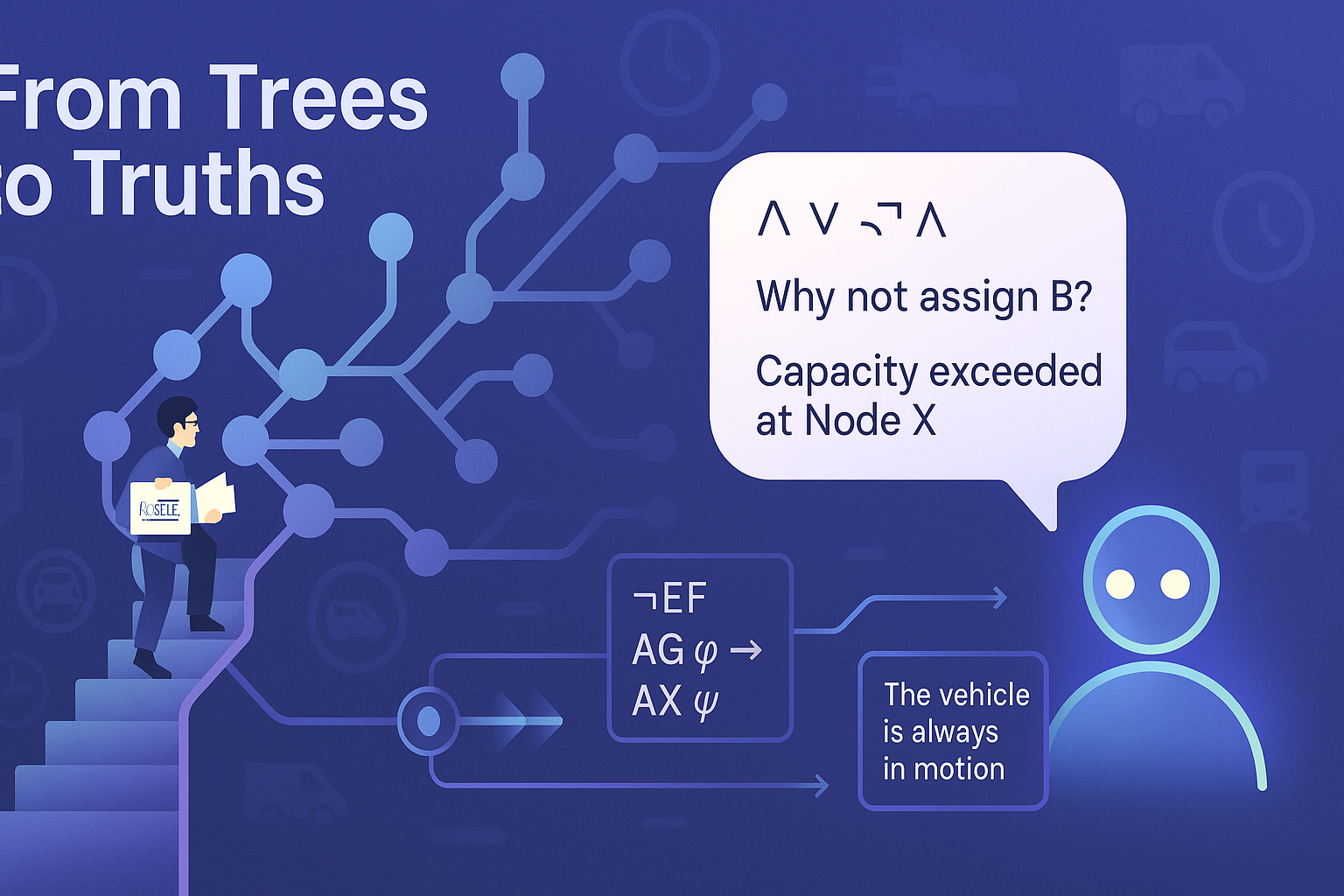
In the quest to make AI more trustworthy, few challenges loom larger than explaining sequential decision-making algorithms like Monte Carlo Tree Search (MCTS). Despite its success in domains from transit scheduling to game playing, MCTS remains a black box to most practitioners, generating decisions from expansive trees of sampled possibilities without accessible rationale. A new framework proposes to change that by fusing LLMs with formal logic to bring transparency and dialogue to this crucial planning tool1. ...

May 4, 2025 · 6 min
Cover image

The Right Tool for the Thought: How LLMs Solve Research Problems in Three Acts

Generative AI is often praised for its creativity—composing symphonies, painting surreal scenes, or offering quirky new business ideas. But in some contexts, especially research and data processing, consistency and accuracy are far more valuable than imagination. A recent exploratory study by Utrecht University demonstrates exactly where Large Language Models (LLMs) like Claude 3 Opus shine—not as muses, but as meticulous clerks. When AI Becomes the Analyst The research project explores three different use cases in which generative AI was employed to perform highly structured research data tasks: ...

April 24, 2025 · 4 min
Cover image

Traces of War: Surviving the LLM Arms Race

Traces of War: Surviving the LLM Arms Race The AI frontier is heating up—not just in innovation, but in protectionism. As open-source large language models (LLMs) flood the field, a parallel move is underway: foundation model providers are fortifying their most powerful models behind proprietary walls. A new tactic in this defensive strategy is antidistillation sampling—a method to make reasoning traces unlearnable for student models without compromising their usefulness to humans. It works by subtly modifying the model’s next-token sampling process so that each generated token is still probable under the original model but would lead to higher loss if used to fine-tune a student model. This is done by incorporating gradients from a proxy student model and penalizing tokens that improve the student’s learning. In practice, this significantly reduces the effectiveness of distillation. For example, in benchmarks like GSM8K and MATH, models distilled from antidistilled traces performed 40–60% worse than those trained on regular traces—without harming the original teacher’s performance. ...

April 19, 2025 · 5 min
Cover image

Agents in Formation: Fine-Tune Meets Fine-Structure in Quant AI

The next generation of quantitative investment agents must be more than data-driven—they must be logic-aware and structurally adaptive. Two recently published research efforts provide important insights into how reasoning patterns and evolving workflows can be integrated to create intelligent, verticalized financial agents. Kimina-Prover explores how reinforcement learning can embed formal reasoning capabilities within a language model for theorem proving. Learning to Be a Doctor shows how workflows can evolve dynamically based on diagnostic feedback, creating adaptable multi-agent frameworks. While each stems from distinct domains—formal logic and medical diagnostics—their approaches are deeply relevant to two classic quant strategies: the Black-Litterman portfolio optimizer and a sentiment/technical-driven Bitcoin perpetual futures trader. ...

April 17, 2025 · 7 min