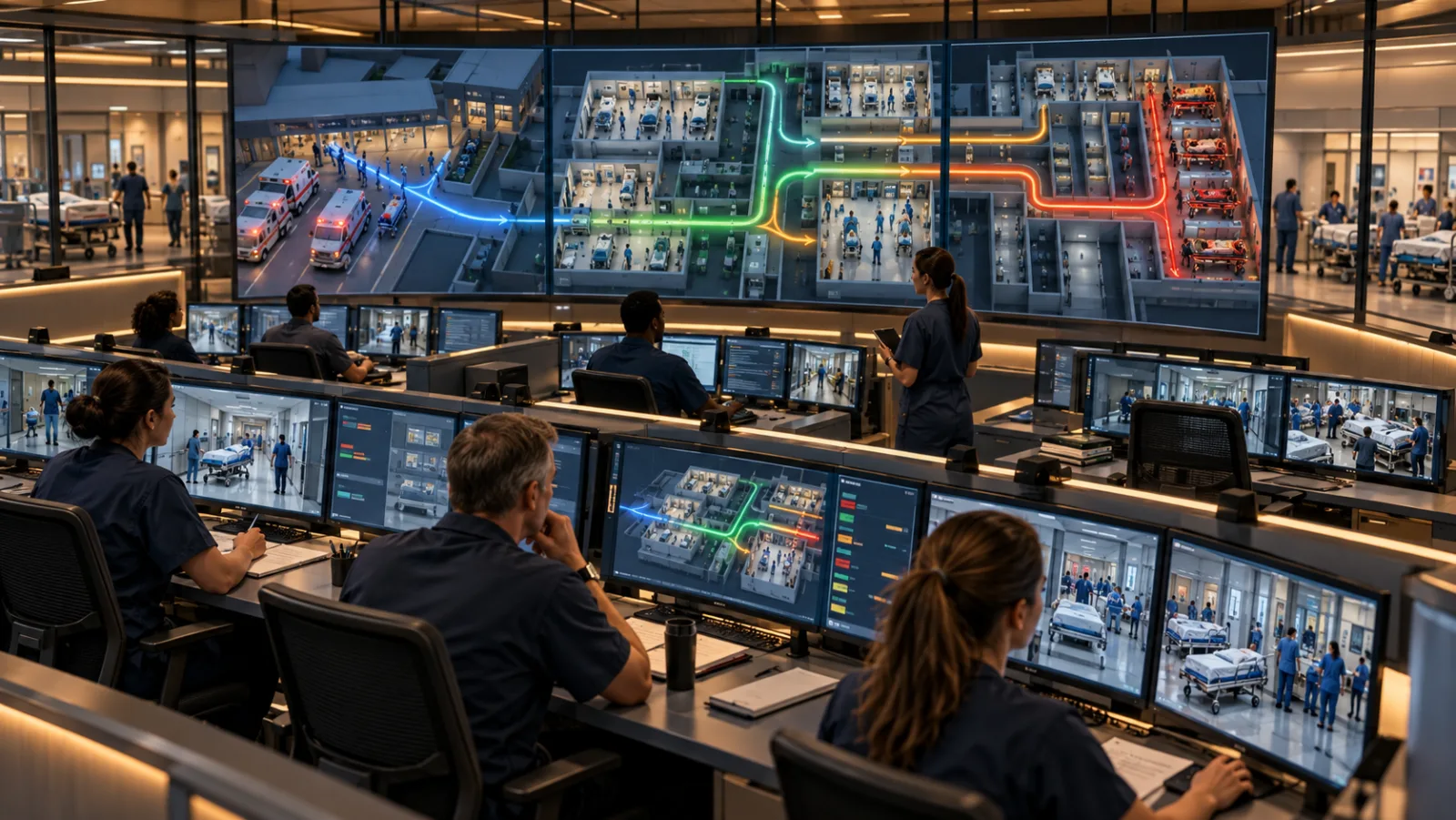
Clearing One Queue, Creating Another: Why Hospital AI Needs Coordinated Routing
TL;DR for operators Hospital congestion cannot always be resolved by making individual departments process patients faster. When one ward accelerates admissions or transfers, it can increase pressure on another department with limited capacity. The operational problem is therefore partly one of coordinating patient movement across connected units. Zhang, Hadfi, and Ito develop a decentralized reinforcement learning framework that combines hospital queueing-network constraints with cooperative departmental decision-making. In their MIMIC-IV-calibrated simulation, the cooperative system reduces cumulative patient delay by approximately 98.2% relative to static operation. More revealingly, removing cooperative routing from the system increases simulated delay from 2,835.2 to 226,231.1 hours, a substantially larger deterioration than removing dynamic service acceleration or neighboring policy communication. ...