TL;DR for operators
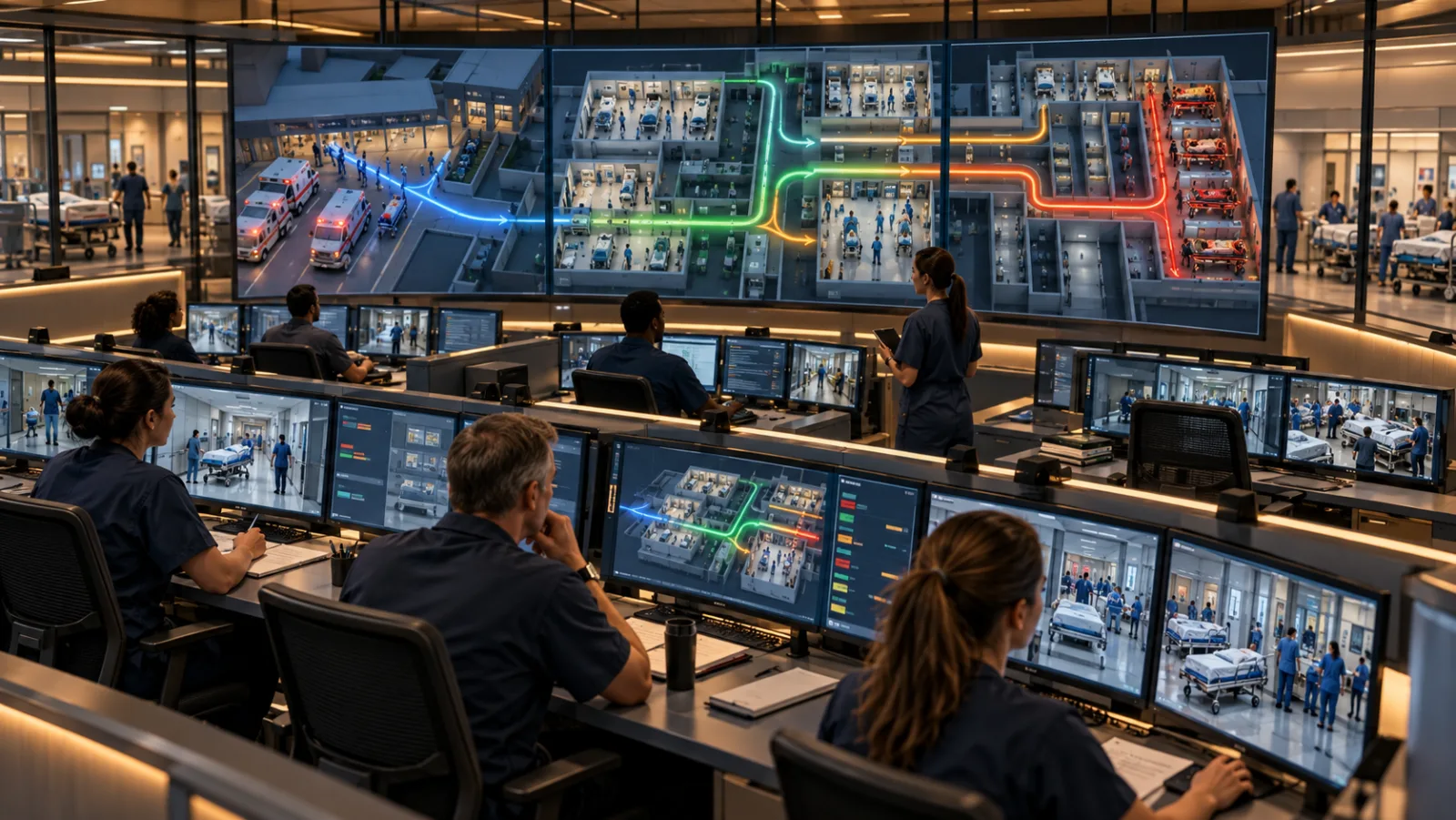
Hospital congestion cannot always be resolved by making individual departments process patients faster. When one ward accelerates admissions or transfers, it can increase pressure on another department with limited capacity. The operational problem is therefore partly one of coordinating patient movement across connected units.
Zhang, Hadfi, and Ito develop a decentralized reinforcement learning framework that combines hospital queueing-network constraints with cooperative departmental decision-making. In their MIMIC-IV-calibrated simulation, the cooperative system reduces cumulative patient delay by approximately 98.2% relative to static operation. More revealingly, removing cooperative routing from the system increases simulated delay from 2,835.2 to 226,231.1 hours, a substantially larger deterioration than removing dynamic service acceleration or neighboring policy communication.
For hospital operations leaders, the strongest implication concerns what to coordinate, not how much to automate. Admission routing, downstream capacity, and shared performance objectives deserve evaluation alongside local service speed. The evidence supports simulation-based design and testing, not autonomous clinical deployment. Reported safety improvements rely on modeled pathway proxies, and one action-masking ablation does not support the claimed safety benefit for its measured ICU discharge indicator.
A department can improve its queue while worsening hospital-wide delay
Consider an emergency department transferring patients into inpatient wards. Clearing the emergency queue may improve that department’s immediate performance, but a receiving ward may have limited beds, slower discharges, and patients waiting for further transfers.
The emergency department’s decision has changed another department’s workload. If each unit independently optimizes its own admissions and discharges, congestion can accumulate elsewhere even when individual decisions appear reasonable.
Adding capacity or accelerating treatment may reduce the pressure, but neither necessarily addresses how patients are distributed across the hospital.
This is the operational problem examined by Guoqing Zhang, Rafik Hadfi, and Takayuki Ito in Physics-Informed Multi-Agent Coordination for Hospital Patient Flow Optimization.1
Their simulation reports 117,478.1 cumulative patient-delay hours under a static Markovian baseline, compared with 2,081.2 hours under stochastic cooperative multi-agent control (Section 6.2, Table 1).
That is approximately a 56-fold difference. Yet a separate experiment supplies the more informative result: when cooperative routing is disabled, most of the coordination advantage disappears.
The finding challenges the assumption that hospital-flow optimization should begin and end with accelerating departmental service rates.
Queueing equations define the network; learning controls its changing flows
The proposed framework begins with a mathematical representation of how patients move through interconnected departments.
A BCMP queueing network describes expected arrivals, service demands, routing probabilities, and resource capacities. Its traffic-conservation relationship estimates demand at each department as the sum of external arrivals and transfers from other departments.
A corresponding utilization constraint compares offered workload with available service capacity. As utilization approaches capacity, waiting times can rise sharply.
These relationships provide the structural basis for identifying bottlenecks. However, the classical stationary formulation becomes insufficient when full departments block incoming patients and routing decisions change with current conditions.
The authors therefore combine this queueing structure with decentralized multi-agent reinforcement learning.
Each hospital department becomes an autonomous computational agent operating with incomplete information about the wider hospital. The agents are reinforcement-learning controllers, not large language models.
The framework treats coordination as a decentralized partially observable Markov decision process and applies a cooperative multi-agent actor-critic approach, MA2C, with centralized training and decentralized execution.
Each departmental agent observes five operational indicators: bed occupancy, normalized queue depth, available capacity, a service-level warning, and current discharge acceleration.
It can adjust two control channels:
- Service acceleration: Four discrete levels permitting increases of up to 15% in effective service or discharge rates.
- Admission gating: Five discrete levels regulating incoming patient flows, spanning 0% to 100%.
The queueing model supplies the network and capacity relationships. Learning determines how departmental controls respond to changing congestion.
Two additional mechanisms connect the otherwise local decisions.
Neighbor action fingerprints provide compact, exponentially smoothed summaries of the action probabilities favored by adjacent departmental policies. An agent can therefore respond to neighboring policy tendencies without receiving the complete hospital state.
Spatially decomposed rewards combine local operational outcomes, neighboring departmental rewards, and changes in hospital-wide delay. A department is discouraged from improving its own queue by simply moving congestion into another unit.
Expert-derived action masks also eliminate candidate actions classified as clinically infeasible under the encoded transition rules.
The architecture’s contribution is a specific allocation of computational control: departments retain local decision policies, but those policies operate within a shared network structure and receive feedback about their consequences beyond departmental boundaries.
The performance comparison exposes a coordination problem
The authors calibrate their discrete-event hospital simulation using approximately 60,000 historical MIMIC-IV admissions. Training comprises 250 episodes, each representing 4,000 simulated operating hours.
The comparative evaluation introduces stochastic arrivals and a 1.25 demand multiplier, representing a 25% demand surge.
Section 6.2, Table 1 reports the following cumulative delays:
| Control policy | Simulated cumulative delay (hours) |
|---|---|
| Static Markovian baseline | 117,478.1 |
| Greedy heuristic dispatcher | 43,148.5 |
| Independent A2C, stochastic | 2,789.7 ± 642.8 |
| Cooperative MA2C, stochastic | 2,081.2 ± 571.7 |
| Independent A2C, greedy | 463,038.7 ± 243,695.6 |
| Cooperative MA2C, greedy | 3,974.0 ± 481.0 |
The source package does not establish the exact dispersion statistic represented by the reported ± quantities. These are simulated delay totals over the evaluation horizon, not average patient waiting times.
The cooperative policy’s stochastic execution achieves approximately 25.4% less reported delay than stochastic independent A2C, using the point estimates. This comparison more directly addresses the contribution of cooperative learning than the substantially larger reduction relative to static operation.
The greedy-execution results are also instructive.
Independent A2C deteriorates dramatically when selecting its highest-probability actions deterministically, recording 463,038.7 delay hours. The cooperative controller records 3,974.0 hours under its corresponding greedy execution.
These results expose execution-mode sensitivity in the independent controller under the simulated configuration. They do not establish that every independent learning policy would exhibit the same instability.
The evidence supports a narrower conclusion: under the authors’ calibrated environment and training setup, cooperative departmental control performs better than the reported independent and nonlearning alternatives on cumulative delay.
A centralized reinforcement learning controller is not included as a comparator, so the experiments cannot establish that decentralized learning outperforms centralized control.
Removing cooperative routing causes the largest deterioration
The authors then conduct structural ablations to identify which architectural components account for the performance differences.
Unlike the main comparison, these experiments use an independent standardized evaluation-seed set. Their full-model result is therefore 2,835.2 hours, not the 2,081.2 hours reported in Table 1.
Section 6.3, Table 2 reports:
| Configuration | Simulated delay (hours) | Increase over full model |
|---|---|---|
| Full cooperative MA2C | 2,835.2 | — |
| Without neighbor fingerprints | 3,024.5 | 6.7% |
| Without cooperative routing | 226,231.1 | ~79-fold |
| Without dynamic acceleration | 3,990.8 | 40.8% |
| Without expert action masking | 3,108.9 | 9.7% |
Percentages and ratios use the reported point estimates. These ablations test component contributions within the simulated architecture, not independent real-world interventions.
The cooperative-routing ablation dominates the results.
Removing dynamic acceleration worsens delay, as expected when saturated departments lose their temporary service-rate adjustment. Removing neighboring fingerprints also worsens performance, although the reported effect is comparatively modest.
But disabling cooperative routing produces an entirely different magnitude of deterioration.
This suggests that, within the tested network, agents’ ability to regulate incoming patient flows is considerably more consequential than their ability to accelerate local service or exchange policy fingerprints.
The result also clarifies the relationship among the components. Neighboring communication helps agents anticipate adjacent policies; shared rewards align their objectives; service acceleration supplies additional capacity flexibility. Cooperative routing directly controls how incoming workload is distributed.
These mechanisms are not interchangeable.
The ablations do not isolate every possible interaction among them, and the authors do not establish that routing must dominate acceleration in every hospital configuration. Nevertheless, the experiment identifies where the proposed system’s largest measured advantage originates.
For designers of hospital operations systems, that is a more actionable finding than the headline comparison with static scheduling.
Action constraints are not evidence of clinical safety
The framework includes expert-derived action masking to restrict transitions classified as clinically infeasible.
Mathematically, the masked policy gives invalid actions zero probability and renormalizes the remaining choices.
That is an enforceable constraint within the modeled action space. Its protective value depends on whether the encoded rules correctly identify relevant clinical risks.
The authors also report simulated clinical pathway anomalies, including repeated ward transfers and premature ICU discharges.
Under stochastic cooperative MA2C, the modeled ping-pong transfer rate is 1.736%, compared with 7.375% in historical MIMIC-IV records. The modeled premature ICU discharge rate is 0.211%, compared with a historical reference of 2.585% (Section 6.4, Table 3).
These comparisons require careful interpretation.
The historical records reflect actual clinical operations, while the learned-policy outcomes come from simulated trajectories. Moreover, premature ICU discharge is defined using transfers before a calibrated average ICU length of stay, not an independently adjudicated unsafe discharge or observed patient harm.
The action-mask ablation provides a further qualification. Removing expert masking raises cumulative delay from 2,835.2 to 3,108.9 hours but reduces the premature ICU discharge proxy from 0.211% to 0.190%.
Consequently, that experiment does not demonstrate a protective effect of action masking on this particular safety metric.
The appropriate conclusion is that expert rules constrain the policy’s available actions, while clinical safety remains a separate empirical question requiring validation.
What hospital operators can test before deployment
The most defensible business application is not replacing hospital personnel with autonomous departmental controllers. It is evaluating whether coordinated operational policies outperform locally optimized ones before introducing changes into clinical workflows.
Three decisions follow from the evidence.
First, measure network-level performance alongside departmental throughput. Hospital operations teams evaluating admission and transfer policies should examine downstream queues, accumulated patient delay, and the distribution of capacity pressure. A local reduction in waiting time is insufficient evidence of a system-wide improvement.
Second, test routing coordination before prioritizing automated acceleration. The ablation results justify asking whether better information about receiving-unit capacity and coordinated admission rules could deliver more value than additional local speed interventions. The answer must still be established using the institution’s actual service and routing conditions.
Third, separate operational optimization from clinical authorization. A decision-support system can propose routing or capacity adjustments while retaining clinician review for decisions with patient-safety consequences. Action constraints should be audited for coverage and correctness, and clinical outcomes assessed independently of delay reduction.
A site-specific digital twin provides a possible evaluation environment for these decisions. It can compare decentralized coordination against existing scheduling policies, simpler routing rules, and centralized alternatives using common operational scenarios.
Such testing would extend the paper’s experimental design rather than assume its reported gains transfer directly.
The remaining boundary is the hospital outside the simulation
The reported evidence is substantial within its simulated setting, but several deployment questions remain unanswered.
The model relies on historical service characteristics and aggregated clinical stages. It does not dynamically represent clinician workload, nursing fatigue, stress, or behavioral responses to changes in service acceleration.
The experiments also focus on a calibrated hospital network and a specified 25% demand surge. They do not demonstrate transferability to hospitals with different staffing models, capacity structures, patient populations, or clinical procedures.
Evaluation replication details and statistical significance information are not sufficiently specified in the source package to support stronger population-level performance claims.
Most consequentially, the paper reports no live hospital intervention or prospective validation of clinical outcomes.
These boundaries affect how the findings should influence investment decisions. A hospital can reasonably prioritize experiments on cross-department routing coordination; it cannot reasonably budget for a 98% reduction in actual patient delays based on these results alone.
The operating unit is the patient-flow network
The research’s central contribution is an architecture for coordinating decentralized decisions under shared resource constraints.
Its strongest experimental evidence concerns cooperative routing. When that capability disappears, simulated congestion rises far more than when neighboring communication or temporary service acceleration is removed.
For hospital administrators, the question becomes how admission rules, transfer policies, and departmental performance measures should reflect their consequences for other units.
The paper demonstrates that queueing-network structure and cooperative reinforcement learning can address this problem effectively within a calibrated simulation. Whether they can do so safely and reliably in an operating hospital remains a question for prospective evaluation.
The direction for further work is clear: validate coordinated patient-flow decisions as a network-level operational intervention, while keeping clinical authorization and patient outcomes independently accountable.
Cognaptus: Automate the Present, Incubate the Future.
-
Guoqing Zhang and Rafik Hadfi and Takayuki Ito (2026). Physics-Informed Multi-Agent Coordination for Hospital Patient Flow Optimization. arXiv:2609.37022. https://arxiv.org/abs/2609.37022 ↩︎