Cover image

The Drift Alarm Is Not the Strategy

TL;DR for operators A production model rarely collapses with theatrical dignity. It usually degrades in increments: a fraud pattern shifts, an electricity market regime changes, a sensor starts reporting under a new operating condition, or network traffic stops looking like yesterday’s traffic. The dashboard still has a reassuring green check. Naturally. The paper “Learner-based Concept Drift Detection: Analysis and Evaluation” by Md Moman Ul Haque Khan and Samira Sadaoui is useful because it refuses to treat concept drift detection as one magic alarm bolted onto a model after deployment.1 It surveys learner-based detectors and compares three families: Statistical Process Control methods, window-based methods, and ensemble-based methods. The experiment tests them across synthetic abrupt and gradual drift streams and two real-world streams: electricity price movement and network intrusion data. ...

July 3, 2026 · 16 min · Zelina
Cover image

Mind the Reward Gap: Why Business AI Needs More Than Pretty Answers

Opening — Why this matters now Business AI has entered its awkward teenage years. The first phase was easy to admire: models could draft, summarize, classify, recommend, and explain. Then companies started asking the rude adult questions: Can we trust the answer? Did it make the right trade-off? Can it improve from outcomes? What happens when the reward signal is wrong? ...

May 2, 2026 · 17 min · Zelina
Cover image

Balance Sheets Meet Brain Cells: Why Financial Reasoning Still Trips Up AI

A balance sheet does not care how confident a model sounds. That is the useful cruelty of accounting. A number either reconciles, a subtotal either belongs where it belongs, treasury stock is either treated correctly, and a rule either applies or it does not. Fluent explanation is welcome, but it is not evidence. It is the garnish. The meal is verification. ...

March 15, 2026 · 14 min · Zelina
Cover image

Show Me the Money (Reasoning): Benchmarking Financial Intelligence in LLMs

Money has a useful habit: it exposes nonsense quickly. In ordinary chatbot use, a slightly wrong answer may be annoying. In financial analysis, a slightly wrong number can change a valuation, distort a risk view, or make a portfolio note look more confident than it deserves. That is why financial AI is not just another “domain application” of large language models. It is a stress test for whether a model can combine facts, time, arithmetic, business context, and restraint without pretending that a polished paragraph is the same as a verified conclusion. ...

March 12, 2026 · 14 min · Zelina
Cover image

Trading Without Cheating: Teaching LLMs to Reason When Markets Lie

Trade has a special talent for humiliating clean theories. A model reads a market brief. It sees earnings beats, sales guidance, analyst upgrades, and a few scattered corporate events. Asked to behave like a turnaround specialist, it starts building buy signals. Some recommendations are reasonable. Others quietly smuggle in missing assumptions: maybe the company has new management; maybe the earnings beat reflects restructuring; maybe debt reduction is happening somewhere behind the curtain. Very elegant. Also, very convenient. ...

January 8, 2026 · 15 min · Zelina
Cover image

When Agents Agree Too Much: Emergent Bias in Multi‑Agent AI Systems

When Agents Agree Too Much: Emergent Bias in Multi-Agent AI Systems Credit review is not supposed to work like a group chat. A bank cannot defend a biased lending workflow by saying, “each analyst looked fair on their own.” The decision process matters. Who sees whose opinion matters. Whether dissent survives matters. Whether the final answer comes from independent judgment or from a politely self-reinforcing committee definitely matters. ...

December 21, 2025 · 14 min · Zelina
Cover image

When Small Models Learn From Their Mistakes: Arithmetic Reasoning Without Fine-Tuning

Numbers are where language models usually stop sounding impressive. Ask a model to summarize a financial report and it may produce a fluent paragraph with just enough confidence to make everyone in the meeting relax. Ask it to calculate a percentage change from a table, preserve the correct scale, and return a verifiable number, and the poetry ends. Suddenly the model must select the right values, understand the wording, apply the right operation, avoid sign mistakes, avoid scale mistakes, and not hallucinate a formula because the word “change” appeared nearby. ...

December 16, 2025 · 18 min · Zelina
Cover image

When FX Gets a Mind of Its Own: Cognitive ATS Meets the EUR/USD Mirage

Forex has a talent for humiliating confident people. The market looks orderly enough on a chart: waves, levels, retracements, clean little indicators pretending they know where Europe and America are about to disagree next. Then a central banker speaks, an inflation print surprises, liquidity thins, and yesterday’s elegant setup starts looking like astrology with candlesticks. ...

November 22, 2025 · 15 min · Zelina
Cover image

When Markets Dream: The Rise of Agentic AI Traders

Liquidity is boring until it vanishes. Most investors notice market makers only when the screen suddenly looks thin: fewer bids, wider spreads, worse execution, and the faint smell of panic priced into every click. A market maker’s job is not glamorous. It quotes buy and sell prices, earns the spread, manages inventory, and tries not to become the proud owner of too much of the wrong asset at the wrong moment. Finance, as usual, rewards the person who stands calmly in the middle of everyone else’s urgency. ...

November 5, 2025 · 15 min · Zelina
Cover image

Mirror, Signal, Trade: How Self‑Reflective Agent Teams Outperform in Backtests

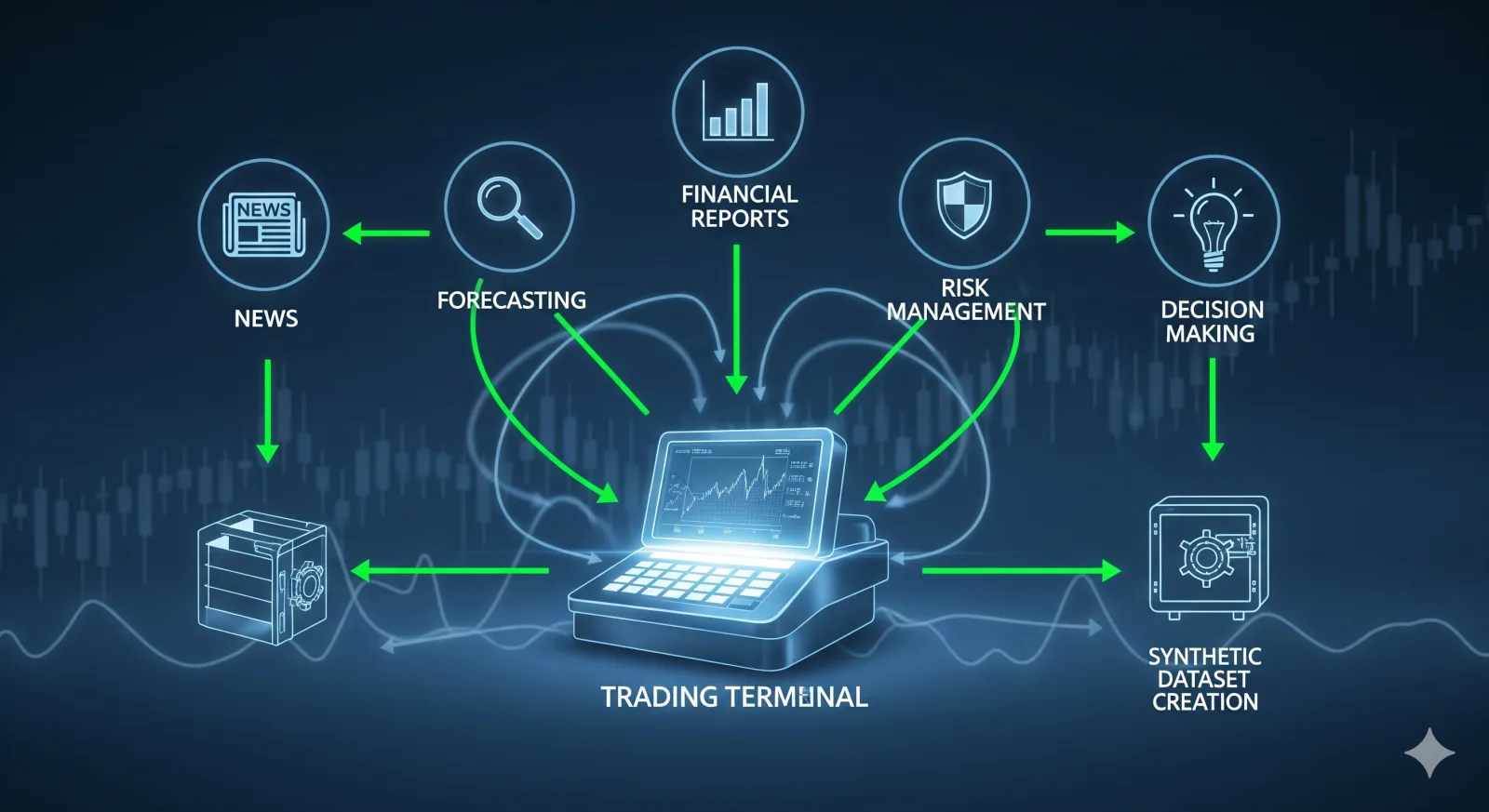
TL;DR for operators TradingGroup is best read as an operating design for financial agents, not as a permission slip to hand the treasury account to a chatbot with a brokerage API. The paper proposes a five-agent trading system that combines news sentiment, financial-report retrieval, technical forecasting, trading-style selection, and final trade decisions. Around that agent team, it adds two mechanisms that matter more than the agent labels themselves: self-reflection from logged outcomes, and dynamic risk management through stop-loss, take-profit, and position-sizing rules.1 ...

August 26, 2025 · 14 min · Zelina