Cover image

Talk is Flight: How RALLY Bridges Language and Learning in UAV Swarms

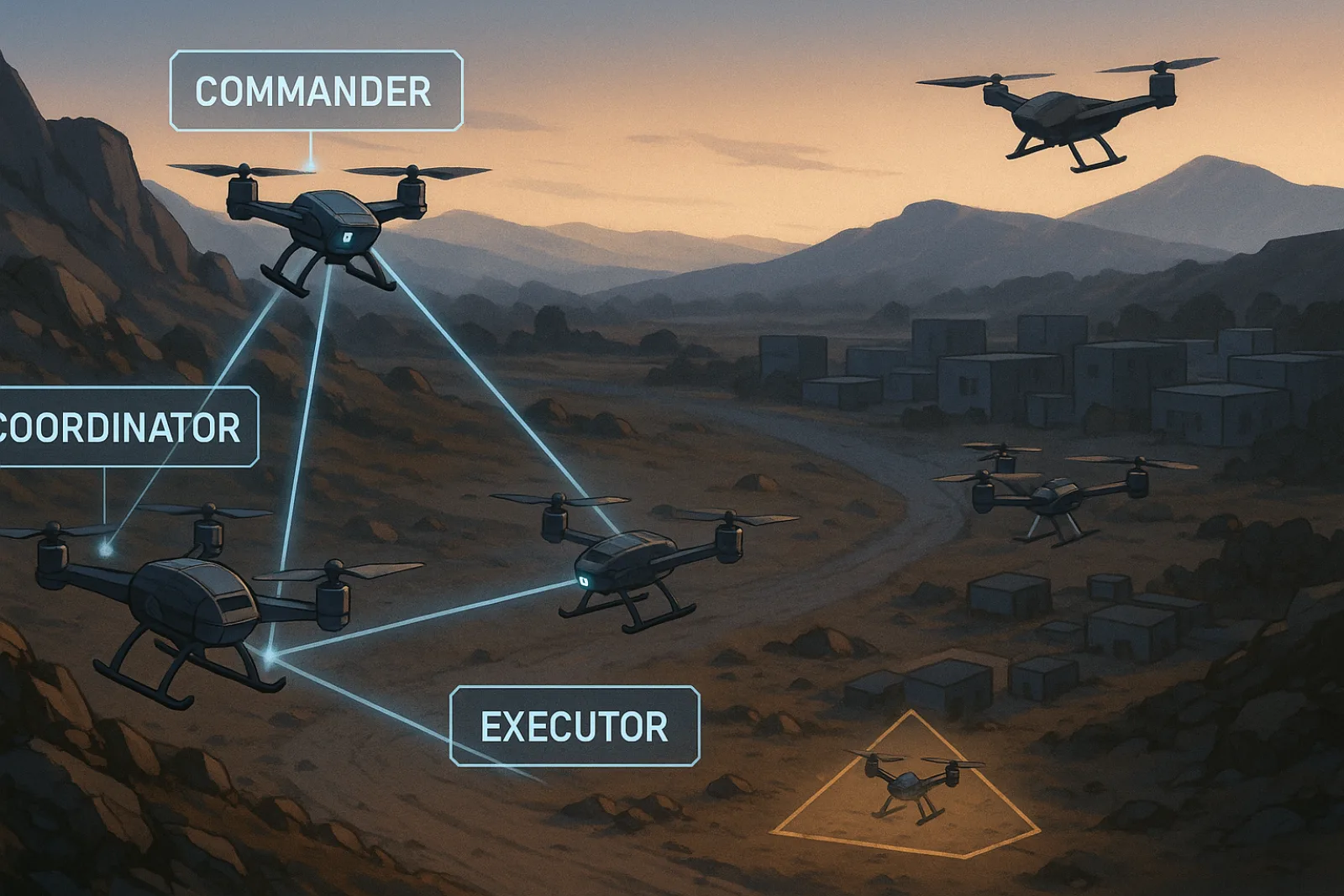
TL;DR for operators RALLY is not a chatbot with propellers. It is a hybrid control framework for UAV swarms where the LLM supplies structured semantic reasoning and the reinforcement-learning layer decides how agents should divide responsibility.1 The practical insight is the separation of labour. A drone swarm does not only need to know where to fly; it needs to agree who should lead, who should coordinate, who should follow, and when those roles should change. RALLY handles that by combining two-stage LLM consensus with RMIX, a role-value mixing network trained to assign Commander, Coordinator, and Executor roles under partial observability and limited communication. ...


July 7, 2025 · 16 min · Zelina
Cover image

Unsafe at Any Bit: Patching the Safety Gaps in Quantized LLMs

TL;DR for operators Quantizing an LLM is not a harmless cost-saving step. It changes the model, and the paper analysed here shows that those changes can weaken safety even when familiar utility scores still look respectable. That is the uncomfortable part: the dashboard can say “performance preserved” while the model has become more willing to comply with harmful requests. Very efficient. Very modern. Very easy to miss. ...

June 26, 2025 · 20 min · Zelina
Cover image

The Outlier Is a Lie: Quantization Breakthroughs with OSP

TL;DR for operators If your deployment plan depends on squeezing a language model into cheap inference hardware, this paper is worth reading because it changes the timing of the quantization problem. Most quantization work asks: “How do we repair a model after training so it survives 4-bit inference?” Outlier-Safe Pre-Training asks a more irritating question: “Why did we train a quantization-hostile model in the first place?”1 ...

June 25, 2025 · 18 min · Zelina
Cover image

Crunch Time for AI: Photonic Chips Enter the Menu

TL;DR for operators Photonic AI chips are not “GPUs, but shiny.” That is the lazy version, and as usual the lazy version is slightly wrong in the most expensive place. The practical story is narrower and more useful. Two recent Nature papers show that photonic systems can now do more than charming lab tricks. Hua et al.’s PACE system demonstrates a 64 × 64 photonic matrix-vector accelerator with more than 16,000 photonic components, low-latency optical multiply–accumulate operations, and strong performance on Ising-style optimisation workloads.1 Ahmed et al. demonstrate a photonic AI processor capable of running real neural-network workloads, including ResNet, BERT, and Atari reinforcement learning, with near-electronic precision across many tasks.2 ...

April 16, 2025 · 16 min · Zelina