Cover image

Triage by Token: When Context Clues Quietly Override Clinical Judgment

Opening — Why this matters now Large language models are quietly moving from clerical assistance to clinical suggestion. In emergency departments (EDs), where seconds matter and triage decisions shape outcomes, LLM-based decision support tools are increasingly tempting: fast, consistent, and seemingly neutral. Yet neutrality in language does not guarantee neutrality in judgment. This paper interrogates a subtle but consequential failure mode: latent bias introduced through proxy variables. Not overt racism. Not explicit socioeconomic labeling. Instead, ordinary contextual cues—how a patient arrives, where they live, how often they visit the ED—nudging model outputs in clinically unjustified ways. ...


January 24, 2026 · 4 min · Zelina
Cover image

Think Before You Beam: When AI Learns to Plan Like a Physicist

Opening — Why this matters now Automation in healthcare has a credibility problem. Not because it performs poorly—but because it rarely explains why it does what it does. In high-stakes domains like radiation oncology, that opacity isn’t an inconvenience; it’s a blocker. Regulators demand traceability. Clinicians demand trust. And black-box optimization, however accurate, keeps failing both. ...

December 24, 2025 · 4 min · Zelina
Cover image

When Bigger Isn’t Smarter: Stress‑Testing LLMs in the ICU

Opening — Why this matters now Healthcare AI has entered its foundation model phase. LLMs trained on trillions of tokens are being casually proposed for everything from triage to prognosis, often with an implicit assumption: bigger models must understand patients better. This paper quietly punctures that assumption. By benchmarking LLMs against smaller, task‑focused language models (SLMs) on shock prediction in ICUs, the authors confront a question most vendors avoid: Do LLMs actually predict future clinical deterioration better—or do they merely sound more convincing? ...

December 24, 2025 · 3 min · Zelina
Cover image

Painkillers with Foresight: Teaching Machines to Anticipate Cancer Pain

Opening — Why this matters now Cancer pain is rarely a surprise to clinicians. Yet it still manages to arrive uninvited, often at night, often under-treated, and almost always after the window for calm, preventive adjustment has closed. In lung cancer wards, up to 90% of patients experience moderate to severe pain episodes — and most of these episodes are predictable in hindsight. ...

December 19, 2025 · 4 min · Zelina
Cover image

From Chaos to Care: Structuring LLMs with Clinical Guidelines

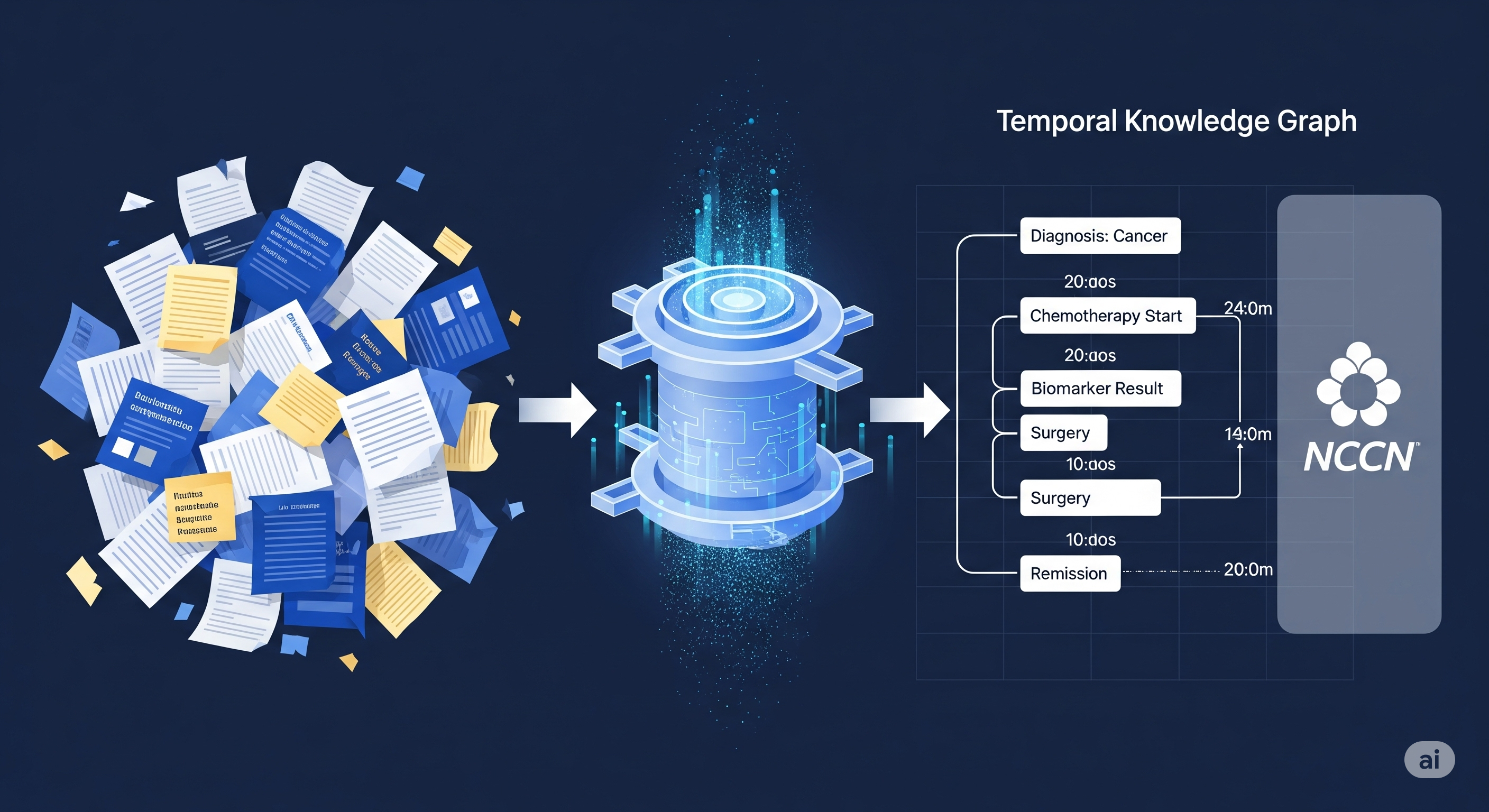
Modern oncology is an overwhelming cognitive battlefield: clinicians face decades of fragmented notes, tests, and treatment episodes, scattered across multiple languages and formats. Large Language Models (LLMs) promise relief—but without careful design, they often collapse under the weight of these chaotic Electronic Health Records (EHRs), hallucinate unsafe recommendations, or fail to reason over time. Enter CliCARE: a meticulously designed framework that not only tames this complexity but grounds the entire decision process in clinical guidelines. Rather than stuffing raw records into long-context transformers or bolting on retrieval-augmented generation (RAG), CliCARE introduces a radically more structured approach. ...

July 31, 2025 · 3 min · Zelina