Cover image

Same Causal Effect, Different Bill: Derivation Graphs and the Estimand Trap

The formula is not a clerical detail A business asks a causal question: What happens if we change X? The analytics team returns a formula. Everyone relaxes. The effect is identifiable, the notation looks official, and a graph somewhere has probably been blessed by someone with a PhD. Excellent. Time to move to dashboards. ...


June 13, 2026 · 14 min · Zelina
Cover image

When Predictions Persuade: The Hidden Causal Risks of AI Decision Support

A prediction looks harmless when it is presented as “just information.” A loan officer sees a default-risk score. A doctor sees a survival estimate. A welfare caseworker sees a predicted probability of program success. The model does not press the button. The human still decides. Everyone in the room can therefore relax, at least until the audit committee arrives with coffee and regrettable questions. ...

February 26, 2026 · 18 min · Zelina
Cover image

From Causal Parrots to Causal Counsel: When LLMs Argue with Data

Causal claims are cheap now. A model can look at variable names such as advertising spend, web traffic, sales conversion, and customer churn, then produce a causal story in seconds. The story may even sound sensible. That is precisely the problem. In business analytics, “sensible” is often the polite costume worn by “untested.” ...

February 19, 2026 · 17 min · Zelina
Cover image

When Agents Talk Back: Why AI Collectives Need a Social Theory

Teams are easy to draw and hard to govern. Put five AI agents in a workflow diagram and everything looks reassuringly corporate: one planner, one researcher, one coder, one critic, one manager. Give them arrows. Add a dashboard. Call it orchestration. Investors relax. Engineers nod. Consultants quietly increase the font size on the word “autonomous.” ...

January 16, 2026 · 18 min · Zelina
Cover image

Causality Remembers: Teaching Social Media Defenses to Learn from the Past

Moderation teams do not usually lose because they see nothing. They lose because they see too much: thousands of accounts posting near the same topic, near the same time, with enough similarity to look suspicious and enough difference to remain deniable. Some are campaign assets. Some are enthusiastic humans. Some are bots. Some are people who simply saw the same trending story and behaved like everyone else, which is annoying for both democracy and data science. ...

January 5, 2026 · 17 min · Zelina
Cover image

Kill the Correlation, Save the Grid: Why Energy Forecasting Needs Causality

Humidity looks harmless on a scatter plot. Actually, in this paper, it looks worse than harmless: it appears negatively correlated with electricity demand. That is the kind of result a busy forecasting team might quietly accept. Add humidity as a feature, let the model figure it out, move on. The grid will not wait politely while everyone debates Pearl diagrams. ...

December 15, 2025 · 14 min · Zelina
Cover image

Confidence, Not Confidence Tricks: Statistical Guardrails for Generative AI

A product team launches an AI assistant. The demo works. The benchmark looks respectable. The model even says “I’m confident” with the serene authority of a consultant who has never owned a pager. Then the real users arrive. Some ask ambiguous questions. Some ask adversarial questions. Some ask perfectly normal questions that happen to sit outside the model’s competence. The assistant still answers. Sometimes it refuses too often. Sometimes it refuses too late. Sometimes its confidence score is less a forecast and more a decorative sticker. ...

September 13, 2025 · 14 min · Zelina
Cover image

Confounder Hunters: How LLM Agents are Rewriting the Rules of Causal Inference

TL;DR for operators Clinical analytics teams already know the unpleasant truth: observational data is cheap, rich, and biased in ways that do not politely announce themselves. The paper behind this article proposes a way to make that bias-hunting process less artisanal. Instead of asking experts to manually inspect every causal-tree rule, the framework lets causal trees segment patients, asks medical LLM agents to suggest plausible confounders using decomposed prompting plus retrieval, sends those suggestions through expert validation, then recursively focuses on samples whose treatment-effect estimates still have wide confidence intervals.1 ...

August 12, 2025 · 14 min · Zelina
Cover image

Causality in Stereo: How Multi-Band Granger Unveils Frequency-Specific Influence

TL;DR for operators Signals do not always influence each other on one clock. A machine vibration may create a fast alarm signature and a slower thermal drift. A brain region may interact through one rhythm quickly and another rhythm slowly. A market signal may move through intraday noise, weekly positioning, and slower macro repricing. Treating all of that as one blended time series is convenient. It is also a rather efficient way to throw away the thing you wanted to understand. ...

August 4, 2025 · 15 min · Zelina
Cover image

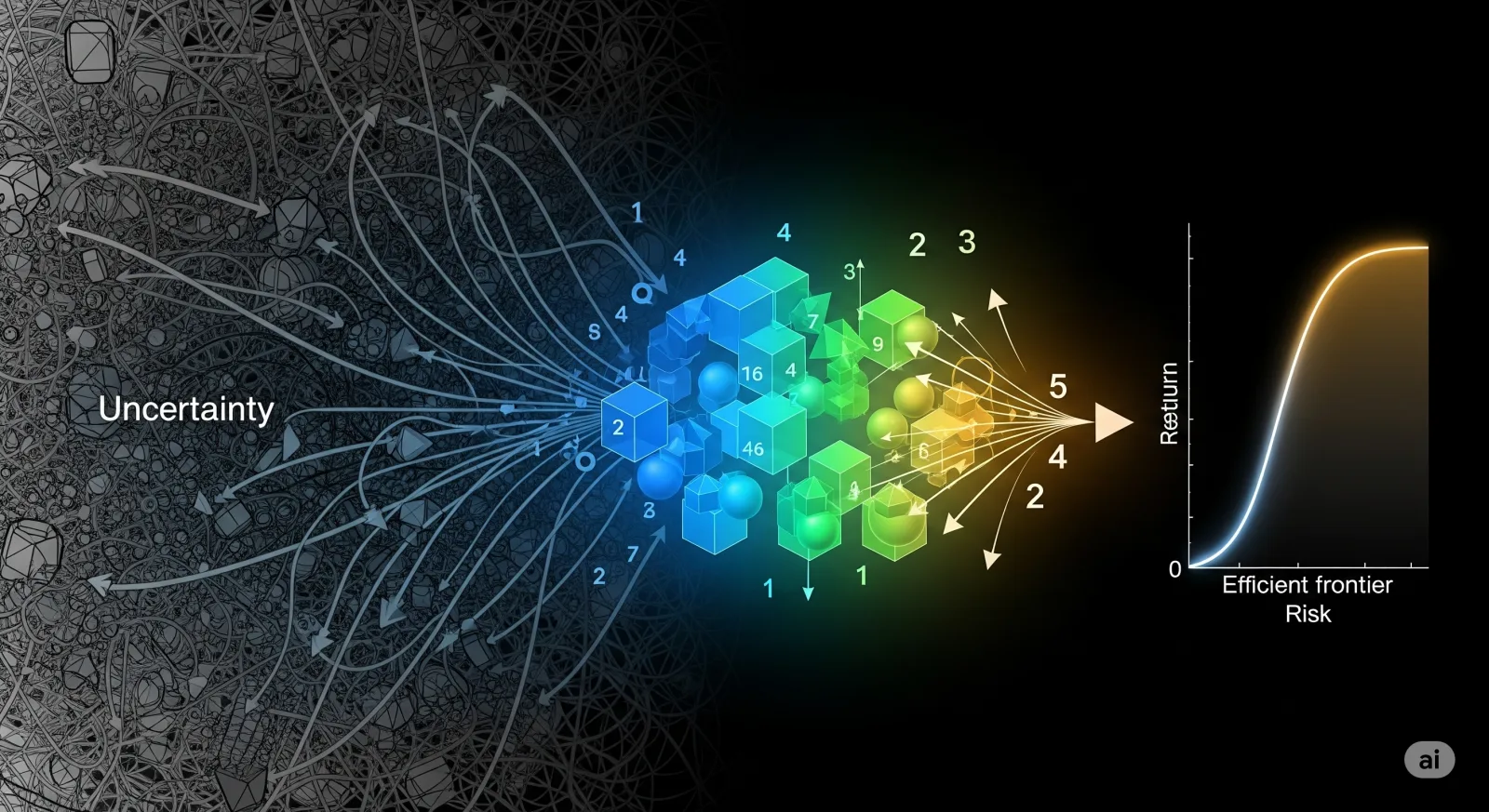
Causality Is Optional: Rethinking Portfolio Efficiency Through Predictive Lenses

TL;DR for operators A portfolio does not care whether your signal has a beautiful causal origin story. It cares whether the signal points in roughly the right direction, ranks assets usefully, and is scaled well enough not to produce absurd weights. That is the useful, slightly impolite message of Alejandro Rodriguez Dominguez’s paper, Is Causality Necessary for Efficient Portfolios?1 The paper challenges a strong claim in recent causal factor-investing work: that causal factor models are necessary for investment efficiency. Its answer is narrower and more operational. Within static mean-variance and related quadratic optimisation frameworks, causal identification is not the necessary condition. The necessary operating conditions are geometric. ...

August 3, 2025 · 13 min · Zelina