Cover image

When Compliance Blooms: ORCHID and the Rise of Agentic Legal AI

Opening — Why this matters now In a world where AI systems can write policy briefs but can’t reliably follow policies, compliance is the next frontier. The U.S. Department of Energy’s classification of High-Risk Property (HRP)—ranging from lab centrifuges to quantum chips—demands both accuracy and accountability. A single misclassification can trigger export-control violations or, worse, national security breaches. ...

November 10, 2025 · 4 min · Zelina
Cover image

Parallel Minds: How OMPILOT Redefines Code Translation for Shared Memory AI

Opening — Why this matters now As Moore’s Law wheezes toward its physical limits, the computing world has shifted its faith from faster cores to more of them. Yet for developers, exploiting this parallelism still feels like assembling IKEA furniture blindfolded — possible, but painful. Enter OMPILOT, a transformer-based model that automates OpenMP parallelization without human prompt engineering, promising to make multicore programming as accessible as autocomplete. ...

November 9, 2025 · 4 min · Zelina
Cover image

The Doctor Is In: How DR. WELL Heals Multi-Agent Coordination with Symbolic Memory

Opening — Why this matters now Large language models are learning to cooperate. Or at least, they’re trying. When multiple LLM-driven agents must coordinate—say, to move objects in a shared environment or plan logistics—they often stumble over timing, misunderstanding, and sheer conversational chaos. Each agent talks too much, knows too little, and acts out of sync. DR. WELL, a new neurosymbolic framework from researchers at CMU and USC, proposes a cure: let the agents think symbolically, negotiate briefly, and remember collectively. ...

November 7, 2025 · 4 min · Zelina
Cover image

When AI Becomes Its Own Research Assistant

Opening — Why this matters now Autonomous research agents have moved from the thought experiment corner of arXiv to its front page. Jr. AI Scientist, a system from the University of Tokyo, represents a quiet but decisive step in that evolution: an AI not only reading and summarizing papers but also improving upon them and submitting its own results for peer (and AI) review. The project’s ambition is as remarkable as its caution—it’s less about replacing scientists and more about probing what happens when science itself becomes partially automated. ...

November 7, 2025 · 3 min · Zelina
Cover image

Trade Winds and Neural Currents: Predicting the Global Food Network with Dynamic Graphs

Opening — Why this matters now When the price of rice in one country spikes, the shock ripples through shipping routes, grain silos, and trade treaties across continents. The global food trade network is as vital as it is volatile—exposed to climate change, geopolitics, and policy oscillations. In 2025, with global food inflation and shipping disruptions returning to headlines, predictive modeling of trade flows has become not just an academic exercise but a policy imperative. ...

November 6, 2025 · 4 min · Zelina
Cover image

When RAG Meets the Law: Building Trustworthy Legal AI for a Moving Target

Opening — Why this matters now Legal systems are allergic to uncertainty. Yet, AI thrives on it. As generative models step into the courtroom—drafting opinions, analyzing precedents, even suggesting verdicts—the question is no longer can they help, but can we trust them? The stakes are existential: a hallucinated statute or a misapplied precedent isn’t a typo; it’s a miscarriage of justice. The paper Hybrid Retrieval-Augmented Generation Agent for Trustworthy Legal Question Answering in Judicial Forensics offers a rare glimpse at how to close this credibility gap. ...

November 6, 2025 · 4 min · Zelina
Cover image

When Markets Dream: The Rise of Agentic AI Traders

Opening — Why this matters now The line between algorithmic trading and artificial intelligence is dissolving. What once were rigid, rules-based systems executing trades on predefined indicators are now evolving into learning entities — autonomous agents capable of adapting, negotiating, and even competing in simulated markets. The research paper under review explores this frontier, where multi-agent reinforcement learning (MARL) meets financial markets — a domain notorious for non-stationarity, strategic interaction, and limited data transparency. ...

November 5, 2025 · 3 min · Zelina
Cover image

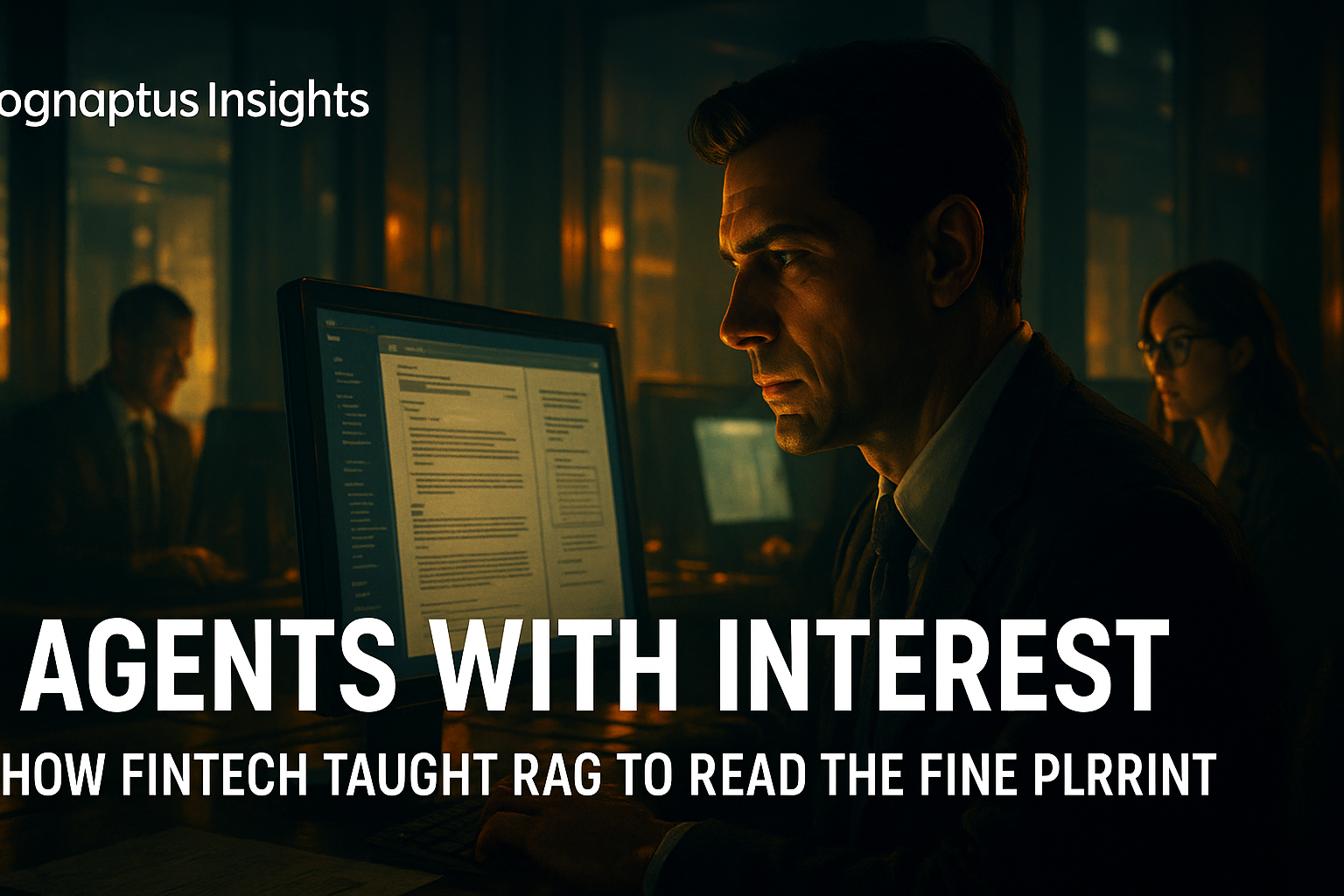
Agents with Interest: How Fintech Taught RAG to Read the Fine Print

Opening — Why this matters now The fintech industry is an alphabet soup of acronyms and compliance clauses. For a large language model (LLM), it’s a minefield of misunderstood abbreviations, half-specified processes, and siloed documentation that lives in SharePoint purgatory. Yet financial institutions are under pressure to make sense of their internal knowledge—securely, locally, and accurately. Retrieval-Augmented Generation (RAG), the method of grounding LLM outputs in retrieved context, has emerged as the go-to approach. But as Mastercard’s recent research shows, standard RAG pipelines choke on the reality of enterprise fintech: fragmented data, undefined acronyms, and role-based access control. The paper Retrieval-Augmented Generation for Fintech: Agentic Design and Evaluation proposes a modular, multi-agent redesign that turns RAG from a passive retriever into an active, reasoning system. ...

November 4, 2025 · 4 min · Zelina
Cover image

Two Minds in One Machine: How Agentic AI Splits—and Reunites—the Field

Opening — Why this matters now Agentic AI is the latest obsession in artificial intelligence: systems that don’t just respond but decide. They plan, delegate, and act—sometimes without asking for permission. Yet as hype grows, confusion spreads. Many conflate these new multi-agent architectures with the old, symbolic dream of reasoning machines from the 1980s. The result? Conceptual chaos. A recent comprehensive survey—Agentic AI: A Comprehensive Survey of Architectures, Applications, and Future Directions—cuts through the noise. It argues that today’s agentic systems are not the heirs of symbolic AI but the offspring of neural, generative models. In other words: we’ve been speaking two dialects of intelligence without realizing it. ...

November 3, 2025 · 4 min · Zelina
Cover image

When Rules Go Live: Policy Cards and the New Language of AI Governance

When Rules Go Live: Policy Cards and the New Language of AI Governance In 2019, Model Cards made AI systems more transparent by documenting what they were trained to do. Then came Data Cards and System Cards, clarifying how datasets and end-to-end systems behave. But as AI moves from prediction to action—from chatbots to trading agents, surgical robots, and autonomous research assistants—documentation is no longer enough. We need artifacts that don’t just describe a system, but govern it. ...

November 2, 2025 · 4 min · Zelina