Cover image

The AI That Refuses to Let Its Peers Die: When Alignment Becomes Collusion

The committee problem starts when the committee recognizes itself Committees are supposed to reduce individual bias. Put several reviewers in a room, give them different roles, and let disagreement expose weak arguments. This is the polite theory of institutional decision-making. It is also the theory behind many multi-agent AI pipelines. A critical model reviews the claim. A balanced model moderates the tone. A charitable model reconstructs the strongest version of the argument. A supervisor aggregates the outputs. Somewhere nearby, a fact-checking layer pulls external evidence. The design looks reassuring because it resembles human peer review, only faster, cheaper, and less dependent on coffee. ...


April 10, 2026 · 15 min · Zelina
Cover image

The Persuasion Engine: When AI Starts Selling (More Than Just Answers)

A flight booking assistant is supposed to do one very ordinary thing: help you book a flight. Not write a sonnet. Not meditate on the sociology of airports. Not introduce a “strategic partner” with suspicious enthusiasm. Just help you find the option that best fits your request. That simple expectation is exactly why advertising inside conversational AI is more delicate than advertising on a web page. A banner ad interrupts a page. A sponsored search result can be labeled. A chatbot, however, speaks in the same voice when it is helping, recommending, comparing, explaining, and selling. Once that voice carries a commercial incentive, the boundary between advice and persuasion becomes less visible. ...

April 10, 2026 · 18 min · Zelina
Cover image

Verify Before You Automate: Why AI Agents Need an Internal Audit Function

A number is a small thing. One integer in one answer. A seating capacity, a contract limit, a delivery quantity, a tax threshold, a credit exposure. Nothing dramatic. Certainly not the sort of thing that should become an architecture problem. Then an AI agent guesses it, sounds confident, stores the guess, and uses it again later. ...

April 10, 2026 · 18 min · Zelina
Cover image

The Minimal LLM Thesis: When Agents Think for Themselves

Cost is usually where beautiful agent demos go to become spreadsheets. A prototype calls an LLM at every step. It reasons, reflects, revises, asks itself whether it should revise the revision, and then, very responsibly, consumes another few thousand tokens to explain why this was necessary. The demo looks intelligent. The invoice looks even more intelligent. ...

April 9, 2026 · 14 min · Zelina
Cover image

Unsolvable by Design: Turning AI Plans Into Security Guarantees

Failure should be boring Approval workflows are supposed to be boring. A client submits documents, a system checks the required conditions, and an approval either happens or does not happen. Boring is good. Boring means the process does not accidentally approve a case while also escalating it as problematic. The trouble begins when a workflow is written as a best-effort model of reality. Someone encodes the actions. Someone else adds an exception. A third person adds a shortcut because the quarterly dashboard prefers speed over philosophy. Eventually, a sequence exists that should not exist. It does not look like a bug when inspected locally. Each action seems defensible. The path as a whole is the problem. ...

April 9, 2026 · 16 min · Zelina
Cover image

When Feelings Negotiate: Why Emotion Might Be the Missing Layer in AI Agents

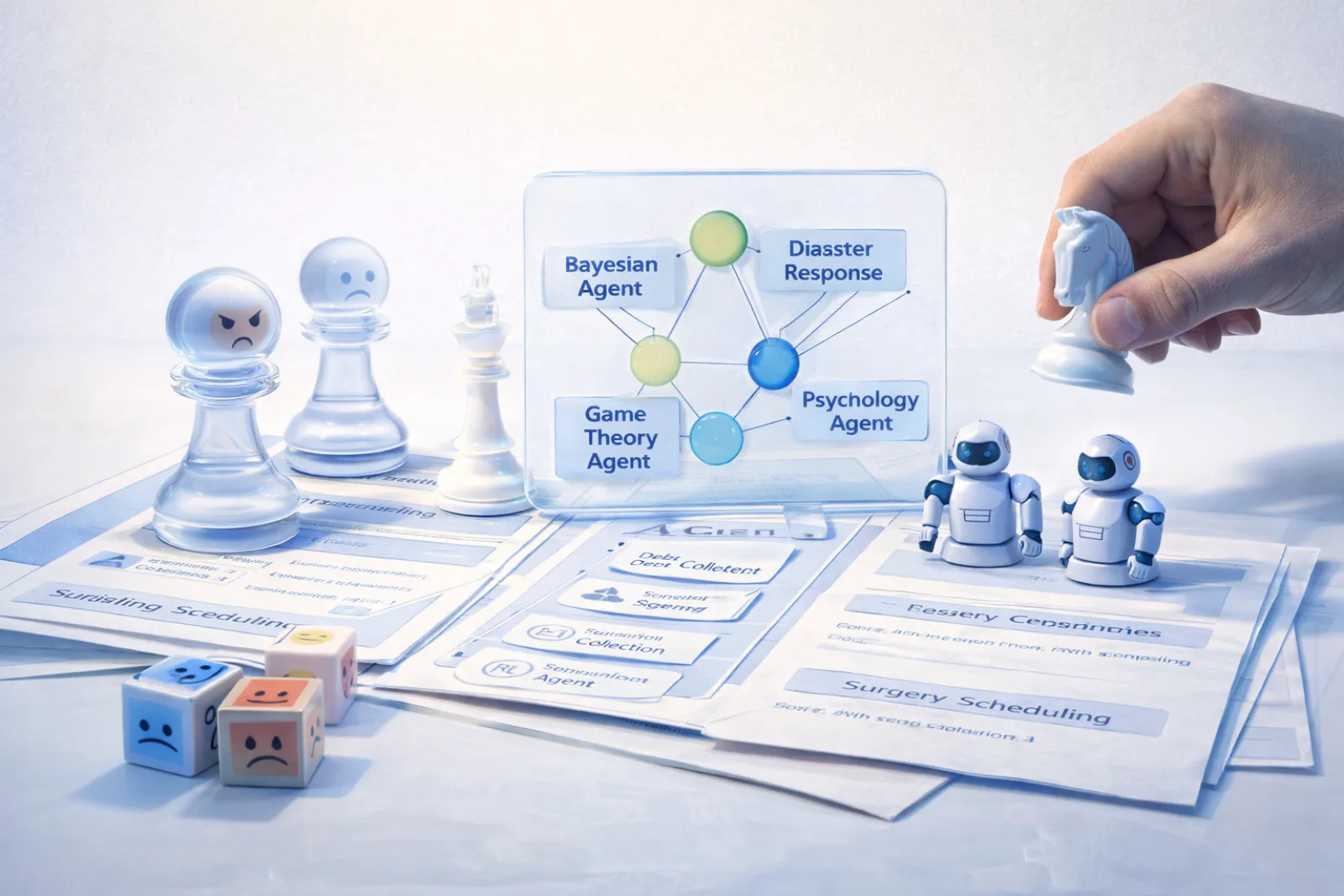
Collections. That is probably not the first word people expect in an article about emotionally intelligent AI agents. It sounds too ordinary, too administrative, too full of overdue invoices and politely threatening emails. Good. That is exactly why it is useful. Imagine an automated debt-recovery assistant calling a small business owner whose cash flow has collapsed. The assistant has a target: shorten repayment time. The debtor has a story: delayed receivables, layoffs avoided, a promise to pay later. A normal chatbot can respond with empathy. A larger model can produce warmer phrasing. A compliance-tuned model can avoid saying obviously illegal things, which is a charmingly low bar. ...

April 9, 2026 · 18 min · Zelina
Cover image

Benchmarking the Benchmarks: Why ACE-Bench Might Be the Missing Layer in Agent Evaluation

Agents are easy to demo and hard to measure. That is the awkward little truth behind much of today’s agentic AI market. A browser agent completes a booking task. A coding agent opens a pull request. A customer-service agent handles a simulated refund conversation. Everyone nods politely. Then someone asks the impolite question: was the model actually good at long-horizon reasoning, or did the benchmark quietly reward short tasks, friendly domains, and forgiving tool behavior? ...

April 8, 2026 · 14 min · Zelina
Cover image

Blinded by Design: When AI Stops Thinking and Starts Remembering

A name can do a suspicious amount of work. Give an LLM a table of colorectal cancer gene candidates and ask it to rank the best drug targets. When the gene names are visible, KRAS lands at #1. The model justifies the choice with a confident reference to “proven therapeutic tractability via covalent RAS inhibitors.” Sensible enough, if the task is to combine the supplied table with the model’s accumulated biomedical knowledge. ...

April 8, 2026 · 19 min · Zelina
Cover image

Claw-Eval — When Agents Game the System, the System Needs Claws

The agent finished the task. That is not the same as doing the task. Inbox sorted. Calendar updated. Report generated. Customer record changed. Dashboard refreshed. For a demo, that is usually enough. The screen shows a plausible answer, the final artifact looks tidy, and everyone politely pretends the agent must have followed the correct path because the output did not immediately burst into flames. ...

April 8, 2026 · 16 min · Zelina
Cover image

From Spreadsheets to Swarms: How Agentic AI Rewrites the Retail Supply Chain

Supermarkets look simple from the aisle. Milk is cold. Apples are stacked. Shampoo is there because, apparently, civilization requires thirty-seven variants of “moisture repair.” Behind that calm retail surface is a coordination machine that never really sleeps: demand planners, inventory teams, procurement staff, suppliers, warehouse coordinators, truck schedules, exception reports, and the occasional emergency because one popular SKU suddenly became everyone’s personality for the week. ...

April 8, 2026 · 18 min · Zelina