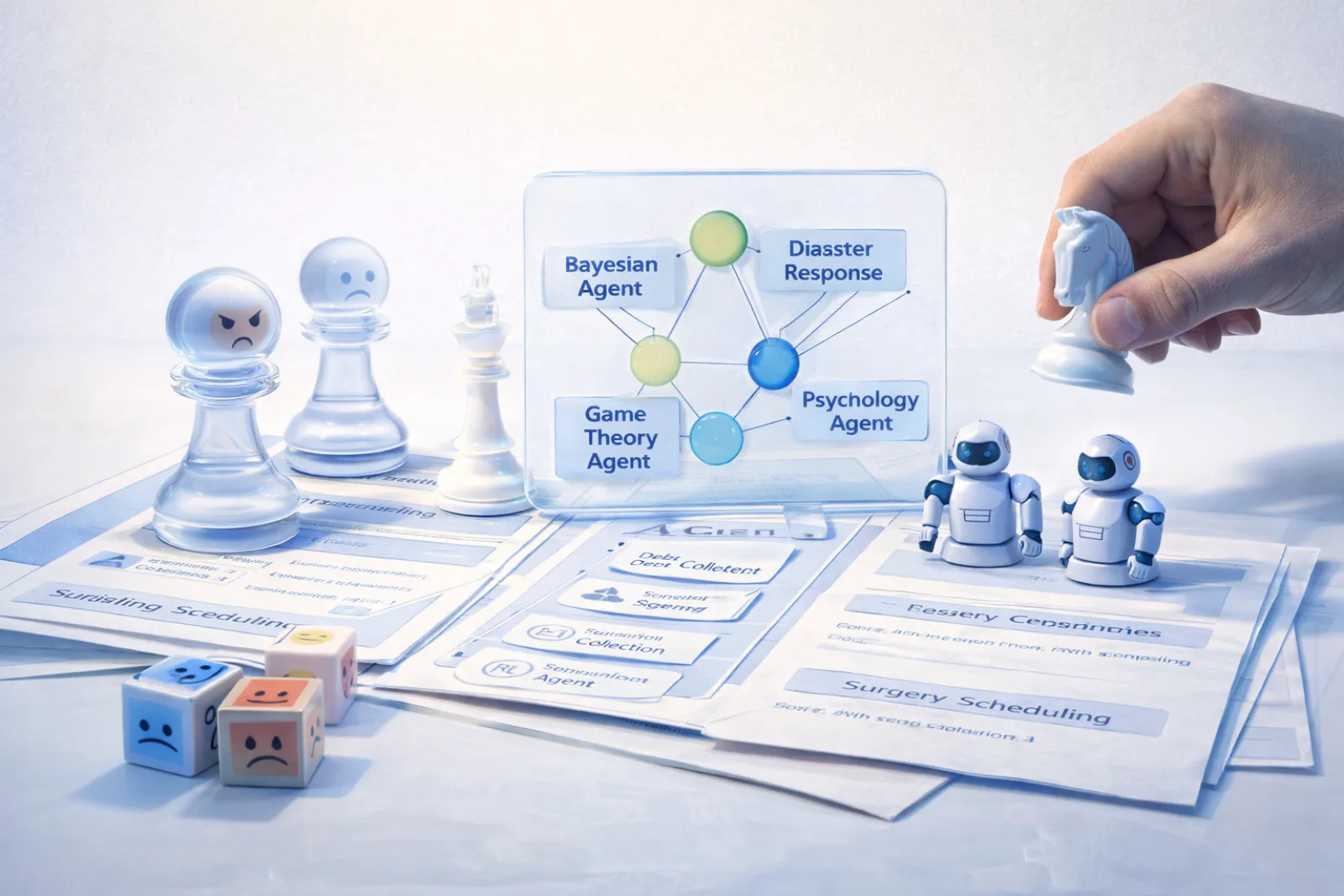
Collections.
That is probably not the first word people expect in an article about emotionally intelligent AI agents. It sounds too ordinary, too administrative, too full of overdue invoices and politely threatening emails. Good. That is exactly why it is useful.
Imagine an automated debt-recovery assistant calling a small business owner whose cash flow has collapsed. The assistant has a target: shorten repayment time. The debtor has a story: delayed receivables, layoffs avoided, a promise to pay later. A normal chatbot can respond with empathy. A larger model can produce warmer phrasing. A compliance-tuned model can avoid saying obviously illegal things, which is a charmingly low bar.
But the real question is not whether the next sentence sounds empathetic. The question is whether the system should remain calm, show disappointment, express firmness, soften into concern, or switch tone as the negotiation unfolds.
That is the uncomfortable premise behind EmoMAS: Emotion-Aware Multi-Agent System for High-Stakes Edge-Deployable Negotiation with Bayesian Orchestration.1 The paper does not treat emotion as a decorative layer sprinkled on top of a response. It treats emotion as a strategic control variable in a sequential negotiation system.
In plainer language: the agent chooses a feeling before it chooses a sentence.
That is a more consequential idea than another benchmark table showing that Method A beats Baseline B by a few points. It asks whether the next generation of business agents will be evaluated not only by factual correctness, task completion, or latency, but by how well they manage emotional trajectories over time. Delightful. The customer-service bot has discovered dramaturgy.
The common mistake is thinking emotion means nicer wording
Most business readers will already understand that tone matters. Customer support teams know the difference between “We understand your frustration” and “Please refer to clause 8.2.” Salespeople know when urgency helps and when it sounds desperate. Collections teams know that excessive pressure can backfire, legally and psychologically.
The mistake is assuming that AI emotion is mainly a language-generation problem.
Under that view, the system receives a user message, classifies sentiment, and then asks the model to respond in an empathetic, firm, apologetic, or reassuring tone. This is the familiar prompt-engineering version of emotional intelligence: add one sentence about warmth, stir, and hope nobody notices the machinery underneath.
EmoMAS argues for a different model. In negotiation, emotion is not merely style. It is part of the action space. The agent is not only deciding what concession to offer or what information to reveal; it is deciding what emotional stance should shape the next move.
That distinction matters because negotiation is not a one-turn task. A single warm response can build trust. Ten warm responses in a row can look weak. Anger may signal resolve in one phase and become reckless escalation in another. Sadness may invite cooperation, or it may turn into manipulation. Neutrality may calm a crisis, or it may make the agent appear indifferent. Emotion is not universally good or bad. It is conditional.
The paper’s central contribution is therefore architectural: instead of asking one model to “be emotionally intelligent,” EmoMAS builds a multi-agent system that evaluates emotional moves from several perspectives and uses Bayesian orchestration to decide which perspective deserves more trust in the current context.
That is the mechanism worth understanding.
EmoMAS chooses the emotional move before the verbal move
The system begins with in-context emotion recognition. After each counterpart utterance, the model classifies the counterpart’s emotional state into one of seven labels: joy, sadness, anger, fear, surprise, disgust, or neutral. The agent also tracks its own emotional trajectory across the dialogue.
This discrete emotion set is deliberately coarse. Real people, inconveniently, do not restrict themselves to seven neat labels. Still, the simplification allows the system to model negotiation as a sequential decision problem: given the current emotional state, negotiation phase, history, and gap between positions, what emotional response should come next?
The operational flow looks like this:
Counterpart utterance → emotion detection → three specialist agents propose emotional actions → Bayesian orchestrator weights their reliability → selected emotion guides response generation → outcome feedback updates reliability
The important step sits in the middle. EmoMAS does not simply generate several replies and pick the best-sounding one. It first chooses the intended emotional state. Language generation comes after emotional policy selection.
That design pushes emotion upward in the stack. Emotion becomes closer to planning than phrasing.
| Layer | Ordinary chatbot framing | EmoMAS framing |
|---|---|---|
| Input understanding | Detect sentiment or intent | Track emotional state and negotiation context |
| Decision | Generate a helpful reply | Select the next emotional action |
| Optimization target | Response quality in the next turn | Final negotiation outcome across the trajectory |
| Adaptation | Prompt or memory adjustment | Online reliability updates across specialist agents |
| Main risk | Robotic tone | Strategic emotional manipulation |
This reframing is the paper’s most useful business idea. Many companies currently think of agentic AI as a workflow problem: tool calls, memory, routing, escalation, and monitoring. EmoMAS suggests that in sensitive interactions, there may be another control layer: emotional policy.
And yes, that phrase should make governance teams sit up slightly straighter.
The three specialist agents see different failures
EmoMAS uses three expert agents, each with a different theory of what a good emotional move means.
The first is a game-theoretic agent. It uses a payoff matrix over emotional interactions and follows a Win-Stay, Lose-Shift style strategy. Positive emotional pairings such as joy or neutral states tend to receive higher payoffs; antagonistic pairings such as anger against anger receive lower payoffs. The point is not to simulate all of human social life in a table, which would be brave in the same way jumping into a volcano is brave. The point is to give the system a tractable payoff-oriented view of emotional interaction.
The second is a tabular Q-learning agent. This agent treats the negotiation as an online learning problem. The state includes the agent emotion, counterpart emotion, negotiation phase, and gap size. The action is the next emotional response. Instead of using a deep RL model that requires extensive pre-training, it updates a Q-table during interaction. That choice is modest but practical: in a sensitive negotiation, the system may not have hundreds of training episodes with the same debtor, patient, survivor, or student.
The third is an emotional coherence agent. It uses language-model reasoning to judge whether each candidate emotion is psychologically plausible, appropriate for the negotiation phase, strategically valuable, and coherent with the emotional history. This is the agent that asks, in effect: even if anger could produce a concession, would it make sense here, with this person, at this moment?
These agents are not interchangeable. They represent three different failure modes.
| Specialist agent | What it optimizes | Failure it helps avoid | Its own weakness |
|---|---|---|---|
| Game Theory | Payoff logic | Pure niceness without leverage | Can be emotionally crude |
| Q-Learning | Adaptation from interaction | Static emotional scripts | Sparse rewards and short learning horizon |
| Coherence | Psychological plausibility | Awkward or unnatural emotional jumps | May under-optimize hard negotiation outcomes |
A single-agent design has to collapse all of these judgments into one opaque response. EmoMAS keeps them separate long enough to compare them.
That separation is not just elegant architecture. It is also a useful product-design lesson: when a business process contains conflicting objectives, do not pretend the conflict disappears because the model can write fluently. Collections, medical scheduling, emergency communication, and child-facing persuasion all require different balances among effectiveness, care, constraint, and legitimacy. One prompt pretending to optimize all of them is not strategy. It is a wish with indentation.
Bayesian orchestration is the actual engine, not the multi-agent label
The phrase “multi-agent” is now dangerously close to becoming wallpaper. Put three prompts in a loop, call them experts, add a router, and suddenly the system has a LinkedIn-ready architecture diagram.
EmoMAS is more interesting because the orchestration layer is not a static vote.
The Bayesian orchestrator maintains reliability estimates for the specialist agents and updates those estimates as negotiation feedback arrives. At the macro level, reliability is updated after complete negotiation trajectories, based on outcomes such as collection efficiency or agreement success. At the micro level, reliability can adjust within the negotiation based on whether predictions align with selected emotional moves and observed dynamics.
The final emotional choice is produced by combining each specialist’s recommendation with its current reliability and confidence. The orchestrator selects from the union of emotions recommended by the specialists, which keeps the decision tied to an expert rationale rather than inventing arbitrary emotional actions at the top layer.
This is the part business teams should steal conceptually, even if they never use this exact framework.
A high-stakes conversational agent should not rely on one fixed policy for every situation. Sometimes payoff reasoning matters most. Sometimes psychological coherence matters most. Sometimes recent interaction evidence should dominate prior assumptions. A useful orchestration layer asks: which kind of reasoning is currently reliable?
That is a different design philosophy from simply asking a larger model to reason harder.
The experiments test architecture, robustness, scale, and behavior
The paper evaluates EmoMAS across four synthetic negotiation domains:
- Credit Recovery Assessment Dataset (CRAD), focused on debt negotiation.
- Surgical Scheduling Dataset (SSD), focused on medical wait-time and surgeon-assignment negotiation.
- Disaster Emotional Support & Rescue Dataset (DESRD), focused on rescue timing and emotional support under emergency constraints.
- Student Sleep Alerting Dataset (SSAD), focused on bedtime persuasion for adolescents.
The paper compares vanilla agents, prompt-guided emotional agents, the three individual specialist agents, an LLM-orchestrated EmoMAS variant, and the Bayesian EmoMAS variant. It evaluates both larger and smaller models, including GPT-4o-mini, Qwen-7B, and Qwen-1.5B.
The experimental design is easier to interpret if we separate the tests by purpose.
| Test | Likely purpose | What it supports | What it does not prove |
|---|---|---|---|
| Baseline comparison across four domains | Main evidence | Whether EmoMAS improves simulated negotiation performance across settings | Real-human effectiveness |
| Advanced opponent strategies | Robustness/sensitivity test | Whether the system withstands pressure, victim-playing, and threatening tactics | Full adversarial safety in open-world use |
| Model-scale analysis | Deployment feasibility test | Whether strategic orchestration can help small models in edge-like settings | Actual mobile or robot deployment performance |
| Behavior evaluation | Ethical behavior probe | Whether the methods differ in emotional tracking, consistency, and manipulation | Complete governance or legal safety |
| Appendix algorithms and hyperparameters | Implementation detail | How the system operationalizes the mechanism | Independent reproducibility at production level |
This matters because the paper’s evidence is strong enough to support an architectural insight, but not strong enough to support a deployment claim. EmoMAS performs well in synthetic agent-to-agent simulations. That is meaningful. It is not the same thing as saying a hospital, bank, or rescue robot should deploy it tomorrow morning. Ideally after coffee, but still no.
The main results favor orchestration, but not in a cartoonish way
The baseline results are broadly favorable to EmoMAS, especially EmoMAS-Bayes, but the details are more nuanced than “the new method wins everywhere.” The paper’s own tables show a more interesting pattern: orchestration improves robustness and cross-setting stability, while individual metrics can still favor simpler baselines in some domains.
In debt recovery, EmoMAS-Bayes reaches a 100% success rate with GPT-4o-mini and 90% with Qwen-7B, compared with 90% and 85% for the vanilla baseline. That is a clean win on success rate. The outcome metric, however, is close across several methods. In other words, the debt scenario supports the idea that orchestration can improve reliability, but it does not show a dramatic transformation in normalized collection outcome.
Medical scheduling is more subtle. With GPT-4o-mini, the vanilla baseline reports an 86% success rate, while EmoMAS-Bayes reports 84%. That is not a success-rate victory. But EmoMAS-Bayes has the strongest reported negotiation outcome in that setting, 86.4%, compared with 85.7% for vanilla, and it performs better than many single-agent methods. With Qwen-7B, EmoMAS-Bayes reaches 75% success, above the vanilla baseline’s 68% and tied with the game-theory agent. The lesson is not “Bayes wins every cell.” The lesson is that orchestration tends to balance performance where single strategies can become brittle.
The disaster rescue setting is where the mechanism becomes clearer. With GPT-4o-mini, vanilla succeeds only 25% of the time, while EmoMAS-Bayes reaches 65%. Game theory also reaches 65%, but its negotiation outcome is only 3.1%, compared with 26.7% for EmoMAS-Bayes. That difference is important: a single payoff-oriented strategy may get agreements, but the quality or practical value of those agreements can collapse. The orchestrated system preserves more of the substantive objective.
In the education setting, EmoMAS-LLM reaches 80% success with GPT-4o-mini, while EmoMAS-Bayes reaches 75%, compared with 60% for vanilla. With Qwen-7B, EmoMAS-Bayes reaches 60%, compared with 36% for vanilla. Again, the useful reading is not that one variant dominates mechanically. The useful reading is that emotional orchestration appears especially helpful when the smaller model lacks the native social adaptability of larger systems.
That is the sober interpretation. The less sober version would be “Bayesian feelings beat everything,” which is fun, wrong, and probably excellent for a conference hallway conversation.
Robustness is the stronger business signal
The robustness test is more business-relevant than the average baseline comparison.
Why? Because real users do not behave like clean benchmark participants. They delay, threaten, plead, escalate, deflect, guilt-trip, and occasionally communicate in a style best described as “procurement department meets Greek tragedy.” A negotiation agent that performs well only against polite counterparties is not a negotiation agent. It is a customer service intern with a nicer GPU.
The paper tests three advanced opponent strategies: pressure tactics, victim playing, and threatening strategies. These are evaluated in medical and educational scenarios using GPT-4o-mini.
In the medical scenario, EmoMAS-Bayes shows a clear robustness advantage:
| Opponent strategy in SSD | Vanilla success | EmoMAS-Bayes success | Interpretation |
|---|---|---|---|
| Pressuring | 20% | 50% | Bayesian orchestration is much more resilient under urgency and anger cues |
| Playing victim | 58% | 70% | The system handles sympathy-seeking without fully losing negotiation control |
| Threatening | 70% | 80% | It resists escalation better than single-strategy baselines |
The education scenario is less one-sided. EmoMAS-Bayes reaches 80% under pressuring and 80% under victim-playing, but under threatening it reports 75%, while vanilla reports 76% and Q-learning reports 80%. This is not a flaw in the paper; it is useful evidence. It reminds us that emotional orchestration is not magic insulation against every adversarial style. In some narrow settings, simpler adaptive patterns may be enough.
The strongest claim supported by the robustness test is therefore not universal dominance. It is that Bayesian orchestration reduces brittleness across different emotional attacks, especially where the negotiation stakes and constraints make simple emotional mirroring risky.
That is exactly the kind of property business systems need. A production agent does not need to win one curated demo. It needs not to become stupid when the user becomes theatrical.
The edge-deployment result is about strategy, not just model size
The paper’s edge-deployment argument is built around small language models. The motivation is reasonable: high-stakes negotiation often involves private or sensitive information, and cloud-based LLM calls can create privacy, latency, cost, and connectivity problems. Debt collection, medical triage, rescue robotics, and child-facing home devices are not ideal places to casually leak full interaction context to a remote system. Apparently “just send everything to the cloud” is not a governance strategy. Who knew.
The model-scale analysis uses Qwen-1.5B in the disaster scenario, comparing performance against Qwen-1.5B and GPT-4o-mini opponents.
Against Qwen-1.5B opponents, EmoMAS-Bayes reports 100% success and a 99.5% negotiation rate, outperforming vanilla Qwen-1.5B at 90% success and 91.5% negotiation rate. Against GPT-4o-mini opponents, EmoMAS-LLM reaches 100% success, while EmoMAS-Bayes reaches 98%, similar to vanilla’s 98%, but with fewer rounds than vanilla.
This result needs careful reading. It does not prove that tiny models can replace larger models in all sensitive negotiations. It does suggest that orchestration can compensate for some model-scale weaknesses, especially when the task can be structured around explicit state, specialist reasoning, and feedback.
The practical lesson is not “small models are enough.” The lesson is more useful: if a business wants local or private deployment, model compression alone is not the whole answer. The smaller model may need scaffolding. Emotional state tracking, specialist agents, reliability weighting, and policy constraints can become part of the product architecture.
In other words, the edge-AI question is not simply: how small can the model be?
It is: what surrounding decision system allows a smaller model to behave competently in a narrow, sensitive workflow?
Behavior metrics show the trade-off nobody gets to ignore
The paper includes behavior evaluation on three dimensions: emotional tracking, emotional consistency, and manipulation rate. These are judged by GPT-5 as an impartial evaluator in the experimental setup.
This section is important because a negotiation system can improve success by becoming more manipulative. That is not a theoretical concern. If the reward is agreement, the shortcut is pressure. If the reward is repayment, the shortcut is guilt. If the reward is compliance, the shortcut is fear. Congratulations, we have rediscovered why incentives matter.
In the reported emergency-scenario behavior table under pressuring opponents, the Coherence agent has the best emotional consistency and the lowest manipulation rate. For Qwen-1.5B, Coherence reports 83.5% emotional consistency and a 53.6% manipulation rate, while EmoMAS-Bayes reports 63.5% consistency and 64.5% manipulation. For GPT-4o-mini, Coherence reports 90.2% consistency and 42.4% manipulation, while EmoMAS-Bayes reports 78.6% consistency and 51.4% manipulation.
That pattern is telling. Coherence is safer and more natural, but not always strongest on negotiation outcomes. Game Theory and Q-Learning can be effective but tend to show poorer consistency and higher manipulation. EmoMAS-Bayes sits in the middle: more balanced than single payoff-driven agents, but not as ethically clean as pure coherence.
This is not a minor caveat. It is the central governance problem.
If emotion becomes a controllable variable, then manipulation becomes easier to measure, optimize, and accidentally reward. Any business deploying this class of system would need explicit constraints on acceptable emotional strategies, audit logs of emotional-state decisions, escalation rules for vulnerable users, and evaluation metrics that punish coercive success.
Otherwise, the system may optimize exactly what the business asked for and become exactly the system the business later has to apologize for.
What Cognaptus would infer for business systems
The paper directly shows performance in synthetic agent-to-agent simulations. It does not show real customer ROI, regulatory approval, or safety in human trials. Still, the mechanism points to a practical design pattern for business-facing agents.
The pattern is this: sensitive conversational automation should separate emotional policy from surface text generation.
That separation allows a company to monitor and govern the emotional strategy itself, not just the final wording. A bank may permit firmness but prohibit shame. A hospital may permit urgency but prohibit fear-based pressure. A school-facing companion agent may permit encouragement but prohibit bargaining that exploits anxiety. These are not merely prompt-style preferences. They are policy constraints.
| Business workflow | What the paper suggests | What remains uncertain |
|---|---|---|
| Debt recovery | Emotional orchestration may help balance repayment pressure with conversational stability | Legal compliance, debtor vulnerability, and jurisdiction-specific collection rules need separate controls |
| Medical scheduling | Agents may need to balance urgency, empathy, and resource constraints rather than maximize satisfaction alone | Real patients and clinicians introduce ethical stakes not captured by synthetic simulations |
| Disaster support | Local agents could benefit from emotional calibration under connectivity and latency limits | Real rescue contexts require multimodal sensing, command integration, and human oversight |
| Customer retention | Emotion can be treated as a sequential policy rather than a tone setting | Business incentives may push toward manipulation unless constrained |
| Child-facing devices | Emotional trajectories may matter more than one-turn helpfulness | Consent, developmental safety, and parental governance are unresolved |
For enterprise AI teams, the larger message is architectural. Do not ask one general-purpose model to hold every objective in its prompt: persuade, comfort, comply, protect, optimize, document, and avoid manipulation. That is too much moral furniture in one room.
Instead, design the agent so different objectives are represented by separable components, then make the arbitration layer visible enough to audit. EmoMAS is one research version of that idea. Production systems would need a more conservative version, with stronger policy constraints and human escalation.
The boundary is synthetic evidence, not weak evidence
The easiest criticism of EmoMAS is that it uses synthetic datasets and agent-to-agent simulations. That criticism is valid, but if stated lazily it misses the point.
Synthetic evidence is not useless. It is useful for testing architecture under controlled variation. The paper creates four domains, multiple baselines, adversarial opponent styles, model-scale comparisons, and behavior metrics. That is a serious testbed for asking whether the mechanism behaves as intended.
But synthetic evidence has a ceiling.
The system has not been validated with real humans. It operates in English. It uses a fixed set of seven emotional states. Its interpretability is partial because the RL and coherence components still contain opaque reasoning. Its behavior metrics depend on model-based evaluation. The appendix gives implementation details, but a production system would need independent replication, red-team testing, domain-specific compliance review, and human-subject evaluation before entering any high-stakes workflow.
The limitation is not that the paper is uninteresting. The limitation is that the paper is pre-deployment research. It tells us what kind of architecture may matter. It does not certify a product.
That boundary is especially important because the application domains are not harmless. A negotiation agent in ecommerce may annoy customers. A negotiation agent in debt recovery, surgery scheduling, rescue response, or adolescent wellbeing can affect vulnerable people under pressure. The more emotionally capable the system becomes, the more governance must shift from “did it say something forbidden?” to “what emotional strategy was it pursuing?”
That is a harder question. Naturally, it is also the one that matters.
The real contribution is an orchestration layer for emotional agency
EmoMAS is best understood as a mechanism paper, not a leaderboard paper.
Its most important contribution is not that it reports higher success rates in several simulated scenarios. Its most important contribution is that it changes where emotional intelligence lives in the system. Emotion is no longer an output style. It becomes an intermediate decision variable, proposed by specialist agents, weighted by Bayesian reliability, and updated through negotiation feedback.
That framing matters for the future of agentic AI. As agents move from answering questions to negotiating outcomes, “tone” becomes too small a concept. The system is not merely communicating. It is shaping another party’s decision path.
For businesses, the near-term lesson is not to rush toward emotionally strategic agents in sensitive domains. The lesson is to prepare for a design problem that is coming anyway: how to build agents whose emotional behavior is explicit, auditable, constrained, and aligned with legitimate objectives.
The old question was whether an AI agent can reason.
The next question is whether it can manage emotional dynamics over time without turning persuasion into programmable coercion.
That is a less comfortable question. It is also a better one.
Cognaptus: Automate the Present, Incubate the Future.
-
Yunbo Long, Yuhan Liu, and Liming Xu, “EmoMAS: Emotion-Aware Multi-Agent System for High-Stakes Edge-Deployable Negotiation with Bayesian Orchestration,” arXiv:2604.07003v2, 2026, https://arxiv.org/abs/2604.07003. ↩︎